
11 Best Passive Income Ideas for Doctors and Medical Pros
 Akinpedia
14 min read
Akinpedia
14 min readDoctors and medical professionals have the opportunity to generate substantial passive income by strategically investing in various avenues such as real estate syndications, dividend-paying stocks, and innovative digital medical products that capitalize on their specialized knowledge and expertise.
These investment options allow them to build and grow their wealth steadily over time without the need to continuously exchange additional hours of their valuable time for money, thereby creating a more flexible and financially secure future.
Physicians encounter a range of unique and demanding challenges throughout their careers: grueling and often unpredictable schedules, overwhelming student debt that averages well over $200,000, high tax brackets that can reach up to 37%, and the constant risk of lawsuits that make protecting their personal assets a crucial concern.

Passive income ideas provide a way to separate earnings from the limitations of patient hours, offering a path to greater financial freedom and security. Early-career residents often focus on creating safety nets through knowledge-based income streams that require minimal capital investment, while mid-career attending physicians typically scale up by investing in higher-capital ventures aimed at achieving Financial Independence, Retire Early (FIRE) goals.
Recent industry trends reveal that approximately 40% of doctors are supplementing their primary income with additional side income streams, especially in response to stagnant salary growth, which is projected to remain flat at around $374,000 in 2024. These income diversification strategies have become increasingly essential for building wealth that is resilient to burnout and financial stress.
Time-Capital Spectrum
Here is a well-organized and detailed Time-Capital Spectrum table specifically designed for passive income ideas tailored to doctors and medical professionals. This comprehensive spectrum categorizes various income-generating ideas based on their initial time and capital requirements, effectively matching different stages of a medical career and personal availability:
| Idea | Initial Time | Initial Capital | Ideal For | Est. Annual Yield* |
|---|---|---|---|---|
| High-Yield Savings/CDs | Low | Low ($1K+) | Residents | 4-5% |
| Dividend Stocks | Low | Medium ($10K+) | All | 2-4% |
| HSA Investments | Low | Low ($3K/year) | Self-employed | Tax-free growth |
| REITs | Low | Medium ($5K+) | Mid-career | 5-7% |
| P2P Lending | Low | Low ($1K+) | Early-career | 5-8% |
Yields provided here are approximate estimates and should not be taken as guarantees, as past performance does not reliably predict or indicate future results. The lower rows typically demand a higher amount of capital investment but require less active time commitment, making them well-suited for busy attending physicians who have limited availability.
In contrast, the upper rows tend to be better suited for residents or individuals who may have limited capital but possess greater flexibility in their schedules, allowing them to leverage their knowledge and time more effectively.
This comprehensive framework assists physicians in selecting passive income strategies that are well-suited to their specific career stage, available time commitments, and financial resources, enabling them to build sustainable and long-lasting wealth in a highly effective manner.
Best Passive Income Ideas
These passive income ideas emphasize genuine passivity after the initial setup phase, ensuring that ongoing involvement is minimal while still reaping various financial benefits. They incorporate important tax advantages such as depreciation benefits and strategic Roth conversions, which can enhance long-term wealth accumulation.
Additionally, these approaches offer strong liability protection by using structures such as LLCs or trusts to safeguard assets and reduce personal risk. The concepts are thoughtfully organized according to the Time-Capital Spectrum, enabling investors to choose options that align with their current life stage and financial objectives. This organized classification helps customize investment options to meet individual needs and resources.
Low Capital, Moderate Knowledge Leverage (Residents/Fellows)
Having limited time and capital doesn’t mean you can’t begin creating passive income streams. These passive income ideas are thoughtfully designed to help you monetize the specialized knowledge and skills you are already acquiring. They require only a modest initial time investment to establish, allowing you to set up sustainable passive revenue streams that can operate on their own with minimal ongoing effort.
Paid Medical Surveys
Platforms such as Sermo offer compensation ranging from $100 to $300 per hour for providing brief, focused input on drug trials, usually lasting around 15 minutes. By creating and setting up a profile just once, you can receive recurring invitations to participate in these surveys, enabling you to earn between $5,000 and $10,000 annually on a part-time basis.
Additionally, you have the option to deduct various related expenses as legitimate business costs. This deduction can play a significant role in lowering your overall taxable income, thereby offering you valuable tax relief and potentially increasing your financial savings during tax season.
High-Yield Savings & CDs
Securely deposit your funds into FDIC-insured accounts that offer an attractive and competitive 5% APY, all without requiring any ongoing management, monitoring, or oversight on your part. These carefully designed accounts are specifically created to help you build strong and reliable debt payoff safety nets, giving you enhanced peace of mind and a greater sense of financial security.
This is especially beneficial for early-career professionals who might frequently feel anxious, overwhelmed, or uncertain about how to effectively manage their finances and make sound financial decisions during this crucial and formative stage of their lives.
HSA Triple Tax-Free Growth
You can contribute up to $4,150 in 2025 as the individual limit into index funds, allowing you to benefit from tax-deductible contributions, tax-free investment growth over time, and tax-free withdrawals for qualified medical expenses.
For self-employed physicians, this passive income idea not only supports and enhances health savings efforts but also plays a crucial role in significantly accelerating debt reduction. By fully maximizing these valuable tax advantages, physicians can improve their financial health more effectively and efficiently over time.
Peer-to-Peer Lending
Begin investing with as little as $25 in loans on Prosper, where you can potentially earn returns ranging from 5% to 7%. These lending platforms take care of the complexities involved in diversification and collections, making the entire investment process straightforward and accessible for everyone.
This low-entry investment option offers a valuable alternative that helps you steer clear of the volatility and unpredictable fluctuations that are commonly experienced in the stock market, providing a more stable and manageable way to grow your money over time.
Medium Capital/Time, Scalable Expertise Plays (All Stages)
This is the unique intersection where high income potential meets significant high impact. These scalable opportunities involve a moderate upfront investment of both your valuable time and some capital, but they are intentionally designed to leverage your decades of specialized medical expertise into digital products or highly streamlined services.
This approach enables you to generate a steady and reliable income on autopilot, independent of the number of clinical hours you work, allowing you to maximize your professional knowledge while creating lasting financial benefits.
Dividend Stocks & Index Funds
Consider investing in dividend-paying S&P 500 stocks, which typically offer around an 80% yield on dividends, or choose ETFs that provide similar benefits. Using a Backdoor Roth IRA allows you to enjoy tax-free compounding returns, typically ranging from 2-4%.
This passive income strategy is particularly effective and accessible for high-income physicians looking to maximize their investment growth while minimizing tax liabilities. By using this approach, these professionals can significantly improve their financial portfolios and achieve greater long-term wealth accumulation with lower tax burdens.
Healthcare REITs
Consider investing in medical office or senior housing real estate investment trusts, such as Healthpeak, which currently offers an attractive yield of 6.4%. These types of REITs provide a dependable and steady source of hands-off income, making them an excellent option for those seeking consistent returns without active management.
Additionally, the significant depreciation benefits offered by these REITs can help offset your tax liabilities, making them especially advantageous for medical practice owners who want to enhance and optimize their overall financial strategies while maintaining a steady cash flow.
Digital Medical Products
Develop comprehensive evergreen CME templates, in-depth and detailed e-books, or highly engaging patient education courses on platforms like Teachable to create a steady stream of continuous royalties within a booming $527 million market. Optimize and automate the entire sales process to achieve maximum efficiency and scalability.
Additionally, it is highly advisable to establish a limited liability company (LLC) to effectively safeguard your valuable intellectual property. Doing so will provide you with strong legal protection and enhanced security for all your important business assets, helping to shield them from potential risks and liabilities.
Online Courses/Webinars
Create and record highly specialized, one-time content such as detailed dermatology procedures that can be offered for perpetual enrollments, providing you with a consistent opportunity to generate ongoing revenue streams. These offerings typically allow you to achieve profit margins ranging from 20% to as high as 50%, making them a lucrative addition to your educational portfolio.
Additionally, these platforms handle all aspects of CME compliance management, ensuring that your courses fully meet the necessary educational standards and regulatory requirements without any extra effort or administrative work on your part.
High Capital, Low Time (Attendings/Business Owners)
When your time is valued at hundreds of dollars per hour, maximizing efficiency becomes absolutely crucial. We have committed ourselves fully to the capital-intensive, time-light strategies that are most favored by experienced Attendings and established practice owners.
These approaches focus on allocating substantial amounts of capital into well-established investment vehicles—such as syndications and funds—that require minimal active management on your part but offer significant passive income streams and impressive returns over time.
Real Estate Syndications
Commit $50,000 or more as a silent limited partner in multifamily real estate projects, allowing you to benefit from professionally managed investments. Experienced operators work diligently to deliver consistent returns typically ranging from 8-12%, in addition to valuable depreciation benefits that can enhance your overall investment performance.
Additionally, carefully structured trusts have been meticulously designed and put in place to provide robust protection against any potential lawsuits, helping to safeguard your investment from unforeseen legal challenges. This thoughtful arrangement offers you a greater sense of security and peace of mind throughout the entire duration of the partnership, ensuring that your interests remain well-protected at all times.
Private Equity in Health
Consider investing in cardiology or dermatology practice consolidations to achieve an Internal Rate of Return (IRR) of 15% or higher by utilizing specialized platforms specifically designed for these medical sectors.
This strategic approach effectively leverages the valuable industry insights, hands-on experience, and clinical expertise of practicing doctors, allowing for the maximization of financial returns as well as improvements in operational efficiencies and patient care quality.
By concentrating their efforts on these specific niche areas, investors have the opportunity to take full advantage of the increasing and expanding demand for highly specialized healthcare services. At the same time, they can enjoy the benefits that come from a more efficient, streamlined consolidation process that is expertly managed and driven by professionals with deep knowledge in the field.
This approach enables investors to strategically position themselves within the ever-evolving healthcare market, allowing them to maximize their potential financial returns while simultaneously supporting and enhancing the delivery of targeted, high-quality care services that meet the specific needs of patients.
Medical Equipment Leasing
Acquire medical equipment through a dedicated practice entity specifically set up for this purpose, and then lease the equipment back to your main practice. This strategy enables you to claim more than $20,000 annually in accelerated depreciation deductions, significantly enhancing your tax benefits.
Additionally, to maintain the passive nature of this income stream and minimize your administrative responsibilities, consider outsourcing the equipment management to a reliable third-party service provider who can handle maintenance, tracking, and other operational tasks efficiently.
Case Study
A highly skilled and experienced surgeon made a strategic investment of $100,000 into real estate syndications, which proved to be a very successful financial decision. Through this investment, the surgeon was able to consistently generate a reliable 10% cash flow, providing a steady stream of income. In addition to the cash flow benefits, the investment also offered valuable tax savings that further enhanced the overall financial outcome.
When combining the steady cash flow with the tax advantages, the surgeon achieved an impressive effective return on investment of approximately 15%. This well-planned financial strategy ultimately enabled the surgeon to transition smoothly into a comfortable and enjoyable semi-retirement lifestyle, free from financial worries.
Key Concepts and Tax Strategies
Passive income succeeds through a concept known as “decoupling,” which means that the initial effort you put in creates a continuous and ongoing cash flow that does not rely on any additional or continuous work afterward. This process allows you to generate money independently of your active involvement once the initial setup is complete, enabling financial gains that persist over time without the need for constant effort.
Core frameworks empower physicians:
- QBI Deduction: Take advantage of a 20% deduction on qualified business income derived from eligible practices or rental activities, significantly reducing the overall effective tax rates for individuals with higher earnings and substantial income streams.
- 1031 Exchanges allow investors to defer capital gains taxes indefinitely by swapping one real estate property for another, making it an excellent strategy for those involved in syndication rollovers. This method enables the continuous reinvestment of proceeds from property sales into new real estate investments without immediate tax consequences, thereby maximizing investment growth over time. Ideal for syndicators and investors alike, 1031 Exchanges provide a powerful tool to build wealth by deferring taxes while repositioning assets within the real estate market.
- Backdoor Roth IRA: High-income doctors who exceed the income limits for direct Roth IRA contributions often start by contributing to traditional IRAs. They then convert those traditional IRAs into Roth IRAs, allowing them to benefit from tax-free growth and tax-free withdrawals in retirement. This strategy effectively bypasses the income phaseout thresholds, which typically begin around $150,000 or more, enabling these doctors to make the most of their retirement savings without being restricted by income limits.
- Asset Protection: Forming LLCs in Wyoming or Nevada provides a strong legal shield that effectively ring-fences your investments, protecting them from potential malpractice lawsuits. Additionally, opting for series LLCs further enhances this protection by creating separate compartments within the main LLC, allowing for even greater intra-asset isolation and reducing the risk that a claim against one asset will impact the others.
- Municipal Bonds: Invest in tax-exempt state and local government issues offering yields in the range of 3-5%, which can be equivalent to about 6% taxable returns for investors in the highest tax brackets. These bonds provide a stable and reliable ballast for your investment portfolio, helping to reduce overall risk while generating steady income.
These carefully designed strategies effectively reduce physicians’ average federal tax rates, which typically stand at 37%, by a significant margin of 10-15%. At the same time, they provide a robust shield for accumulated wealth, transforming what would otherwise be considered high tax liability into a form of protected financial growth and stability.
This strategic approach not only significantly minimizes tax burdens but also guarantees that the substantial wealth physicians have diligently worked hard to accumulate is effectively preserved. Moreover, it allows this wealth to continue growing steadily and securely over an extended period, providing lasting financial stability and security.
Current Trends and Developments
In 2025, real estate syndications have experienced a significant surge in popularity, particularly among physicians who face considerable time constraints in their demanding careers. These syndications provide an attractive opportunity for these busy professionals to invest in hands-off multifamily and medical office real estate deals.
- Investors are drawn to these opportunities because they offer relatively stable and consistent returns, typically ranging between 8-12%, which is especially appealing in the current economic climate. This trend is further fueled by ongoing housing shortages in many regions, making multifamily properties and medical office spaces highly sought-after assets that can generate reliable income streams for investors seeking passive involvement.
- Healthcare private equity is rapidly accelerating its investments into primary care consolidations, driving significant growth and delivering impressive returns of over 15% internal rate of return (IRR). These investment platforms strategically acquire high-margin primary care practices that doctors know and understand intimately, ensuring a strong alignment between clinical expertise and business operations. This focused consolidation approach not only enhances operational efficiencies but also creates scalable healthcare models that benefit both providers and patients alike.
- Artificial intelligence significantly streamlines the process of creating online courses and digital products—advanced tools such as Descript automatically edit Continuing Medical Education (CME) content, which in turn drives an impressive 30% growth in royalty revenues within the $527 million physician education market. This transformation not only accelerates production timelines but also enhances content quality and accessibility, making it easier for educators to reach their audience effectively and efficiently.
- Physician salaries have remained stagnant, with the average income holding steady at around $374,000. This lack of significant growth has driven approximately 38% of physicians to seek alternative, passive income sources as a way to supplement their earnings, especially in light of inflation rates exceeding 3%. Meanwhile, healthcare real estate investment trusts (REITs), such as Healthpeak Properties, have seen their yields climb to over 6.4%, largely propelled by the increasing demand for senior living facilities. This trend highlights a shift in financial strategies among medical professionals and the growing importance of healthcare-related real estate investments.
HSA portfolios are now expanding significantly to include crypto ETFs alongside a wide variety of alternative investment options, offering self-employed doctors considerably more opportunities for aggressive, tax-free growth rates of 10% or even higher.
This enhancement is particularly advantageous for those who are maximizing their annual HSA contributions of $4,150, as it allows them to potentially accelerate and increase their wealth accumulation more efficiently by utilizing diversified investment choices within their Health Savings Accounts, thereby optimizing their long-term financial strategies.
FAQs
Are these truly passive for busy doctors?
After the initial setup phase is complete, all ongoing operations are managed entirely by third-party managers, platforms, or sponsors. This includes everything from rent collections to tenant management and property maintenance.
To ensure the investment remains genuinely passive, it is important to avoid do-it-yourself rentals or any form of active trading, as these require hands-on involvement and can compromise the passive nature of the investment.
How do taxes work for high-bracket physicians?
Strategies like real estate depreciation, QBI deduction (20% off qualified income), and HSAs reduce effective rates by 10-15% in 37% brackets. Always consult a CPA specializing in physicians for personalized optimization.
What’s the risk for lawsuit-prone pros?
Consider structuring your investments through LLCs, trusts, or series LLCs established in states such as Wyoming, which offer robust legal frameworks to effectively isolate your assets from potential malpractice claims.
Additionally, utilizing syndications and Real Estate Investment Trusts (REITs) can provide an extra layer of protection by further limiting your personal exposure, especially when participating as a passive limited partner (LP) in these investment vehicles. This approach not only safeguards your assets but also enhances your overall risk management strategy in real estate and other ventures.
Can residents start with $1K?
Options such as Health Savings Accounts (HSAs) with an annual maximum contribution limit of $4,150, peer-to-peer (P2P) lending platforms that allow investments starting as low as $25, and participating in medical surveys all involve relatively small initial amounts of money.
These opportunities enable individuals to gradually build financial momentum over time without requiring significant upfront capital investments or large sums of money. This approach makes it easier for many people to get started and steadily grow their financial involvement without the pressure of committing substantial funds right away.
Expected returns in 2025?
Net yields typically range from 5% to 12% across these investment ideas, frequently exceeding the average returns of the S&P 500, which historically stands at around 10%. This superior performance is often achieved with lower volatility, largely due to the benefits of diversification and various tax efficiencies that help optimize overall returns and reduce risk exposure.
Conclusion
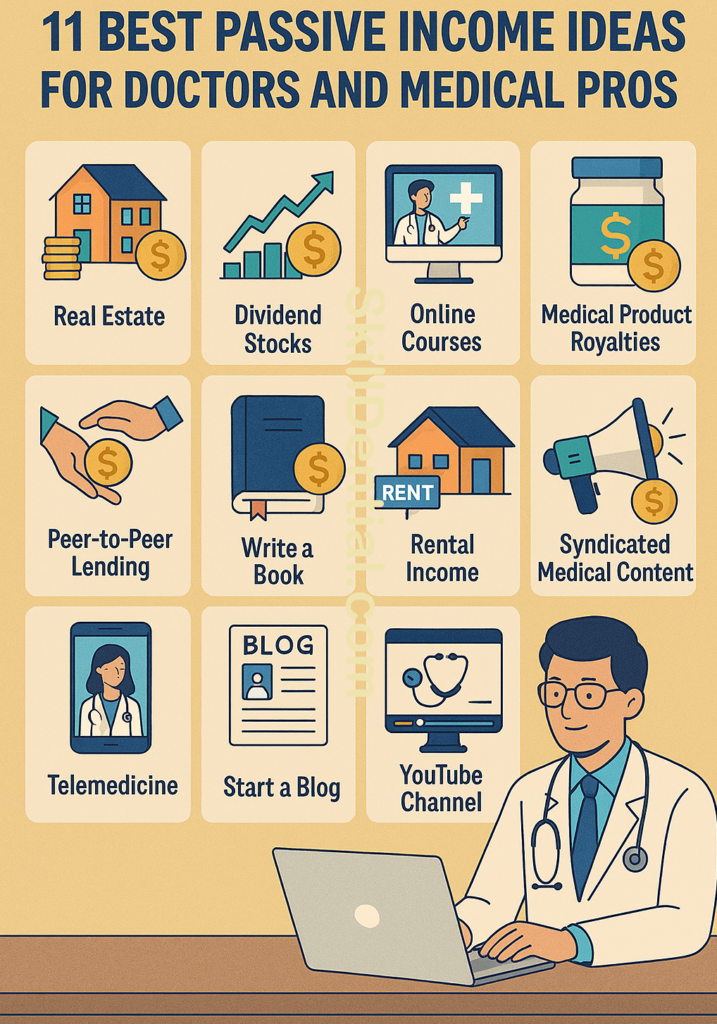
These 11 passive income ideas—from understanding HSA fundamentals to mastering syndication strategies—are designed to help doctors at various stages of their careers build tax-efficient and well-protected wealth. By exploring these concepts, physicians can create diversified income streams that support long-term financial security and growth.
Key takeaways and important points to remember:
- Align your ideas carefully with your unique time-capital profile to achieve the best possible fit and maximize your potential for success. By matching your concepts to the specific resources and time you have available, you can ensure a more effective and efficient outcome that suits your personal circumstances perfectly.
- Prioritize taking full advantage of tax shields such as the Qualified Business Income (QBI) deduction and depreciation benefits in order to significantly enhance and maximize your overall investment returns and financial gains. By strategically leveraging these tax advantages, you can effectively reduce your taxable income and increase your net profitability over time.
- Begin with small, manageable steps to gradually build momentum and establish a strong, reliable foundation. This approach allows you to scale up confidently and sustainably over time, ensuring steady progress without overwhelming yourself or risking burnout. By taking it slow and steady, you create a solid base that supports growth and long-term success.
Explore the article “5 Tax Pitfalls Doctors Must Avoid” next to gain essential insights, or consider joining our physician finance newsletter for personalized tips tailored specifically to medical professionals. Be sure to consult with financial advisors, as individual results and situations may vary.

His mission is to provide clear, actionable advice that helps readers navigate the complexities of the modern workplace, advance their careers, and unlock their full potential. You can find his expert guides on technology, entrepreneurship, and professional development.
Discover more from SkillDential
Subscribe to get the latest posts sent to your email.