11 Best Coding Tools to Speed Up App Development Workflow
 Akinpedia
19 min read
Akinpedia
19 min readEfficiency isn’t merely a bonus—it stands as a fundamental and essential competitive advantage in the rapidly evolving and fast-paced development environment of today. With strict deadlines constantly looming and increasingly complex technology stacks continuously evolving, developers require the most effective and reliable coding tools available.
These tools help to streamline various development processes, significantly reduce the time spent on debugging, and accelerate the overall deployment cycles, ensuring projects are completed on time and with higher quality.
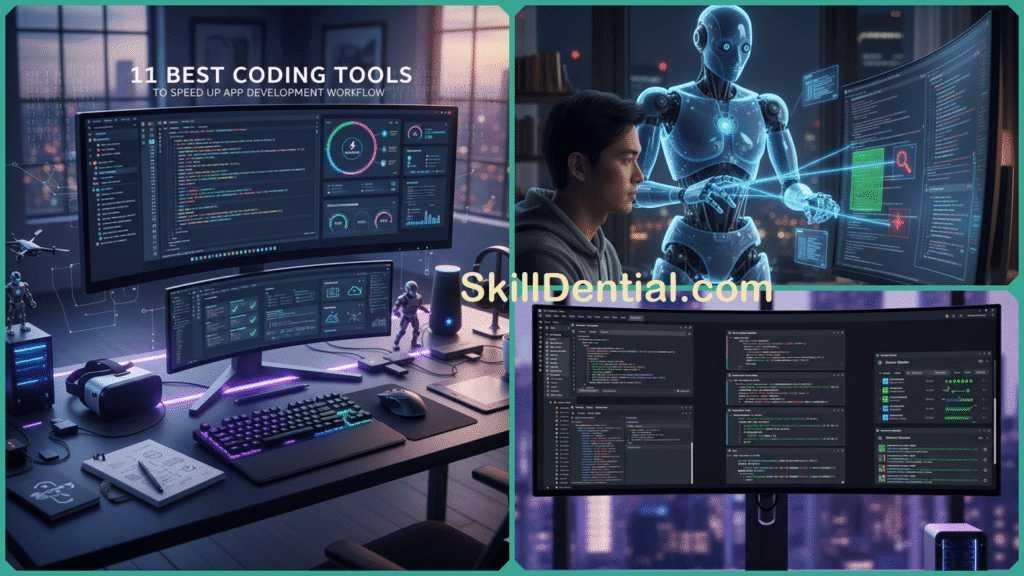
This comprehensive article carefully curates and highlights the 11 best coding tools available for 2025, providing an in-depth look at some of the most advanced and innovative options in the market. It covers a wide range of categories, including.
- AI-powered coding assistants that intelligently help developers write and debug code
- Powerful automation platforms designed to streamline repetitive tasks
- Highly efficient integrated development environments (IDEs) that offer a seamless coding experience
- Various workflow enhancers that significantly optimize the entire app development process from initial coding stages all the way through to final deployment
Why Coding Tools Matter More Than Ever
Modern app development has significantly evolved into a comprehensive discipline that goes beyond simply writing clean and functional code. It now emphasizes effectively managing complexity, ensuring scalability, and reducing time-to-market to meet the fast-paced demands of the industry.
Developers in today’s environment are required to work smarter rather than harder, making efficient use of their skills and resources. This is precisely why advanced coding tools have become absolutely indispensable, as they help streamline workflows, improve productivity, and support developers in navigating the numerous challenges they face.
Managing Complexity at Scale
In the year 2025, digital systems have become significantly more distributed than ever before, with microservices, APIs, and cloud applications operating seamlessly across complex hybrid environments. Developers now depend extensively on a variety of sophisticated coding tools to effectively orchestrate and manage these numerous moving parts and interconnected components.
According to the findings of the Stack Overflow Developer Survey 2025, the vast majority of engineering teams currently rely on no fewer than five different workflow tools daily to handle critical tasks such as continuous integration and continuous delivery (CI/CD), comprehensive testing, thorough debugging, and smooth deployment processes.
Boosting Productivity and Accuracy
Modern tools play a crucial role in automating repetitive or redundant tasks such as code formatting, dependency updates, and unit testing, significantly reducing the manual effort required. With the integration of AI-driven assistants and advanced workflow automators, developers are now empowered to write, refactor, and document their code up to 40% faster compared to traditional methods.
This acceleration not only significantly enhances overall productivity but also greatly improves the maintainability of code, making it easier to manage and update over time. Additionally, it leads to a substantial increase in overall accuracy, which contributes to more reliable and error-free software. As a result, these improvements collectively drive higher-quality outcomes in software development projects, ensuring better performance and user satisfaction.
Enabling Continuous Integration and Delivery
Continuous Integration and Continuous Delivery (CI/CD) tools have truly become the essential backbone of modern application delivery processes. By fully automating critical tasks such as builds, testing, and deployments, platforms like GitHub Actions and Jenkins empower development teams to iterate much faster while significantly reducing the number of errors that occur during the release process.
Many businesses that implement robust CI/CD pipelines consistently report experiencing noticeably shorter release cycles, much quicker recovery times from failures, and a substantial improvement in overall code quality and reliability.
Facilitating Collaboration and Cloud Integration
As teams grow increasingly global and distributed across different time zones and locations, tools that promote real-time collaboration—such as GitHub, Jira, and Notion—play a crucial role in synchronizing efforts effectively and significantly reducing miscommunication among team members.
These collaboration platforms connect seamlessly with various cloud environments and DevOps pipelines, enabling the creation of transparent, traceable, and reproducible workflows that enhance productivity and ensure smooth project execution.
Driving Innovation Through Automation and AI
AI’s rapidly growing influence in modern development workflows stands out as one of the most transformative and game-changing trends in the technology landscape today. Advanced tools powered by sophisticated machine learning algorithms, such as Copilot and AskCodi, offer context-aware code generation and intelligent debugging capabilities that significantly reduce the mental load on developers while dramatically accelerating project turnaround times.
This seamless union of human creativity and AI-driven precision has fundamentally redefined and expanded the very concept of what “coding productivity” means in today’s fast-paced software development environment.
In Summary
Coding tools matter more than ever before because they enable developers to concentrate on what truly adds meaningful value—such as innovation, creative design, and addressing real‑world problems—while shifting routine, repetitive tasks to automation.
These tools act as powerful catalysts for scalability, operational efficiency, and seamless collaboration in an era where the quality of applications and the speed of their delivery are critical factors that define overall business success and competitive advantage.
Best Coding Tools to Speed Up App Development Workflow
In today’s rapidly evolving and fast-paced technology landscape, the speed at which you bring a product to market, commonly referred to as time-to-market (TTM), is absolutely crucial and often determines success or failure. To maintain a competitive edge in this dynamic environment, developers need to effectively eliminate any unnecessary friction in their processes, automate repetitive and mundane tasks, and dedicate more time and energy to true innovation and creative problem-solving.
This carefully curated and comprehensive list showcases the 11 best coding tools available, each specifically designed to streamline and optimize your entire software development cycle—from the moment you write your very first line of code all the way through to the final deployment stage—significantly accelerating your app development workflow and boosting overall productivity.
GitHub Copilot X – AI Pair Programming Evolved
GitHub Copilot X has fundamentally transformed the way developers approach writing code by leveraging advanced AI to understand natural language prompts and then generate highly accurate, context-aware code completions that fit seamlessly into the coding workflow.
Its seamless integration with popular development environments such as VS Code, JetBrains IDEs, and GitHub Actions enables developers to experience continuous, intelligent code assistance throughout every stage of the development process, significantly enhancing productivity and code quality.
Why It’s Great:
- AI suggestions trained on vast open-source repositories
- Autocompletion that adjusts to individual coding style
- Chat-based debugging interface
- Seamless CI/CD integration
Best For: Developers who are seeking advanced intelligent code support across a wide range of programming languages and frameworks, enabling them to write more efficient and error-free code with greater ease and speed.
AskCodi – The Productivity Multiplier
AskCodi (Qodo.ai) is rapidly gaining popularity and quickly becoming a top choice among developers for cross-language code generation and automated documentation. It offers robust support for more than a dozen programming languages, including widely used ones like Python, Java, and Kotlin.
This potent tool greatly assists developers by effectively streamlining and simplifying the often challenging process of converting complex logic, intricate algorithms, and abstract conceptual ideas into fully functional, well-structured, and thoroughly documented code implementations. It achieves this with remarkable speed and efficiency, making the entire development workflow much smoother and more productive.
Highlights:
- Code generation, optimization, and refactoring tools
- IDE plugins for VS Code, PyCharm, and IntelliJ IDEA
- Smart query handling and quick bug resolution
Why It Works: Unlike traditional autocomplete systems that predict and complete code, AskCodi functions as an active and intelligent partner in your development process. It not only suggests code snippets but also provides detailed explanations to help you understand the logic behind each suggestion.
Additionally, AskCodi can test snippets within your workflow, ensuring they work as intended before integration. It also offers valuable workflow hints designed to streamline your tasks, enabling you to complete projects more efficiently and with greater confidence than ever before.
Visual Studio Code (VS Code)
Still widely regarded as the gold standard for lightweight yet incredibly powerful development environments, VS Code continues to stand out prominently due to its extensive customizability and the availability of a growing number of AI-ready extensions that enhance its capabilities even further.
Features:
- Git integration for seamless version control
- Extensions like GitLens, Prettier, and Docker management
- Real-time pair programming with Live Share
- Built-in Copilot integration
Ideal For: Cross-platform developers and collaborative teams seeking a highly extensible, lightweight, and low-footprint integrated development environment (IDE) that can be easily customized to fit a wide variety of programming needs and workflows.
JetBrains IntelliJ IDEA
For large-scale enterprise projects, IntelliJ IDEA offers comprehensive and deep code insight, advanced refactoring capabilities, and intelligent automation features designed to boost developer productivity. Enhanced by JetBrains’ powerful AI assistant, IntelliJ now significantly improves the efficiency of routine code generation and streamlines integration testing processes, making development faster and more reliable.
Why Developers Love It:
- Smart autocomplete and on-the-fly code analysis
- Spring, React, and Android support
- Built-in database management tools
This tool truly shines when it comes to full-stack development using Java and Kotlin, providing developers with unmatched and comprehensive debugging capabilities along with advanced refactoring support that significantly enhances code quality and maintainability.
Notion – The All-in-One Dev Workspace
While Notion is not a traditional coding IDE, it is significantly redefining developer productivity by seamlessly blending powerful documentation capabilities, efficient task management, and real-time collaboration features into one unified platform.
Benefits:
- Centralized workspace for API documentation, SOPs, and notes
- Kanban boards and integration with GitHub for project tracking
- AI summaries for tech documentation
For remote teams that are coordinating their work across multiple time zones, Notion offers an exceptional level of transparency and significantly reduces the need for frequent context switching. This helps team members stay aligned and focused despite geographical and temporal differences.
Monday.com – Simplified Project & Build Tracking
Monday.com significantly enhances visibility into app development cycles by automating various essential processes such as progress tracking, sprint planning, and team communication. This automation not only streamlines workflows but also ensures that every stage of the development cycle is clearly monitored and managed efficiently, leading to improved project outcomes and better collaboration among team members.
Why It’s Useful:
- Automated workflows and status synchronization
- Custom dashboards for sprints, QA, and deployment pipelines
- Integrations with GitHub, Slack, and Zapier
It’s especially ideal for tech leads who are responsible for managing multiple developers and juggling numerous deadlines, as it significantly helps to reduce the overall management overhead and streamline the workflow effectively.
Jira – The Backbone of Agile Teams
Widely regarded as the central command center for managing complex software workflows, Jira continues to be an indispensable tool for Agile and DevOps practitioners around the world. Its robust features and flexible platform make it essential for teams aiming to streamline their development processes and improve collaboration.
Strengths:
- Customizable Scrum and Kanban boards
- Advanced issue tracking and automation
- Integration with Confluence, Bitbucket, and CI/CD tools
For technical managers, Jira’s real-time reporting capabilities significantly accelerate iteration cycles by providing up-to-the-minute data, which helps in making quick, informed decisions. This feature also ensures that all stakeholders remain consistently aligned and up to date throughout the development process, fostering better communication and collaboration across teams.
Vellum AI – Low‑Code Automation and Integration
For developers who are primarily focused on enhancing and streamlining workflow automation, Vellum AI provides an innovative AI-first environment specifically designed to facilitate the orchestration of model calls, complex decision flows, and comprehensive testing automation. This platform empowers developers to efficiently manage and automate various aspects of their workflows with advanced AI capabilities.
Features:
- Visual builder with SDKs in Python and TypeScript
- Version control, rollbacks, and production pipeline management
- Multi-environment support (dev, stage, prod)
Vellum effectively bridges the gap between coding and operational workflows, enabling developers to seamlessly deploy AI-powered processes more quickly and efficiently. By integrating these two critical aspects, Vellum empowers development teams to accelerate the implementation of advanced AI solutions, significantly reducing the time required to bring innovative processes into production environments.
Postman – The API Lifesaver
Postman continues to be an essential and widely used tool in the API development toolkit. It greatly simplifies the process of testing API requests, managing different environments efficiently, and generating comprehensive API documentation with ease. This makes it an invaluable resource for developers working on API design and implementation.
Advantages:
- Automated API test suites and mock servers
- Seamless collaboration for backend and frontend teams
- Integration with Git and CI/CD tools
Postman’s Collections feature continues to play a crucial role in making large-scale microservice testing significantly smoother and more efficient, helping developers catch and reduce integration bugs well before deployment.
This powerful tool streamlines the entire testing process, allowing teams to manage complex microservice interactions with greater ease and confidence, ultimately leading to more reliable and robust application releases.
Docker – Rapid Environment Setup
Docker provides a powerful way to standardize the development process through the use of containerization technology. This approach enables developers to package applications along with all their dependencies into containers, ensuring that the software runs consistently across different computing environments.
By using Docker, developers can ship fully consistent and isolated environments regardless of the underlying operating system, whether it be Windows, Linux, or macOS. This greatly reduces the “it works on my machine” problem and streamlines collaboration and deployment.
Core Features:
- Container-based isolation
- Seamless CI/CD integration
- Efficient resource usage
Using Docker significantly reduces the common “works on my machine” scenarios by ensuring that applications run consistently across all environments. This streamlined approach to app delivery makes it much easier to move software seamlessly through development, staging, and production stages without encountering unexpected issues related to environment differences.
ChatGPT Code Interpreter (Advanced Data & Test Automation)
Developers are increasingly leveraging ChatGPT‘s Code Interpreter, also known as Advanced Data Analysis, to automate complex data transformation processes, create detailed visualizations of bug trends, and rigorously test logic before deployment.
This powerful and versatile tool significantly enhances workflow efficiency by substantially reducing the need for manual coding efforts, which are often time-consuming and prone to errors. Additionally, it improves accuracy and reliability in critical stages such as data handling and software testing, ensuring more consistent and dependable outcomes throughout the development process.
What It Offers:
- IDE-style debugging inside natural language prompts
- Test data simulation for QA
- Integration with APIs via plugins and actions
It is fundamentally and completely transforming the entire way developers go about creating prototype scripts and performing thorough, comprehensive end-to-end testing processes, all of which can now be done seamlessly without ever having to leave or exit the chat interface itself.
The Modern App Development Workflow
The modern app development workflow in 2025 represents a highly dynamic and hybrid model that seamlessly integrates advanced AI-driven decision-making processes, encourages extensive cross-functional collaboration among diverse teams, and incorporates robust continuous delivery pipelines.
This significant evolution in the workflow empowers development teams to produce scalable, highly efficient, and feature-rich applications at a much faster pace than ever before, meeting the growing demands of today’s fast-moving technology landscape.
The Shift Toward Hybrid Toolchains
In the year 2025, hybrid toolchains have become the dominant force within development ecosystems, largely because they successfully merge traditional engineering rigor with cutting-edge AI-powered automation and the expansive scalability offered by cloud-native technologies.
This hybrid approach signifies that developers now rely on a diverse set of multiple integrated tools, each specifically designed and optimized for a particular phase of the development lifecycle—whether that be authoring, testing, deployment, or automation.
By cohesively leveraging these specialized tools in a strategic and integrated manner, developers are able to achieve a remarkably smooth and seamless end-to-end productivity experience. This comprehensive approach not only streamlines workflows but also dramatically enhances overall efficiency and significantly improves output quality across every stage of the development process and across the board.
Key Components of the Modern Workflow
| Workflow Stage | Recommended Tool | Core Benefit |
|---|---|---|
| Code Authoring | GitHub Copilot X, AskCodi | Speeds up coding with intelligent AI completion and language‑agnostic assistance |
| Debugging & Testing | IntelliJ IDEA, Postman | Accelerates issue detection, testing automation, and bug resolution |
| Collaboration | Notion, Monday.com, Jira | Improves project visibility, communication, and agile task management |
| Deployment | Vellum AI, Docker | Streamlines CI/CD pipelines, ensures reproducibility, and enables scalable container deployment |
| Optimization & Learning | ChatGPT Code Interpreter | Automates testing, data analysis, and workflow improvement insights |
This highly versatile and modular multi‑tool workflow significantly shortens the overall Time‑to‑Market (TTM) by guaranteeing seamless coordination and integration across every single stage of the application development process—from the initial concept and planning phase all the way through to final deployment and delivery.
AI‑Driven Intelligence in Workflows
AI has now become the essential connective tissue that holds together and drives the complexity of modern application ecosystems. Advanced platforms like GitHub Copilot X and Vellum AI are designed to automate hundreds of small but critical micro-tasks, ranging from generating tests to optimizing cloud resource allocation.
By leveraging sophisticated algorithmic inference techniques, these tools meticulously analyze vast amounts of historical build data and development patterns to provide smart, data-driven recommendations that help improve system performance automatically and efficiently.
Machine learning significantly enhances the capabilities of monitoring and reporting systems. These advanced systems can autonomously identify inefficiencies in processes, suggest comprehensive code refactoring to improve performance, and even predict potential integration failures well before they actually happen. This proactive approach allows teams to address issues early, ensuring smoother operations and minimizing unexpected downtime.
Collaboration in Hybrid Work Environments
The rapid rise and widespread adoption of remote and distributed development teams have made collaboration platforms absolutely indispensable in today’s work environment. Powerful tools such as Notion and Jira play a crucial role in this ecosystem by ensuring that every team member—whether a developer, tester, or project manager—operates consistently from a single, unified source of truth.
This approach significantly reduces misunderstandings and enhances productivity across the board. Additionally, hybrid project management frameworks, as thoroughly detailed in the ONES Project analysis, expertly blend the best practices of Agile and Waterfall methodologies.
This innovative hybrid approach provides highly customizable workflows that can be meticulously tailored to specifically address and meet the unique and diverse requirements, as well as the complex challenges faced by both fast-growing dynamic startups and large-scale enterprises operating across various industries.
These innovative solutions significantly enhance synchronization among team members, automate complex reporting processes, and maintain real-time transparency across all collaborating teams. By fostering this seamless harmonization of both human expertise and advanced AI input, the system effectively reduces the number of blockers and facilitates much smoother handoffs within continuous development environments, ultimately driving greater efficiency and productivity throughout the entire workflow.
Continuous Integration and Deployment (CI/CD)
Today’s CI/CD systems have become significantly more autonomous and adaptive than ever before, enhancing the efficiency and reliability of software delivery pipelines. Docker containers play a crucial role by providing consistent, reproducible environments that seamlessly span across development, staging, and production stages.
Meanwhile, advanced platforms such as Vellum AI expertly manage critical aspects like version control, enabling precise tracking of code changes, implementing effective rollback strategies to quickly revert to previous stable versions when needed, and orchestrating automated rollouts to ensure smooth and controlled software deployments.
Modern CI/CD setups are designed to integrate seamlessly with advanced security measures and performance optimization tools, ensuring that compliance requirements are consistently met while significantly reducing the need for manual oversight and intervention. This integrated approach not only enhances security but also streamlines the entire development process.
As a result, this model has been credited with achieving notably faster completion rates, with reports indicating a 35% improvement in the speed of mobile app project deliveries when compared to traditional, older methods and workflows.
Optimization and Post‑Deployment Insights
Finally, optimization has evolved into an ongoing and continuous feedback loop that constantly improves system performance. By leveraging ChatGPT’s highly advanced code interpretation technology, developers are now able to carry out dynamic and real-time performance testing more efficiently.
They can simulate complex user interactions in various scenarios and generate tailored, insightful analytics from data pipelines without the need for time-consuming manual scripting or coding efforts. This seamless integration significantly enhances the development workflow and accelerates the optimization process.
Teams can visualize detailed failure trends, analyze test coverage ratios comprehensively, and monitor build efficiency closely. This insight allows them to continuously refine and improve future sprints with greater precision. The outcome is a dynamic, learning-enabled ecosystem—one in which every build becomes progressively smarter and more optimized over time, driving ongoing improvement and success.
The Strategic Value of a Hybrid Workflow
Beyond simply enhancing productivity, hybrid toolchains offer significant strategic resilience for organizations. They reduce reliance on any single vendor, thereby minimizing risks associated with vendor lock-in and service disruptions.
Additionally, these toolchains improve scalability by enabling seamless integration across a wide variety of infrastructure environments. This flexibility ensures that organizations can adapt more easily to changing demands.
Moreover, hybrid toolchains play a crucial role in effectively future-proofing businesses by enabling them to remain highly agile and responsive to the continuously evolving technology stacks and shifting industry trends over an extended period of time. This adaptability ensures that companies can seamlessly integrate new tools and methodologies as they emerge, maintaining a competitive edge in their respective markets.
In the rapidly evolving and ever-changing ecosystem of 2025, achieving meaningful and sustained success increasingly depends on the seamless and efficient integration of AI-assisted creation tools, highly advanced collaborative platforms, and robust, fully automated development pipelines that streamline workflows and enhance productivity.
When combined, these technologies empower teams to work smarter, move faster, and adapt more effectively to changing requirements, fundamentally transforming the traditional development workflow. This cohesive approach redefines the entire process of how applications progress from initial ideation stages all the way through to a successful global launch.
Current Trends in Coding Tools (2025)
The development landscape in 2025 is experiencing a rapid and profound transformation driven by advancements in artificial intelligence technologies. This section delves into the most significant tools and platform shifts that are fundamentally reshaping developer productivity.
Key innovations include the seamless integration of Agentic AI and generative code assistants directly within integrated development environments (IDEs), enabling developers to write, debug, and optimize code more efficiently than ever before.
Additionally, there is a significant and ongoing expansion taking place within the realm of Low-Code/No-Code (LCNC) platforms, which are designed to empower a much broader and more diverse range of users to create and build applications with minimal reliance on traditional, in-depth coding knowledge or expertise. This growing trend is making software development more accessible than ever before.
Alongside these developments, there is a strong emphasis on cloud-native development practices, tightly coupled with integrated security measures through DevSecOps frameworks. Together, these emerging trends are driving the future of development toward a landscape that is significantly faster, highly automated, and increasingly accessible to both professional developers and non-technical users alike.
FAQs
What is a Coding Tool?
A coding tool (or programming tool) is any software that assists developers in creating, testing, debugging, or deploying applications efficiently. These include code editors, IDEs (Integrated Development Environments), AI coding assistants, version control systems, CI/CD automation tools, and project management platforms. Modern examples—like VS Code, GitHub Copilot, and Docker—solve common developer friction points such as syntax errors, environment mismatches, and debugging delays.
Which Tools Are Best for Mobile App Development?
For mobile and app developers aiming to build efficient and high-performing applications, the optimal technology stack includes a carefully selected combination of tools, frameworks, and programming languages that work seamlessly together to deliver the best user experience and robust functionality. This stack typically encompasses frontend technologies, backend services, databases, and additional utilities tailored specifically for mobile and app development projects.
- GitHub Copilot X – Automates code generation for iOS, Android, Flutter, and React Native projects.
- IntelliJ IDEA – Native Android and Kotlin integration with AI debugging and test automation.
- Visual Studio Code – Lightweight, cross‑platform editor ideal for hybrid mobile development.
- Postman – Enables comprehensive API testing for mobile backends.
Combined, these powerful tools significantly accelerate the entire build–test–release cycles, enabling faster development and deployment processes while consistently maintaining exceptional levels of high performance and unwavering reliability throughout each stage.
Can AI Coding Tools Replace Developers?
AI coding tools are enhancement technologies, not replacements. They automate tasks such as autocompletion, code review, and error identification, but lack human creativity, architecture awareness, and contextual business understanding. AI assistants like Copilot or ChatGPT Code Interpreter handle repetitive logic while professionals focus on innovative problem‑solving, design patterns, and product scalability.
Which Tools Work Best for Freelancers?
Freelancers gain the greatest advantages from platforms that are not only portable and easy to access from anywhere but also affordable and budget-friendly. Additionally, these platforms should offer a high level of integration with various tools and services, allowing freelancers to streamline their workflows and manage multiple aspects of their work efficiently in one place.
- AskCodi – Provides multilingual AI support for small, fast projects.
- VS Code – Cloud synchronization ensures mobility across laptops and workspaces.
- Notion – Centralizes client communication, documentation, and project tracking.
These innovative tools empower independent developers to effectively manage a wide range of clients with greater efficiency, all while maintaining low operational costs and significantly boosting overall productivity levels.
What’s the Key to Choosing the Right Coding Tool?
When selecting coding tools, it is important to concentrate on three essential metrics that will significantly impact your development process and overall efficiency:
- Integration Compatibility: Choose tools that plug seamlessly into your tech ecosystem (e.g., GitHub + Jira + Docker).
- Productivity ROI: Assess how much time the tool saves in repetitive coding or debugging tasks.
- Scalability & Support: Opt for platforms with active communities, integrations, and long‑term version stability.
In essence, the “best” coding tool is not a fixed entity but one that evolves alongside your unique workflow, continuously adapting to meet changing needs. It enhances productivity and efficiency for both individual developers and entire teams, boosting overall velocity without causing any technological friction or disruptions. This seamless integration ensures that the tool supports rather than hinders the development process, making it an invaluable asset in any coding environment.
In Conclusion
Achieving coding success in 2025 relies heavily on both technical expertise and the effective mastery of modern workflows. Relying solely on technical know‑how is no longer enough; the most successful developers, teams, and tech organizations are those who strategically adopt a combination of advanced tools tailored for every stage of the app development lifecycle.
The integration of AI assistants like GitHub Copilot X and AskCodi revolutionizes code authoring, helping teams build robust, clean code with unprecedented speed and accuracy. Productivity platforms, such as Notion and Monday.com, empower teams to document processes, manage tasks, and collaborate effectively across distributed environments.
Essential container systems like Docker ensure that software runs consistently and securely across different infrastructure setups, while collaboration suites like Jira bring visibility to team workflows and sprint progress.
Leveraging this hybrid toolkit does more than just cut down development hours—these tools improve app quality, reduce time‑to‑market, and keep teams resilient in a competitive digital landscape. For solo freelance developers, this approach means taking on more projects without sacrificing quality. For fast‑growing startups and large enterprises, it enables the scaling of operations and delivery of innovative features with agility.
Mastering workflow and selectively adopting the 11 best coding tools lets you build smarter, deploy faster, and maintain agile control at every development phase. This toolbox is the foundation for future-proofing your success in app development throughout 2025 and beyond.

His mission is to provide clear, actionable advice that helps readers navigate the complexities of the modern workplace, advance their careers, and unlock their full potential. You can find his expert guides on technology, entrepreneurship, and professional development.
Discover more from SkillDential
Subscribe to get the latest posts sent to your email.