
11 Dark Sides of “Faceless Automation” on YouTube Revealed
 Akinpedia
9 min read
Akinpedia
9 min readFaceless automation on YouTube is often promoted as a simple way to generate passive income by creating videos without showing your face or directly participating in the content creation process. However, the reality behind this concept reveals several significant challenges and risks that many aspiring creators overlook or do not fully understand.
These challenges include strict YouTube demonetization policies that can limit earnings, ongoing content quality issues that impact viewer engagement, difficulties in selecting the right niche that balances popularity with competition, the complexity of effectively outsourcing video production, and various financial risks that lie behind the scenes.
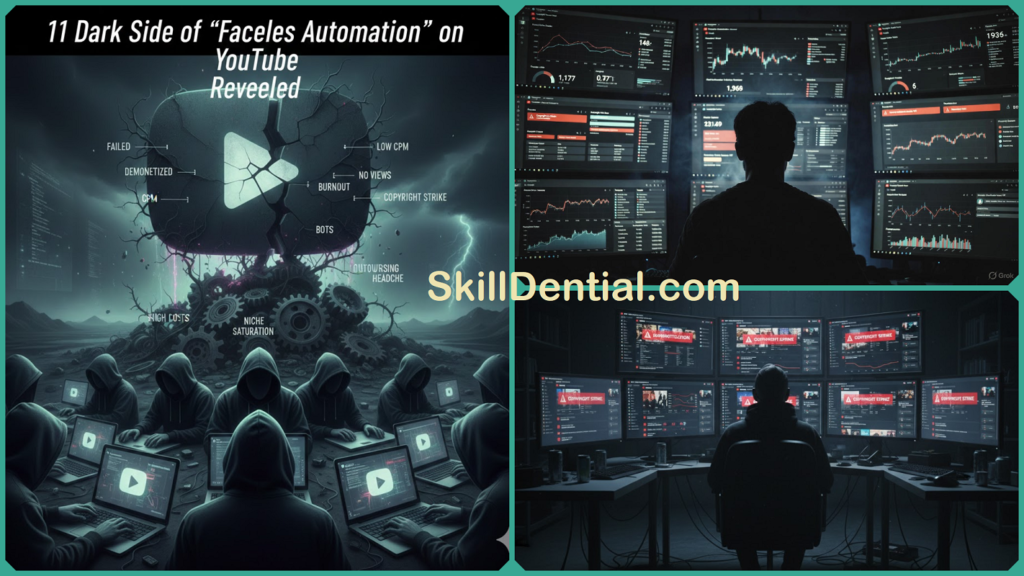
This particular endeavor is actually far more complex, intricate, and challenging than it might appear at first glance, and it carries significantly more risks, uncertainties, and potential complications than one might initially assume or anticipate.
What is Faceless Automation on YouTube?
Faceless Automation on YouTube is a unique method that involves creating and managing YouTube channels without the content creator ever appearing on camera or using their own natural voice. Instead, this strategy relies heavily on advanced AI-generated scripts, sophisticated text-to-speech voiceovers, carefully selected stock footage, engaging animations, and a network of outsourced freelancers who handle various aspects of production and uploading.
This innovative approach offers several benefits, including the ability to maintain complete anonymity, achieve significant scalability, and generate a steady stream of passive income by automating many of the repetitive and time-consuming tasks such as scripting, video editing, and timely posting.
It is especially appealing to side hustlers, introverts, and anyone seeking a low-effort method to consistently create content without requiring personal exposure or significant hands-on involvement. This approach offers a convenient solution for individuals who want to maintain a steady flow of content while minimizing the time and energy they need to invest.
Core Components of Faceless Automation
The process generally follows a highly streamlined and efficient workflow that is driven by the cutting-edge AI advancements expected to be available in 2025:
- Script Generation: Advanced AI tools like ChatGPT are capable of producing highly engaging and detailed outlines as well as compelling narratives specifically tailored to a wide variety of niches. These niches include areas such as finance, technology reviews, motivational compilations, and many other specialized topics. This customization ensures content that resonates well with the target audience and meets specific thematic requirements.
- Voiceovers and Visuals: Realistic text-to-speech technology, such as ElevenLabs, can effectively narrate scripts by generating natural-sounding audio that plays over various types of media, including stock footage, screen recordings, AI-generated visuals, or animations. This approach eliminates the necessity for individuals to record their own voices, streamlining the content creation process while maintaining professional-quality narration.
- Editing and Uploads: Advanced tools such as Descript, Pictory, or InVideo AI efficiently manage the entire process of video assembly, smooth transitions, eye-catching thumbnails, and precise scheduling. Meanwhile, skilled freelancers provide essential oversight and coordination to ensure the smooth operation of multiple high-performing “cash-cow” channels, maximizing productivity and content quality.
- This particular model has experienced a significant surge in popularity recently, especially among faceless channels operating within niches such as AI news and explainer content. These channels have been able to amass large numbers of subscribers by consistently producing a high volume of quality videos over time, demonstrating the effectiveness of this approach in building and maintaining an engaged audience.
The Dark Side of Faceless Automation
The dark side of faceless automation on YouTube uncovers numerous significant pitfalls that many aspiring creators often overlook, even though they are drawn to the enticing promise of passive income and the appeal of maintaining complete anonymity.
One significant and increasingly common issue faced by many creators is demonetization, which often occurs as a result of using reused or AI-generated content. YouTube has implemented much stricter monetization policies in recent years, specifically targeting channels that depend heavily on repetitive content that lacks originality, creativity, or meaningful human input.
As a result, many automated channels frequently experience sudden and unexpected loss of monetization privileges because their content is considered repetitive and fails to meet the platform’s stringent standards for authenticity and uniqueness. This crackdown aims to ensure that only genuinely original and engaging content receives monetization opportunities.
Another significant challenge faced by many content creators is the widespread prevalence of low-quality, generic videos that fail to stand out. When the automation process relies heavily on AI-generated scripts combined with unlicensed stock footage, the resulting videos often come across as dull and uninspired.
This lack of originality and creativity makes it difficult to capture and maintain viewers’ attention, causing engagement levels to drop noticeably. Consequently, this leads to reduced watch times and a slower rate of audience growth, which can have a serious negative effect on the long-term sustainability of a channel as well as its potential for generating revenue and building a loyal fanbase.
The Automated Dream vs. The Hidden Cost of Execution
Finding the right niche is often much more challenging and complex than it is commonly advertised or portrayed. Many of the popular and trending niches are heavily oversaturated with a large number of creators and businesses competing for the same audience.
On the other hand, the niches that experience less competition and are less crowded tend to have weaker monetization potential, making it harder to generate significant income. This inherent difficulty in selecting the perfect niche significantly reduces the likelihood of successfully building a profitable and sustainable channel solely through automation methods.
The high costs and significant complexity involved in outsourcing add an additional and often underestimated layer of risk to the creative process. Managing freelancers or virtual assistants responsible for tasks such as scriptwriting, voiceovers, and video editing frequently proves to be both expensive and complicated.
Without strong and effective management strategies in place, creators may encounter delays in project timelines, receive content that falls below expected quality standards, and experience unnecessary budget overruns. These challenges collectively create obstacles that can seriously hinder the overall growth and success of creative projects.
Lastly, a significant number of people fall victim to various financial risks and misleading false promises. Faceless YouTube automation is often promoted as a quick and effortless way to generate easy money with minimal effort. However, in reality, most creators end up spending a substantial amount of money on expensive courses, specialized software, and outsourcing services, yet they still struggle to maintain consistent quality in their content.
Additionally, they frequently encounter issues related to copyright claims or problems with monetization, which further complicate their efforts. This combination of challenges often leads to deep frustration, severe burnout, and a growing sense of disillusionment among those who hoped for a simple path to success.
These harsh and often overlooked realities clearly highlight that faceless automation is far from being effortless or foolproof. Achieving success in this area demands a significant amount of dedicated effort, careful and strategic niche selection, rigorous quality control measures, and disciplined financial management. Without these essential components, the likelihood of failure increases substantially.
Latest Trends and Challenges of Faceless Automation on YouTube
YouTube’s content policies underwent significant tightening in 2025, specifically targeting “inauthentic” or mass-produced AI-generated content as well as reused materials. These updated rules, which took effect starting July 15, include renaming the previous “repetitive content” guidelines to place greater emphasis on originality and the value added by human creators.
Channels that rely exclusively on AI-generated voices, stock footage, or fully automated scripts face the risk of demonetization or becoming ineligible for the YouTube Partner Program (YPP) unless they incorporate unique transformations. Such transformations could include custom video editing, personal creator insights, or other distinct elements that clearly demonstrate human contribution and creativity.
Key Policy Shifts
- Authenticity Over Automation: YouTube has now shifted its focus to prioritize videos that are genuinely “original and authentic,” placing greater value on content that clearly demonstrates creativity and human effort. As a result, the platform is actively flagging compilations, reaction channels, and videos that rely heavily on low-effort AI-generated material, often referred to as AI slop. While the use of AI tools is still permitted, this is only the case when the content showcases unique ideas and substantial human involvement in its creation. Purely automated content, however, does not meet YouTube’s standards for viewer retention or monetization eligibility and is therefore less likely to succeed on the platform.
- AI-Specific Scrutiny: Deepfakes, cloned voices, and undisclosed synthetic media are now subject to much stricter labeling requirements or even demonetization, driven by new and evolving regulations such as the NO FAKES Act. Content creators are required to transparently disclose any meaningful use of AI technologies in their work to avoid potential penalties or legal consequences. This heightened scrutiny aims to promote greater transparency and accountability in the creation and distribution of AI-generated content.
Emerging Trends
Advanced AI tools such as ElevenLabs for creating realistic voiceovers, Pictory for seamless video editing, and ChatGPT for generating compelling scripts significantly accelerate the production process. These technologies enable creators to build scalable faceless channels in popular niches like sports, history, and business that consistently attract millions of views.
High-retention content formats—including educational Shorts, data-driven explainers, and highly targeted niche-specific insights—are dominating the landscape, as platform algorithms increasingly prioritize user engagement and watch time over sheer content volume in an environment saturated with videos.
Persistent Challenges
Despite significant advancements and improvements in available tools, the oversaturation within popular niches now demands much more precise and thorough research to stand out effectively. At the same time, increasing policy risks contribute to amplified burnout as content creators face the relentless pressure of continuous quality adjustments and strict compliance requirements.
Ultimately, achieving success in this increasingly challenging and competitive environment tends to favor hybrid approaches that effectively combine the remarkable efficiency and rapid speed of AI technology with the unique creativity, deep insight, and nuanced understanding that only human input can provide.
This powerful and highly effective combination produces standout, exceptionally engaging, and easily monetizable content that truly captures and consistently holds the audience’s attention from start to finish. It ensures that viewers remain interested and invested throughout the entire experience.
FAQs
Can faceless YouTube channels truly generate passive income?
Faceless channels can produce income through ads, affiliates, and sponsorships, but true passivity demands upfront investment in AI tools, outsourcing, and systems—often $1,500+ monthly after scaling to 1,000 subscribers and 4,000 watch hours. Ongoing tweaks for algorithm compliance and quality control make it semi-passive at best, not hands-off from day one.
Why do many automated channels get demonetized?
YouTube’s 2025 policies target “inauthentic” or repetitive AI-generated content lacking human creativity, such as unedited stock footage compilations or synthetic voices without unique input. Channels violate reused content rules, leading to swift YPP removal unless they add transformative editing or disclosure.
Are there profitable niches for YouTube automation in 2025?
Profitable niches include sports highlights, history explainers, business tips, personal finance, health hacks, and AI tools, offering high CPMs and views when researched for low competition. Success requires data-driven selection via tools like VidIQ, as saturation hits popular areas.
What are common outsourcing challenges?
Outsourcing to Fiverr freelancers for scripts, editing, and voiceovers incurs high costs ($500–2,000/month per channel), quality inconsistencies, communication delays, and management overhead—especially without experience. Poor hires lead to policy-violating content and stalled growth.
Is buying courses enough to succeed with YouTube automation?
Courses provide basics like niche picks and AI workflows but overpromise quick riches; real success stems from hands-on testing, consistent uploads, SEO adaptation, and policy navigation. Many buyers fail due to lacking execution skills and facing 2025’s stricter rules.
In Conclusion
Faceless YouTube automation offers an intriguing and potentially lucrative opportunity for individuals who are looking for scalable content creation methods that require minimal personal involvement. However, the reality behind this seemingly effortless model is quite different and far more complex than it appears at first glance.
The many challenges associated with demonetization, maintaining high content quality, fierce niche competition, the intricacies of outsourcing, and the inherent financial risks all highlight the critical importance of transparency and a committed, diligent approach.
Instead of pursuing unrealistic “magic button” solutions or shortcuts, true success in this space demands a combination of creativity, consistently high-quality output, strategic and well-researched niche selection, and a proactive approach to adapting to YouTube’s constantly evolving policies and algorithms.
By committing to ethical practices and seeking out expert guidance, aspiring YouTube entrepreneurs can effectively navigate the darker aspects of faceless automation and ultimately build sustainable, profitable channels that thrive well into 2025 and beyond.

His mission is to provide clear, actionable advice that helps readers navigate the complexities of the modern workplace, advance their careers, and unlock their full potential. You can find his expert guides on technology, entrepreneurship, and professional development.
Discover more from SkillDential
Subscribe to get the latest posts sent to your email.