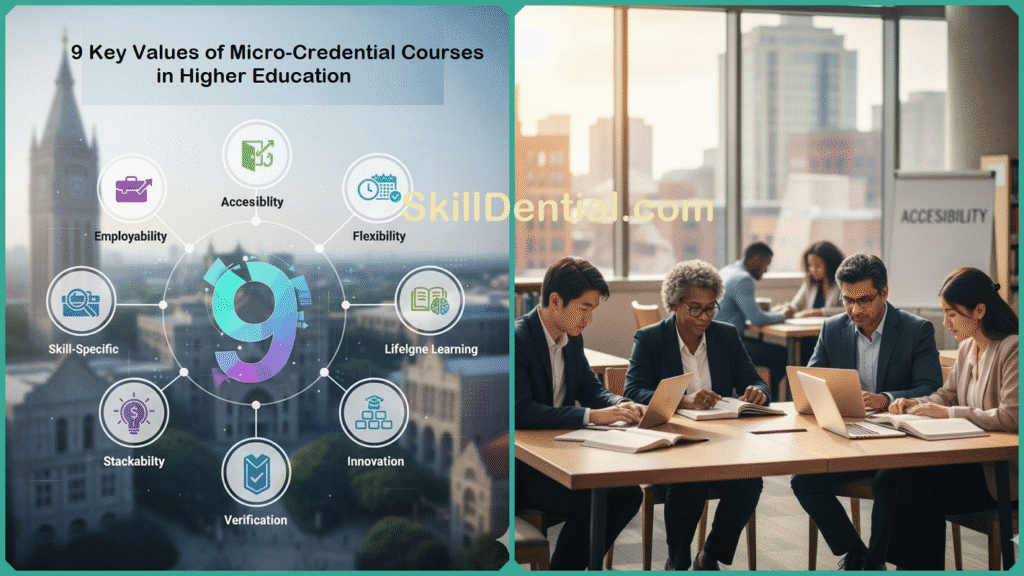
9 Key Values of Micro-Credential Courses in Higher Education
 Akinpedia
20 min read
Akinpedia
20 min readMicro-credential courses are transforming higher education from a rigid academic system into a dynamic, learner-centered, and skills-focused ecosystem. As universities face changing learner demographics, increased competition, and the demand for industry-ready graduates, these short, specialized programs have emerged as sustainable solutions that balance academic rigor with real-world relevance.
According to the Coursera Micro-Credentials Impact Report 2025, more than 82% of higher education institutions are planning to incorporate micro-credentials into their academic credit systems within the next five years.
This significant trend highlights the growing recognition of micro-credentials as an essential tool for effectively bridging the gap between traditional academic programs and the evolving needs of industry and employers. Institutions are increasingly seeing the value of these credentials in enhancing student employability and aligning education with real-world skills demands.
This post delves deeply into the nine essential core values of micro-credential courses—these foundational pillars that support and drive their increasing significance and relevance for a diverse group of stakeholders, including educational institutions, individual learners, employers across various industries, and policymakers involved in shaping the future of education and workforce development.
Understanding Micro-Credential Courses
A micro-credential course is an intentionally short and highly focused learning experience that serves to validate a particular skill, competency, or specialized knowledge area. It represents a modern and agile approach to education, thoughtfully developed to keep pace with the rapid and constantly evolving demands of today’s job market.
These courses have been carefully and specifically designed to effectively bridge the often significant and sometimes challenging gap that exists between traditional education systems and the practical, real-world needs and expectations of a wide range of industries.
Here is a detailed breakdown of what a micro-credential course entails, especially within the context of higher education institutions and their academic offerings:
Core Definition and Purpose
- Focus: Narrow and highly specific. Unlike a traditional degree program that encompasses a wide and broad body of knowledge across multiple disciplines, a micro-credential course is designed to target a single, well-defined skill set with precision and clarity (for example, Python for Data Analysis, Agile Project Management, or UX Design Fundamentals). This targeted approach allows learners to gain expertise in one particular area efficiently and effectively.
- Length: Short-term. These courses are considerably shorter than a typical semester-long university course, usually requiring only a few weeks up to a few months to finish. This shorter duration makes them particularly well-suited and convenient for busy professionals who need to acquire new skills or knowledge without committing to a lengthy academic program.
- Assessment: The evaluation method is competency-based, meaning the course emphasizes the importance of demonstrated mastery and practical application of the skills learned, rather than merely focusing on attendance or participation. Learners are required to complete a project or assessment that clearly proves their ability to apply the knowledge and skills effectively in real-world or practical scenarios. This approach ensures that the value of the course lies in actual competence and skill acquisition.
- Output: A verifiable digital credential that serves as official recognition of achievement. Upon successful completion of the course or program, the learner typically receives a digital badge or certificate that clearly and comprehensively articulates the specific skills and competencies mastered. This digital credential is easily shared and showcased on professional platforms like LinkedIn, making it convenient for learners to display their accomplishments. Additionally, these credentials are fully verifiable by employers, providing a trustworthy way to validate the learner’s expertise and qualifications.
Key Characteristics in Higher Education
Micro-credential courses provided by universities stand apart from generic online courses, such as MOOCs, due to their distinct and strategic role within the overall academic framework and curriculum design. These courses are intentionally developed to serve specific educational objectives and career pathways, integrating closely with degree programs or professional development tracks.
Unlike generic online courses, which often offer broad, standalone learning experiences, micro-credentials are tailored to provide targeted skills and knowledge that align with institutional standards and workforce demands, thereby enhancing their value and recognition within academic and professional contexts.
- Industry Alignment: Higher education institutions frequently collaborate closely with industry experts and employers to co-design these courses. This collaborative approach guarantees that the skills being taught are not only up-to-date but also highly relevant to the evolving demands of the modern workplace. As a result, students gain practical knowledge and competencies that can be immediately applied in real-world professional settings, enhancing their readiness and value to potential employers.
- Flexibility and Accessibility: Flexibility refers to the course design, offering learners the ability to study anytime, anywhere. Micro-credential courses are typically delivered online and are self-paced, allowing working professionals and adult learners to fit education around their existing jobs and family commitments. While accessibility refers to the reduced barriers to entry. These courses are generally more affordable and require a shorter time commitment than traditional degrees, opening up specialized, high-quality education to a wider, more diverse audience, promoting social inclusion and lifelong learning.
- Delivery: These courses are typically offered in a variety of flexible formats, including fully online, hybrid, or blended options. This flexibility is designed to make the programs highly accessible and convenient for working professionals, who are the primary audience seeking to enhance their skills and advance their careers through upskilling opportunities.
- Cost & Time: They require a significantly lower financial investment and demand much less time compared to traditional full degree programs, thereby making specialized training more accessible and affordable to a broader range of individuals. This approach helps democratize education by reducing barriers related to both cost and duration, allowing more people to benefit from targeted learning opportunities without the extensive commitments typically associated with full-length degree courses.
- Stackability: One of the most important and defining characteristics of micro-credentials is their inherently “stackable” nature. Each micro-credential course is designed to serve as a fundamental building block that learners can combine progressively:
- Learners have the opportunity to accumulate several related micro-credentials over time, which can then be combined to form a comprehensive Certificate or a more advanced Specialization. This approach allows for a flexible and modular learning experience, enabling individuals to build their expertise step-by-step while working toward a larger, more recognized qualification.
- In many instances, the credit hours that students earn from completing a micro-credential course can often be applied directly toward fulfilling the requirements of a full bachelor’s or master’s degree program at the same educational institution. This arrangement offers a highly flexible and convenient “on-ramp” for individuals who wish to re-enter or continue their formal education journey without starting over from scratch.
- Quality Assurance: When a micro-credential course is awarded by a reputable university, it carries not only the authority but also the academic rigor and credibility associated with an accredited institution. This ensures that the course meets high standards of quality and reliability. As a result, it effectively addresses and alleviates employer concerns regarding the value, legitimacy, and quality of non-traditional credentials, providing reassurance about the skills and knowledge acquired through such programs.
Who Uses Them and Why?
- Working Professionals: To quickly upskill or reskill to stay competitive in their current field or to successfully transition into a new, rapidly growing area such as cybersecurity, it is crucial to acquire relevant knowledge and skills efficiently. This approach enables professionals to keep pace with evolving industry demands and opens doors to promising career opportunities in high-demand sectors.
- Employers: To quickly address and fill immediate skill gaps that exist within their workforce by providing targeted, focused, and continuous professional development opportunities specifically designed for their employees. This approach ensures ongoing growth and improvement in employee capabilities.
- Universities: To significantly enhance institutional agility and better respond to rapidly evolving market demands, while also attracting a broader and more diverse pool of lifelong learners who are interested in educational opportunities beyond traditional full degree programs. This approach allows institutions to adapt more effectively to changing learner needs and workforce trends.
- Career Changers: To acquire essential entry-level skills and foundational competence in a completely new field without the extensive time investment and significant financial burden that usually comes with starting an entirely new degree program. This approach allows individuals to transition smoothly into a different industry by focusing on practical knowledge and relevant experience.
Key Values of Micro-Credential Courses in Higher Education
Micro-credential courses in higher education deliver measurable strategic value to universities, learners, employers, and policymakers, primarily through agility, employability, accessibility, and innovation. They redefine how institutions respond to market needs by embedding modular and skills-based credentials that verify competence faster than traditional degrees.
Micro-credentials are short, targeted, industry-aligned programs, often online, designed to validate specific skills through digital badges or certificates recognized by employers worldwide. The following key values detail how they are shaping the modern higher education landscape:
Agility and Responsiveness to Market Change
One of the most significant advantages of micro-credential courses is their speed of implementation. They enable universities to design and launch new courses within weeks to address emerging trends such as artificial intelligence, digital sustainability, or supply chain analytics.
For instance, Harrisburg University’s micro-credential model responds directly to shifts in data science and cybersecurity, allowing curricula to evolve in real time. This ability to adapt enhances institutional agility and ensures graduates possess current, demand-driven expertise, not outdated theoretical instruction.
Enhancing Employability and Industry Alignment
Employers are embracing skills-based hiring over degree-based criteria. The Association to Advance Collegiate Schools of Business (AACSB) reports that 97% of global employers now prioritize demonstrable competencies, making micro-credentials evidence of practical skill mastery.
Programs like Coursera’s “Google Project Management” or IBM’s “AI Fundamentals” serve as verified signals of job readiness. Consequently, learners gain a competitive career edge, while institutions supplying these credentials close the academic-employer alignment gap.
Stackability and Pathways to Degrees
Micro-credentials provide learners with the valuable opportunity to progressively build comprehensive qualifications through a system of stackable learning modules. These smaller, focused credentials can be strategically combined and accumulated over time to create more substantial certifications, such as official certificates and diplomas. In fact, when accumulated thoughtfully, they can even contribute toward earning advanced academic degrees, offering a flexible and personalized pathway for educational advancement.
For example, Hult International Business School and Western University’s Ivey Business School now recognize stacked credentials from industry platforms like Coursera as partial credits toward MBAs or specialized master’s programs. This modular approach enables lifelong learning progression and mobility between academic and vocational education.
Expanding Access and Inclusion
The modular design of micro-credentials promotes educational equity by lowering cost and time barriers. Programs are often online, asynchronous, and affordable—enabling participation from non-traditional students, including working adults and parents.
Research by UNESCO and OECD confirms that such models broaden participation among underrepresented groups and regions lacking traditional university infrastructure. This flexibility extends access to learners who might otherwise be excluded from higher education.
Strengthening Institutional Relevance and Innovation
University-led micro-credentials inspire educational innovation and entrepreneurial agility. By collaborating with corporate partners—like Google, Amazon Web Services, and Salesforce—higher education institutions experiment with hybrid learning models that merge academic depth with market relevance.
These initiatives rejuvenate institutional competitiveness, diversify revenue through short-course enrollment, and strengthen branding as forward-thinking education providers. eCampus News (2025) notes measurable increases in student retention and employer collaboration following the implementation of micro-credentialing frameworks.
Building Employer Partnerships and Workforce Development
Micro-credentials thrive on co-created content between academia and industry, ensuring learners acquire skills directly applicable to workplace challenges. According to the 2025 Lumina Foundation Report, joint design between universities, employers, and policymakers ensures standardization and employability recognition.
Examples such as Google’s “Career Certificates” program and Microsoft’s collaborations with universities for upskilling initiatives clearly demonstrate successful synergies between industry and academia. These partnerships are effectively producing graduates who possess verified, practical skills and actionable expertise that closely align with the evolving demands of the global workforce. This alignment ensures that students are better prepared to meet real-world challenges and employers’ expectations in a rapidly changing job market.
Promoting Lifelong Learning and Professional Mobility
Micro-credential courses promote a continuous and ongoing learning journey instead of focusing solely on earning one final degree. As individuals move through various career transitions and shifts, these concise and targeted programs provide the flexibility to reskill and upskill as needed. This approach enables workers to enhance their knowledge and abilities without the necessity of enrolling in lengthy, full-time educational programs or making long-term commitments.
Coursera’s 2025 Impact Study observed that learners who completed micro-credentials displayed improved long-term career outcomes and were more likely to pursue further degrees. This reinforces a lifelong learning culture that keeps professionals competitive in evolving job markets.
Supporting Quality Assurance and Trust
Maintaining academic credibility continues to be of utmost importance in the educational landscape. Regulated frameworks, like those developed and implemented by reputable organizations such as the European MOOC Consortium and the OECD, play a crucial role in guaranteeing transparency, ensuring rigorous quality assurance, and promoting the seamless interoperability of micro-credentials across different countries and educational systems.
These frameworks help establish trust and recognition for credentials on an international scale, facilitating learner mobility and the broader acceptance of micro-credentials worldwide. University-issued micro-credentials often feature digital verification via blockchain technology, ensuring authenticity while maintaining the integrity associated with accredited institutions. This reassures employers and learners that the credential represents substantial, assessed learning achievements.
Driving Data-Driven Personalization and Engagement
Micro-credential programs increasingly leverage AI and analytics to enhance learner engagement and institutional insight. EdTech providers like FutureLearn and Coursera track completion rates, skill mastery, and progression to personalize learning experiences.
This data-driven approach significantly enhances student motivation and substantially reduces dropout rates—educational institutions that implement adaptive learning strategies consistently report retention rates that are up to 20% higher than traditional methods, making these courses not only more efficient but also highly learner-centered and tailored to individual needs.
Comparison of Micro-Credential Courses and Traditional Degree Programs
| Feature | Micro-Credential Course | Traditional Degree Programs |
|---|---|---|
| Duration | Weeks to months | 2–4 years |
| Cost | Affordable; pay-per-module | High tuition fees |
| Flexibility | Fully online or hybrid | On-campus fixed schedule |
| Curriculum Design | Market-responsive | Slow curriculum change |
| Recognition | Digital badges, stackable | Diplomas or transcripts |
| Quality Assurance | Industry-aligned, accredited | Institutional credentialing |
| Target Audience | Working professionals, lifelong learners | Full-time students |
Key Insights
- Hybrid Credential Models: Increasingly, educational institutions are integrating micro-credentials directly into their existing degree curricula, allowing students to earn embedded skill certifications as part of their overall academic progress. This approach not only enhances the value of traditional degrees but also provides learners with tangible, specialized skills recognized by employers, creating a more comprehensive and flexible educational experience.
- Government Endorsement: Both the OECD and UNESCO strongly support the implementation of standardized frameworks, emphasizing their importance in ensuring consistent and reliable international recognition across different countries and educational systems. This endorsement highlights the global commitment to creating unified standards that facilitate mutual understanding and validation of qualifications worldwide.
- Corporate Adoption: Leading global employers such as IBM, LinkedIn, and Google have increasingly taken an active role in co-developing micro-credentials. These collaborations aim to expand the reach and impact of these credentials on a worldwide scale, enhancing accessibility and relevance for learners across various industries and regions.
- Global Momentum: Currently, half of all universities around the world are already issuing micro-credentials to their students; furthermore, an impressive 82% of these institutions plan to fully integrate micro-credentials into their educational offerings by the year 2030, reflecting a significant shift in higher education trends.
Micro-credential courses represent a significant paradigm shift in the landscape of higher education—bringing together the essential elements of agility, enhanced employability, greater inclusivity, and unwavering academic integrity. These innovative programs empower educational institutions to actively engage with lifelong learners, allowing them to continuously update and expand their skill sets.
At the same time, micro-credentials enable employers to efficiently validate and recognize the specific skills and competencies of their workforce. Additionally, they provide individuals with the opportunity to pursue flexible, industry-recognized education pathways that are tailored to meet the demands of today’s rapidly evolving job market.
Far from entirely replacing traditional degrees, micro-credentials serve to complement them by effectively filling crucial skill gaps that often exist in standard curricula. They also play a significant role in expanding institutional innovation, allowing educational institutions to explore new approaches and teaching methods.
Moreover, micro-credentials reinforce the vital social mission of education by making learning more accessible and relevant to diverse populations. As the higher education ecosystem continuously adapts to the demands of an unpredictable and rapidly changing global economy, micro-credentials have emerged as a foundational element, standing firmly as the cornerstone of future-ready learning and workforce preparation.
Key Trends Shaping Micro-Credentials in 2025
Micro-credentials in 2025 stand at the dynamic intersection of rapid technological innovation, expanding market growth, and increasing policy harmonization, fundamentally reshaping the ways education, employment, and skills development are interconnected on a global scale.
These developments are driving a significant transformation in how individuals acquire new competencies and how employers recognize and value these skills across diverse industries. The following key trends highlight this ongoing global evolution, drawing insights from the comprehensive 2025 Micro-Credentials Impact Reports produced by the Lumina Foundation, Coursera, and AACSB.
Additionally, these trends are supported by extensive market data and analysis provided by Proficient Market Insights and POK Technologies, offering a detailed view of the micro-credentialing landscape as it continues to grow and mature worldwide.
Global Growth Rate
The global micro-credentials market has expanded significantly, reaching an estimated value of approximately USD 682 billion in the year 2025. Industry forecasts suggest that this market is expected to grow even more rapidly, surpassing an impressive USD 1.7 trillion by the year 2033.
This remarkable expansion corresponds to a compound annual growth rate (CAGR) ranging between roughly 10.75% and 14.5%, with variations depending on specific geographic regions and industry sectors. These figures highlight the dynamic nature of growth, reflecting how different areas and sectors experience varying levels of acceleration. The diversity in growth rates underscores the importance of regional and industry-specific factors that contribute to this impressive overall expansion.
The driving forces behind this explosive growth include the widespread adoption of digital learning ecosystems, an increasing demand for workforce reskilling and upskilling, and the growing acceptance and normalization of online, stackable certification programs across multiple fields.
Several key factors are driving this significant expansion, including the following main reasons:
- Employer acceptance: 72% of global employers now consider micro-credentials equal or more important than degrees.
- Learner demand: Nearly 74% of working professionals prefer short-term skill programs for reskilling, according to LinkedIn Learning (2024).
- Post-pandemic learning attitudes: Remote learning platforms have normalized short-format academic delivery as a mainstream education model.
This rapid acceleration fundamentally redefines the traditional business model of higher education, positioning micro-credentials as a crucial and strategic pillar that supports both institutional sustainability and the preparedness of the workforce.
By integrating these smaller, targeted credentials, educational institutions can better align with the evolving needs of industries while ensuring long-term viability and relevance in a competitive market.
Integration and Institutional Adoption
Micro-credentials have transitioned from being peripheral elements to becoming fully integrated and essential components within mainstream academic structures. As highlighted in the 2025 AACSB and Coursera Impact Reports, this trend reflects a significant shift in how educational institutions recognize and value these specialized qualifications.
- Over 53% of higher education institutions worldwide already offer micro-credentials for academic credit.
- 82% plan to expand their offerings significantly by 2030, integrating them into degree pathways and workforce development programs.
This institutionalization demonstrates a shift from experimentation to systemic reform, where micro-credentials complement traditional qualifications. Universities reporting such integration also indicate improved student recruitment, retention, and engagement, as learners seek immediate value and employability outcomes.
Furthermore, credit-bearing micro-credentials serve to validate the legitimacy of short-format educational programs, thereby enabling learners to accumulate recognized academic capital flexibly. This approach allows individuals to gain valuable credentials without the necessity of committing to a full degree program from the outset, providing a more accessible and efficient pathway to academic and professional advancement.
AI and Automation: The New Learning Frontier
Artificial intelligence (AI) and automation technologies are profoundly transforming and reshaping the core focus and content of micro-credential programs. By the year 2025, micro-credentials are expected to place an even greater emphasis on developing skills in AI literacy, effective automation strategy, advanced data analytics, and innovative green technology solutions. These areas will become central to the learning objectives and curriculum design of micro-credential offerings.
Emerging dynamics include a variety of new and evolving factors that are beginning to shape the landscape in significant ways, reflecting ongoing changes and trends that are influencing the current environment and will likely continue to do so in the near future.
- Generative AI integration: Platforms now personalize learning paths by recommending the next course or credential based on learner performance and goals—creating adaptive, competency-based progressions.
- Employer demand in AI-driven sectors: Over 87% of companies incorporated AI or automation tools in recruitment and talent development, emphasizing skill-based hiring supported by micro-credentials.
- NFT and blockchain credentials: Institutions and EdTech platforms like POK now issue blockchain-verifiable badges, enabling lifelong traceability and ownership of achievements.
Collectively, these advanced technologies work together to ensure that micro-credentials stay at the very forefront of both innovative pedagogy and practical employability skills. They play a crucial role in preparing graduates comprehensively for a rapidly evolving, automated, and data-intensive future, where adaptability and specialized knowledge are essential for success in the workforce.
Policy Frameworks and Quality Standards
To effectively address the increasing diversity and rapid expansion of credentialing systems worldwide, governments, along with various international organizations, are actively working to establish comprehensive and formal quality frameworks. These frameworks are designed to ensure consistency, reliability, and recognition across different credentialing processes and standards globally.
The EU Micro-Credentials Framework (2024) functions as a comprehensive model designed to establish standardized accreditation processes, placing strong emphasis on ensuring interoperability across different educational systems, enhancing transparency in credential recognition, and safeguarding the rights and interests of learners. On a global scale:
- UNESCO promotes guidelines to align micro-credentials with Sustainable Development Goal (SDG) 4 on lifelong learning and inclusion.
- Accrediting bodies in North America and the Asia-Pacific are developing policies to ensure credit transferability across universities and systems.
This policy harmonization significantly enhances trust, broadens recognition, and expands funding eligibility, thereby greatly reducing skepticism and doubts surrounding non-traditional qualifications. It effectively elevates these alternative credentials to a level of institutional parity comparable to that of conventional degrees, fostering greater acceptance and credibility within educational and professional circles.
Moreover, new accreditation initiatives introduced by national regulatory bodies are designed to ensure that educational programs offered by universities, and not merely those provided through online platforms, uphold a high standard of academic rigor and deliver measurable, tangible outcomes for students. These efforts emphasize the importance of maintaining quality and consistency across all forms of higher education, reinforcing the credibility and value of university-issued programs in the evolving educational landscape.
Employer Validation and Co-Branding Models
Employers have increasingly become active co-creators and enthusiastic endorsers of micro-credentials, representing a significant shift from their previous role of merely passively recognizing these credentials to now participating directly in their collaborative design and development.
Recent data gathered from comprehensive research conducted by Lumina Foundation and Coursera in 2025 highlight the growing trend and impact of this evolving partnership between employers and educational institutions:
- 80% of institutional leaders acknowledge that employer partnerships enhance course credibility and student retention.
- Companies such as Google, Microsoft, AWS, and IBM routinely co-brand credentials with universities to guarantee job-market relevance.
This innovative symbiotic model effectively blurs the traditional boundaries between corporate training programs and formal academic education. By offering co-branded micro-credentials, both sectors experience a range of significant mutual benefits that enhance their overall value and impact:
- For employers: Access to a skilled talent pipeline, measurable skill validation, and improved hiring efficiency.
- For institutions: Enhanced trust, enriched curricula, and real-time data on workforce alignment.
- For learners: A direct, verifiable link between their coursework and employability outcomes.
Additionally, micro-credentials have increasingly come to function as a form of “talent currency,” meaning that these verified and specialized skills can now effectively substitute for traditional formal experience when candidates are being evaluated during hiring processes.
In Summary
Collectively, these five important trends vividly reflect the growing maturity and sophistication of the micro-credential ecosystem as we approach 2025. With rapid and exponential market growth, deeper institution-level integration, increased AI-driven personalization and relevance, stronger policy support from governments and regulatory bodies, as well as heightened employer engagement and recognition, micro-credentials are fundamentally transforming and redefining both the purpose and structural framework of higher education in profound ways.
Rather than serving as a short-lived innovation, they have progressively developed into a lasting and robust framework that supports agile, equitable, and industry-aligned learning experiences. This framework effectively bridges the gap between the world of academia and the professional work environment by offering trusted, data-driven, and easily portable qualifications that benefit learners and employers alike.
FAQs
Are micro-credential courses recognized by employers?
Micro-credential courses are widely recognized by global employers as credible indicators of practical, job-ready skills. According to the 2025 Coursera and Lumina Foundation Impact Reports, 96% of employers say micro-credentials strengthen a candidate’s application, and 9 in 10 employers are willing to offer higher starting salaries to applicants who have earned them. Additionally, 87% of companies worldwide have hired at least one candidate with a micro-credential in the past year, confirming their growing acceptance in hiring practices.
Can micro-credentials count toward a degree?
Many universities now integrate micro-credentials into stackable qualification frameworks, allowing learners to accumulate academic credit toward a diploma or degree over time. More than 53% of higher education institutions currently offer credit-bearing micro-credentials, with another 82% planning integration by 2030. This ensures learners can bridge short-term training with long-term academic achievement, supporting lifelong learning and formal progression pathways.
How are micro-credentials different from standard online certificates?
While both validate learning, micro-credentials differ in structure and accreditation. They are linked to formal qualification frameworks within higher education, meaning they carry measurable outcomes, quality-assured assessments, and the potential for academic credit transfer. By contrast, online certificates may not align with institutional or national standards, focusing more on personal enrichment or short skills training. Micro-credentials thus offer both employability and academic mobility advantages.
Do micro-credentials maintain academic quality?
University-issued micro-credentials uphold rigorous academic standards and undergo formal quality assurance processes equivalent to traditional degrees. Frameworks developed by the OECD, the European Qualifications Framework, and national accrediting bodies ensure consistency, verifiability, and credibility across institutions. Moreover, blockchain-enabled verification and partnerships with accredited bodies strengthen employer confidence in the authenticity of these credentials.
What subjects or skills are best for micro-credentialing?
Micro-credentials thrive in fast-evolving and high-demand fields where technology, innovation, or sustainability drive continuous upskilling needs. In 2025, the top domains include:
- Artificial Intelligence & Automation: Courses in machine learning, data science, and generative AI literacy are now essential for the tech and business sectors.
- Digital Marketing & E-Commerce: Programs from platforms like Google and Meta specialize in analytics, campaign management, and automation strategy.
- Data Analytics & Business Intelligence: Micro-credentials in Power BI, Python, and data visualization deliver high career ROI and salary potential.
- Sustainability & Green Technology: With global ESG priorities, universities offer skills-focused pathways in renewable energy, carbon accounting, and circular economy management.
- Healthcare Technology & Remote Care: Digital health, telemedicine, and health informatics upskilling remain priority areas in response to post-pandemic digitalization.
Research conducted by POK Technologies in 2025 further reveals that technical fields consistently lead when it comes to return on investment (ROI). Learners who complete micro-credentials in these areas report significantly higher salary increases and experience much faster career advancement compared to their peers in other fields. These findings highlight the tangible benefits and strong career impact associated with pursuing micro-credentials in technical disciplines.
In Conclusion
Micro-credential courses mark a defining shift in the architecture of higher education—ushering in an era that is responsive, inclusive, and skills-focused. Once viewed as supplementary, these modular, competency-based programs have evolved into vital educational instruments that bridge the gap between academic instruction and labor market demand.
According to the 2025 Lumina Foundation Impact Report, students are twice as likely to enroll and 91% more likely to stay engaged in programs that integrate micro-credentials, underscoring their power to enhance both enrollment and retention. For universities, this represents not only academic innovation but also a sustainable model for institutional agility. They can rapidly adjust curricula to meet emerging industry skills—from generative AI to sustainability design—without waiting years for traditional approval cycles.
- For learners, the value lies in flexibility and employability. Micro-credentials empower professionals to acquire recognized, job-relevant skills in short, intensive sessions that fit around work or personal commitments. The Coursera 2025 Report shows 85% of students believe micro-credentials improve job prospects and 91% trust them as credible signals of real expertise.
- Employers, meanwhile, benefit from workforce readiness and competency validation. Micro-credentials provide a transparent way to identify verified skillsets, strengthen recruitment pipelines, and reduce hiring friction. According to ICDL (2025), organizations increasingly co-design micro-credential frameworks to align skills directly with business outcomes and industry standards.
- For policymakers and education leaders, micro-credentials represent a blueprint for lifelong learning ecosystems—scalable, equitable, and globally portable. Frameworks such as the EU Micro-Credentials Framework (2024) and UNESCO’s recommendations for digital credential standards enable unified credential recognition across national and institutional boundaries.
Ultimately, adopting micro-credential courses is not a passing trend but a strategic investment in the global learning economy. By integrating them deeply into academic and workforce development systems, higher education institutions can future-proof their missions—delivering relevant, high-quality, and inclusive education for the modern age. In doing so, they reaffirm their purpose as engines of opportunity, innovation, and human advancement.

His mission is to provide clear, actionable advice that helps readers navigate the complexities of the modern workplace, advance their careers, and unlock their full potential. You can find his expert guides on technology, entrepreneurship, and professional development.
Discover more from SkillDential
Subscribe to get the latest posts sent to your email.