
Mobile Robotics 101: Get FREE SLAM & Kalman Filter Tutorial
 Akinpedia
26 min read
Akinpedia
26 min readMobile robotics has fundamentally transformed a wide range of industries, including manufacturing, healthcare, aerospace, and logistics, by introducing advanced automation and intelligent systems. At the heart of this technological revolution lies a significant challenge: achieving autonomy. This means enabling robots to navigate and move safely and intelligently through environments that are unfamiliar or constantly changing.
Whether you are a student eager to learn the basics, a dedicated hobbyist passionate about robotics projects, an engineer making a career shift into the robotics field, or a technical manager responsible for overseeing complex autonomous systems, gaining a solid understanding of Simultaneous Localization and Mapping (SLAM) and the Kalman Filter is essential. Mastery of these concepts is crucial for anyone aiming to succeed and innovate in the dynamic world of mobile robotics.
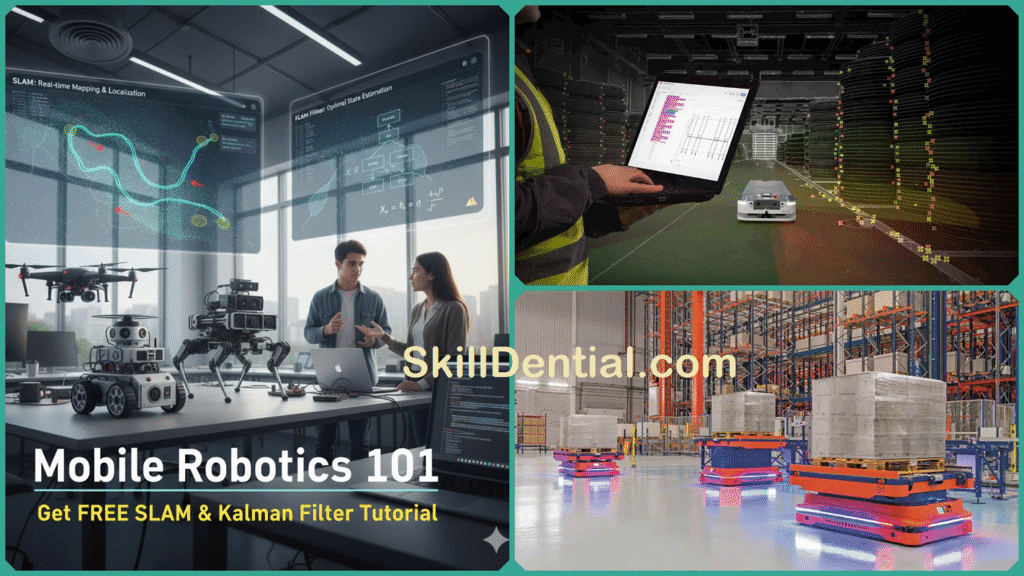
This detailed guide provides a thorough introduction to the fundamental building blocks of mobile robotic navigation. After establishing a solid understanding of the core concepts, it directs you to a valuable FREE tutorial that explores practical implementations of SLAM and Kalman Filter techniques in much greater depth.
Our approach is designed to seamlessly connect theoretical knowledge with real-world hands-on applications—empowering you with the confidence and skills necessary to successfully tackle academic assignments, personal projects, or even complex commercial deployments in the field of robotics.
What Are Mobile Robots?
Mobile robots are autonomous or semi-autonomous machines specifically engineered to navigate and carry out a wide range of tasks within diverse and often complex environments, all without the need for continuous human supervision or intervention.
These advanced robots depend heavily on a variety of onboard sensors, including high-resolution cameras, LiDAR systems, ultrasonic detectors, and inertial measurement units (IMUs), to effectively sense and understand their immediate surroundings.
Meanwhile, sophisticated algorithms and control systems process this sensory input in real time, enabling these robots to interpret environmental data accurately and make intelligent, context-aware decisions that guide their actions and movements efficiently.
Examples of Mobile Robots
- Automated Vacuum Cleaners: These advanced robotic devices are designed to detect obstacles and map out floor layouts with precision, enabling them to clean homes thoroughly and efficiently. By using a combination of sensors and intelligent navigation systems, these robots can adapt to different room configurations and avoid furniture or other objects, ensuring a comprehensive cleaning process throughout your living space.
- Self-Driving Cars: These vehicles are equipped with a wide array of advanced sensors and sophisticated artificial intelligence systems, enabling them to effectively avoid collisions, strictly adhere to road rules, and seamlessly adapt to ever-changing traffic scenarios and conditions on the road.
- Drones are widely utilized for a variety of purposes, including aerial photography, package delivery, and surveillance operations. These unmanned aerial vehicles are designed to autonomously follow predefined flight paths, skillfully navigate around obstacles, and adapt dynamically to changing environmental conditions to ensure efficient and safe operation in diverse scenarios.
- Industrial Automated Guided Vehicles (AGVs) are extensively utilized in warehouses and manufacturing plants to efficiently transport materials from one location to another. These sophisticated vehicles are designed to optimize travel routes, ensuring the fastest and most efficient paths are taken. They are equipped with advanced sensors and navigation systems that allow them to detect and avoid obstacles in real-time, enhancing safety and reducing the risk of accidents. Furthermore, AGVs integrate seamlessly into existing logistics workflows, supporting a smooth and continuous flow of goods and materials throughout the production and distribution processes.
- Healthcare Delivery Robots: In many modern hospitals, advanced robots are increasingly being utilized to transport medications, medical supplies, and meals throughout the facility. This innovative use of robotics significantly enhances operational efficiency by streamlining delivery processes and reducing the workload on hospital staff. Additionally, these robots play a crucial role in minimizing contamination risks, thereby promoting a safer and more hygienic environment for patients and healthcare workers alike.
- Agricultural Robots: These advanced machines operate autonomously across vast farms and agricultural fields, continuously monitoring the health and growth of crops. They are equipped to apply treatments such as fertilizers, pesticides, and water with remarkable precision, ensuring optimal plant care. Additionally, these robots can perform harvesting tasks efficiently, reducing labor costs and increasing productivity while maintaining crop quality.
Applications and Functions
Mobile robots are widely adopted for a variety of important and practical applications across many industries and sectors, including:
- Warehouse logistics and material handling encompass a wide range of essential activities, including inventory transport, sorting, palletizing, and cross-docking processes. These operations are crucial for ensuring the efficient movement, organization, and management of goods within a warehouse environment. Proper inventory transport involves the careful and systematic movement of products from one location to another within the facility. Sorting refers to the process of categorizing and organizing items based on specific criteria to streamline subsequent handling or shipping. Palletizing is the method of stacking and securing goods onto pallets to facilitate easier handling and storage. Cross-docking involves the direct transfer of products from incoming to outgoing transportation with minimal or no storage time, significantly improving supply chain efficiency. Together, these functions play a vital role in optimizing warehouse productivity and maintaining smooth logistics operations.
- Healthcare: Automated supply delivery systems that streamline hospital logistics, highly efficient medicine transport solutions ensuring timely and safe distribution, advanced disinfection technologies designed to maintain sterile environments, and comprehensive telepresence capabilities that enhance remote patient monitoring and consultation.
- Agriculture: Comprehensive crop monitoring that utilizes advanced technologies, precise seeding techniques tailored to specific soil and climate conditions, and highly efficient harvesting processes designed to maximize output. These integrated approaches work together to optimize crop yield significantly while promoting sustainable farming practices that protect the environment and maintain soil health over the long term.
- Inspection and maintenance: Performing regular inspections and maintenance tasks while working in hazardous and challenging environments such as oil rigs, nuclear power plants, and other high-risk industrial settings to ensure safety and operational efficiency during routine checks and necessary repairs.
- Exploration: Extensive and wide-ranging deployments across the vast and expansive oceans, intricate and highly complex space missions, and comprehensive remote geographic surveying conducted in diverse, often challenging, and frequently inaccessible terrains and environments.
Mobile robots are fundamentally transforming a wide range of industries by significantly boosting operational efficiency, minimizing the need for human labor in repetitive, mundane, or hazardous tasks, and opening up new possibilities through the integration of cutting-edge sensing technologies and sophisticated decision-making algorithms.
These remarkable advancements not only significantly improve overall productivity but also greatly enhance safety measures, creating a more secure environment. Additionally, they open the door to innovative applications and possibilities that were previously considered unattainable or beyond reach.
Why Are SLAM and Kalman Filters Crucial?
SLAM (Simultaneous Localization and Mapping) and Kalman Filters play an absolutely crucial role in the field of mobile robotics because they effectively address the two fundamental challenges of localization and mapping at the same time.
- Localization refers to the problem of determining the robot’s exact position and orientation in its environment, essentially answering the question, “Where am I?”
- Meanwhile, mapping involves creating a detailed representation of the surrounding environment, which answers the question, “What’s around me?”
These challenges become particularly significant in situations where GPS signals are either unavailable, weak, or unreliable. Such environments include indoor spaces, underground locations like tunnels or mines, and densely built urban areas where tall buildings block satellite signals.
By integrating SLAM and Kalman Filters, mobile robots can navigate and operate autonomously in these complex and GPS-denied environments with a high degree of accuracy and reliability. SLAM enables a robot to build and update a map of its surroundings while tracking its own changing position within that map in real time.
This is vital because, in unfamiliar environments, a robot must continually interpret new data from its sensors, recognize features or landmarks, and correct its own navigational errors. Without a robust SLAM approach, a mobile robot would quickly get lost, be unable to plan paths, or risk collisions.
Kalman Filters, and in particular advanced variants such as the Extended Kalman Filter (EKF) and the Unscented Kalman Filter (UKF), are fundamental and widely used algorithms within numerous simultaneous localization and mapping (SLAM) systems.
These filters offer an efficient and mathematically rigorous approach to effectively manage uncertainty and the inherent noise present in sensor measurements. By leveraging probabilistic techniques, Kalman Filters enable robust state estimation and reliable mapping even in dynamic and noisy environments:
- They integrate predictions derived from the robot’s internal movement model together with noisy and uncertain sensor measurements to achieve more accurate results.
- They recursively estimate the robot’s most accurate best-guess location as well as the surrounding environmental map, continuously updating both to improve navigation and understanding of the area.
- In nonlinear robotics scenarios (most real-world cases), the EKF expands Kalman Filter operations to work with curved (nonlinear) relationships, a necessity for dynamic, unpredictable environments.
By effectively fusing information from a variety of different sensors, such as LiDAR, cameras, and wheel encoders, and simultaneously tracking both the robot’s precise pose and various environmental features, SLAM with Kalman Filtering enables highly reliable, real-time autonomous operation.
This advanced technology is essential for a broad range of applications, including self-driving cars navigating busy streets, rescue drones operating in hazardous environments, and industrial Automated Guided Vehicles (AGVs) working in dynamic factory settings.
Without the use of these sophisticated methods, mobile robots would lack the ability to navigate accurately, adapt to changing surroundings, or perform their tasks safely and efficiently in the complex and unpredictable conditions found in real-world scenarios.
Key Concepts and Theories of Mobile Robotics
SLAM (Simultaneous Localization and Mapping) is a fundamental and essential technique widely used in the field of mobile robotics. It allows robots to simultaneously construct a detailed map of their surrounding environment while accurately determining their own precise location within that environment, all happening in real time.
This intricate and multifaceted process relies heavily on the integration of several fundamental principles alongside advanced, highly robust mathematical algorithms that function together in perfect harmony and coordination:
SLAM: Principles and Processes
- Landmark Detection: Robots utilize a variety of advanced sensors, including LiDAR, cameras, and sonar, to effectively identify and recognize distinct points or features within their surrounding environment. These features can include structural elements like walls and corners, as well as various objects present in the area. By detecting these landmarks, robots are able to better understand and navigate their surroundings with increased accuracy and reliability.
- Trajectory and Environment Estimation: The system continuously estimates both the robot’s precise path and the detailed spatial layout of its surrounding environment, dynamically updating this information with every movement it makes and incorporating new sensor data as it becomes available to ensure accuracy and responsiveness.
- Continuous Updates: SLAM algorithms continuously and dynamically refine the robot’s precise location and the detailed map as fresh information becomes available or as the robot explores and encounters new environmental features and changes in its surroundings.
Types of SLAM Algorithms
SLAM methods differ significantly based on the types of sensor inputs they utilize as well as the specific statistical approaches they employ to process and interpret data. These variations allow SLAM techniques to be tailored to different environments and applications, improving accuracy and efficiency in mapping and localization tasks.
- LiDAR-based SLAM technology relies on laser range finders to accurately capture the environment. For example, Cartographer is a standout system that excels at generating highly precise and detailed maps. It achieves this through advanced techniques such as global optimization and probabilistic updates, which significantly enhance the quality and reliability of the mapping process. Compared to older SLAM methods like GMapping and Hector SLAM, Cartographer consistently outperforms them, especially in challenging and complex indoor environments where accuracy and robustness are crucial.
- Visual SLAM (V-SLAM) is a technique that primarily utilizes different types of cameras, including monocular, stereo, and RGB-D cameras, to perform simultaneous localization and mapping. Among the various implementations, ORB-SLAM is particularly well-regarded for its robust feature detection capabilities and its high accuracy in global localization, making it a popular choice in many applications. Additionally, methods like LSD-SLAM and DSO are representative examples of direct approaches that rely on analyzing the intensity of image pixels directly rather than extracting features, offering alternative strategies for visual SLAM tasks.
- Multi-sensor fusion: RTAB-Map combines data from LiDAR, cameras, and various other sensors to create highly accurate and detailed maps. This integration significantly enhances mapping quality and environmental understanding, although it requires a greater amount of computational resources and processing power to manage the increased data complexity.
Kalman Filter: State Estimation Backbone
The Kalman Filter is a powerful and widely used statistical algorithm that plays a crucial role in effectively managing noisy, uncertain, or imprecise sensor data encountered in mobile robotics applications. This algorithm helps to improve the accuracy and reliability of sensor measurements by estimating the true state of a system over time, despite the presence of random fluctuations and errors in the data.
Through a process of prediction and correction, the Kalman Filter continuously refines its estimates, making it an essential tool for navigation, tracking, and control tasks in mobile robotic systems.
- Prediction Step: During this phase, the robot calculates an estimate of its next position by analyzing its prior movement data, such as information gathered from wheel encoders. This process involves using the robot’s previous motion to predict where it will be in the near future, allowing it to update its position estimate accordingly.
- Update Step: New sensor measurements obtained from LiDAR and cameras are used to correct and refine the robot’s estimated position, significantly improving the accuracy of its location. These sensor inputs help adjust the robot’s internal map and trajectory by incorporating the most recent environmental data, ensuring the position estimate remains reliable and precise over time.
- This ongoing recursive cycle of prediction followed by update plays an absolutely crucial and indispensable role in significantly minimizing errors. It effectively fuses and integrates multiple disparate data streams from various sources, allowing for a more comprehensive understanding. This process consistently maintains robust, reliable, and highly accurate localization over extended periods of time, ensuring optimal performance and precision throughout.
Kalman Filter Variants
- Extended Kalman Filter (EKF): The Extended Kalman Filter is specifically designed to handle the nonlinear relationships that are very common in real-world robotics applications. It expands upon the traditional Kalman Filter mathematics by allowing for the estimation and prediction of system states in scenarios where the system dynamics and measurement models are not strictly linear. This makes the EKF highly valuable for practical robotics problems where simplifying assumptions of linearity do not hold.
- Unscented Kalman Filter (UKF): Utilizes a distinct and more advanced statistical method specifically designed for handling nonlinear scenarios. It is particularly effective in situations where traditional sensor or motion models are complex and cannot be easily simplified or linearized through standard techniques. This approach provides improved accuracy and robustness in estimating states under nonlinear conditions.
SLAM algorithms commonly employ these sophisticated and advanced filters to effectively navigate and adapt within highly dynamic and unpredictable environments. By utilizing these techniques, mobile robots are able to maintain a reliable and accurate understanding of their precise location as well as the surrounding environment at all times.
This ongoing and continuous awareness is absolutely crucial and fundamentally essential for enabling robots to function safely, reliably, and efficiently, particularly when they are operating in complex, dynamic, and ever-changing environments or settings that present numerous unpredictable challenges and variables.
How Do SLAM and Kalman Filters Work Together?
SLAM (Simultaneous Localization and Mapping) and Kalman Filters, particularly in traditional systems such as EKF-SLAM, work together in a highly effective manner to deliver robust and reliable real-time navigation capabilities for mobile robots.
This integration enables robots to build maps of unknown environments while simultaneously keeping track of their own location within those maps. Here’s a detailed explanation of how this integration unfolds in practice:
- Motion Model Prediction: The robot utilizes its internal sensors, such as wheel encoders, inertial measurement units (IMUs), and other proprioceptive devices, to estimate its subsequent position or pose, denoted as (x, y, θ). This prediction is made by analyzing data from previous movements and applying mathematical models to forecast where the robot will be next in terms of its location coordinates and orientation angle. This process is essential for understanding and anticipating the robot’s trajectory over time.
- Landmark Observation Update: External sensors, including but not limited to cameras, LiDAR systems, or sonar devices, actively detect distinct landmarks present in the robot’s surrounding environment. The robot then refines and updates its internal estimates of its own position and orientation by analyzing where these identified landmarks appear in relation to its previously predicted location. This process helps improve the accuracy of the robot’s navigation and positioning within its operational space.
- Statistical Fusion: The Kalman Filter mathematically combines both sources of information—prediction and sensor update—by carefully weighing their respective uncertainties. This sophisticated approach minimizes errors effectively, enabling the robot to accurately track its own pose over time while simultaneously constructing a detailed map of the surrounding environment. By continuously integrating new data and correcting for any drift or inaccuracies, the system maintains a reliable understanding of its position and surroundings throughout its operation.
What Does This Achieve?
- Pose Tracking: Robots continuously maintain a highly accurate and reliable estimate of their current position and orientation within their surroundings. This capability remains effective even in environments that are uncertain, constantly changing, or dynamic, allowing the robots to adapt and respond appropriately to new obstacles or shifts in their surroundings.
- Map Refinement: As the robot continues to move through its environment, it constantly gathers and adds more data to the existing map. This ongoing process results in a continuously improving and more detailed map, which significantly enhances the robot’s ability to plan its routes more efficiently and avoid obstacles with greater accuracy.
- Error Correction: SLAM with Kalman Filters not only corrects localization errors but also addresses mapping inaccuracies, such as drift or sensor noise, thereby ensuring a much safer and more reliable autonomous operation. This dual correction capability significantly enhances the overall performance and accuracy of the system in dynamic environments.
For example, in experimental setups such as Duckietown, researchers make extensive use of EKF-SLAM techniques to effectively combine odometry data with landmark observations. This integration enables their robots to advance from basic dead-reckoning methods to much more sophisticated closed-loop state estimation processes.
Similarly, practical robots that operate in dynamic and ever-changing environments, such as busy warehouses or residential homes, depend extensively on Kalman Filter-based SLAM approaches. These advanced methods are crucial for enabling the robots to accurately map their surroundings and localize themselves in real time despite the complexity and variability of such settings.
These methods merge odometry measurements with various forms of environmental sensing, which ultimately results in navigation and mapping that is significantly more accurate, with reduced errors and practically drift-free performance over extended periods.
SLAM Algorithm Comparison
Here is a detailed comparison of three foundational SLAM algorithms, highlighting their distinct strengths and advantages. This overview is based on extensive analysis of recent academic literature and comprehensive technical reviews from the field:
| Algorithm | Suitable For | Core Approach | Notable Strengths |
|---|---|---|---|
| EKF-SLAM | Small-scale robots | Joint covariance | Simplicity, easy to debug, good accuracy for small environments, but high computational complexity and low scalability with increasing map size. |
| FastSLAM | Large, complex maps | Particle filters | Scalability with many features, handles nonlinear motion models well, parallelism; each particle manages separate map estimates, reducing memory bottleneck, but can suffer from sample degeneration. |
| Graph SLAM | Long-term mapping | Optimization graph | Exceptional accuracy, especially at loop closure; robust to environmental changes, high scalability, but very demanding in terms of memory and computation. |
Graph SLAM is often preferred in scenarios where achieving high mapping accuracy and ensuring robustness to dynamic changes in the environment are critical factors. FastSLAM, on the other hand, is favored for its ability to efficiently scale to very large and complex environments, making it suitable for extensive mapping tasks.
Meanwhile, EKF-SLAM is widely regarded as the most suitable approach for smaller environments where noise levels are relatively low and the number of distinct features is limited. In these more controlled and constrained settings, EKF-SLAM is known to deliver consistently reliable and accurate performance, making it an ideal choice for applications that require precise mapping and localization within compact spaces.
From Theory to Practice: Robotics Navigation Systems
A highly robust and effective robotics navigation system seamlessly integrates multiple essential components and advanced techniques to enable mobile robots to operate completely autonomously and with maximum efficiency across a wide variety of complex and dynamic settings and environments:
Essential Navigation System Components
- Position Estimation: Robots continuously determine their current pose, which includes their coordinates (x, y) and orientation (θ), by utilizing various sensor inputs. These inputs typically consist of odometry data derived from tracking wheel motion, readings from inertial measurement units (IMUs), and, in some cases, GPS signals when operating outdoors. Accurate and reliable position updates are essential for effective navigation, whether the robot is moving between predetermined known points or exploring entirely unknown environments where precise localization is crucial for successful operation.
- Obstacle Sensing: Various sensors, including LiDAR, sonar, and cameras, continuously scan the surrounding environment to detect landmarks such as walls, doors, and various objects, as well as potential hazards. Among these technologies, LiDAR stands out due to its widespread use in the field, as it is highly effective in generating detailed 3D maps and delivering accurate, real-time depth data that is crucial for navigation and obstacle avoidance. This combination of sensors ensures comprehensive environmental awareness and enhances the safety and efficiency of automated systems.
- Map Creation: Raw sensor data collected from the robot’s environment is carefully processed and converted into detailed environmental models. These models can take various forms, such as grids (including occupancy grids), graphs, or topological layouts. Each of these representations is designed to depict the environment by categorizing areas into free spaces, occupied regions, and unexplored zones. This comprehensive mapping approach allows the robot to effectively “see” its surroundings and retain crucial information about pathways and obstacles, facilitating better navigation and decision-making in complex environments.
- Path Calculation: Advanced path planning algorithms, which frequently utilize Simultaneous Localization and Mapping (SLAM) techniques, are designed to compute the safest and most efficient routes from an initial starting point to a specified goal. These algorithms take into account both pre-existing known obstacles as well as new obstacles detected in real-time through sensors. Commonly used algorithms in this domain include A* (A-star), Rapidly-exploring Random Trees (RRT), and probabilistic roadmaps, all of which are highly effective for dynamic and adaptive navigation in complex environments. These methods ensure that the path calculated is optimized for safety and efficiency, adjusting dynamically as new data is received during movement.
Practical Sensor Fusion Example
Sensor fusion is a process that combines data from multiple sources or sensors in order to improve the overall reliability and accuracy of information. By integrating these diverse data inputs, it helps to compensate for the inherent weaknesses or limitations that individual sensors might have, resulting in a more robust and dependable system. This approach leverages the strengths of different sensors to provide a comprehensive understanding of the environment or situation.
- Wheel Odometry + LiDAR Fusion: When wheel encoders experience slip on wet or slippery surfaces, causing inaccuracies in position tracking, LiDAR can independently provide precise corrections to the robot’s location within the digital map. By using a Kalman Filter to intelligently blend data from both wheel odometry and LiDAR sensors, the system dynamically updates the robot’s pose estimates in real time, effectively compensating for temporary errors or inconsistencies in sensor readings to maintain accurate navigation.
Real-World Implementation
These fundamental core functions are continuously processed in real time as a robot moves and navigates through its environment, enabling it to perform complex tasks effectively and efficiently:
- Navigation in dynamic and constantly changing environments, such as areas where people are frequently moving around and doors are continuously opening and closing, presents unique challenges and complexities. This requires advanced systems capable of adapting in real time to the unpredictable nature of these surroundings to ensure smooth and efficient movement.
- Adaptation to sensor faults or the temporary loss of reference signals is crucial for maintaining system stability and performance. This process involves implementing strategies that allow the system to detect when a sensor is malfunctioning or when reference signals are temporarily unavailable, and then adjusting its operations accordingly to continue functioning effectively despite these issues. By incorporating such adaptive mechanisms, the system can ensure continuous and reliable operation even in the face of unexpected disruptions or signal interruptions.
- Collision avoidance and efficient path execution are critical for completing various tasks such as factory delivery, home cleaning, or warehouse logistics. These processes ensure that robots or automated systems navigate their environments safely without collisions while optimizing their routes to perform tasks quickly and effectively. By integrating advanced sensors, real-time data processing, and intelligent algorithms, these systems can dynamically adapt to changing conditions, avoid obstacles, and maintain smooth operation. This not only enhances productivity but also minimizes downtime and potential damage, making it essential for industries relying on automation to achieve high efficiency and reliability in their daily operations.
Through the seamless integration of these advanced components, mobile robots are able to achieve highly precise, adaptive, and fully autonomous navigation capabilities. These sophisticated features are essential for the practical and reliable deployment of robots in dynamic, ever-changing real-world environments that present a wide variety of challenges and obstacles.
Current Trends and Innovations
Recent trends and groundbreaking innovations in the field of mobile robotics are significantly transforming the ways in which robots perceive their surroundings, navigate complex environments, and interact with the world around them.
These advancements are having powerful and far-reaching impacts not only in academic research but also in practical, real-world applications and deployments across various industries and sectors.
AI-Driven SLAM & Deep Learning
- Deep Learning Integration: Modern state-of-the-art SLAM systems increasingly incorporate deep neural networks to achieve more robust and reliable feature extraction, with a particular emphasis on visual SLAM (V-SLAM) applications. Convolutional Neural Networks (CNNs) have demonstrated superior performance compared to traditional handcrafted descriptors by automatically learning stable and distinctive features directly from raw input data. This advanced capability significantly enhances the accuracy and robustness of mapping and localization processes, making them far more resilient to challenging conditions such as varying lighting environments, dynamic moving obstacles, and complex or ambiguous scenes that typically pose difficulties for conventional methods.
- Transformer Models: Transformers, originally developed and primarily designed for natural language processing tasks, are now rapidly transforming the field of robotics navigation in significant ways. More advanced and specialized formats, such as Multi-Step Prediction Transformers, are capable of processing complex spatial and inertial data streams, which enables robots to achieve superior trajectory planning and enhanced environmental reasoning. This capability is especially valuable in challenging scenarios where GPS signals are unavailable or unreliable, such as underground locations or densely built urban environments. These innovations are pushing the boundaries of autonomous navigation to new levels of precision and reliability.
- Deep Reinforcement Learning (DRL): DRL enables robots to actively learn from their surroundings and accurately predict dynamic changes in the environment over time. Robots that are trained using advanced DRL algorithms gain the ability to proactively detect and avoid moving obstacles, enhancing their safety and efficiency. This technology allows them to continuously adapt and optimize their navigation strategies in highly unpredictable and complex settings, such as bustling manufacturing factories or critical disaster response situations where conditions can shift rapidly and unpredictably.
Hardware Acceleration
- Specialized Hardware (FPGAs and GPUs): Modern SLAM algorithms, particularly those involving Kalman Filters, often require significant computational power due to their complexity and the volume of data processed. To address these demands, hardware acceleration techniques using Field-Programmable Gate Arrays (FPGAs), Graphics Processing Units (GPUs), and dedicated Application-Specific Integrated Circuits (ASICs) have become essential. These specialized hardware components greatly enhance the speed of processing, allowing SLAM systems to operate more efficiently and effectively. Additionally, they help reduce overall power consumption, which is especially critical for real-time mapping applications in resource-constrained environments such as drones, compact robots, and various mobile devices, where energy efficiency and fast response times are paramount.
- Performance Gains: Custom accelerators can deliver performance improvements of up to 10 times faster processing speeds and offer more than 100 times greater energy efficiency when compared to traditional standard CPUs. These significant enhancements make it possible to run advanced Simultaneous Localization and Mapping (SLAM) algorithms effectively on platforms with limited power resources, enabling sophisticated applications in environments where energy consumption and processing power are critical constraints.
Open-Source Platforms and Tools
- Robot Operating System (ROS): ROS continues to be the preferred open-source framework widely used in the field of robotics, providing a comprehensive collection of libraries and tools that support various key functionalities such as SLAM implementations, sensor fusion, path planning, and real-time control. This extensive ecosystem allows developers and researchers to rapidly prototype and seamlessly integrate advanced AI models and algorithms, making it an indispensable platform for accelerating innovation and development in robotic systems. ROS’s flexibility and robust community support further enhance its position as the go-to solution for building complex and intelligent robotic applications.
- Arduino & Raspberry Pi: These highly affordable and widely accessible hardware platforms provide an excellent opportunity for students, hobbyists, and professionals alike to implement and run practical SLAM applications with ease. A wealth of step-by-step guides, tutorials, and community-developed software packages are readily available, covering essential topics such as mapping, navigation, and robotic experimentation. This extensive support network significantly lowers the barrier to entry, making it much easier for individuals to engage in robotics innovation and develop their skills in this rapidly evolving field.
Through these remarkable advancements, mobile robots are now reaching unprecedented levels of autonomy, adaptability, and intelligence, making significant strides in their capabilities. These improvements are not only enhancing their performance in academic experimentation but are also driving their effective deployment in a wide range of commercial applications, thereby expanding their practical usefulness and impact across various industries.
Experience & Case Study
Case studies, along with real-world implementations, provide clear and compelling evidence of how SLAM technology, combined with sensor fusion, plays a crucial role in driving the overall success and efficiency of autonomous cleaning robots.
These examples demonstrate the practical applications and the significant impact these advanced technologies have on improving the performance and reliability of robotic cleaning systems in various environments.
Case Study: Commercial Robot Vacuum Cleaner
A ROS-SLAM powered autonomous vacuum cleaner showcases state-of-the-art navigation capabilities and superior cleaning efficiency by seamlessly integrating advanced SLAM technology with sophisticated sensor fusion techniques. The primary steps involved in its operation include:
- Initialization: At the beginning of the process, the robot finds itself positioned at an unknown location within a completely new and unfamiliar environment. This initial state requires the robot to determine its surroundings before proceeding with any tasks.
- Motion Estimation: Wheel odometry offers an essential initial prediction of movement by measuring the rotation of the wheels, which helps estimate the vehicle’s displacement and direction. This preliminary prediction serves as a foundational input for more advanced motion tracking and navigation systems.
- Environment Mapping: A LiDAR sensor continuously scans the surroundings in detail, identifying walls, furniture, obstacles, and other relevant features. It constantly updates both the robot’s precise position and constructs a comprehensive real-time map of the environment, enabling efficient navigation and obstacle avoidance.
- SLAM Integration: Sensor readings obtained from wheel encoders and LiDAR devices are meticulously fused using a sophisticated Kalman Filter algorithm within a ROS-based software stack. This advanced integration enables the robot to continuously and accurately track its precise trajectory, including its position coordinates (x, y) and orientation angle (θ). As a result, the robot can effectively avoid missing any spots during navigation and significantly reduce the chances of making navigational errors, ensuring smooth and reliable operation throughout its environment.
- Dynamic Path Planning: By leveraging the advanced capabilities of the ROS Nav2 stack, the robot is able to dynamically calculate and continuously update optimal cleaning routes. It adapts in real time to changes in the environment, such as when furniture is rearranged or unexpected obstacles appear, thereby ensuring thorough and complete spatial coverage throughout the cleaning process.
- Simulation & Testing: The system’s overall effectiveness and reliability are thoroughly confirmed through comprehensive Gazebo simulations as well as extensive real-world experiments. These rigorous evaluations clearly highlight significant improvements in cleaning performance, demonstrating the system’s enhanced ability to navigate and effectively avoid obstacles during operation.
Anecdotal Experience
- An undergraduate student successfully developed an Extended Kalman Filter-Simultaneous Localization and Mapping (EKF-SLAM) solution implemented on a Raspberry Pi-powered robot platform. By intelligently combining data from simple wheel encoders with input from a cost-effective LiDAR sensor, the student observed significant and notable improvements in the accuracy and reliability of the generated environmental maps:
- Previous systems often experienced significant positional drift when operating in cluttered environments filled with numerous obstacles. This issue was particularly pronounced in rooms densely packed with furniture and other objects, which interfered with accurate positioning. The challenge of maintaining precise location tracking in such complex, obstacle-rich settings led to reduced system reliability and performance.
- With EKF-SLAM, the robot was able to autonomously navigate through a densely furnished dorm room filled with various obstacles and furniture. Throughout the entire process, it continuously updated its internal map and precisely determined its own location in real time, allowing for smooth and accurate movement within the complex environment.
- The modular setup combining Raspberry Pi and Arduino enabled rapid prototyping and efficient debugging processes, greatly enhancing the development experience. This approach made autonomous navigation not only more accessible but also highly reliable, even when applied to personal hobby projects or educational initiatives. The flexibility and ease of use provided by these platforms allowed developers and learners alike to experiment, iterate, and refine their designs quickly and effectively.
These case studies effectively demonstrate how fundamental theoretical principles are transformed into practical, real-world systems: integrating diverse sensor data, continuously updating maps, and advancing innovations in robotics that operate in actual environments.
These kinds of solutions play a crucial role in the development of both commercial-grade and do-it-yourself robotics projects, empowering machines to function in a smarter, safer, and significantly more efficient manner during autonomous operation.
FAQs
What is the main purpose of SLAM in mobile robotics?
SLAM allows a robot to simultaneously build a spatial map of an unknown environment and accurately determine its own position within that map—without needing prior knowledge or GPS. This capability is fundamental for safe, efficient navigation in any dynamic or unfamiliar setting.
Are Kalman Filters only used for linear systems?
Standard Kalman Filters work best with linear system models, where state dynamics and sensor relationships are straightforward. When dealing with nonlinear realities of robotics, extended variants like the EKF (Extended Kalman Filter) and UKF (Unscented Kalman Filter) successfully adapt the math to manage complex, real-world scenarios and sensor uncertainty.
Which sensors are commonly used in SLAM systems?
Typical SLAM-enabled robots employ LiDAR, visual cameras (standard, stereo, and RGB-D), IMUs (Inertial Measurement Units), sonars, and wheel encoders. Fusing these sensor data streams (sensor fusion) dramatically improves localization accuracy and mapping robustness, allowing operation across various environments.
Is it possible to implement SLAM on low-cost platforms like Arduino or Raspberry Pi?
Lightweight SLAM algorithms and simplified versions of Kalman Filters are available for affordable computing platforms. ROS and open-source libraries make it easy for hobbyists, educators, and researchers to deploy real-world mapping and localization—even with basic hardware setups.
How can technical managers use SLAM knowledge to improve projects?
A solid understanding of SLAM empowers managers to evaluate system proposals, anticipate project limitations (like mapping accuracy or required sensors), and communicate more effectively across engineering, design, and business teams. This insight ensures projects meet their performance targets and adapt quickly to new requirements or environments.
In Conclusion
SLAM and Kalman Filters form the essential foundation of contemporary mobile robotic autonomy, serving as critical tools that allow robots to operate intelligently and independently. These powerful technologies enable robots to create detailed maps of previously unknown environments and accurately track their own location within those spaces.
This capability is what makes safe, efficient, and intelligent navigation possible in a wide variety of settings, including busy warehouses, comfortable homes, cutting-edge research laboratories, and many other complex environments.
Whether you are a student eager to learn, a hobbyist passionate about robotics, an engineer focused on practical applications, or a technical manager overseeing projects, gaining mastery over SLAM and state estimation technologies equips you with the vital skills needed to design, develop, implement, and troubleshoot sophisticated navigation systems that can operate reliably in real-world conditions.
Why This Matters:
- SLAM and Kalman Filters are essential for dependable mapping and localization—core functions for any truly autonomous robot.
- Understanding these concepts equips you to succeed in academic, personal, and industrial robotics projects.
- The field is evolving rapidly: AI-powered methods, hardware acceleration, and robust open-source tools are making hands-on learning and deployment more accessible than ever.
Ready to Dive Deeper and Explore More?
Get your FREE SLAM & Kalman Filter eBook today to develop a comprehensive and solid foundation in robot localization, mapping, and state estimation—effectively bridging the important gap between classroom theory and practical real-world robotics applications.
Whether you are preparing for an upcoming course, launching a brand-new robotics build, or managing and leading a robotics team, having strong navigation fundamentals is essential for success and efficient operation in the field.
Recommendations for Further Exploration:
- Explore open-source SLAM packages in ROS for immediate, hands-on practice.
- Implement simple Kalman Filters on Arduino or Raspberry Pi for affordable experimentation.
- Stay up to date by reading cutting-edge research on AI-driven and deep learning SLAM innovations.
- Engage with robotics forums and online communities to share your projects, gain new insights, and troubleshoot challenges collaboratively.
Still have questions or need personalized guidance on a specific robotics project you’re working on?
Please feel welcome to leave a comment below—our vibrant and supportive community is always here to assist you, offering guidance and encouragement as you confidently and creatively work towards building the exciting future of robotics. We look forward to hearing your thoughts and helping you succeed every step of the way.

His mission is to provide clear, actionable advice that helps readers navigate the complexities of the modern workplace, advance their careers, and unlock their full potential. You can find his expert guides on technology, entrepreneurship, and professional development.
Discover more from SkillDential
Subscribe to get the latest posts sent to your email.