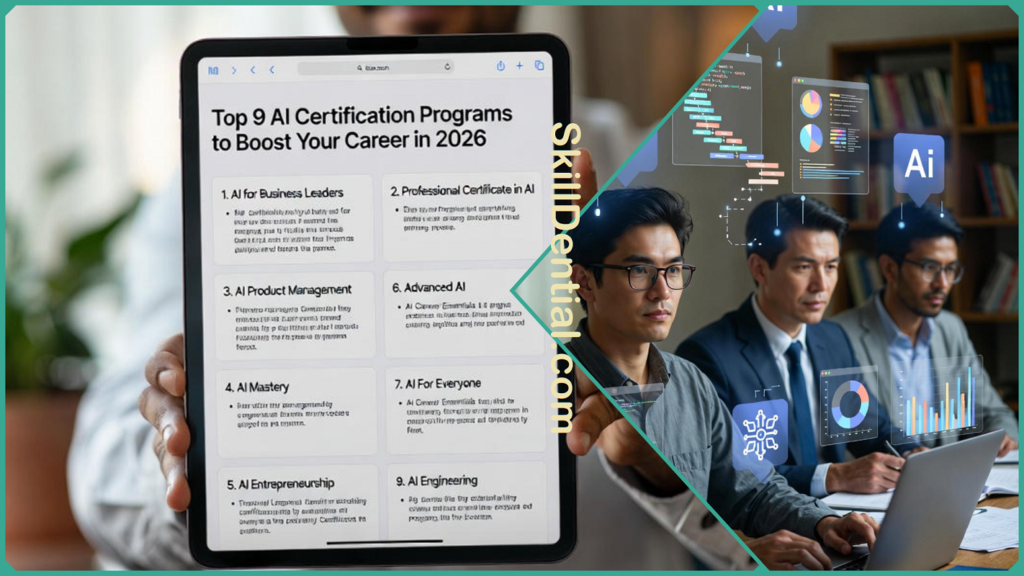
Top 9 AI Certification Programs to Boost Your Career in 2026
 Akinpedia
25 min read
Akinpedia
25 min readAn AI certification program can significantly enhance and elevate your career prospects in 2026 by offering official validation and recognition of highly sought-after, specialized, and in-demand skills in critical areas such as generative AI, AI strategy development, MLOps implementation, and AI security measures.
This certification significantly helps you stand out and distinguish yourself from other candidates in today’s highly competitive and ever-changing job market, making you much more attractive and appealing to potential employers across various industries.
Additionally, it ensures that you remain fully aligned with the rapidly evolving standards, cutting-edge trends, and best practices within the constantly advancing AI industry, effectively positioning you for sustained long-term success, continuous professional growth, and valuable career development opportunities.
Why AI Certification Programs Matter in 2026
AI certification programs are especially important in 2026 because they demonstrate your ability to design, deploy, and govern complex, real-world AI systems—not merely to prompt chatbots or perform basic AI tasks—at a critical time when enterprises are integrating AI into their core products and services on a large scale.
As artificial intelligence technologies become deeply embedded across every business function and industry sector, employers are placing greater emphasis on recognized certifications. These certifications help organizations identify and select professionals who possess the expertise to operationalize AI solutions safely, efficiently, and in full compliance with evolving regulations and ethical standards, ensuring responsible and effective AI adoption.
From “Basic ML” to Applied, Enterprise-Ready AI
AI adoption in enterprises has moved decisively beyond the initial stages of experimentation and pilot projects: recent surveys now show that roughly 8 in 10 companies are actively deploying or integrating generative AI technologies and large language models directly into their core business workflows and operational processes.
This significant shift in adoption creates a growing and urgent demand for specialized skills not only in algorithm development but also across the full lifecycle of MLOps, including model deployment, monitoring, and maintenance. There is an increasing need for expertise in AI risk management and governance frameworks to ensure ethical, secure, and compliant use of these advanced AI systems within enterprise environments.
As organizations strive to achieve ambitious goals of 30% or greater improvements in efficiency and significant cost reductions through the adoption of AI technologies, they increasingly require skilled professionals who possess the expertise to transform experimental prototypes into fully operational production systems.
These systems must be carefully monitored, properly versioned, secured against vulnerabilities, and designed to be auditable to meet regulatory and operational standards. In response to these evolving needs, modern AI certification programs have adapted by placing a strong emphasis on the development and management of deployment pipelines, continuous monitoring processes, and adherence to comprehensive compliance frameworks.
These frameworks include prominent guidelines such as the National Institute of Standards and Technology’s (NIST) AI Risk Management Framework, the European Union’s AI Act, and the latest emerging ISO standards, all of which aim to ensure responsible, transparent, and accountable AI implementation across industries.
Why This Matters to Different Professional Profiles
For individuals looking to upskill in software or data-related roles, obtaining certifications in specialized fields such as MLOps and cloud-based AI technologies serves as a strong validation that you possess the necessary skills to effectively bridge the critical gap between model-building and production deployment.
This particular area remains a significant challenge for most companies, many of which still have immature or developing capabilities when it comes to integrating machine learning models into real-world operational environments.
Vendor-specific certifications offered by industry leaders like Google, Microsoft, and AWS are designed to rigorously test and confirm your expertise in key competencies such as designing scalable and efficient data pipelines, automating complex machine learning workflows, and managing models throughout their entire lifecycle, from initial development to ongoing maintenance and optimization.
Executives and strategic career changers are increasingly opting for AI governance and strategy certificates as they recognize the critical need to align AI initiatives with risk management, regulatory compliance, and overall business value.
These specialized credentials equip leaders with the knowledge and skills to effectively interpret complex technical trade-offs, thoroughly evaluate potential vendors, and confidently demonstrate to boards of directors that AI investments are being managed with a strong sense of responsibility and accountability.
By obtaining these valuable certifications, professionals can confidently ensure that their organizations effectively leverage advanced AI technologies in a responsible manner that supports long-term sustainable growth while also mitigating potential risks and challenges associated with their implementation and use.
FOBO, Brand Signaling, and Career Insurance
The “fear of becoming obsolete” is entirely rational and understandable in today’s rapidly evolving job market, where an overwhelming 67% of available positions now demand some degree of AI-related skills and knowledge.
In response to this pressing reality, professionals increasingly gravitate toward well-recognized “gold-standard” brands such as Google, Microsoft, USAII, various security alliances, and major governance organizations.
These prestigious names serve as powerful credibility filters, instantly enhancing the perceived value of résumés and LinkedIn profiles, and making it easier for candidates to stand out in a highly competitive employment landscape.
At the same time, serious employers today are increasingly looking beyond just the brand name of a certification to determine its true value. They want to see whether the certification actually covers concrete, high-risk domains that are critical in the current landscape, such as AI security, risk governance, and the safe deployment of AI technologies.
The most valuable certification programs in 2026 will explicitly measure tangible impact: whether you can effectively reduce the risk of incidents, accelerate deployment cycles, and maintain compliance of AI systems as regulations become more stringent and complex.
Key Concepts Behind Modern AI Certification Programs
Modern AI certification programs are designed around several fundamental core concepts that significantly enhance their practicality and make them much more suitable for real-world enterprise applications compared to the older, more “theory-heavy” courses that were common in the past.
These essential concepts shape not only the curriculum content and the teaching approach but also influence the methods used for assessment, ultimately determining the overall value and relevance of the credential when it appears on your CV in a competitive job market.
The Three Core Pillars
Modern, high-quality programs typically revolve around three closely interconnected pillars: technical depth, operational excellence, and governance. This comprehensive structure reflects the approach that serious organizations now take when building and running AI products in production environments, moving beyond isolated proof-of-concept projects to fully integrated, scalable solutions.
- Technical depth: You are expected to have a comprehensive understanding of and practical experience working with large language models (LLMs), intelligent agents, advanced deep learning architectures, and complex data pipelines. This goes beyond just classical machine learning techniques, requiring familiarity with cutting-edge AI technologies and the integration of these components into scalable systems.
- Operational excellence in MLOps: Certifications are increasingly designed to evaluate your ability to effectively deploy, monitor, scale, and retrain machine learning models as integral components of a continuous and iterative AI lifecycle. This ensures that models not only perform well initially but also maintain their effectiveness and reliability over time through ongoing management and optimization.
- Governance and risk management now place a significant emphasis on ethics, safety, and regulatory compliance, with frameworks such as the NIST AI Risk Management Framework (RMF), the European Union’s AI Act, and the ISO/IEC 42001 standards becoming central components. These topics have become essential core modules, particularly within certifications focused on governance or leadership roles. The integration of these elements ensures that professionals are well-equipped to navigate the complex landscape of AI governance and risk, promoting responsible and compliant practices throughout organizations.
This powerful triad is exactly what distinguishes truly serious and in-depth AI certification programs from the more generic and superficial “AI overview” courses that often fail to make a significant impact or move the needle when it comes to attracting the attention of enterprise recruiters and hiring managers.
The AI Lifecycle as a Learning Backbone
Many contemporary certifications explicitly structure their curriculum around the comprehensive AI lifecycle, which includes critical stages such as problem framing, data collection and preparation, model development, deployment, ongoing monitoring, and eventual retirement.
This holistic lifecycle perspective encourages learners to move beyond simply working with notebooks and coding exercises, prompting them to grasp the entire journey from formulating a business question to delivering a stable, reliable production system that can operate effectively in real-world environments.
Typical lifecycle stages emphasized in these programs include:
- Data & development: This phase includes comprehensive activities such as data collection from various sources, thorough preprocessing to clean and prepare the data, extensive model training using different algorithms, rigorous validation to assess model performance and accuracy, and detailed explainability checks to ensure transparency and interpretability of the results.
- Deployment & monitoring: Integrating machine learning models seamlessly into production environments, effectively scaling to accommodate real-world traffic volumes, continuously monitoring model performance metrics, detecting any data or concept drift over time, and efficiently managing rollback procedures when necessary to ensure system stability and reliability.
- Maintenance & decommissioning: Ongoing continuous improvement efforts, regular retraining sessions, timely updates to compliance standards, and the formal retirement of models carried out strictly under well-documented policies and procedures.
Assessment tasks in well-structured and effective programs frequently mirror this entire lifecycle process: for instance, you might be required to create a comprehensive deployment plan, establish detailed monitoring key performance indicators (KPIs), or suggest a thoughtful retraining strategy.
These tasks often appear as integral components of final projects or scenario-based examinations, allowing learners to demonstrate their understanding and application of the concepts in realistic and practical contexts.
Governance, Risk, and Compliance as Core Content
As AI regulation becomes increasingly stringent and comprehensive, governance and risk management frameworks have taken on a more prominent and central role within the curricula of serious certification programs.
Certifications focused on AI governance, risk management, and compliance now explicitly incorporate and reference widely recognized standards such as the NIST AI Risk Management Framework (RMF), ISO/IEC 23894, ISO/IEC 42001, as well as the European Union’s AI Act as essential components of their examination blueprints and study materials.
These standards serve as the essential foundation for thoroughly understanding and successfully implementing effective AI oversight within various professional settings and industries. They provide a critical framework that guides organizations in managing AI technologies responsibly and ethically.
Key governance concepts typically covered include:
- Model risk management involves the critical process of identifying and effectively mitigating various risks such as bias, model drift, privacy leakage, and adversarial attacks throughout the entire lifecycle of the model. This comprehensive approach ensures that potential vulnerabilities and threats are continuously monitored and addressed from the initial development phase through deployment and ongoing maintenance, thereby safeguarding the integrity and reliability of the model in real-world applications.
- Accountability and documentation play a crucial role in maintaining transparency and supporting regulatory audits. This includes implementing comprehensive versioning systems to track changes over time, maintaining detailed audit trails to record every action and modification, creating informative model cards that describe model characteristics and intended use, and keeping thorough decision logs that document the rationale behind key decisions. Together, these elements ensure a clear and accessible record of processes, enhancing trust and compliance with regulatory requirements.
- Ethical principles such as fairness, transparency, accountability, and privacy are fundamentally embedded into all aspects of data practices and deployment decisions. These guiding values ensure that every stage of data handling and implementation respects the rights and dignity of individuals while promoting trust and integrity throughout the process. By prioritizing these core principles, organizations commit to responsible and ethical use of data in all their operations.
For certifications that focus on AI strategy and AI safety, these frameworks are far from being merely peripheral elements—they serve as the essential backbone that firmly connects technical decisions with the broader scope of organizational accountability and responsibility.
Without the presence of these essential frameworks, it would become significantly challenging to guarantee that AI initiatives are properly aligned with both the overarching strategic goals and the necessary safety standards. These frameworks serve as a crucial foundation, making them absolutely central and indispensable to the entire certification process, ensuring that all aspects are thoroughly addressed and maintained.
Alignment With Enterprise AI Productization
Enterprises are increasingly reorganizing their structures around the productization of AI, creating more integrated and efficient workflows. Cross-functional teams that include experts from data science, engineering, risk management, and various business lines now collaborate closely on shared AI platforms rather than conducting separate, ad-hoc experiments.
Current trends research highlights a significant movement toward developing unified AI platforms that support the entire AI lifecycle, emphasize comprehensive governance, and establish clear capability pathways that connect specific skills directly to well-defined roles within organizations.
Modern AI certification programs follow this shift by:
- Emphasizing the importance of strong cross-functional collaboration skills, such as effectively working alongside diverse teams including compliance officers, security experts, and various business owners throughout every stage of the project lifecycle. This approach ensures seamless communication, alignment of goals, and successful integration of perspectives from multiple departments.
- Training learners to effectively operate within unified platforms and comprehensive pipelines that seamlessly integrate data, advanced AI services, and various business operations, ensuring a cohesive and efficient workflow throughout the organization.
In practical terms, this means that certifications have evolved beyond simply assessing whether someone can build a model. Today, they focus more on whether an individual can effectively assist a real organization in safely deploying, continuously monitoring, and properly governing AI products that consistently deliver measurable and meaningful value to the business.
This significant shift clearly highlights the critical importance of applying artificial intelligence in a responsible manner while simultaneously ensuring that it effectively drives meaningful and tangible outcomes within real-world settings and practical applications.
Selected Top AI Certification Programs
The noise in the AI education space is absolutely deafening, with thousands of courses and programs all competing fiercely for your valuable attention. To save you countless hours of research and overwhelm, we have carefully narrowed down the vast field to highlight the nine most recognized, reputable, and high-ROI certifications that will be essential for success in 2026.
Whether you are a skilled engineer aiming to secure a lucrative salary exceeding $180k or a forward-thinking business leader guiding an AI-first organization toward innovation, these specially selected programs serve as a clear and strategic roadmap to help you achieve your professional goals and stand out in a competitive market.
USAII® Certified AI Scientist & Transformation Leader
The United States Artificial Intelligence Institute (USAII®) provides a wide range of globally recognized certification programs in artificial intelligence, tailored specifically for both highly skilled technical practitioners and strategic AI-focused leaders.
These comprehensive certification tracks, including the Certified Artificial Intelligence Scientist (CAIS™) and the Certified AI Transformation Leader (CAITL™), encompass advanced topics such as neural networks, reinforcement learning, and effective AI adoption strategies.
These programs are designed to equip professionals with the knowledge and skills necessary to drive successful digital transformation initiatives in their organizations. USAII proudly reports gaining global recognition across more than 160 countries worldwide, with an ambitious mission to certify a total of 150,000 professionals by the year 2025.
This impressive goal highlights its rapidly growing influence and leadership role in the field of enterprise AI hiring and talent development. For individuals looking to up-skill or for forward-thinking AI-curious leaders, USAII offers exceptional value. It is especially strong and highly regarded when you require a credential that effectively combines practical, hands-on technical AI skills with strategic content designed for executives and business decision-makers.
Google Cloud Professional Machine Learning Engineer
The Google Cloud Professional Machine Learning Engineer certification thoroughly validates a candidate’s comprehensive skills in designing, developing, and deploying machine learning models on the Google Cloud platform. This certification places a strong emphasis on applying MLOps best practices, ensuring that models are not only accurate but also maintainable and scalable in production environments.
The associated training paths focus heavily on implementing continuous integration and continuous deployment (CI/CD) pipelines specifically tailored for machine learning workflows. Additionally, they cover the creation of scalable and efficient data pipelines that can handle large volumes of data seamlessly.
Robust monitoring techniques for detecting model drift and anomalies are also a critical part of the curriculum, helping engineers maintain model performance and reliability over time. This certification holds significant value particularly for software engineers and data engineers who are transitioning into roles focused on agentic systems and LLM-powered technologies.
It requires practical, hands-on expertise across the entire machine learning infrastructure lifecycle, ensuring candidates can manage and deploy ML solutions effectively from start to finish. Many engineers choose to undertake specialized MLOps training programs, often curated with a strong emphasis on Google technologies and tools, as a targeted and efficient preparation strategy before sitting for the certification exam.
This approach plays a crucial role in significantly helping them develop the essential skills they require while also building the confidence they need in order to succeed effectively in their endeavors. It provides a strong foundation that empowers them to face challenges with assurance and competence.
Databricks Certified Machine Learning Professional
The Databricks Certified Machine Learning Professional credential is specifically designed for experienced data scientists and machine learning engineers who are eager to deepen their expertise in deploying and managing machine learning models on the Databricks Lakehouse platform.
The preparation process for this certification typically includes a series of detailed courses and hands-on training sessions that focus on building robust training and inference pipelines, effectively implementing continuous integration and continuous deployment (CI/CD) practices, and designing comprehensive monitoring solutions to ensure the smooth operation and reliability of production machine learning systems.
This credential aims to equip professionals with the advanced skills and knowledge required to excel in real-world ML deployment scenarios on the Databricks Lakehouse platform. Because Databricks serves as a critical backbone platform for a vast number of AI-first companies across various industries, obtaining this certification clearly signals that you possess the skills to manage complex, real-world MLOps workflows rather than being limited to simple notebook experiments.
This credential is especially appealing for FOBO fighters working in data roles who are seeking a robust, platform-backed certification that is directly associated with enterprise-grade infrastructure, ensuring their expertise is recognized and valued in professional environments.
MLOps Zoomcamp (DataTalks.Club Certificate)
MLOps Zoomcamp is a completely free, community-driven educational program designed to teach you everything you need to know about deploying, monitoring, and maintaining machine learning models in a real production environment.
This hands-on course covers essential tools and technologies such as MLflow for experiment tracking, Docker for containerization, and AWS for cloud deployment and scalability. Participants who complete the program will earn a valuable certificate by finishing a comprehensive final project that simulates a real-world MLOps scenario.
Additionally, learners engage with the community by peer-reviewing the projects of three other students, enhancing their understanding and collaborative skills throughout the course. For individuals who are making strategic career changes as well as for engineers in the early stages of their professional journey, this opportunity offers an exceptionally high return on investment.
You obtain comprehensive, portfolio-ready experience working on end-to-end projects, all while avoiding the burden of expensive tuition fees. The program’s strong focus on hands-on, practical project delivery provides a highly effective complement to certifications from major vendors, which often carry significant brand recognition but may lack the same level of real-world application.
This powerful combination transforms it into an incredibly valuable and highly sought-after asset that can significantly advance your professional career by equipping you with a broad range of practical, tangible skills and widely recognized credentials that are respected across many industries and organizations.
ISC2 AI Security & Strategy Certificates
ISC2, a globally recognized and leading association in the field of cybersecurity, has recently introduced a series of AI-focused certificates designed specifically to equip security professionals with the necessary skills and knowledge to effectively manage AI-related risks.
These certifications also emphasize secure-by-design initiatives, ensuring that AI technologies are developed and implemented with security as a foundational principle. The AI Security Certificate program, in particular, requires participants to complete six comprehensive on-demand courses that collectively total approximately 16 hours of in-depth training.
These courses cover a broad range of essential topics, including the fundamental principles of artificial intelligence, the application of AI in enhancing cybersecurity measures, strategies for managing AI overconfidence, and an overview of how to align AI practices with evolving global AI regulations and standards.
For security engineers and AI leaders, this certificate serves as a vital bridge connecting the established principles of traditional cybersecurity with the rapidly evolving challenges and risks associated with emerging artificial intelligence technologies. It covers critical areas such as regulatory compliance and the secure integration of AI into existing security operations, ensuring that professionals are equipped to handle both current and future threats effectively.
Additionally, the certificate program offers continuing professional education credits specifically for ISC2 members, further enhancing its recognition and credibility within the broader security community and supporting ongoing professional development.
Trusted AI Safety Expert (TAISE) – Cloud Security Alliance
The Trusted AI Safety Expert (TAISE) certificate offered by the Cloud Security Alliance (CSA), created in collaboration with Northeastern University, is designed to emphasize the importance of safe and responsible AI development throughout the entire AI lifecycle.
This comprehensive program consists of a 10-module course followed by a final exam, providing professionals with in-depth knowledge about generative AI architecture, effective governance strategies, risk management techniques, privacy considerations, and the critical aspects of cloud security as they relate to AI systems.
Participants gain valuable expertise to ensure AI technologies are developed and deployed in a secure, ethical, and trustworthy manner. This program is ideally suited for executive leaders and risk officers who are responsible for designing and implementing AI governance frameworks that not only comply with emerging and evolving regulatory requirements but also actively support and encourage ongoing innovation within their organizations.
Additionally, it serves as an excellent choice for managers who experience FOBO (fear of better options) and seek a well-structured, standards-based credential that enhances their expertise in AI safety and assurance, providing them with the confidence and credentials needed to lead effectively in this rapidly changing field.
USAII® Certified AI Transformation Leader (CAITL™)
Within the extensive portfolio offered by USAII, the Certified AI Transformation Leader (CAITL™) program particularly stands out as an essential credential for executives and senior managers who are responsible for overseeing complex enterprise AI initiatives.
This comprehensive program places a strong emphasis on developing effective AI adoption strategies, driving successful digital transformation efforts, ensuring ethical AI implementation, and aligning AI projects closely with measurable and impactful business value.
The curriculum is designed to equip leaders with the knowledge and skills necessary to navigate the challenges of AI integration at an organizational level and to maximize the potential benefits of AI technologies in their enterprises.
Industry articles frequently highlight CAITL as one of the premier executive-level AI credentials specifically designed for leaders who are responsible for driving AI strategy within their organizations. This is particularly true for companies undergoing significant digital transformation initiatives on a large scale.
For leaders who are curious about AI, whether they work in marketing, finance, or human resources, this certification offers valuable support in justifying AI-related budgets. Additionally, it equips them with the appropriate language and terminology needed to communicate effectively and confidently with technical teams and AI specialists.
Enterprise-Focused AI Leadership & Strategy Programs (e.g., USAII & Similar Institutes)
Beyond purely technical certifications, organizations such as USAII and several other prominent institutes now provide comprehensive AI leadership programs specifically designed for board-level executives and C‑suite stakeholders.
These advanced programs place a strong emphasis on managing AI portfolios effectively, driving organizational change, and implementing responsible AI frameworks, focusing more on strategic oversight and governance rather than hands-on coding skills.
This particular type of AI certification program is especially well-suited for senior leaders and executives who are responsible for overseeing comprehensive AI transformation initiatives within their organizations. These leaders need to critically evaluate vendor claims and ensure that all AI-related projects and strategies align closely with current regulatory standards as well as ethical expectations.
For executives who experience FOBO (Fear of Better Options), obtaining such credentials not only provides valuable career insurance but also acts as a powerful credibility signal during cross-functional discussions and decision-making processes across various departments.
Vendor-Neutral AI Fundamentals & Applied AI Certificates
Finally, vendor-neutral foundations along with applied AI certificates offered by independent organizations (including those carefully cataloged by various industry roundups and popular learning platforms) continue to serve as a crucial on-ramp for individuals making strategic career changes.
These comprehensive programs generally cover essential core concepts such as supervised learning, deep learning, generative AI, and prompt engineering in detail. They then extend beyond theory into hands-on practical projects and real-world sector-specific case studies, providing learners with valuable experience and insights.
While these certifications may not always carry the same level of brand recognition as industry giants like Google or Microsoft, they are thoughtfully designed to offer significant flexibility, allowing professionals to learn at their own pace. Additionally, they provide an excellent cost-to-value ratio, making them particularly appealing for individuals working in fields such as marketing, human resources, and operations.
Beyond their immediate benefits, these certifications can also act as a valuable stepping stone, helping learners build a solid foundation that can lead to more advanced and specialized career paths, including areas like MLOps or AI security, once the fundamental concepts have been thoroughly understood and mastered.
Quick Comparison of 2026-Ready AI Certification Programs
| Certification / Provider | Primary Focus Area | Ideal For | Typical Commitment / Format |
|---|---|---|---|
| USAII CAIS™ / Technical tracks | Deep AI/ML, neural networks, reinforcement learning, computer vision | Up‑skillers, AI engineers, data scientists | Self‑paced learning with proctored exam |
| USAII CAITL™ | AI strategy, digital transformation, AI roadmapping | AI‑curious leaders, product heads, executives | Self‑paced, leadership‑focused certification |
| Google Cloud ML Engineer | Cloud ML, production ML pipelines, MLOps on GCP | ML engineers, data engineers, cloud engineers | Guided learning path + proctored exam |
| Databricks ML Professional | MLOps on the Databricks Lakehouse platform | Data scientists, MLOps / platform engineers | Advanced exam after platform‑specific prep |
| MLOps Zoomcamp | End‑to‑end MLOps, deployment, monitoring, CI/CD | Career changers, junior ML/DS professionals | Free cohort‑based course + project certificate |
| ISC2 AI Security Certificate | AI security, risk, compliance, secure‑by‑design AI | Security pros, AI risk and governance teams | ~16 hours of self‑paced, on‑demand content |
| CSA TAISE | AI safety, governance, responsible AI practices | Risk leaders, architects, senior executives | 10 structured modules + final exam |
| Executive AI leadership programs | AI strategy, portfolio management, ethical AI | Senior managers, directors, C‑suite leaders | Self‑paced or blended executive‑style format |
| Vendor‑neutral AI fundamentals | Core AI, generative AI, applied business projects | Strategic career changers, non‑tech professionals | Short courses with quizzes or final assessment |
Real-World Outcomes and ROI Examples
AI and ML roles rank among the fastest‑growing and most in-demand positions within the global labor market today. The certifications that offer the highest return on investment are those designed to transition professionals from merely “experimenting with models” to consistently delivering measurable business impact in real-world production environments.
Educational programs and certification tracks that focus heavily on MLOps, AI security, and governance align most closely with the specific roles and skill sets that employers will be urgently seeking to fill throughout 2025 and 2026.
Why These Programs Deliver High ROI
Recent labor-market analyses indicate that roles such as AI/Machine Learning Engineer, Data Scientist, and other related positions are at the forefront of job growth. In fact, openings for AI/ML engineers have increased by more than 40% year-over-year in several key markets, highlighting the rapidly expanding demand for these skills.
Additionally, highly specialized roles in MLOps and AI infrastructure are experiencing a significant surge, as companies accelerate their efforts to transition from initial pilot projects to fully developed, robust, monitored, and secure AI systems that can operate reliably at scale. This trend underscores the growing importance of not only developing AI models but also ensuring their stability and security in production environments.
This is precisely the area where specialized certifications truly make a significant difference: they serve to validate the specific skills that hiring managers consistently find difficult to source—such as deploying machine learning models effectively, managing complex data pipelines, handling ongoing system monitoring, and expertly navigating the challenges of AI risk and governance.
In today’s highly competitive talent market, candidates who can demonstrate recognized, industry-respected credentials alongside substantial production‑grade project experience often find themselves in the enviable position of receiving multiple job offers and negotiating meaningful salary increases.
Example: MLOps Zoomcamp and Deployment‑Focused Roles
Project‑based learning pathways such as MLOps Zoomcamp are often emphasized in numerous career guides and portfolio-building articles as powerful and effective differentiators for individuals seeking jobs in competitive fields.
The Zoomcamp’s publicly accessible GitHub repositories provide comprehensive examples of full deployment processes, detailed CI/CD pipelines, and robust cloud‑based machine learning workflows, all of which recruiters and hiring managers can explore and evaluate firsthand. These resources offer practical demonstrations that highlight a candidate’s hands-on experience and technical capabilities in real-world scenarios.
Because participants actively engage in hands‑on projects that closely mirror real‑world MLOps tasks—such as containerization, orchestration, monitoring, and governance—they graduate with practical experience that allows them to credibly transition from “Jupyter‑only” experimentation into junior MLOps roles, ML engineer positions, or deployment‑focused data science jobs.
This tangible portfolio evidence often carries significantly greater value compared to merely possessing several years of generic Python programming experience, especially when trying to break into production-oriented roles within the industry. Demonstrating concrete projects and real-world applications in a portfolio can provide a much clearer indication of practical skills and readiness for professional challenges than just listing years of experience.
Example: Executive‑Level AI Transformation Credentials
On the leadership side, executive‑level AI transformation and governance certifications provide managers with well-structured frameworks that help them justify and effectively steer AI investments within their organizations. Many reports on AI adoption in the workplace reveal that although nearly all companies are actively investing in AI technologies, only a small fraction of these organizations consider themselves “mature” in their AI journey.
This lack of maturity is primarily due to the absence of leaders who possess the skills to bridge the gap between technical AI capabilities and critical business aspects such as risk management, regulatory compliance, and return on investment (ROI). These certifications equip leaders with the necessary tools to understand and manage these complex intersections, ultimately driving more successful AI integration.
AI strategy and governance programs are designed to educate and empower leaders on how to effectively develop comprehensive AI roadmaps. These programs also guide them in establishing robust model risk management frameworks and in articulating the financial and operational impacts of AI initiatives clearly and convincingly to boards of directors and investors.
For directors, vice presidents, and C-suite executives, this education translates into more informed and strategic funding decisions, a significant reduction in the number of failed pilot projects, and the ability to craft a compelling narrative around value creation. These outcomes are not only tangible but also highly visible in their careers, providing benefits that extend far beyond merely understanding AI buzzwords.
FAQs
Are AI certification programs really worth it in 2026?
Especially programs that focus heavily on production, governance, or security—because employers are increasingly using certifications as a quick and standardized form of proof that you have the ability to operationalize AI safely and effectively at scale, rather than merely demonstrating the capability to build prototype or demo models.
Which AI certification program is best for software engineers?
Engineers who already have experience with coding usually achieve the highest return on investment (ROI) from pursuing MLOps-focused and cloud-AI certifications. These certifications include well-recognized options such as Google Cloud’s Professional Machine Learning Engineer credential, various Databricks ML certifications, and practical, project-based programs like the MLOps Zoomcamp.
Engaging in these specialized certifications helps engineers deepen their expertise in machine learning operations and cloud AI technologies, making their skills more valuable and applicable in real-world scenarios.
What should executives or non‑technical leaders choose?
Executives and non-technical leaders must place a strong emphasis on acquiring AI strategy and governance credentials. These credentials, such as AI transformation programs or specialized “AI for Executives” courses offered by reputable institutes and industry alliances, are designed to equip leaders with essential knowledge.
They focus on critical areas like portfolio management, risk assessment, ethical considerations, and understanding the broader business impact of AI technologies, rather than emphasizing technical skills like coding or programming. This strategic approach ensures leaders are well-prepared to guide their organizations through AI adoption effectively.
How long does it take to complete an AI certification?
Timeframes for completing AI security or executive certificates can vary widely depending on the depth and complexity of the program. Some of these certificates can be finished in as little as 15 to 20 hours of guided learning, making them accessible for professionals seeking a quick yet comprehensive overview.
On the other hand, more advanced technical or cloud certifications often demand a significantly greater time commitment. These comprehensive programs may require several weeks or even months of dedicated part-time study, combined with thorough exam preparation to ensure mastery of the material and successful certification.
Do I need prior coding experience?
Most technical certifications typically recommend having at least a basic understanding of Python and machine learning concepts, with practical experience ranging from one to three years being ideal for candidates.
On the other hand, leadership and governance programs generally do not enforce strict coding prerequisites. These programs are specifically designed for managers and professionals who possess a broad awareness of business operations and strategic thinking, rather than deep technical skills.
In Conclusion
In 2026, the smartest and most strategic AI certification program choice is the one that directly aligns and maps to your specific professional role and career goals: MLOps and platform credentials are ideal for engineers and technical practitioners, AI security and safety certifications are designed for risk-conscious professionals focused on safeguarding AI applications, and AI leadership programs are tailored for executives who are responsible for driving organizational transformation with AI.
It is crucial to focus on certification programs that validate your practical ability to build, deploy, secure, and govern AI systems effectively in real-world business and operational environments, rather than those that only assess your theoretical understanding of algorithms and models. This practical focus ensures that your skills and knowledge are immediately applicable and valuable in today’s fast-evolving AI landscape.
Three key takeaways
- Whenever possible, give priority to providers that are widely recognized and trusted within the brand industry to ensure the highest quality and reliability. Prioritizing these well-known and reputable providers can help maintain consistency and strengthen brand integrity across all services and products.
- Choose a specialization that best aligns with your desired career path, such as MLOps, security, or strategy, in order to effectively tailor your skills and expertise toward the role you aim to pursue. Selecting the right focus area will help you build the necessary knowledge and experience to excel in your target position and stand out in the competitive job market.
- Look specifically for certifications that include tangible projects or hands-on assessments as part of their requirements. These certifications often provide practical experience and real-world applications, helping to ensure that you gain valuable skills that can be directly applied in professional settings.
To stay consistently ahead of the curve in the rapidly evolving field of artificial intelligence, it is highly beneficial to subscribe to a variety of ongoing AI education resources that provide continuous learning opportunities. Additionally, consider combining or stacking one technical AI certification program with a governance or leadership credential.
This strategic approach will help you build a well-rounded skill set, ensuring maximum career resilience and adaptability in a competitive job market. By doing so, you position yourself not only as a technical expert but also as a capable leader who understands the broader implications and ethical considerations of AI technology.
Select one certification from this list that aligns most closely with your professional goals for 2026, then develop a comprehensive 90-day study and project plan to guide your preparation. Commit fully to earning this AI certification program as your next strategic and impactful career advancement step, positioning yourself for future success and growth in the field.

His mission is to provide clear, actionable advice that helps readers navigate the complexities of the modern workplace, advance their careers, and unlock their full potential. You can find his expert guides on technology, entrepreneurship, and professional development.
Discover more from SkillDential
Subscribe to get the latest posts sent to your email.