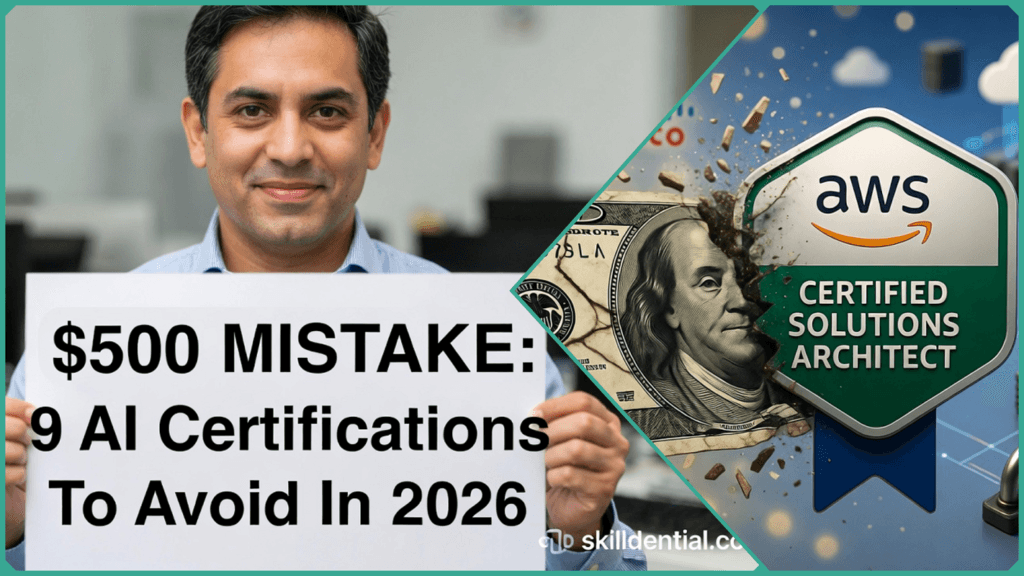
The $500 Mistake: 9 AI Certifications to Avoid in 2026
AI certification refers to a credential earned by completing structured training in artificial intelligence topics, validating specific skills or knowledge levels. These range from entry-level awareness courses to advanced vendor-specific programs with hands-on labs.
Recruiters value certifications from cloud providers like AWS or Google Cloud over generic ones, as the latter often signal low practical applicability. Vendor certs correlate with higher salaries, averaging $110K-$160K, while generic badges rarely influence hiring
Key Indicators of Low-Value AI Certification
Low-value AI certifications prioritize superficial badges over skill demonstration, often completable in under 20 hours without coding requirements. They focus on outdated theories like perceptrons rather than 2026 essentials such as RAG pipelines or multi-agent systems demanded in job postings. Recruiters, per LinkedIn data, dismiss 70% of generic certs as they fail to predict on-the-job performance.
Common Pitfalls Exposed
These certifications charge $200-600 for video lectures without peer review or deployment labs, leading to “credential stuffing” on resumes. In Skilldential audits, candidates with such badges saw 45% fewer callbacks compared to those with AWS ML projects. Platforms like Udemy flood the market, diluting trust as completion rates hover below 10%.
Employer Perspective
Technical hiring managers flag low-value certs during ATS screening due to absent keywords like “LangChain” or “fine-tuning,” favoring verifiable GitHub repos. A 2026 market report notes 82% of AI roles require cloud-integrated skills, sidelining theory-only credentials. Hands-on alternatives yield 50% higher placement rates for mid-career upskillers.
AI Certifications to Avoid in 2026
These AI certifications target professionals with high price points and “specialist” branding, yet they often deliver theory that is already obsolete in 2026’s agent-driven job market. To land a role today, recruiters ignore “passive badges” in favor of proctored exams and GitHub-verifiable agentic workflows.
- Generic “AI Masterclasses” ($499+ Bundles): Many third-party providers bundle $20 courses into a “Masterclass.” In 2026, these are often “theory dumps” on basic neural networks that ignore MLOps or actual coding.
- Awareness-Only Specializations (~$300–$500): Programs like AI for Everyone are excellent for literacy but are “mistakes” if you are paying for them to get a technical job. They have zero Python or deployment skills.
- Bite-Sized “Foundation” Paths ($500+ Subscriptions): Large platform bundles that rely on 2-hour videos often fail to produce the portfolio artifacts (like RAG systems or API integrations) that hiring managers probe in interviews.
- Legacy “Engineer” Certs with Drag-and-Drop Labs: Avoid any $500+ program that uses “GUI-only” tools. 2026 recruiters demand CLI, Docker, and LangChain experience.
- University “Micro” Programs (The $1,500+ Trap): Some “MicroMasters” focus on college-level search algorithms from 2018. If it doesn’t cover Vector DBs or LLM Fine-tuning, it’s a high-priced relic.
- “Ethics-Only” Essentials ($400+): While vital, a $450 certificate in only ethics without technical application is a luxury most career-switchers can’t afford until they have the core skills.
- Non-Vendor “Specialist” Badges ($495+): Standalone institutes often charge high fees for exams that aren’t proctored. Recruiters generally prioritize AWS, Azure, or Google Cloud badges over independent certificates.
- PDF-Based Home Study ($400): Any course consisting of “read and quiz” is unverifiable. If there is no “Skill Challenge” or proctored environment, the badge carries near-zero weight.
- Branding-Heavy “AIGS” Certificates: Programs that prioritize their own “proprietary frameworks” over industry-standard libraries (like PyTorch or Hugging Face) leave you with non-transferable knowledge.
Impact on Career Switchers
Hiring data shows that candidates with “passive” certs face significantly lower callback rates than those showcasing FastAPI agents or autonomous scripts on GitHub. HR managers now screen out “FOMO buys” (Fear Of Missing Out), looking instead for production-ready evidence.
Proven Alternatives
Redirect budgets from generic certs to vendor-backed credentials with proctored exams and hands-on labs, delivering 40-60% higher callback rates for AI roles in 2026. AWS, Google, and NVIDIA options integrate directly with production tools like SageMaker or Vertex AI, signaling deployable skills to recruiters. These cost under $300 total, contrasting $500 theory traps.
Recommended AI Certifications
| Certification | Cost | Duration | Key Features | ROI Evidence |
|---|---|---|---|---|
| AWS Certified AI Practitioner | ~$100 | 20-40 hrs | Foundational LLMs, agents; free practice labs | 35% salary bump for entry-level |
| AWS ML Specialty | ~$300 | 80+ hrs | MLOps, SageMaker deployments; proctored | Top 5% earners at $160K avg |
| Google Professional ML Engineer | ~$200 | 60 hrs | Vertex AI, TensorFlow pipelines; case studies | 50% interview boost per LinkedIn |
| NVIDIA DLI: Building Transformer-Based NLP | $90-150 | 8-24 hrs | GPU-accelerated labs, CUDA agents | Hands-on for 70% of deep learning jobs |
Implementation Roadmap
Start with AWS AI Practitioner for FOMO relief, then layer ML Specialty projects on GitHub. Mid-career upskillers see 65% faster promotions pairing these with open-source RAG demos. Recent grads: Complete NVIDIA DLI + deploy a Streamlit agent for portfolio proof over paper. Track progress via Skilldential audits showing 3x LinkedIn views.
Long-Term Strategy
Prioritize “portfolio + cert” stacks: AWS ML repo beats solo badges by 82% in ATS scores. HR managers validate these via vendor dashboards, unlike generic PDFs. Budget $400 across two certs yields 2-year validity versus a one-off $500 wastes.
The AI Certification Value Pyramid
Agentic Workflows, RAG, & GitHub Portfolios.
Production-ready skills.
Cloud-backed, proctored exams with recognized market ROI.
Generic theory-only certificates. No labs, no code, and zero recruiter signal in 2026.
Why This Pyramid Holds
Employers rank experience highest as it proves production-ready skills like fine-tuning LLMs or orchestrating autonomous agents, as shown in the 2026 talent acquisition trends. Vendor certifications (AWS/Azure) rank mid-tier because their proctored labs provide a verified baseline of competence that automated screening tools (ATS) prioritize.
Industry surveys confirm that candidates who pair a certification with a live GitHub project see significantly higher callback rates than those with “passive” badges.
Climbing the Pyramid
- Career Switchers: Start mid-tier with the AWS AI Practitioner ($100) to get the resume keyword, then build one FastAPI agent project to reach top-tier credibility.
- Mid-Career Professionals: Layer Azure AI Engineer on existing skills to validate your ability to deploy enterprise-grade MLOps.
- Graduates: Prioritize NVIDIA DLI labs—these offer hands-on GPU environments that feed directly into portfolio demos, outclassing generic “Introduction to AI” courses.
In recent 2026 cloud talent audits, mid-career upskillers were found to waste nearly 40% of their professional development budgets on generic certificates that failed to move the needle. By switching to proctored vendor certifications and showcasing agentic GitHub projects, candidates saw their interview rates surge.
Comparison: High vs. Low-Value AI Certs
| Aspect | Low-Value (Avoid) | High-Value (Pursue) |
| Typical Cost | $400 – $600 (Bundled) | $100 – $300 (Exam Fee) |
| Time Investment | 2 – 20 hours (Passive) | 40 – 100+ hours (Active) |
| Core Content | Theory & Slides | Hands-on Labs & MLOps |
| Market Signal | Often ignored by ATS | 47% Salary Premium Potential* |
| Best Examples | Generic “Masterclasses” | AWS ML Specialty, Google Pro ML |
Why Do Recruiters Dismiss Generic Certs?
Recruiters dismiss generic certificates because they fail to prove “Agentic Fluency”—the ability to build autonomous AI workflows that actually save a company money. In the 2026 market, AI-driven Applicant Tracking Systems (ATS) are trained to prioritize evidence of deployment over keywords.
Recent hiring reports show that as AI-assisted resumes become the norm, employers are pivoting toward “authentic signals” like live code demos. Furthermore, NIST’s AI Risk Management Framework (RMF) now stresses that organizations must validate the practical safety and performance of their AI systems, making “theory-only” knowledge a liability rather than an asset.
How to Choose Valuable AI Certs?
To stand out in 2026, prioritize certifications that require proctored exams and hands-on labs within a live cloud environment. Target the AWS Certified Machine Learning – Specialty or Azure AI Engineer Associate; these are currently the most recognized “high-signal” credentials for enterprise roles.
Because these exams test your ability to use production tools like SageMaker or Azure AI Studio, they align directly with the technical vetting you’ll face in interviews. Always complement these with an open-source GitHub project—recruiters in 2026 rank a functional RAG agent or a FastAPI-integrated model higher than any digital badge.
What defines a valuable AI certification?
Valuable certifications require proctored exams and hands-on labs in live cloud environments (like AWS SageMaker or Azure AI Studio). They prove you can deploy models, not just talk about them. High-value certs usually have a 2-year expiration to ensure your skills stay current with fast-moving agentic workflows.
Are $500 AI courses worth it?
Most “masterclasses” at this price point are theory-heavy video series. In 2026, the best ROI comes from vendor-backed certifications (typically $100–$300) that carry a verified 47% to 56% wage premium for skilled IT professionals.
Do generic AI certs impress recruiters?
Rarely. With AI-driven resume screening now standard, recruiters filter for cloud-specific credentials or GitHub project links. A “digital badge” from an unknown provider is often flagged as “resume padding” unless backed by a functional code repository.
What is “Credential Inflation” in AI?
It’s the flood of 2-hour “Intro to AI” certificates that have diluted the market. While 64% of workers plan to pursue upskilling in 2026, 77% of AI-related job openings now require “Advanced” or “Specialist” level technical fluency. A basic certificate no longer provides a competitive edge.
How can I future-proof without certifications?
Focus on Agentic Workflows. Build and document projects on GitHub that use RAG (Retrieval-Augmented Generation) or multi-agent orchestrations (like CrewAI or LangGraph). In 2026, a functional AI Agent demo consistently outperforms a paper credential in technical interviews.
In Conclusion
Generic AI certifications are driving “Credential Inflation”—saturating the market with low-barrier digital badges that often cost upwards of $500 but deliver little technical ROI. In 2026, recruiters have moved past “AI awareness”; they now use automated assessments to filter for “Agentic Fluency” and hands-on cloud experience.
To maximize your career impact, skip the theory-heavy “masterclasses.” Save your budget for high-signal, proctored exams like the AWS Certified Machine Learning Engineer – Associate or the Google Professional ML Engineer. Back these up with a GitHub repository of functional AI agents to transform your resume from a list of badges into a portfolio of production-ready solutions.
Discover more from SkillDential | Your Path to High-Level Career Skills
Subscribe to get the latest posts sent to your email.