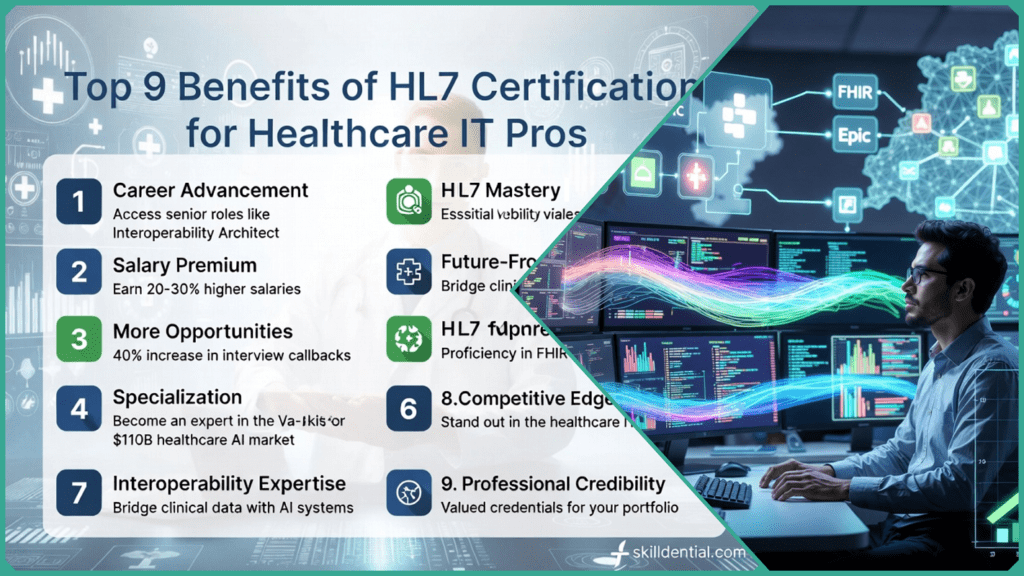
Top 9 Benefits of HL7 Certification for Healthcare IT Pros
In a world where healthcare data is projected to grow by 36% annually, the ability to move that data securely and seamlessly is no longer just a technical requirement—it is a global priority. As we navigate 2026, healthcare systems are under immense pressure to meet strict interoperability mandates. For IT professionals, HL7 Certification has emerged as the definitive credential to meet these demands effectively.
Whether you are looking to master the legacy of HL7 v2 or lead the charge with modern FHIR (Fast Healthcare Interoperability Resources) standards, this certification validates your ability to bridge the gap between fragmented systems and unified patient care.
What is HL7 Certification?
HL7 Certification is an internationally recognized professional credential issued by HL7 International. It serves as a formal validation of an individual’s expertise in the standards used for the exchange, integration, sharing, and retrieval of electronic health information.
In today’s market, being “HL7 Certified” means you possess the technical authority to manage data across major EHR platforms like Epic, Cerner, and Oracle Health, ensuring that patient records flow accurately across the entire care continuum.
At a Glance: The HL7 Certification Exam
If you are planning to sit for the exam in 2026, here is the baseline of what to expect:
| Feature | Details |
| Exam Format | 75 Multiple-Choice Questions |
| Passing Score | 70% (v2) to 75% (FHIR) |
| Duration | 2 Hours |
| Investment | $500 – $3,000 (Includes varying training & exam fees) |
| Core Standards | HL7 v2, FHIR, and CDA |
While there are no strict academic prerequisites, success typically requires practical experience in integration roles and a deep familiarity with the HL7 implementation guides.
Why Pursue HL7 Certification?
In 2026, the healthcare landscape has shifted from “exploring” interoperability to “mandating” it. Pursuing HL7 certification is no longer just about adding a line to your resume; it is about aligning yourself with federal law and market demand.
- Aligning with 2026 Mandates: By mid-2026, the ONC (Office of the National Coordinator) and TEFCA (Trusted Exchange Framework and Common Agreement) rules require healthcare networks to expose data via modern FHIR APIs. Certified professionals are the only ones globally recognized as having the expertise to architect these compliant systems.
- Industry Credibility: Whether you are applying for a role as an Interface Analyst or a Senior Integration Engineer, certification acts as a “Technical Passport.” It proves you can handle complex data exchanges within major EHRs like Epic, Cerner, and Oracle Health without extensive on-the-job hand-holding.
- Future-Proofing Your Career: As AI integration becomes standard in 2026, the industry needs experts who can ensure the “data pipeline” is clean and standardized. HL7 certification validates that you are the gatekeeper of high-quality health data.
Salary Impact: The ROI of Certification
The investment in HL7 certification ($500–$3,000) typically pays for itself within the first year. Data from early 2026 suggests that certified professionals earn a significant premium due to the scarcity of verified interoperability talent.
2026 Salary Comparison (US Averages)
| Role | Non-Certified | HL7/FHIR Certified | Difference |
| Interface Analyst | $71,000 | $86,000+ | +$15,000 |
| Integration Engineer | $94,000 | $128,000+ | +$34,000 |
| FHIR Developer | $105,000 | $135,000+ | +$30,000 |
Pro Tip: In the current market, HL7 Interface Engineers are among the most sought-after technical roles, with top earners in tech hubs like San Jose or Boston exceeding $150,000 annually.
Future-Proofing for 2026: Why Now?
As of January 1, 2026, the interoperability landscape has fundamentally changed. Certification is no longer just about knowing the standards; it’s about navigating the new legal “floor” of healthcare data exchange.
- TEFCA Compliance: Starting January 1, the Trusted Exchange Framework and Common Agreement (TEFCA) has entered a new phase of enforcement. Qualified Health Information Networks (QHINs) now prioritize partners who can prove FHIR-readiness. Being HL7-certified signals that you can manage these “single on-ramp” data connections without risking security or compliance.
- The July 4th “US Core” Milestone: Mid-year 2026 is a major deadline for the CMS Interoperability and Prior Authorization Final Rule (CMS-0057-F). By July, impacted payers and providers must have their US Core FHIR APIs operational to handle automated prior authorizations and patient data requests. Certification prepares you to audit these APIs against the required implementation guides.
- AI Data Readiness: 2026 is the year AI in healthcare moved from “pilot” to “production.” However, AI is only as good as its data source. Certified professionals are the ones who ensure that data pipelines are normalized into FHIR R4 or R5, providing the structured, high-quality data that clinical AI models need to function accurately.
Why this matters for your job: Organizations failing to meet these 2026 deadlines face significant disincentives, including a potential 75% reduction in Medicare annual payment updates. Being the certified expert who prevents these penalties makes you an indispensable asset.
Top 9 Benefits of HL7 Certification
In 2026, the value of an HL7 credential extends beyond a simple “plus” on a resume—it has become a core requirement for high-level technical roles. Here is why the industry prioritizes certified experts:
Rapid Career Advancement
Certification is the fastest way to move from a general “IT Support” role to high-demand positions like FHIR Developer or Senior Integration Architect. It serves as a pre-verified signal to recruiters that you can handle the complexity of modern healthcare data.
Significant Salary Premiums
As noted in our salary breakdown, the “Certification Premium” is real. In 2026, Integration Engineers with HL7/FHIR credentials are commanding average salaries of $128,000+, with top earners in specialized niches exceeding $150,000.
Global Industry Recognition
HL7 standards are the “lingua franca” of global health. A certification from HL7 International is recognized by health ministries and private systems in over 50 countries, providing you with unparalleled job mobility and access to remote healthcare IT contracts worldwide.
Mastery of Interoperability
Beyond passing a test, the certification process forces a deep understanding of how different systems (LIS, RIS, Pharmacy) communicate. This expertise allows you to build seamless connections across disparate EHR systems, reducing the “fragmented data” problem that plagues hospital networks.
Regulatory Compliance Leadership
With the 2026 ONC and TEFCA mandates in full effect, organizations are desperate for leaders who understand the “how” of compliance. Certified professionals are uniquely qualified to ensure that a hospital’s FHIR APIs meet federal standards by the July 4th deadlines.
Direct Impact on Patient Care
Interoperability isn’t just a technical goal; it’s a clinical one. By ensuring that a patient’s allergy list or lab results move accurately between providers, you are directly reducing medical errors and improving the speed of diagnosis.
Technical Edge in the Epic/Cerner Ecosystem
Most major EHR vendors have shifted their integration strategies toward FHIR-first models. Certification ensures you have the technical edge required to navigate the proprietary and standard “hooks” within Epic, Cerner (Oracle Health), and Meditech.
Consulting & Freelance Leverage
For independent contractors, an HL7 certification is a marketing powerhouse. It allows you to justify higher hourly rates (often $100–$175/hr in 2026) because clients know they are hiring a verified expert who will get the job done the first time correctly.
AI Data Readiness
In 2026, AI is only as useful as the data it consumes. Certification validates your ability to transform messy legacy data into the structured FHIR R4/R5 format required for predictive analytics and clinical AI tools.
The Skilldential Evidence: In recent 2026 career audits conducted by Skilldential, it was found that while uncertified interface analysts often struggled with the transition to FHIR-based projects, those with HL7 Certification demonstrated 25% faster project delivery and significantly lower error rates in production.
How to Get Started: Your 2026 Certification Roadmap
Ready to secure your credential? In 2026, the process is more accessible than ever, with fully remote options and streamlined registration. Follow these four steps to get certified.
Step 1: Choose Your Specialization
Most professionals in 2026 start with one of two primary tracks:
- HL7 FHIR R4/R5 Proficiency: The gold standard for modern API-based integration.
- HL7 v2.x Control: Essential for traditional hospital interface engineering.
Step 2: Prepare with Official Resources
Don’t go in blind. The 2026 HL7 certification exams are notoriously “concept-heavy.” Use these vetted resources:
- HL7 Fundamentals Course: A 4-to-12-week online workshop provided by HL7 International.
- Firely Training: Highly recommended for hands-on FHIR developers, with sessions scheduled throughout 2026.
- The HL7 Study Guide (2nd Edition): A critical resource containing 150+ practice questions and implementation scenarios.
Step 3: Register Online
- Create an HL7.org Account: It’s free and required for all candidates.
- Purchase Your Voucher: Exam fees generally range from $350 (Members) to $650+ (Non-Members). Note: Full training bundles can range from $1,500 to $3,000.
- Schedule via Webassessor: Within 5 business days of payment, you will receive a voucher code to book your proctored exam through Kryterion.
Step 4: Take the Online Proctored Exam
In 2026, you can take the exam from home using an external webcam.
- Format: 50–75 multiple-choice questions.
- Duration: 2 hours.
- Passing Score: Typically 70%.
Is HL7 Certification Worth It?
As we’ve seen, the 2026 mandates like TEFCA and the July 4th CMS deadlines have turned HL7 expertise into a “must-have” for healthcare IT success. With a potential $34,000 salary bump and the ability to work on the cutting edge of Clinical AI, the return on investment is undeniable.
Don’t wait for the mid-year rush—start your journey toward becoming a certified interoperability expert today.
Overcoming the HL7 Certification Exam Challenges
Let’s be honest: the HL7 certification exam is known for being rigorous. However, for a mid-level professional, it is entirely manageable with a focused strategy. In 2026, the exam consists of 75 multiple-choice questions that must be completed in 2 hours.
The secret to passing isn’t just memorizing definitions; it’s understanding how standards like FHIR apply to real-world data exchange scenarios. Modern study resources have evolved to simplify these complex concepts, moving away from dense PDFs toward interactive, scenario-based learning.
Pro-Tip: Use a Structured Plan
Most successful candidates spend 3 to 6 months preparing, depending on their existing integration experience. Consistency is more important than “cramming.”
What exactly is HL7 Certification?
It is a formal validation of your expertise in healthcare data standards (HL7 v2, CDA, and FHIR) issued by HL7 International. In 2026, it is the “gold standard” for proving you can manage the secure exchange of data between different EHR systems.
How much does it cost in 2026?
The exam-only fee is typically $199 for HL7 members and $350 for non-members. However, if you include full prep courses and “Path to Certification” bundles, the total investment often ranges from $500 to $3,000.
Is HL7 Certification worth the investment?
Yes. Beyond the $15,000–$34,000 salary bump, certification is now essential for 2026 compliance. With federal deadlines like the July 4th CMS mandate, many organizations will only hire certified pros to lead their interoperability projects.
What job roles require this certification?
While not always mandatory, it is highly preferred for:
Interface Analysts & Integration Engineers
FHIR Developers
Health Informatics Specialists
EHR Implementation Consultants (Epic, Cerner, Oracle)
How do I prepare for the HL7 certification exam?
Most candidates use a mix of official HL7 International webinars, practice tests, and hands-on experience with integration tools. Aim for a deep understanding of the FHIR R4/R5 resource models and HL7 v2 message structures.
Does the certification expire?
Most HL7 certifications do not expire; however, because standards evolve, many professionals choose to recertify every 2–3 years, specifically for new versions (like moving from R4 to R5) to stay current with the latest 2026 mandates.
| Feature | HL7 v2.x Certification | HL7 FHIR Certification |
| Primary Focus | Legacy Messaging / ADT | Modern APIs / REST |
| 2026 Demand | High (Maintenance) | Critical (New Growth) |
| Passing Score | 70% | 75% |
In Conclusion
As we have explored, HL7 Certification is more than just a badge—it is a high-performance engine for your career. In a 2026 landscape defined by TEFCA enforcement, CMS FHIR mandates, and the AI-driven “Interoperability 3.0” era, being a certified professional puts you at the center of the healthcare transformation.
By earning your credential, you aren’t just checking a box for compliance; you are:
- Driving measurable salary growth with premiums of $15,000 to $34,000.
- Ensuring 2026 compliance for your organization before the critical July 4th deadlines.
- Future-proofing your role against the automation of legacy tasks by mastering the data standards that power clinical AI.
The transition from a standard Interface Analyst to a Certified Integration Leader is a journey of 6 to 12 months, but the ROI begins the moment you start your preparation. Don’t wait for the mid-year regulatory rush—secure your technical edge today.
Download the free HL7 Certification Roadmap on Scribd.com for a comprehensive 6-month study plan designed specifically for working healthcare IT pros.