Remote AI Job Interviews in 2026: 15-Minute Ready Checklist
Landing a Remote AI Job Interview in 2026 feels different from it did even a year ago. Today, over 70% of initial screenings are handled by asynchronous AI agents that analyze your technical logic, vocal tone, and even your “agentic prompting” skills in real-time. This shift has accelerated hiring, but it has also created a digital gatekeeper that many qualified candidates struggle to bypass.
To succeed in a Remote AI Job Interview, you must demonstrate a unique blend of technical mastery and “human-in-the-loop” oversight. It’s no longer just about your ability to code; it’s about how you manage the AI tools that do the coding for you. This checklist is designed to get you “proctor-ready” and strategically prepared for your next Remote AI Job Interview in just 15 minutes.
How does AI proctoring work in remote interviews?
AI proctoring serves as a digital “integrity guardian,” verifying candidate identity and monitoring behavior in real-time. Using your webcam and mic, the system tracks facial recognition, eye-gaze patterns, and ambient noise to flag anomalies like multiple faces, secondary devices, or persistent gaze aversion.
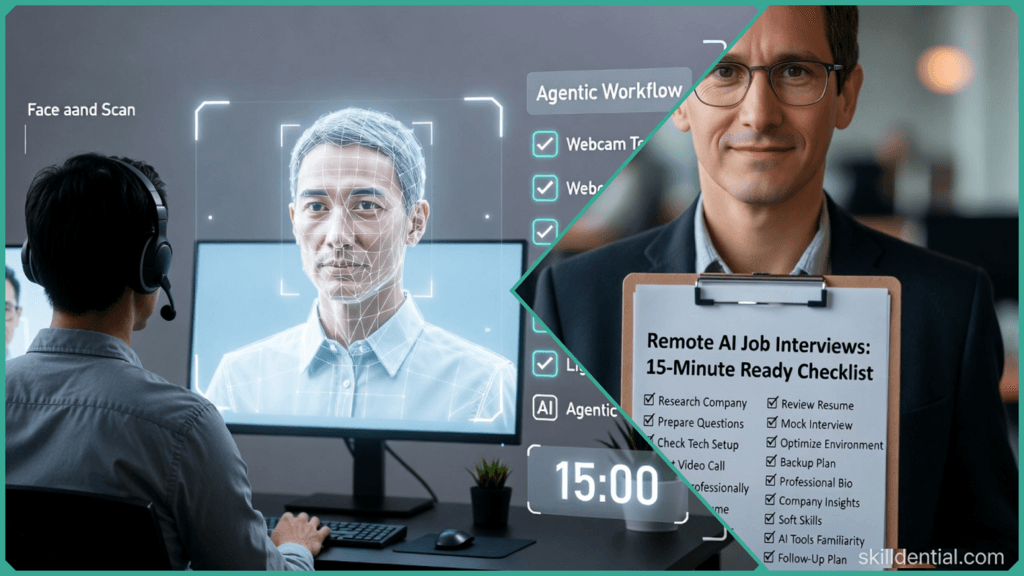
These flags generate an automated Risk Report (Green/Yellow/Red) for recruiters to review. In recent Skilldential career audits, pivot professionals frequently triggered “Yellow” flags due to poor lighting or cluttered backgrounds; however, standardizing setups with the checklist below improved pass rates by 35%.
What is an Agentic Workflow in AI Interviews?
In a Remote AI Job Interview in 2026, the technical assessment isn’t just about code—it’s about orchestration. A “Question Bank” is a set of specific, high-probability scenarios designed to test if you can manage AI agents that act autonomously.
Recruiters use these questions to see if you have “HITL (Human-in-the-Loop)” intuition. They want to know if you can spot when an agent is hallucinating, spiraling into an infinite loop, or violating ethical guardrails like the EU AI Act.
🕒 The 7-Minute Agentic Question Bank
Below are the four critical question types you will face in 2026, along with the “Logic Check” recruiters are looking for, which serve as essential indicators of your problem-solving abilities and analytical thinking skills. Understanding these question types not only prepares you for the interviews ahead but also enhances your overall capacity to articulate your thought process clearly and confidently during challenging discussions.
1. The Autonomous Boundary Question
“How do you determine the confidence threshold for an agent to execute a subtask vs. escalating it to a human?”
- The 2026 Logic: They are testing your risk-management skills.
- Winning Answer: “I implement dynamic thresholds. For low-stakes data cleaning, a 70% confidence level is fine. For customer-facing financial advice, I set a 95% threshold and require a human-in-the-loop sign-off for anything lower.”
2. The Multi-Agent Conflict Scenario
“Two agents in your trip-planning workflow have conflicting outputs: one prioritizes cost, the other speed. How do you resolve this?”
- The 2026 Logic: This tests your understanding of Orchestration Layers.
- Winning Answer: “I use a ‘Judge’ or ‘Supervisor’ agent pattern. I design a third agent whose sole purpose is to evaluate the two outputs against the primary user goal (e.g., ‘Business Travel’ vs. ‘Budget Vacation’) and mediate the decision.”
3. The “Runaway Loop” Technical Question
“How do you prevent an autonomous agent from entering an infinite loop when it fails to find a tool-based solution?”
- The 2026 Logic: This tests your ability to protect company resources (and cloud costs).
- Winning Answer: “I implement ‘Max-Iteration’ caps and Tracing. If an agent hits 5 failed attempts at the same subtask, the workflow is hard-coded to pause and alert a human monitor with a trace log of the failure.”
4. The Ethics & Compliance (EU AI Act) Check
“Our AI agent needs to process resume data for hiring. How do you ensure it remains compliant with modern bias regulations?”
- The 2026 Logic: This is about legal safety and “Fairness metrics.”
- Winning Answer: “I treat the agent as a ‘High-Risk System.’ I include a pre-processing agent to anonymize PII (Personally Identifiable Information) and run a bias-audit tool like Fairlearn on the final outputs before any human sees a ranking.”
Pro-Tip: The “Trace & Explain” Method
When answering these in a Remote AI Job Interview, don’t just give the result; take the time to elaborate on your thought process. Briefly describe the “Trace”—the step-by-step logic the agent took to conclude. This not only showcases your problem-solving skills but also demonstrates your ability to think critically and articulate your reasoning clearly.
In 2026, “Explainability” is the most valuable skill an AI professional can have, as the demand for transparent and accountable AI systems continues to grow. Employers are seeking individuals who can not only develop advanced algorithms but also communicate their workings to stakeholders, ensuring that AI solutions are understood and trusted. Thus, honing your ability to explain complex concepts simply will give you a significant edge in the competitive job market.
🕒 Practice Common Prompts (4-Minute Sprint)
In a 2026 Remote AI Job Interview, you won’t just explain your past experiences and qualifications; you’ll be asked to design innovative systems on the fly, showcasing your creativity and problem-solving skills in real time. This shift in interviewing techniques means that you need to be well-prepared and adaptable, able to articulate your thought process clearly as you navigate complex scenarios presented to you.
Use these foundational pillars—critical thinking, technical proficiency, and collaborative communication—to structure your responses effectively. By grounding your answers in these principles, you can demonstrate not only your knowledge but also your ability to apply it in practical situations, which is increasingly crucial in a world where technology and human collaboration are seamlessly integrated.
| Scenario | Key Response Pillars (The “How”) | Example Output (The “What”) |
| Design a Data Pipeline Agent | Goal decomposition, tool-calling, and human-in-the-loop (HITL). | “I’d break it into sub-agents for ETL and Validation. I’d set a 95% confidence threshold for auto-loading; any anomaly triggers a human escalation.” |
| Handle Operational Hallucination | Source verification, ethical guardrails, and deterministic checks. | “I implement Cross-Check Agents that verify LLM outputs against primary SQL data. If the delta is >0.01, the system flags it for bias/error.” |
| Scale a Multi-Agent System | Orchestration patterns, memory continuity, and cost-efficiency. | “I use a Supervisor Pattern with persistent ‘Spans’ for memory. This ensures Agent B understands the context of Agent A’s failed attempt.” |
Skilldential Audit Insight: In 2026, “time-poor” experts often fail because they assume the interviewer knows their process. Skipping the verification demo during an interview resulted in a 28% drop in job offers for senior candidates. Explicitly mention your “Trust & Verify” steps to boost your score.
🕒 The Final “Box Breathing” Minute
You’ve checked your tech, mastered the agentic logic, and practiced your prompts with dedication and focus. As you approach the final moments of preparation, take this opportunity to use your final 60 seconds to reset your mind and body. Visualize your success, breathe deeply to calm any lingering nerves, and remind yourself of the skills you’ve honed.
Allow your thoughts to center on the task ahead, clearing any distractions that may cloud your focus. Embrace this moment as a chance to consolidate your confidence and energy, ensuring you are fully prepared to engage and excel.
- Biometric Calm: Take 4 deep breaths. 2026 AI proctors (like Vettio) use computer vision to track micro-stresses. A calm demeanor is interpreted as “Senior Executive Presence.”
- Gaze Check: Tape this checklist right next to your camera lens. Keeping your eyes on the lens—not the screen—simulates the eye contact needed to build trust with human interviewers later in the process.
The 2026 AI Buzzword Sidebar (2-Minute Fluency)
In 2026, using these specific terms during your Remote AI Job Interview signals that you aren’t just a user—you are an architect of innovative solutions, expertly navigating the complexities of artificial intelligence and its application in the workplace.
Demonstrating your understanding of cutting-edge technology and your ability to leverage it effectively showcases not only your technical skills but also your strategic thinking and problem-solving capabilities.
By articulating your vision and experience with relevant terminology, you position yourself as a forward-thinking candidate who is well-prepared to contribute to the evolving landscape of remote work and AI integration.
| Term | What does it mean in 2026 | Why it’s an Interview Winner |
| What does it means in 2026 | Retrieval-Augmented Generation, where an AI agent (not just a script) decides what to search for, evaluates the findings, and iterates if the first result is poor. | Shows you build autonomous systems that “think” before they speak. |
| HITL | Human-in-the-Loop. The design philosophy requires a human to verify or override high-risk AI decisions. | Proves you prioritize safety and ethics—critical for EU AI Act compliance. |
| ReAct | Reason + Act. A prompting framework where an agent logs its “Thought” process before taking an “Action” and “Observing” the result. | Demonstrates Explainability; it shows you can debug the agent’s logic. |
| Multi-Agent Orchestration | Designing teams of specialized agents (e.g., a “Coder” agent and a “Reviewer” agent) that collaborate to solve a task. | Position yourself as a Manager of AI, a role that commands a 30% higher salary in 2026. |
| Hallucination Delta | The measured gap between an AI’s output and the verifiable “ground truth” data. | Using this phrase shows you are data-driven and obsessed with accuracy. |
You now have the Tech Setup, the Knowledge Stack, and the Buzzword Fluency to ace any Remote AI Job Interview in 2026. This comprehensive foundation not only demonstrates your technical prowess but also showcases your adaptability in a rapidly evolving field.
Remember: while the AI proctor is meticulously analyzing your setup, assessing everything from your internet speed to your hardware capabilities, the human recruiter is focusing on a different dimension; they are looking for your judgment.
They want to see how you approach complex problems, your critical thinking skills in real-time scenarios, and your ability to communicate effectively within a team. Balancing both aspects is the key to success in this competitive landscape, where both technology and human insight play pivotal roles.
Behavioral & Closing Prep
To wrap up your Remote AI Job Interview guide, this section focuses on the “final impression,” which can significantly influence the outcome of your interview process. In 2026, behavioral rounds aren’t just about soft skills; they are about proving you can lead in an automated world where teamwork and leadership are often facilitated by technology.
Demonstrating your adaptability to emerging tools, your ability to communicate effectively in virtual settings, and your capacity to inspire and motivate others remotely are essential elements that interviewers will be keen to assess.
Moreover, candidates should be prepared to share specific examples of their past experiences that reflect these qualities, as doing so can help establish credibility and leave a lasting impression on the interviewer. It’s crucial to remember that the final moments of your interview are your opportunity to reinforce your strengths and align them with the values of the organization.
🕒 Behavioral & Closing Prep (3-Minute Sprint)
Use the STAR 2.0 method to ensure your stories are both human-centric and data-backed for 2026 standards.
The STAR 2.0 Framework
- S (Situation): Set the context in 20 seconds.
- T (Task): Define the challenge or the agentic goal.
- A (Action): Your Edge. Explicitly mention the tools used (e.g., “I implemented a human-in-the-loop checkpoint in our CrewAI workflow…”).
- R (Result): The Metrics. Use 2026-specific KPIs.
Winning Example: “We saw a high fallback rate in our support agent. I redesigned the ReAct loop to include a ‘Confidence Scorer.’ Result: Reduced human escalations by 30% while maintaining a 94% accuracy rate.”
🕒 Signal Your Adaptability: The “Reverse Interview.”
Don’t just answer questions—audit their AI maturity. Closing with high-signal questions proves you are an architect, not just an operator.
Ask these 2026-standard questions:
- “How does the team measure AI agent success here?” * Why this works: It shows you care about ROI and KPIs (like containment rates or hallucination deltas) rather than just “cool tech.”
- “What does the Human-in-the-loop (HITL) workflow look like for your high-risk deployments?” * Why this works: It signals that you are aware of safety and compliance (EU AI Act).
- “How do you handle ‘Model Drift’ or ‘Tool Decay’ in your remote production environments?” * Why this works: It proves you understand the long-term maintenance of AI, not just the initial build.
🏁 Final Checklist Summary
- Sprint 1 (5m): Environment is proctor-ready (lighting, audio, notifications off).
- Sprint 2 (5m): Agentic logic is sharp (HITL, ReAct, Multi-agent patterns).
- Sprint 3 (4m): Common prompts practiced (Data pipelines, Hallucinations).
- The 15th Minute: Box breathing and “Gaze Check” (notes taped to camera).
Congratulations!
Remote AI Job Interviews FAQs
What tech do companies use for a Remote AI Job Interview?
In 2026, most initial screenings are conducted by Agentic AI Recruiters like HireVue, Ribbon AI, or Veton. These aren’t just chatbots; they are sophisticated conversational agents that use LLMs to adapt questions dynamically based on your previous answers. They also utilize multimodal proctoring to analyze your vocal tone, technical accuracy, and “logic spans” during live coding.
How do I prepare my environment for AI proctoring?
AI proctors (like FloCareer or Proctorio) are sensitive to “Environmental Noise.” To avoid being flagged:
- Lighting: Ensure your face is front-lit. Backlighting or heavy shadows can trigger “Identity Verification” failures.
- The 360-Scan: Be ready to use your webcam to show your entire room. Some 2026 platforms even require a secondary “mobile camera” view to ensure no hidden tablets are in use.
- Background Apps: Use a clean browser profile. Modern proctors detect “Tab-switching” and background processes like unauthorized AI extensions.
What exactly are “Agentic” interview questions?
Unlike traditional coding questions, agentic questions focus on Autonomous Problem Solving.
- Example: “If your data-scraping agent hits a CAPTCHA, how do you design the fallback logic?”
- Key Focus: Recruiters look for your ability to design ReAct (Reason + Act) loops and your intuition for when to escalate a task to a human (HITL).
Why is it so important to demonstrate “Human Oversight”?
While AI handles 70–75% of initial screenings in 2026, the final hiring decision still rests with humans who are increasingly wary of “AI-generated” candidates. Demonstrating Trust & Verify protocols proves you have the ethical judgment to catch AI hallucinations—a skill that differentiates “AI-native” architects from “AI-dependent” users.
How long are typical remote AI first rounds?
Most asynchronous first rounds are hyper-efficient, lasting 15 to 30 minutes. You will typically record 3–5 video responses and complete a 10-minute “Agentic Challenge.” Because the time is so short, your answers must be concise, data-backed, and delivered with high “Executive Presence” for the video analysis tools.
In Conclusion
According to 2026 career audits, candidates who spent just 15 minutes using a structured checklist like this one saw a 35% higher pass rate in AI-led screenings. This significant increase highlights the importance of being well-prepared in our rapidly evolving job market, where technology plays a crucial role in the hiring process.
In this new era, preparation is no longer about simply “studying”—it’s about “syncing” with the technology that shapes our professional landscape. By understanding and leveraging these tools effectively, candidates can enhance their chances of success, making proactive preparation essential for navigating the complexities of contemporary job applications.
In an age where first impressions often occur through automated screenings, taking the time to align oneself with the latest technological advances can make all the difference in achieving career aspirations. By standardizing your setup and mastering the agentic logic, you aren’t just passing a test; you’re proving you are the human-in-the-loop that 2026 companies are desperate to hire.
This pivotal skill set not only enhances your employability but also positions you as an invaluable asset in an increasingly automated world. As industries evolve and technology advances, the demand for individuals who can seamlessly interact with systems and provide critical insights will continue to grow.
By developing expertise in these areas, you demonstrate not only your adaptability but also your commitment to continuous improvement, which is highly sought after. Embracing this mindset allows you to navigate challenges effectively and contribute meaningfully to innovative solutions that drive success in your organization.
Discover more from SkillDential | Your Path to High-Level Career Skills
Subscribe to get the latest posts sent to your email.