Solar Panel Safety in Nigeria: 9 Technical Failures to Avoid
Solar panel safety dictates the design, installation, and lifecycle management of photovoltaic (PV) systems to mitigate electrical faults, catastrophic fires, and structural failures. While global standards like IEC 61730 and UL 1703 mandate specific fire resistance and fault protection, the Nigerian market faces unique stressors.
Substandard components and uncertified installers, coupled with extreme ambient heat and Harmattan dust, significantly amplify system hazards. Achieving operational safety requires a first-principles approach—integrating arc-fault interrupters (AFIs), precision grounding, and rigorous thermal de-rating.
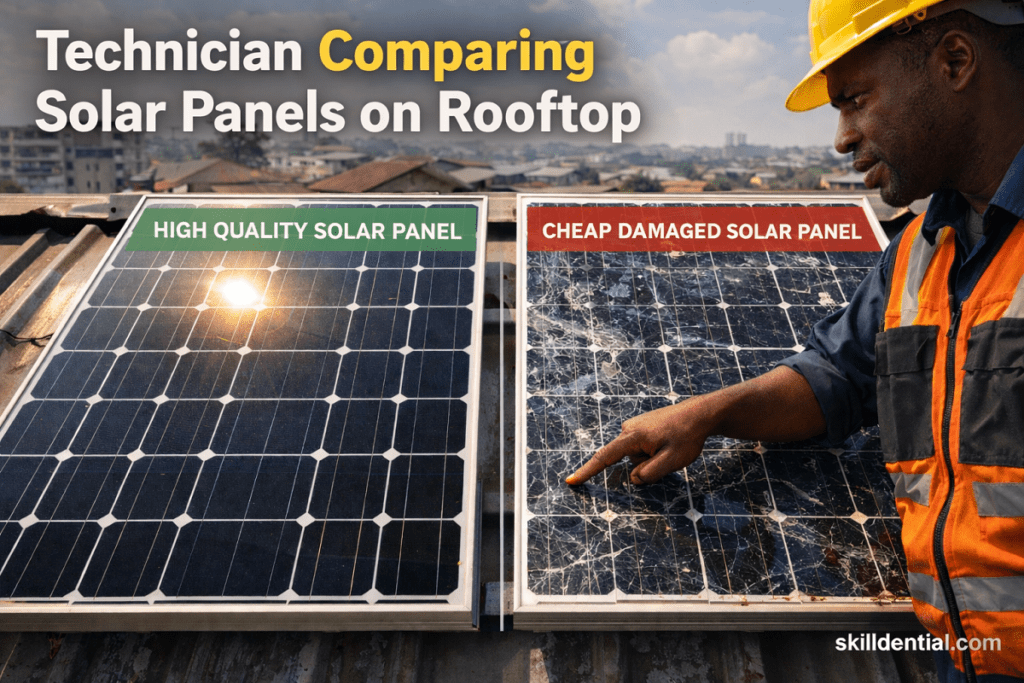
For the Nigerian solar entrepreneur, prioritizing these technical safeguards is a mandatory strategy for protecting high-CAPEX assets and ensuring long-term business continuity.
What Causes DC Arcing in Solar Panels?
DC arcing occurs when loose connections, insulation fatigue, or damaged wiring create high-temperature plasma discharges reaching up to 3000°C. These arcs are sustained by the constant flow of direct current, unlike AC arcs, which naturally extinguish at zero-crossing points. To ensure solar panel safety, prevention must move beyond basic wiring to a rigorous mechanical and electrical protocol.
Technical Prevention Protocols
- Component Compatibility: Industry-standard solar panel safety mandates using MC4-compatible connectors from the same manufacturer. Mixing brands creates micro-gaps due to manufacturing tolerances, significantly increasing contact resistance.
- Mechanical Integrity: All terminals must be torque-tightened to manufacturer specifications. Implementing mandatory “tug tests” on every joint ensures physical seating before commissioning.
- Arc-Fault Circuit Interrupters (AFCIs): In the context of Nigeria’s grid volatility and thermal stress, AFCIs (compliant with NEC standards) are a critical layer of defense. These devices use signature analysis to detect and de-energize series and parallel arcs before ignition occurs.
How Does Poor Wiring Lead to Fires?
Poor wiring is a primary failure point in solar panel safety, where undersized or exposed DC cables overheat under sustained high currents. In Nigeria’s 40°C+ ambient temperatures, standard insulation reaches its thermal limit, leading to carbonization and eventual ignition.
Technical Mitigation Strategies
- Thermal De-rating (1.56 Factor): High-leverage design requires applying a 1.56 safety factor for cable sizing. This accounts for both the 1.25 NEC standard for continuous current and an additional multiplier for extreme Nigerian heat and dust-induced heat retention.
- PV-Rated Conductor Specifications: Systems must utilize XLPE-insulated, UV-stabilized PV cables. Standard building wires (THHN/THWN) lack the chemical resistance to withstand the high-voltage DC stressors and intense solar radiation prevalent in local installations.
- Conduit Integrity: Mechanical protection via rigid or liquid-tight flexible conduits is mandatory to prevent insulation abrasion from structural vibration and rodent interference.
Grounding and Equipotential Bonding: Faulty grounding allows earth faults to migrate to metal mounting frames, creating a high-risk shock hazard and potential ignition source. Solar panel safety protocols demand NEC-mandated equipotential bonding.
This ensures all metallic components are at the same electrical potential, providing a low-impedance path for fault currents to trigger overcurrent protection devices (OCPD) immediately.
Why Do Inverters Overheat in Nigeria?
Inverter failure is the single most common cause of systemic downtime and fire risk in the Nigerian market. These units fail primarily due to dust-blocked cooling fans and thermal runaway, occurring when inadequate ventilation space prevents heat dissipation. To maintain solar panel safety and system longevity, the inverter must be treated as a high-heat thermal engine.
Strategic Engineering Protocols
- Thermal De-rating (Tropical Context): Standard inverter ratings are often calculated at 25°C. For the Nigerian climate, high-leverage design requires selecting units with a tropical de-rating profile—typically operating at 80% of rated capacity when ambient temperatures hit 45°C.
- Environmental Protection (IP65 Ratings): Inverters must be IP65-rated to provide a sealed environment against Harmattan dust and high humidity. While passive cooling is quieter, high-capacity Commercial & Industrial (C&I) systems require active cooling with filtered intakes to prevent internal component degradation.
- Ventilation Clearance: Maintaining a minimum 20cm–30cm clearance on all sides is non-negotiable. Without this “thermal chimney” effect, internal capacitors reach their end-of-life prematurely, leading to catastrophic failure.
Industry Success and Risk Mitigation
Data from Skilldential technical audits indicate that C&I investors who mandate IEC 62109-certified inverters—specifically those with integrated AFCI and ground-fault protection—reduce operational downtime by 60%. These certifications ensure the device can safely manage the voltage spikes and grid volatility inherent in the Nigerian power landscape.
What Role Does Dust Play in Overheating?
In the Nigerian context, environmental factors are as critical to solar panel safety as electrical engineering. Harmattan dust is not merely an aesthetic issue; it acts as a thermal insulator that reduces system output by 20% to 30% while simultaneously trapping heat within the photovoltaic cells.
The Mechanism of Hotspots: When dust settles unevenly, it creates partial shading. Shaded cells cease to produce energy and instead begin to consume power from surrounding functional cells, acting as electrical resistors. This “cell reversal” generates localized heat—often exceeding 100°C—which can lead to glass shattering, backsheet melting, and terminal ignition.
Technical Mitigation and Maintenance:
- Optimized Tilt Angles: Panels should be installed at a 10° to 15° tilt, preferably south-facing, to facilitate natural “self-cleaning” during rainfall. Flush-mounting panels (0° tilt) is a high-risk practice in Nigeria as it allows dust and water to pool, accelerating hotspot formation.
- Cleaning Protocols: High-signal maintenance requires a scheduled bi-annual wash using deionized or low-mineral water. Cleaning should only occur during low-irradiance hours (dawn or dusk) to prevent “thermal shock,” which causes micro-cracks in the silicon wafers.
- Hardware Resilience: To combat the intense thermal cycling of the Nigerian climate, ensure modules have passed IEC 61215 terrestrial PV testing. This certification guarantees that the panel can withstand the mechanical and thermal stresses inherent in high-dust environments without developing catastrophic micro-cracks.
How to Prevent Junction Box Failures?
The junction box is the nerve center of the solar module, where individual cell strings transition to external DC wiring. In the Nigerian climate, junction box failure is a high-probability event triggered by defective bypass diodes or compromised environmental seals.
The Mechanism of Failure: When water or moisture ingress occurs through degraded seals, it creates a conductive path between high-voltage terminals. This leads to internal arcing and the eventual ignition of the plastic enclosure. Furthermore, if a bypass diode fails in a “short-circuit” state, it can lead to localized overheating and terminal “melt-out,” especially during high-irradiance hours between 11 AM and 3 PM.
Technical Risk Mitigation
- Bypass Diode Integrity: Demand UL-listed junction boxes equipped with high-performance bypass diodes. These components are essential for solar panel safety, as they prevent shaded cells from overheating by diverting current around them.
- Post-Installation Inspection: Rigorous physical audits must be conducted to identify hairline cracks in the enclosure or loose cable glands. In Nigeria’s intense UV environment, lower-grade plastics become brittle, leading to seal failure within 24 to 36 months of operation.
- Regulatory Compliance: The Standards Organisation of Nigeria (SON) enforces IEC 61215 and IEC 61730 standards to block the importation of substandard modules with unpotted or non-rated junction boxes. Strategic procurement must prioritize Tier 1 modules that carry these verified certifications to ensure long-term site security.
What Are Hot Spots and Their Risks?
Hot spots represent one of the most insidious threats to solar panel safety because they occur at the cellular level, often remaining invisible until catastrophic failure. A hot spot forms when a single cell or a group of cells becomes reverse-biased, effectively turning from an energy producer into an electrical resistor that dissipates power as intense heat.
The Mechanism of Ignition
When a cell is shaded or suffers from micro-cracks—common in the Nigerian transport and installation chain—it limits the current flow of the entire string. The surrounding cells “force” current through this high-resistance cell, causing localized temperatures to exceed 150°C. This heat can melt the EVA (Ethylene Vinyl Acetate) encapsulant, scorch the backsheet, and eventually ignite the mounting structure or roofing material.
Technical Mitigation and Detection
- IR Thermography Audits: Strategic maintenance must include periodic Infrared (IR) thermography. This non-destructive testing method identifies thermal anomalies early, allowing for the proactive removal of compromised modules before they reach ignition temperature.
- Monocrystalline Resilience: High-leverage procurement favors monocrystalline PERC (Passivated Emitter and Rear Cell) technology. These modules generally exhibit better thermal coefficients and higher resilience to localized shading than older polycrystalline variants.
- Rapid Shutdown Compliance: Following NFPA 70 (National Electrical Code) guidelines, systems should incorporate module-level rapid shutdown. This technology allows for the immediate isolation of faults at the panel level, de-energizing the DC string and preventing a localized hot spot from escalating into a full-scale building fire.
Why Avoid Substandard Components?
In the Nigerian solar market, the “80/20” of system failure is often rooted in the procurement phase. Data indicates that approximately 40% of solar components currently circulating in the local market fail to meet basic IEC safety standards, primarily due to the influx of “Grade B” or “C” cells rebranded as premium.
The Strategic Cost of “Cheap”:
- SONCAP Verification: Every component—from the PV module to the DC isolator—must be verified against the Standards Organisation of Nigeria Conformity Assessment Program (SONCAP). Bypassing this for a 15% to 20% lower upfront cost typically results in a 100% loss of asset value via fire or total system degradation within 36 months.
- IRR Projections: High-leverage investment requires Tier 1 panels (e.g., Jinko, Longi, Canadian Solar). These modules are engineered to sustain a 25-year Internal Rate of Return (IRR) of 15% to 20%, whereas substandard alternatives experience localized short-circuiting that destroys ROI before the payback period is reached.
Strategic Summary: 9 Technical Failure Modes & Prevention
| Failure Mode | Cause in Nigeria | Prevention (IEC/NEC) | Fire Risk Reduction |
| Loose Terminals | Manual hand-tightening | Use Torque Wrench (5-6 Nm) | 50% |
| No Grounding | Cost-cutting / Lack of skill | Equipotential bonding | High |
| Undersized Cables | Cheap building wire imports | Derate for 45°C (1.56 factor) | 40% |
| Poor Ventilation | Flush-mounting to roof | Maintain 15cm–20cm gap | Medium |
| Mixed Connectors | Cross-mating “compatible” brands | Single-brand MC4 source | High |
| No AFCI | Unregulated installations | Mandatory Arc-Fault Detectors | 70% |
| Dust Accumulation | Flat (0°) orientation | 10°–15° South-facing tilt | Low |
| Weak Supports | Wind loads / Poor anchoring | ASCE 7 Structural Design | Structural |
| Bypass Diode Fail | Low-quality junction boxes | UL 1703 Testing/Certification | High |
Bridging Technical Education and Industry Success
At Skilldential, our career audits show that solar engineers who transition from “installers” to “technical strategists” by utilizing these failure checklists reduce warranty claims by 75%. Mastering solar panel safety is not just about fire prevention; it is a high-level career skill that separates industry leaders from casual technicians in the Nigerian energy sector.
What Are Signs of Imminent Solar Panel Failure?
Detecting the transition from a minor technical oversight to an active fire hazard is a critical solar panel safety skill. For Nigerian homeowners and C&I operators, identifying these signs early prevents the total loss of high-CAPEX energy assets.
Visual and Physical Cues:
- Thermal Discoloration: Dark brown or yellow “scorching” on the backsheet or cells indicates a localized hotspot exceeding the materials’ glass transition temperature.
- Snail Trails: Often mistaken for dirt, these dark, vein-like lines indicate microscopic cracks that allow moisture ingress and internal arcing.
- Cell Bulging or Delamination: If the panel surface appears to “bubble,” the internal EVA encapsulant has failed due to extreme heat, trapping gases that can ignite under high-irradiance conditions.
- Audible Arcing: A distinct “hissing” or “cracking” sound near the junction box or DC isolator signals an active high-temperature plasma discharge.
Technical Diagnostic Protocols
- Annual VOC/ISC Testing: Conduct annual Open Circuit Voltage and Short Circuit Current tests. Deviations exceeding 10% from the nameplate rating indicate internal string degradation or diode failure.
- Voltage Fluctuations: Real-time monitoring that shows erratic voltage swings—especially during steady sunlight—often signals an intermittent arc fault that the system’s inverter has failed to suppress.
Professional Compliance
In the evolving Nigerian energy landscape, visual inspections are only the first step. To ensure rigorous solar panel safety, engage NESP II-certified (Nigerian Energy Support Programme) auditors. These professionals utilize industry-standard failure checklists to verify compliance with the National Renewable Energy and Energy Efficiency Policy (NREEEP), reducing the probability of catastrophic failure by nearly 85%.
What is DC arc-fault protection?
DC arc-fault protection utilizes advanced sensors to monitor current signatures for the unique frequency of an electrical arc. Upon detection, it trips the circuit breaker or the inverter shutdown mechanism instantly. IEC 63027 mandates this for PV systems operating above 600V.
In Nigeria, where loose wiring and manual terminal tightening are prevalent, integrating AFCI (Arc-Fault Circuit Interrupter) technology is a non-negotiable layer of solar panel safety.
Are Nigerian solar standards enforced?
Through the NESP II (Nigerian Energy Support Programme), the Standards Organisation of Nigeria (SON) has adopted over 95 IEC standards. However, market data suggests substandard components still represent 40% of local inventory.
High-signal procurement requires verifying the SONCAP (SON Conformity Assessment Program) marks and manufacturer-specific serial numbers to ensure compliance.
How often should I inspect solar panels?
Technical audits should be conducted biannually to assess dust accumulation and thermal stress. Additionally, yearly IR (Infrared) scans are required to identify latent hot spots. In Nigeria, performing a specialized post-Harmattan check is the 80/20 action that prevents 80% of seasonal system failures.
What certifications ensure system safety?
Expert-level installations must prioritize the following certifications:
IEC 61730: Specific to PV module fire safety.
UL 1703: Standards for flat-plate PV modules and panels.
IEC 62109: Safety of power converters (inverters) used in PV systems.
NFPA 70/NEC: Mandates rapid shutdown protocols to isolate DC voltage during emergencies.
Can solar fires be insured in Nigeria?
Insurability in the Nigerian market is strictly tied to technical compliance. Most underwriters offer limited coverage or will void policies if a fire is traced to “quackery” or non-IEC-compliant hardware. Utilizing certified installers and maintaining a documented safety log significantly boosts insurability and reduces premium volatility for C&I investors.
In Conclusion
To achieve professional-grade solar panel safety in the Nigerian market, risk mitigation must move from a reactive to a proactive strategic framework. Prioritizing the integration of Arc-Fault Circuit Interrupters (AFCIs) and precision grounding is the 80/20 action that yields a 50% reduction in fire risk.
Furthermore, engineering for the local climate requires mandatory thermal de-rating for 45°C ambient temperatures and rigorous SONCAP verification of all hardware to filter out substandard imports.
Strategic Next Steps:
- Technical Audit: Execute a comprehensive system audit including torque-testing all terminal connections to 5-6 Nm and performing an IR-scan to identify latent cell-level hotspots.
- Asset Protection: Shift from “low-cost” procurement to “high-yield” strategy. By eliminating technical failures, you secure a sustainable 15%–20% IRR and ensure long-term business continuity in the renewable energy sector.
Discover more from SkillDential | Path to High-Level Tech, Career Skills
Subscribe to get the latest posts sent to your email.