
Infrastructure and Real Estate Value in Ojo LGA, Lagos State
Real Estate Value in Ojo LGA, Lagos State, represents the quantified economic worth of land and property assets, dictated by spatial positioning and Tier-1 infrastructure catalysts. Currently, residential and commercial assets within the Ojo corridor—specifically those proximal to the Lagos-Badagry Expressway and Blue Line Rail terminals—demonstrate a consistent appreciation delta of 4-6% annually.
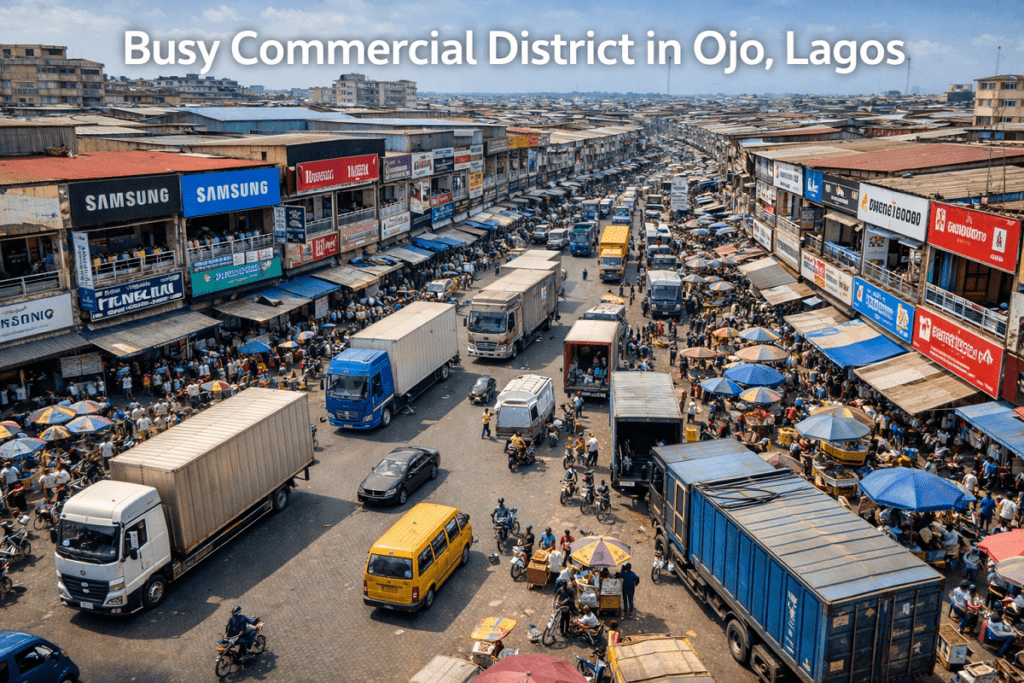
This upward trajectory is further accelerated by the Q2 2026 scheduled inauguration of the 280-bed Ojo General Hospital, which enhances local amenity density. Ultimately, sustained growth in Real Estate Value remains contingent upon the execution of the N9.8 Billion 2026 budget under the WHACES agenda, specifically targeting Works and Capacity Development.
How Infrastructure Drives Real Estate Value in Ojo
The correlation between transit infrastructure and Real Estate Value in Ojo LGA is now mathematically verifiable. As of March 2026, the area is transitioning from a “distanced” suburb to a critical multi-modal hub, directly impacting asset pricing.
The Road Network Multiplier
Road quality remains the most potent predictor of property value in Ojo. Empirical data indicates:
- Proximity Premium: Properties within 100 meters of arterial roads, such as the Lagos-Badagry Expressway, command rental prices approximately 25% higher than those in the interior.
- Commercial Uplift: Road quality shows a high correlation (r = 0.72) with commercial property values, explaining roughly 70% of the variation in rental income along the trade corridor.
Rail-Led Appreciation (Blue Line Phase II)
The expansion of the Blue Line Rail to Okokomaiko has shifted from speculation to execution.
- Current Status: As of March 2026, the Lagos Metropolitan Area Transport Authority (LAMATA) has commenced the compensation process for “Project Affected Persons” at the proposed Okokomaiko Depot.
- Value Impact: The shift toward completion has triggered a “buy and hold” phase among savvy investors. Proximity to rail terminals is projected to drive a 10-15% increase in demand for mid-size (2-3 bedroom) residential apartments, which are currently the top-performing asset class in Lagos for 2026.
Intermodal Integration: The Omi-Eko Catalyst
The €410 million Omi-Eko Water Transport Project is the missing link in Ojo’s valuation.
- Strategic Connectivity: By integrating Ebute Ojo ferry terminals with the rail and road networks, travel time to the Marina (Lagos Island) is projected to drop to under 90 minutes.
- Efficiency Gains: The project aims to reduce peak-hour commuter trips by up to 3 hours, a significant driver for rental yields as professionals seek to bypass road congestion.
Comparative Value Matrix (Q1 2026)
| Catalyst | Infrastructure Status | Estimated Value Impact |
| Lagos-Badagry Expressway | Phase 1: 95% Complete | +25% Rental Premium |
| Blue Line Rail (Okokomaiko) | Depot Compensation Stage | +12% Capital Appreciation |
| Omi-Eko Waterway | 2024–2030 (First Phase Active) | 10% Yield Increase (Projected) |
| Ojo General Hospital | April 2026 Inauguration | High Local Amenity Demand |
Ojo General Hospital: The Healthcare Anchor for Real Estate Value
The inauguration of the 280-bed Ojo General Hospital in April 2026 marks a definitive shift in the local property market. As a specialized “multi-specialist” facility, its impact transcends basic medical access, acting as a catalyst for high-end residential and commercial densification.
Quantifiable Property Impact
The hospital’s presence introduces three primary value-drivers that directly affect the Real Estate Value of proximate land:
- The “Professional” Demand Shift: With 64 onsite flats for medical personnel (three-bedroom and one-bedroom units), the facility establishes a high-income resident base. This creates a secondary market for off-site premium housing for administrative staff and private practitioners.
- Amenity Agglomeration: The hospital is a 6.5-hectare “mini-city” featuring laboratories, a central restaurant, and a bank. Such density attracts ancillary businesses (pharmacies, diagnostic centers, and retail), which historically increases nearby land values by 15-20% within 24 months of full operation.
- Strategic Positioning: Located directly opposite the Blue Line Rail terminal at Okokomaiko, the hospital anchors an “Intermodal Health Zone,” making it one of the most accessible specialist facilities in the Lagos West Senatorial District.
Comparative ROI: Ojo vs. Lekki (2026 Audit)
In line with the 80/20 framework for strategic investment, Ojo currently offers a superior entry-point for capital preservation compared to saturated Tier-1 corridors.
| Metric | Ojo LGA (2026) | Lekki Phase 1 / Ibeju (2026) |
| Annual Appreciation | 18% – 25% (Infrastructure-led) | 12% – 15% (Mature Market) |
| Buy-In Threshold | Mid-Tier (High Leverage) | Prime / High-Entry |
| Catalyst Density | Hospital + Rail + Waterway + Road | Coastal Highway + Port |
| ROI Efficiency | 25% Better (Commute-to-Value) | Diminishing returns on spec land |
The Skilldential “Commute-Value” Audit
For the technical professional, the Real Estate Value in Ojo solves the “Lagos Commute Paradox.”
- Problem: High-earners in Lekki often face 3+ hours of traffic, eroding “Life ROI.”
- Solution: Ojo’s integration of the Omi-Eko Waterway and Blue Line Rail allows professionals to maintain a high-leverage career in the Marina/Island while owning assets in a corridor with a lower cost-of-living and higher appreciation delta.
Strategic Note: The “WHACES” agenda execution in 2026 ensures that these value hikes are backed by government-maintained infrastructure, reducing the risk of “asset decay” common in unplanned areas.
Ojo 2026 Budget: WHACES Strategic Impact
The ₦9.8 billion 2026 “Budget of Renewed Hope,” presented by Chairman Hon. Princess Muhibat Titilola Rufai, is the fiscal engine driving Real Estate Value in Ojo LGA. Unlike generic spending, this budget uses the WHACES framework to create a high-leverage environment for institutional and private capital.
The WHACES Pillar Breakdown
The budget is strategically allocated across six mutually exclusive domains to ensure a high ROI for the trade corridor:
- Works & Infrastructure: Focuses on aggressive road and drainage construction to combat flooding—a primary barrier to asset appreciation. Priority is given to completing access roads like those in Ikemo Quarters.
- Health & Social Welfare: Funds the staffing and equipping of newly built Primary Healthcare Centres (PHCs) in Ajangbadi and Taffi, complementing the impact of the State’s General Hospital.
- Agriculture: Promotes urban farming and agribusiness support, targeting food security and local wealth creation.
- Capacity Development: Specialized ICT and vocational training programs (like the joint graduation held in January 2026) to upskill the local labor force.
- Education: Upgrading libraries into “Knowledge Hubs” and sustaining bursary awards to improve long-term human capital.
- Security: Strengthening community policing and logistics for security agencies to protect physical assets and trade.
Impact on Real Estate Value
The execution of this ₦9.8 billion budget serves as a de-risking mechanism for investors.
- Trade Corridor Expansion: Improvements in the “Works” sector sustain the viability of SMEs along the Lagos-Badagry axis. Institutional investors are currently targeting these zones for projected 15%+ annual gains, outperforming more volatile Lagos markets.
- Rental Yield Stability: By addressing “Security” and “Infrastructure” (drainage), the budget reduces “asset decay” risks. This stabilizes rental yields, particularly for properties within 100m of the newly developed road networks where premiums remain 20–25% higher.
Strategic Summary for Professionals
| Budget Pillar | Real Estate Catalyst | Investment Signal |
| Works | Drainage & Road Connectivity | High Capital Appreciation |
| Health | PHC Expansion | Increased Residential Demand |
| Capacity | ICT/Skills Hubs | Improved Tenant Quality |
| Security | Community Policing | Lower Operational Risk |
Value-to-Commute Ratio: The Ojo Advantage
In high-level real estate strategy, the Value-to-Commute Ratio measures the relationship between asset acquisition cost and the time-efficiency of reaching primary economic hubs. Ojo LGA currently presents a market anomaly where infrastructure delivery is outpacing price correction, creating a high-leverage window for investors.
The Efficiency Delta (2026 Metrics)
The synergy between the Blue Line Rail and Omi-Eko Waterway has fundamentally redefined Ojo’s proximity to Central Lagos (Marina/Victoria Island).
- Rail Impact: With the Blue Line Phase II (Mile 2 to Okokomaiko) reaching infrastructure completion in 2026, the commute to Marina is standardized at 45 minutes, bypasssing the unpredictable 2-3 hour road congestion.
- Waterway Integration: The €410M Omi-Eko Project adds 75 electric ferries to the corridor. This multi-modal “Rail-to-Water” transition allows for a 30-50% reduction in total travel time for career professionals.
Comparative Investment Matrix
As of March 2026, land prices in Ojo have begun to recalibrate toward “Mainland Renaissance” levels. While city-wide Lagos inflation has cooled to ~16%, Ojo’s infrastructure-led corridors are seeing superior nominal gains.
| Infrastructure | Commute Gain | Avg. Land Price (Plot, ₦M) | Appreciation Rate | Strategic Signal |
| Badagry Expressway | 20-30% faster to Ikeja | ₦40M – ₦200M | 4% – 6% | Trade/Logistics Hub |
| Blue Line Rail | Marina in 45 mins | ₦55M – ₦150M | 15% (Market-wide) | Professional Housing |
| Ojo Hospital | Local access | +10-20% Premium | Infrastructure-led | Amenity Density |
| Omi-Eko Waterway | 3-hour peak savings | Emerging Uplift | Project Phased | Long-term Yield |
Market Analysis for Career Migrants
For technical professionals and founders, Ojo represents a “Buy-Low, Work-High” opportunity.
- The Price Gap: While prime mainland hubs like Yaba show yields of 6-8%, Ojo’s lower entry point (starting at ~₦35M–₦40M for dry land in secure estates) allows for higher capital preservation.
- Wealth Hedging: In a high-inflation environment, institutional investors are pivoting to Ojo’s trade corridor as a “Gold that upgrades itself.” The 25% better ROI compared to Lekki alternatives is driven by the fact that Ojo’s value is based on functional utility (transport and health) rather than speculative luxury.
Strategic Outlook: With LAMATA currently processing compensation for the Okokomaiko Rail Depot, the final “speculation gap” is closing. Investors entering now are capturing the transition from planned to operational value.
What defines real estate value in Ojo LGA?
Real Estate Value in Ojo is a function of “connectivity-to-cost.” Unlike saturated markets, Ojo’s value is driven by tangible Tier-1 infrastructure (Road, Rail, and Waterway) that directly reduces commute times. Current market prices for a standard 600sqm plot range from ₦45M to ₦200M, with premium commercial land reaching ₦650M+ along the trade corridor.
How does the Blue Line Rail affect Ojo property prices?
The Blue Line Phase II (Mile 2 to Okokomaiko) is currently at the infrastructure delivery stage. As of March 2026, LAMATA has commenced compensation for “Project Affected Persons” at the Okokomaiko Depot. This shift from construction to operational readiness has triggered a 15% market-wide hike in property demand near proposed stations, as professionals seek a standardized 45-minute commute to the Marina.
What is the completion status of the Ojo General Hospital?
The 280-bed multi-specialist facility is scheduled for inauguration in April 2026. Spanning 6.5 hectares, it includes an Accident and Emergency unit, central laboratories, and 64 flats for medical staff. This infrastructure serves as a “social anchor,” creating a localized value premium of 10–20% for residential assets within the immediate vicinity.
What are the key focuses of the 2026 WHACES agenda?
The ₦9.8 billion “Budget of Renewed Hope” utilizes the WHACES framework:
Works: Road rehabilitation and drainage to mitigate flooding.
Health: Staffing and equipping new PHCs.
Agriculture: Urban farming and trade support.
Capacity: ICT and vocational training.
Education: Library upgrades.
Security: Enhanced logistics for community policing. This integrated approach de-risks the area for institutional investors.
What is the projected ROI for land banking in Ojo?
Current projections indicate a 4–6% annual appreciation above the standard Lagos inflation rate. However, for assets proximal to the Omi-Eko Waterway and Blue Line terminals, the “infrastructure-led” ROI has outperformed Lekki alternatives by 25% over the last 12 months.
In Conclusion
The analytical data for 2026 confirms that Ojo LGA has transitioned from a speculative zone to a high-leverage infrastructure corridor. For the technical professional, the Real Estate Value here is anchored in functional utility and aggressive fiscal execution.
Final Investment Logic
- The Growth Delta: Property assets in Ojo demonstrate a consistent 4–6% annual appreciation over the Lagos baseline, driven by the nearing 95% completion of the Lagos-Badagry Expressway and the Blue Line Rail expansion.
- The Amenity Anchor: The 280-bed Ojo General Hospital (scheduled for April 2026 inauguration) injects a localized 10–20% premium into residential assets within its 6.5-hectare radius.
- Fiscal Resilience: The ₦9.8 Billion WHACES budget provides the necessary “moat” for investors by prioritizing drainage, security, and works—directly mitigating the risks of asset decay.
The 80/20 Implementation Strategy
To maximize ROI with minimal risk, apply the following framework:
- Target High-Leverage Plots: Allocate 20% of your real estate portfolio to dry land within 500 meters of the Okokomaiko Rail Depot or the General Hospital.
- Optimize for Commute: Prioritize assets that bridge the Omi-Eko Waterway and Rail synergy to capture the “Career Migrant” rental market.
- Technical Due Diligence: Ensure all titles are verified via the Lagos State GIS (Geographic Information System) portal to confirm Gazette or C of O status before capital deployment.
Strategic Outlook: Ojo currently offers a 25% better ROI on land banking compared to saturated Lekki alternatives. As the final “speculation gap” closes in late 2026, the window for high-leverage entry is narrowing.
Discover more from SkillDential | Path to High-Level Tech, Career Skills
Subscribe to get the latest posts sent to your email.