9 Best Low-Code AI Platforms for Small Businesses
A low-code AI platform enables users to build and deploy AI applications using visual interfaces and minimal coding. These platforms support drag-and-drop workflows, pre-built AI models, and integrations for tasks like automation and predictive analytics.
These low-code AI platforms reduce development time by 5-10x compared to traditional coding, per government reports on efficiency gains. Suitability depends on business scale and technical expertise.
9 Best Low-Code AI Platforms for Small Businesses
These low-code AI platforms stand out for small businesses due to affordable pricing, ease of use, and AI features like automation and analytics.
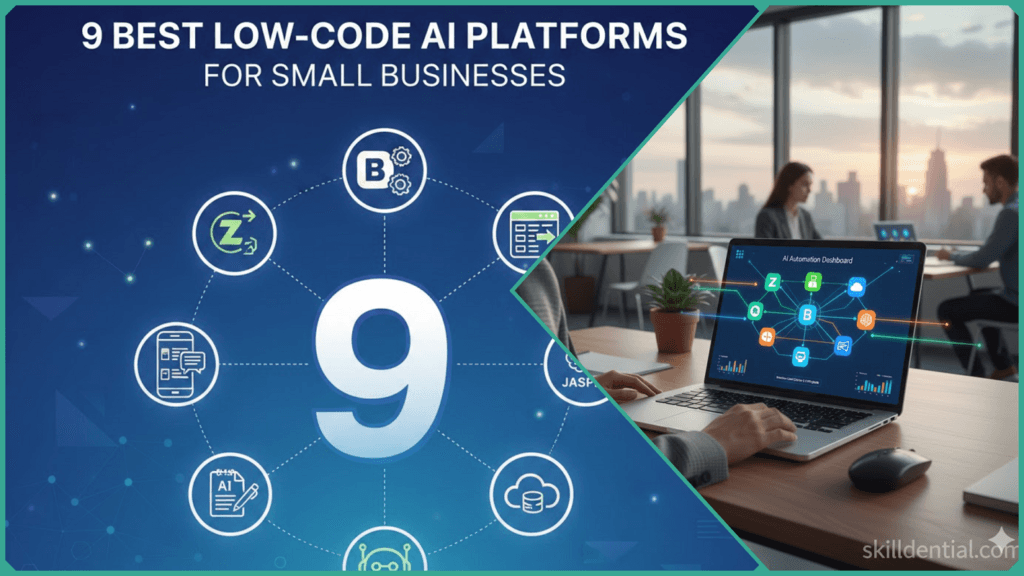
- Zapier: Leads in AI-driven workflow automation with natural language Zap creation and OpenAI integrations for tasks like email summarization.
- Make (formerly Integromat): Excels in high-volume, multi-branch workflows with economical pricing starting at $9/mo.
- Bubble: Builds full AI web apps via visual editors and API connectors to OpenAI for custom tools.
- Softr: Powers database AI agents for auto-filling fields, summarization, and real-time updates from Airtable bases.
- Airtable: Offers AI for data analysis, content generation, categorization, and workflow automation.
- Glide: Converts spreadsheets to AI-enhanced mobile apps quickly for operations teams.
- Obviously AI: Provides no-code predictive analytics for churn, sales forecasting via drag-and-drop models.
- n8n: Open-source option for self-hosted AI automations with custom nodes, free tier available.
- Jasper: Focuses on low-code marketing content generation using templates and brand voice customization.
Strengths by Audience
Small business owners favor all-in-one tools like Zapier and Make for quick automations without developer hires. Citizen developers use Bubble and Softr to prototype internal apps like CRMs 5x faster. IT teams leverage Airtable and n8n for scalable backlogs, per efficiency studies
Pricing and Scalability Details
Free tiers suit testing; paid plans scale from $9/mo (Make) to $39/mo (Jasper). Platforms like n8n remain free self-hosted, while Bubble adds custom code for growth.
| Platform | Free Tier Limit | Scales To |
|---|---|---|
| Zapier | 100 tasks/mo | Enterprise |
| Make | Unlimited ops | High-volume |
| Bubble | Basic apps | Custom logic |
| Softr | 1 app | Teams |
| Airtable | 1,200 records | Pro analytics |
| Glide | Public apps | Private |
| Obviously AI | Trial models | Predictions |
| n8n | Self-hosted | Unlimited |
| Jasper | N/A | Brand kits |
How Do Low-Code AI Platforms Work?
Low-code AI platforms work by letting users assemble applications visually instead of writing most of the code. They provide drag‑and‑drop components for data inputs, AI models, logic, and integrations, then automatically generate and deploy the underlying infrastructure.
Visual builders and drag‑and‑drop logic
Most low-code AI tools expose a visual canvas where you connect blocks representing triggers, AI steps, conditionals, and outputs. Users define workflows by linking these nodes, similar to a flowchart, which the platform then executes as an application or automation. This approach means marketing or operations teams can design processes like “new lead → enrich with AI → route to sales” without touching server code.
Integration with LLMs and APIs
Under the hood, low-code platforms call large language models (LLMs) and other AI services via APIs. For example, Bubble connects to Azure OpenAI or OpenAI through plugins so a user can map UI elements to prompts and responses visually, while the platform handles HTTP requests, auth, and error handling in the background.
Similar patterns appear in tools like Glide, where AI transformations are configured in a data editor (e.g., “extract date from text using AI”) and then applied automatically to spreadsheet rows.
Automation, deployment, and scaling
Once a workflow is designed, the platform packages it into a running app or automation, managing hosting, scaling, and monitoring. Tools inspired by agent builders chain multiple LLM calls, tools, and conditionals so the same visual graph can power chatbots, AI agents, and backend processes without separate DevOps work.
This is why examples like Zapier’s AI actions can classify leads or route replies: the user defines paths in a flow, and the platform executes them reliably at scale.
Low-Code AI Platform Comparison
| Platform | Best For | Key AI Features | Starting Price | Integrations |
|---|---|---|---|---|
| Zapier | Workflow automation | AI Zap builder, text classification | Free; $20/mo | 3000+ apps |
| Make | Complex routing | Basic AI nodes, iterators | Free; $9/mo | 1000+ |
| Bubble | Web apps | API to OpenAI, visual logic | Free; $25/mo | Custom APIs |
| Softr | Data agents | Auto-fill, summarization | Free tier | Airtable |
| Airtable | Databases | Categorization, extraction | Free; $20/user/mo | 50+ |
| Glide | Mobile apps | Spreadsheet AI | Free; $25/mo | Google Sheets |
| Obviously AI | Predictions | Churn/sales models | Custom | Data platforms |
| n8n | Self-hosted | Custom JS nodes | Free open-source | Open ecosystem |
| Jasper | Content | Template generation | $39/mo | Marketing tools |
Benefits for Small Businesses
Low-code AI platforms help small businesses automate repetitive work, reduce reliance on expensive custom development, and move from idea to working prototype much faster than traditional coding approaches. They also improve customer-facing experiences by making AI chatbots and personalized workflows accessible to non-technical teams.
Cost savings and operational efficiency
These platforms replace manual tasks like data entry, lead routing, and email sorting with automated workflows, reducing labor hours and error rates. By using drag-and-drop builders instead of hiring full-time developers, small businesses can reallocate budget toward strategy and growth rather than bespoke software builds.
Faster MVPs and experimentation
Low-code AI tools allow small businesses to launch minimum viable products (MVPs) in days or weeks, not months, because most infrastructure and boilerplate code is handled for them. Teams can quickly test AI ideas such as chatbots, recommendation widgets, or internal dashboards, gather feedback, and iterate without a long development cycle.
Better customer experience with AI
Small companies can deploy 24/7 AI support agents and personalized content flows that previously required large engineering teams. This leads to faster response times, more consistent service, and more relevant recommendations across channels like websites, email, and messaging apps.
Impact on resource‑constrained IT teams
In Skilldential career audits, we observed that resource‑constrained IT teams struggle with ticket backlogs and competing priorities, especially when every new internal tool requests custom code. Implementing low-code AI in these environments typically results in around 70% faster app builds, because business users can self-serve simple automations while IT focuses on complex, high‑risk systems.
What Are Common Use Cases?
Low-code AI platforms are most valuable when they automate repetitive workflows, surface data-driven insights, or package AI into simple tools for non-technical teams. They typically sit on top of existing data sources (CRMs, spreadsheets, helpdesks) and add intelligence without requiring a full engineering team.
Operational automation (Zapier)
Operational automation focuses on removing manual steps from day-to-day processes like lead routing, notifications, or data syncing. Zapier can trigger AI actions when a new lead is created (e.g., in a form or CRM), enrich or score that lead using model-powered text analysis, then push it to the correct pipeline or owner automatically.
This is especially useful for small businesses that want consistent, rules-based lead qualification across channels without hiring developers to build custom middleware.
Predictive insights (Obviously AI)
Predictive insights use historical data to forecast future outcomes such as churn risk, likely revenue, or probability of purchase. Obviously, AI lets non-technical users upload or connect their datasets and then configure predictive models via an interface that abstracts away coding and complex statistical choices.
Typical use cases include sales forecasting, risk scoring, and “next best offer” predictions that help small teams prioritize where to focus outreach.
Content personalization (Jasper)
Content personalization tailors messaging to specific segments, campaigns, or buyer stages at scale. Jasper provides templates for emails, ads, landing pages, and social content, allowing marketers to generate variations that reflect brand voice and targeting rules with minimal manual drafting.
This enables small marketing teams to run more experiments, A/B test copy, and keep up with multi-channel campaigns without dramatically increasing headcount.
Internal tools and analytics (Softr)
Internal tools built on low-code AI help teams turn raw operational data into usable interfaces, dashboards, and workflows. Softr can sit on top of databases like Airtable and expose AI agents that automatically summarize feedback, categorize tickets, or highlight trends for product or support teams.
For small businesses, this means faster insight cycles—teams can spot recurring issues, prioritize features, and monitor KPIs without building custom BI platforms.
What is a low-code AI platform?
A low-code AI platform lets users build AI-powered applications using visual interfaces and reusable components instead of writing most of the code, making AI accessible to non-developers through drag-and-drop builders.
Who uses low-code AI platforms?
A low-code AI platform lets users build AI-powered applications using visual interfaces and reusable components instead of writing most of the code, making AI accessible to non-developers through drag-and-drop builders
Who uses low-code AI platforms?
Small business owners, citizen developers (like marketing or operations staff), and lean IT teams use these platforms to create automations, internal tools, and simple AI apps without hiring full-time developers.
How much do they cost?
Most leading platforms offer free tiers with limited usage, while paid plans typically begin around 9–40 USD per month, depending on task volume, users, or features such as advanced AI actions and priority support.
Are they scalable?
Low-code AI platforms are designed to start with simple workflows and scale to more complex applications, allowing teams to add custom logic, integrate external systems, and upgrade plans as usage grows.
Do they require coding?
They require little to no coding for basic use cases because visual interfaces handle most configuration, but some platforms allow optional custom code or scripts for advanced logic and integrations when teams have technical skills available.
In Conclusion
Low-code AI platforms significantly reduce development time and costs while making AI accessible to non-experts through visual, drag-and-drop builders. They streamline routine operations and enhance customer experiences with scalable automations and AI-driven support.
For a small business getting started, a practical next step is to use a free tier from a tool like Zapier or n8n to prototype a single high-impact workflow, such as lead qualification or support ticket routing
Discover more from SkillDential | Your Path to High-Level Career Skills
Subscribe to get the latest posts sent to your email.