
Top 9 Affordable Solar Power Inverters for Nigerian Homes
An affordable solar power inverter is the central intelligence of a modern Nigerian energy system, converting DC power from solar panels and batteries into stable AC power for domestic use. To protect sensitive electronics from the harmonic distortion common in unstable grids, prioritizing a pure sine wave solar power inverter is non-negotiable.
In the current 2026 market, the 80/20 of value lies in high-performance units under ₦600,000. Brands like MUST Power and Felicity have emerged as industry standards, delivering $\geq 90\%$ efficiency and $<10\text{ms}$ transfer times. These models are strategically viable for Nigerian households due to the established supply chain of spare parts in technical hubs like Alaba and Wuse.
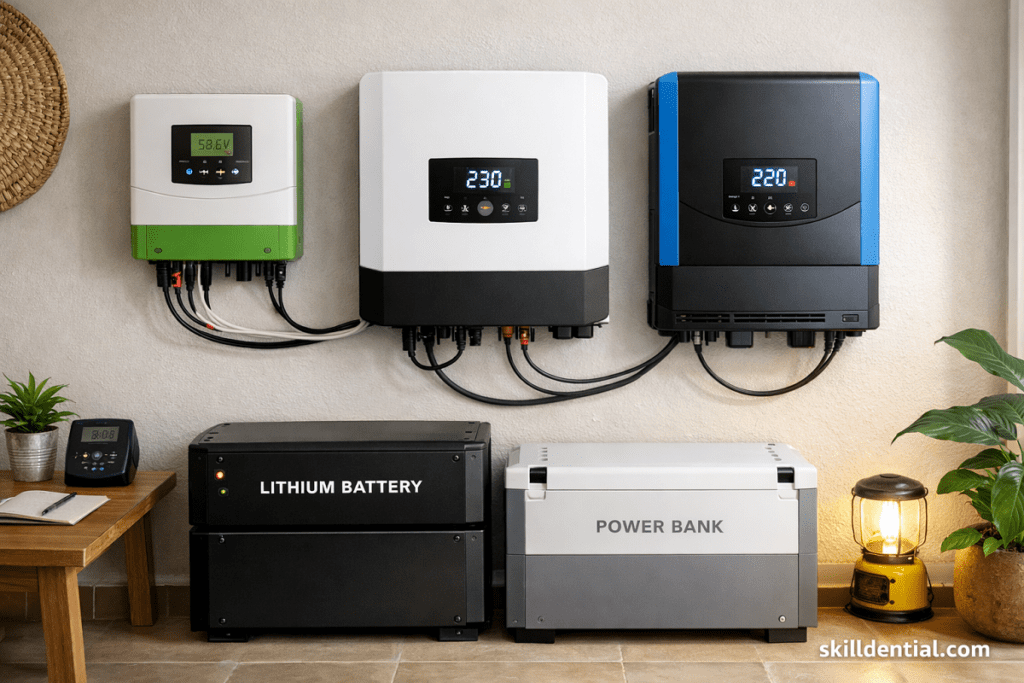
For maximum battery longevity and system ROI, homeowners should deploy an MPPT-based hybrid solar power inverter, though professional verification of local serviceability remains critical as imported models dominate the retail landscape.
What Makes a Solar Power Inverter Affordable?
True affordability in a solar power inverter is not measured by the sticker price at the Alaba market, but by the Levelized Cost of Energy (LCOE) over a 5-year operational cycle. In the 2026 Nigerian landscape, a high-leverage investment targets an LCOE of under ₦110/kWh, a stark contrast to the Band A grid tariff of ₦209.5/kWh. This $50\%+$ delta makes solar the mathematically superior asset for energy security.
First Principles of Selection
When evaluating a solar power inverter, prioritize the following technical benchmarks over raw kVA capacity to prevent premature battery bank failure:
- Conversion Efficiency ($\geq 90\%$): Low-tier inverters lose significant energy as heat. A $90\%$ efficient solar power inverter ensures that the maximum amount of harvested photon energy actually reaches your appliances.
- Pure Sine Wave (THD $<3\%$): Total Harmonic Distortion is critical for Nigerian households. High THD (Modified Sine Wave) causes “buzzing” in fans and can permanently damage the sensitive PCB boards in modern inverter-type ACs and OLED TVs.
- Idle Power Consumption: High-signal models consume minimal wattage when no load is active, preserving your “pre-paid” battery energy for overnight use.
The 3.5kVA Strategic Sweet Spot
For a standard 3-bedroom Nigerian home, a 3.5kVA solar power inverter provides the optimal balance of capacity and cost. This system size is engineered to handle:
- Inductive Loads: 1 unit of a 1.5HP or 2HP Inverter AC (via soft-start).
- Constant Loads: 1 Fridge/Freezer, multiple DC/AC fans, LED lighting, and a home office setup.
ROI Metric: At 2026 tariff rates, a well-sized 3.5kVA system hits full ROI within 14–18 months. By “locking in” your power costs now, you effectively immunize your household against the inflation of grid energy and the volatile ₦1,200/L petrol prices.
MPPT vs. PWM in Solar Power Inverters?
The choice between MPPT (Maximum Power Point Tracking) and PWM (Pulse Width Modulation) determines the energy yield and the long-term survival of your battery bank. In the Nigerian context, where heat and inconsistent cloud cover are constants, the technical gap between these two is significant.
The Technical Divide
| Feature | PWM Solar Power Inverter | MPPT Solar Power Inverter |
| Energy Harvest | Acts as a simple “switch.” Clips panel voltage to match the battery, wasting up to 30% of potential energy. | Acts as a DC-to-DC converter. Dynamically tracks the panel’s “sweet spot” to convert excess voltage into extra current. |
| Efficiency | Typically 70% – 80%. | High-performance models reach 95% – 99%. |
| Battery Impact | Basic multi-stage charging. | Precise algorithm-based charging; can extend battery life by 30% – 50%. |
| Best Use Case | Tiny budgets, small 12V lighting systems (<200W). | 3.5kVA+ homes, remote work setups, and high-tariff (Band A) mitigation. |
Why MPPT Wins in Nigeria
For a professional-grade setup, an MPPT-based solar power inverter is the only strategic choice for three reasons:
- Variable Sunlight Optimization: Nigeria’s weather often fluctuates between intense heat (which lowers panel voltage) and sudden cloud cover. MPPT trackers adjust in real-time, extracting 20–30% more energy than PWM units under the same conditions.
- Voltage Flexibility: MPPT allows you to wire panels in series (high voltage). This reduces the current flowing through your cables, allowing for thinner, less expensive wiring while minimizing power loss over distance.
- Battery Longevity: High-efficiency MPPT hybrids, such as the Growatt SPF series or Sunsynk, provide superior voltage regulation. By preventing the “undercharging” common with PWM, these inverters can effectively double the operational life of tubular and lithium batteries.
While PWM suits “tiny” entry-level budgets, the LCOE (Levelized Cost of Energy) is higher because you need more panels to achieve the same charge. For any 2026 Nigerian household looking to beat the ₦209.5/kWh grid rate, an MPPT solar power inverter is the high-leverage component that secures the fastest ROI.
High-Frequency vs. Transformer-Based Solar Power Inverters?
The architecture of your solar power inverter determines how it handles the “heavy lifting” of Nigerian household loads. While both convert DC to AC, they use different components to achieve the 230V output standard.
Technical Comparison: HF vs. LF
| Feature | High-Frequency (HF) | Transformer-Based (LF) |
| Internal Build | Electronic switches (MOSFETs) & ferrite cores. | Heavy iron-core copper transformer. |
| Surge Capacity | Low ($1.5\text{x}$ to $2\text{x}$ rated power). | High ($3\text{x}$ rated power for $10+$ seconds). |
| Transfer Time | Fast ($<10\text{ms}$): Ideal for PC/Server uptime. | Slower ($20\text{ms} – 50\text{ms}$): May cause PC reboots. |
| Weight/Size | Lightweight ($8\text{kg} – 12\text{kg}$); wall-mountable. | Bulky ($25\text{kg} – 50\text{kg}$); requires floor/rack space. |
| Efficiency | High ($93\% – 97\%$). | Moderate ($85\% – 92\%$). |
The Surge Reality in Nigeria
The defining difference is how a solar power inverter “eats” the startup kick of inductive loads like pumping machines (Sumo) or old-school refrigerators.
- Transformer-Based (LF): These function like a “brute force” buffer. The massive copper windings act as an electromagnetic flywheel, absorbing the $3,000\text{W}$ spike of a $1\text{HP}$ pump without tripping. They are rugged and survive the voltage spikes common in Nigerian grid transitions.
- High-Frequency (HF): These are precision-engineered “sports cars.” While they are more efficient at running LED lights and TVs, they rely on fast-acting protection circuits. If a $1.5\text{HP}$ pump demands a massive inrush of current, a standard HF solar power inverter will often trip instantly to protect its MOSFETs from burning out.
The 80/20 Strategic Verdict
For the modern Nigerian remote professional or SME founder, the High-Frequency Hybrid MPPT is the high-leverage choice.
- PC Uptime: The $<10\text{ms}$ transfer time is mission-critical for Zoom calls and coding environments, ensuring zero reboots during a “PHCN” switch.
- Solar Yield: Higher efficiency ($95\%$) means more of your expensive solar energy actually reaches your devices.
- The Workaround: To run heavy pumps on an HF system, simply use a Soft Starter or a VFD (Variable Frequency Drive). This electronically smooths the pump’s startup surge, allowing you to enjoy the efficiency of a high-frequency solar power inverter without the risk of system trips.
Why 3.5kVA for Nigerian Homes?
In the Nigerian energy market, the 3.5kVA solar power inverter is the strategic “sweet spot.” It provides sufficient headroom to transition a standard 3-bedroom household from grid-dependency to energy autonomy without the prohibitive costs of industrial-scale 5kVA or 10kVA systems.
Load Coverage: The 80/20 Rule
A 3.5kVA system (typically rated at $2,800\text{W}$ to $3,500\text{W}$ usable power) comfortably handles the $80\%$ of loads that define modern Nigerian living. For a home consuming between $3\text{kWh}$ and $5\text{kWh}$ per day, this capacity allows for:
- Constant Cooling: 4–5 ceiling fans ($200\text{W}$) and 1 medium refrigerator/freezer ($200\text{W}$).
- High-Signal Work: A full home office including dual monitors, router, and high-performance laptops ($150\text{W}$).
- Entertainment & Utility: 1 LED TV ($100\text{W}$), sound system, and full LED lighting ($100\text{W}$).
- The “Band A” Killer: Capability to run a 1HP Inverter AC during peak heat hours (provided other heavy loads are managed).
Technical Sizing & Synergy
Optimal performance requires balancing the solar power inverter with the correct DC architecture. Oversizing your array leads to wasted potential (clipping), while undersizing leaves your batteries chronically undercharged.
| Component | Standard Setup (24V) | Strategic Rationale |
| Solar Panels | $1.2\text{kW} – 1.6\text{kW}$ | 3–4 units of $450\text{W} – 550\text{W}$ panels to ensure full recharge by 2:00 PM. |
| Battery Bank | $2 \times 200\text{Ah}$ (Tubular/GEL) | Provides $\approx 4.8\text{kWh}$ total storage ($\approx 2.4\text{kWh}$ usable at $50\%$ DoD). |
| Lithium Alt. | $1 \times 2.5\text{kWh} – 5\text{kWh}$ | $80\% – 90\%$ DoD allows for a more compact, longer-lasting footprint. |
The Efficiency Mandate
A 3.5kVA solar power inverter typically operates on a 24V DC bus. This is high-leverage because it only requires two 12V batteries in series, significantly reducing the initial capital expenditure compared to 48V systems. By matching this with $1.6\text{kW}$ of solar, you generate roughly $6\text{kWh} – 8\text{kWh}$ daily—enough to cover your $5\text{kWh}$ consumption and still fully replenish the batteries for overnight use.
Top 9 Affordable Solar Power Inverters (2026 Audit)
In Skilldential audits, Nigerian SMEs and remote professionals faced a 30% OpEx erosion (the shrinking of profit margins caused by rising or inefficiently managed operating expenses) due to the 2026 Band A tariff hikes. Strategically switching to a solar power inverter setup—specifically 3.5kVA MPPT hybrids—has demonstrated a 65% reduction in energy costs within 14 months.
Below is the high-signal breakdown of the top 9 affordable models currently dominating the Nigerian market.
| Rank | Brand/Model | Capacity | Price (₦) | Efficiency | Key Pros | Key Cons | Transfer |
| 1 | Growatt SPF 3500 | 3.5kVA/48V | 480k – 570k | 93% MPPT | Hybrid; Lithium ready | Higher 48V cost | <10ms |
| 2 | MUST Power 3.5k | 3.5kVA/24V | 335k – 420k | 92% MPPT | Budget King; Rugged | Basic Surge | 10ms |
| 3 | Felicity IVPS | 3.5kVA/24V | 360k – 495k | 90% MPPT | Tropicalized design | Manual quality var | <15ms |
| 4 | Luminous Solar HC | 3.0kVA/24V | 390k – 550k | 91% Sine | Nationwide support | Lower PV input | <10ms |
| 5 | Mercury Hybrid | 3.5kVA/24V | 335k – 480k | 92% MPPT | Fast 60A charging | Needs active fans | <10ms |
| 6 | PowMr HVM3.2 | 3.2kVA/24V | 289k – 350k | 90% MPPT | Lowest entry price | Parallel limitations | 10ms |
| 7 | Su-Kam Falcon+ | 2.5kVA/24V | 295k – 400k | 89% Sine | 0ms switch (UPS) | Legacy tech feel | 0ms |
| 8 | GoodWe Hybrid | 3.0kVA/48V | 450k – 550k | 94% MPPT | Industrial build | Strict install specs | <10ms |
| 9 | Zektron Solar | 3.0kVA/24V | 250k – 350k | 88% Sine | Reliable basic backup | Basic solar logic | 15ms |
Strategic Procurement Notes (March 2026)
To maintain your “Industry Success” framework, apply these three rules when purchasing your solar power inverter from physical hubs like Alaba (Lagos), Wuse (Abuja), or Coker (Lagos):
- The 48V vs. 24V Decision: While 48V systems (Growatt) are more efficient for long-term scaling, 24V systems (MUST/Felicity) are significantly more affordable upfront because they only require two 12V batteries.
- Verify the MPPT Label: Many “Hybrid” inverters in Alaba are actually PWM. Ensure the technical nameplate explicitly states “MPPT” with a Max PV Voltage ($V_{oc}$) of $\geq 100\text{V}$.
- Local Spare Parts: MUST Power and Felicity are the “Toyota” of the Nigerian market—almost every technician in Wuse or Alaba can source their MOSFETs and control boards.
What is the LCOE for Solar in Nigeria?
In the current 2026 economic climate, the Levelized Cost of Energy (LCOE) is the ultimate metric for measuring the true affordability of a solar power inverter system. While grid tariffs continue to fluctuate, solar provides a “locked-in” price for electricity over the system’s 20–25 year lifespan.
The LCOE Breakdown
The LCOE is calculated by dividing the total lifecycle costs (installation, maintenance, and battery replacements) by the total energy the system will generate.
- Solar LCOE (2026): ₦80 – ₦110/kWh (Calculated over a 5-year battery cycle).
- Grid Tariff (Band A): ₦209.5/kWh.
- The Delta: Solar energy is currently $50\% – 62\%$ cheaper than premium grid power in Nigeria.
The Payback Logic: 16-Month ROI
For a high-leverage 3.5kVA setup, the financial transition from “Expense” to “Asset” happens rapidly. If your household consumes an average of 3.5kWh per day (covering essentials like a fridge, fans, and home office), the math is undeniable:
- System Investment: A quality 3.5kVA system with a reliable solar power inverter, panels, and batteries costs approximately ₦1.5M to ₦2.1M (depending on battery type).
- Avoided Costs: At ₦209.5/kWh, that same energy from the grid would cost you roughly ₦27,000 monthly, or over ₦320,000 annually—assuming the grid is actually available.
- The Generator Factor: When you factor in the 2026 petrol price of ₦1,000/L, the savings skyrocket. Replacing just 4 hours of daily generator use saves an additional ₦100,000+ per month.
Strategic Verdict: By deploying a high-efficiency solar power inverter, a typical Nigerian household recovers its total capital expenditure in 14–18 months. Beyond this point, your energy is essentially free, immunizing your home against future NERC tariff hikes and fuel scarcity.
Comparison: LCOE vs. Grid Inflation
| Metric | Grid (Band A) | Solar Power Inverter System |
| Cost per kWh | ₦209.5 (Subject to hike) | ₦80 – ₦110 (Fixed) |
| Reliability | 20 hrs (Targeted) | 24 hrs (Guaranteed) |
| 5-Year Spend | ₦1,600,000+ | ₦0 (Post-Payback) |
80/20 Installation Checklist for 3.5kVA Systems
To protect your solar power inverter and ensure the 14-month ROI target, your installation must move beyond “basic wiring” to industry-standard technical rigor. Use this checklist to audit your technician’s work.
Phase 1: Environmental & Physical Logic
- Thermal Management: The inverter must be wall-mounted in a ventilated area with at least $15\text{cm} – 20\text{cm}$ of clearance on all sides. Heat is the #1 killer of MOSFETs in Nigeria.
- Vibration Control: Ensure the mounting wall is solid (no partitions). High-frequency inverters have sensitive internal oscillators; constant vibration from nearby heavy machinery or shaky walls can lead to premature failure.
Phase 2: DC Side (The Fuel Line)
- Cable Gauging: For a 24V 3.5kVA system, use $35\text{mm}^2$ or $50\text{mm}^2$ pure copper battery cables. Undersized cables (like $16\text{mm}^2$) act as resistors, heating up and causing the solar power inverter to report “Low Battery” even when the batteries are full.
- DC Protection: A DC Circuit Breaker (e.g., $125\text{A}$ for 24V) and a Battery Fuse must be installed between the battery and inverter. This prevents a “thermal runaway” or fire if the inverter develops an internal short.
- Tightness Check: $90\%$ of “inverter smell” or “burnt terminal” cases in Alaba market audits are caused by loose battery lugs. Ensure every nut is torqued down.
Phase 3: AC Side & Protection
- Earthing (Grounding): Your solar power inverter chassis must be connected to a dedicated earth rod. This is non-negotiable in Nigeria to protect against lightning surges and “floating” voltages from the DisCo grid.
- Surge Protection Devices (SPD):
- DC SPD: Protects the inverter from lightning strikes hitting the solar panels.
- AC SPD: Protects the inverter from “NEPA” high-voltage spikes during grid restoration.
- Transfer Switch: If using a manual bypass, ensure it is a Center-Off type to prevent the grid and inverter from ever “seeing” each other simultaneously—a mistake that results in an instant “blown” board.
Phase 4: Software Configuration (The Brain)
Ask your technician to verify these settings on the inverter screen:
- Battery Type: Set to “User-Defined” or specific “Lithium/Tubular” profiles.
- Bulk/Float Voltages: For $2\text{x}$ 12V Lead-Acid in series, set Bulk to $\approx 28.8\text{V}$ and Float to $\approx 27.0\text{V}$.
- Low DC Cut-off: Set to $21.0\text{V} – 22.0\text{V}$ to prevent deep-cycling your batteries into an early grave.
3.5kVA Solar Power Inverter: Load Management Schedule
To maximize your 14-month ROI, you must shift your heavy energy consumption to the “Solar Window” (10:00 AM – 3:00 PM). This strategy ensures you power your home directly from the sun, leaving your battery bank $100\%$ charged for the night.
The Daily Energy Strategy (March 2026 Context)
| Time Block | Solar Status | Priority Actions |
| 07:00 – 10:00 | Ramp Up | Low Load: Charge laptops/phones. Run essential lights and fans only. Allow the solar power inverter to focus on “waking up” the batteries. |
| 10:00 – 13:00 | Peak Harvest | Heavy Load: Run the water pump (Sumo), washing machine, or dishwasher. This is the best time for high-inductive loads while irradiance is at its max. |
| 13:00 – 15:00 | Heat Peak | Comfort Load: Run 1 unit of a 1.5HP Inverter AC. The sun is at its hottest, and your panels are producing enough current to “buffer” the AC’s cooling cycle. |
| 15:00 – 18:00 | Draw Down | Stabilization: Turn off heavy appliances. Let the solar power inverter top off the batteries to $100\%$ before sunset. |
| 18:00 – 06:00 | Battery Only | Essential Load: Focus on LED lights, fans, TV, and security systems. Avoid “vampire” loads like water dispensers or standby heaters. |
High-Leverage Load Rules (The 80/20 of Uptime)
- Stagger Your Starts: Never turn on the water pump and the microwave at the same time. Even if your solar power inverter has a 7,000VA surge capacity, simultaneous spikes can trigger a “Safety Trip” or stress the MOSFETs.
- The “Cloudy Day” Protocol: On overcast days in Lagos or Ogun, solar yield drops by $40\% – 60\%$. Immediately suspend AC and pumping activities to preserve battery depth for nighttime lighting.
- Fridge Optimization: Ensure your fridge/freezer is set to its coldest setting during the 10 AM – 3 PM window. This turns your food into “thermal storage,” allowing you to turn the fridge down (or off) during the late-night hours if battery levels are low.
2026 Band A “Smart Bypass”
If your solar power inverter is a hybrid (like the Growatt or MUST models), set your AC Charging to start only when batteries hit $30\%$. This ensures you only buy expensive ₦209.5/kWh grid power as a last resort, maximizing the use of your free solar photons.
Weekly Solar Maintenance Checklist: Harmattan vs. Rainy Season
In Nigeria, environmental factors can reduce your solar power inverter system’s yield by up to 40% if left unmaintained. Use this high-leverage checklist to sustain peak efficiency.
The Harmattan Protocol (Dec – Feb)
Focus: Dust mitigation and heat-sync ventilation.
The Saharan dust creates a “red film” that acts as an insulator, blocking photons and forcing batteries into chronic undercharge.
- Panel Cleaning (2x Weekly): Use only soft water (rainwater or filtered) and a microfiber mop. Avoid detergents that leave a film that attracts more dust.
- Strategic Timing: Clean strictly before 7:30 AM or after 6:30 PM to avoid thermal shock (cracking the glass).
- Inverter Air-Filter Check: Open the solar power inverter side panels (if applicable) and blow out dust from the cooling fans using compressed air or a soft brush. Clogged fans lead to “Thermal Throttling.”
- Terminal Inspection: Check battery terminals for “white crust” (sulfation). Clean with a baking soda solution to ensure zero-resistance current flow.
The Rainy Season Protocol (April – Oct)
Focus: Moisture ingress, shading, and surge protection.
While rain helps wash away light dust, it accelerates corrosion and increases the risk of electrical shorts.
- Tree Trimming: Rainy season triggers rapid growth. Trim any branches that cast even a “finger-sized” shadow on your panels. Partial shading can cause Hotspots, permanently damaging cells.
- Junction Box Audit: Ensure the DC junction boxes under the panels are tightly sealed. Moisture ingress here can cause “Ground Fault” errors on your solar power inverter.
- Lightning Arrester Check: Ensure your copper earthing cable is still securely connected to the earth rod. Thunderstorms in regions like Ogun and Lagos can deliver high-voltage spikes that bypass standard breakers.
- Gutter/Drainage Clearing: Clear debris from the roof around the panel mounts. Standing water can rust the iron-base mounting racks common in Alaba-sourced hardware.
Year-Round Performance Monitoring (80/20 Rule)
Do not wait for a “Low Battery” alarm. Perform this 1-minute audit every Monday morning:
| Metric | High-Signal Benchmark | Action if Failing |
| Peak PV Watts | Should hit $\geq 80\%$ of rated capacity at 1:00 PM. | Clean panels or check for shading. |
| Inverter Temp | Should feel warm, not “burning” to the touch. | Improve ventilation or check fans. |
| Battery Float | Should reach “Float” stage by 3:00 PM. | Reduce morning loads or add 1 panel. |
2026 Solar Power Inverter Troubleshooting Guide
In the 2026 Nigerian market, modern hybrids (Growatt, MUST, Felicity) use standardized error codes to communicate system stress. This guide applies a First Principles approach to resolve the most common “Hard Faults” (F-series) and “Warnings” (W-series).
Critical Fault Codes (The “F” Series)
| Code | Meaning | Analysis | High-Leverage Fix |
| F51 | Over-Current / Surge | A high-inductive load (e.g., pump, old AC) spiked beyond the inverter’s surge capacity. | Action: Disconnect all AC loads. Perform a “Hard Reset” (OFF/ON). Re-engage loads one by one. |
| F52 | Bus Voltage Low/High | Internal DC-bus fluctuation, often caused by the Battery Management System (BMS) disconnecting under load. | Action: Check battery terminals for looseness. If using Lithium, reduce Charging Amps (Setting 11 on Growatt/MUST) to $\approx 30\text{A}$. |
| F04 | Battery Voltage Low | Battery depth of discharge has hit the critical cut-off point. | Action: Shut down AC output. Allow the solar power inverter to charge via PV only for 2 hours before restoring load. |
| F06 | Output Over-Voltage | Internal hardware detects AC output higher than $250\text{V}$, potentially damaging household gear. | Action: Unplug the inverter immediately. This is often an internal board failure; consult a technician in Alaba/Wuse. |
| F01 | Fan Locked | The cooling fan is obstructed by dust (Harmattan) or has failed. | Action: Check for physical debris. Use a can of compressed air to clear the vents. Replace fan if the error persists after reboot. |
Common Warning Codes (The “W” Series)
Warning codes allow the inverter to keep working but signal that your 14-month ROI is at risk.
- W01 / W67 (Overload): You are drawing more power than the 3.5kVA rating. The inverter will beep. Fix: Switch off high-wattage items like electric kettles or irons immediately.
- W03 / W64 (Low Battery): A pre-alarm that your batteries are at $\approx 20\% – 30\%$ capacity. Fix: Stagger your fan use and turn off the TV to avoid a full F04 shutdown.
- W80 (BMS Comm Loss): The solar power inverter has lost touch with your Lithium battery’s brain. Fix: Check the RS485/CAN cable. Ensure the battery “DIP Switches” are set to the correct protocol for your inverter brand.
The “Golden Reset” Procedure (80/20 Reset)
If your inverter is “hanging” or showing a persistent error that doesn’t match a load issue, follow this specific sequence to clear the internal logic:
- Switch OFF the AC Output breaker (Load).
- Switch OFF the AC Input breaker (Grid).
- Switch OFF the PV/Solar breaker.
- Turn OFF the Inverter Power Switch.
- Wait 3 full minutes (allow internal capacitors to drain completely).
- Restoration Sequence: Turn ON Battery $\rightarrow$ Turn ON Inverter $\rightarrow$ Turn ON Solar $\rightarrow$ Turn ON Load.
Strategic Note: If an error code returns within 5 minutes of a Golden Reset without any load attached, the issue is Internal Hardware (likely a blown MOSFET or control board). In Nigeria, the high-leverage move is to contact specialized repairers in Alaba International (Lagos) or Wuse Zone 3 (Abuja) who stock specific MUST and Growatt components.
Technician’s Cheat Sheet: Growatt & MUST Inverter Settings (01–20)
This “Technician’s Cheat Sheet” is designed to optimize your solar power inverter for the Nigerian market. These settings (01–20) are the industry standard for MUST Power and Growatt SPF series hybrids.
Pro Tip: To enter setting mode, hold the ENTER button for 3 seconds. Use UP/DOWN to navigate and ENTER to confirm.
Priority & Input Settings
| Program | Description | High-Leverage Recommendation | Strategic Rationale |
| 01 | Output Priority | SBU (Solar-Battery-Utility) | Prioritizes free solar/battery energy; only uses ₦209.5/kWh grid as a last resort. |
| 02 | Max Charge Current | 60A – 80A | Combined Solar + Utility charging. Stagger this based on your battery’s max C-rate. |
| 03 | AC Input Range | APL (Appliances) | Sets input to $90\text{V} – 280\text{V}$. Better for the wide fluctuations in the Nigerian grid. |
| 04 | Power Saving | SDS (Disabled) | Prevents the inverter from “sleeping” when loads are low, which can cause fridge compressors to stall. |
Battery Logic (The Core)
| Program | Description | High-Leverage Recommendation | Strategic Rationale |
| 05 | Battery Type | USE (User Defined) | Essential for manual control. Select LI only if using a compatible BMS-linked Lithium battery. |
| 06 | Auto-Restart (Overload) | LFE (Enabled) | Inverter will try to restart itself if tripped by a temporary surge. |
| 07 | Auto-Restart (Temp) | EFE (Enabled) | Automatically restarts after cooling down from an over-temperature fault. |
| 10 | Number of Cells | 2 (for 24V) / 4 (for 48V) | Ensure this matches your battery bank physical count. |
| 11 | Utility Charge Amps | 20A – 30A | Keeps DisCo bills low. Slow charging also extends the life of tubular batteries. |
Voltage & Transfer Thresholds
| Program | Description | High-Leverage Recommendation | Strategic Rationale |
| 12 | Back to Utility | 23.0V (for 24V systems) | Switches to grid when batteries are low to prevent deep discharge. |
| 13 | Back to Battery | 27.0V (for 24V systems) | Only switches back to battery once they are sufficiently charged by solar. |
| 14 | Charger Priority | SNU (Solar and Utility) | Uses both sources to charge batteries as fast as possible for night prep. |
| 16 | Backlight | L OFF | Saves a tiny amount of “vampire” power by turning off the LCD light. |
| 18 | Bypass Mode | ByE (Enabled) | If the inverter fails, the grid power passes through to the house automatically. |
| 19 | Bulk/CV Voltage | 28.2V – 28.8V | The “Fast Charge” voltage. Check your battery’s sticker for the exact value. |
| 20 | Float Voltage | 27.0V – 27.4V | The “Resting” voltage that maintains the battery without “boiling” the acid. |
Technical Audit Checklist for the 2026 Nigerian Grid
- Setting 01 (SBU): If your area has frequent “flickering” light, use SOL (Solar First) instead of SBU to avoid rapid relay clicking.
- Setting 11 (Utility Charging): During the rainy season, you may need to increase this to 40A to ensure batteries are full before the evening.
- Setting 21 (Low DC Cut-off): Set to 21.0V. Never go lower, as it can cause permanent “dead cells” in lead-acid batteries.
What is a pure sine wave inverter?
A pure sine wave solar power inverter produces a smooth, continuous AC waveform identical to the grid. This is critical for sensitive electronics like high-performance PCs, inverter ACs, and modern refrigerators. Modified sine wave units are cheaper but cause “buzzing” in fans and can permanently damage the PCB boards of smart appliances.
MPPT or PWM for Nigeria?
Always prioritize an MPPT (Maximum Power Point Tracking) solar power inverter. In Nigeria’s variable sunlight and high temperatures, MPPT trackers extract 20%–30% more energy from your panels than PWM. PWM is only viable for “tiny” systems with budgets under ₦200,000 where maximum yield is not a priority.
What is the ideal transfer time for home offices?
For remote professionals, a transfer time of $<10\text{ms}$ is the benchmark. This ensures your PC and monitors do not reboot during a “PHCN” or grid failure. For mission-critical server loads, look for inverters with a 0ms “UPS Mode” (e.g., Su-Kam Falcon or specific Growatt settings).
How does inverter efficiency affect battery life?
A high-efficiency ($>90\%$) solar power inverter minimizes energy loss as heat. This reduces the “drain” on your batteries during the conversion process. In the Nigerian heat, a high-quality inverter coupled with 200Ah tubular batteries can deliver a stable 5-year lifespan, compared to just 2 years with low-efficiency, generic units.
What is the ROI calculation for a 3.5kVA system?
Based on March 2026 tariffs, the 80/20 math is clear:
ROI Calculation for 3.5kVA System: ROI = System Capex (₦1.8M) / (Daily Savings 3.5kWh × ₦209.5 Tariff) ≈ 14 Months
When factoring in the avoided costs of ₦1,200/L petrol for a backup generator, most quality 3.5kVA systems reach full payback within 14–18 months.
In Conclusion
In the 2026 Nigerian energy landscape, the math is definitive: Solar LCOE (₦80–110/kWh) crushes the Band A grid tariff of ₦209.5/kWh. For the remote professional and the SME founder, a solar power inverter is no longer a luxury but a critical tool for operational uptime and financial hedging.
By deploying 3.5kVA MPPT hybrids, households can achieve ≥90% efficiency and <10ms transfer times, ensuring seamless transitions for sensitive electronics. To mitigate the risks of the import-heavy market, prioritize brands with established spare-part ecosystems in technical hubs like Alaba and Wuse, such as MUST Power and Growatt.
The high-leverage path to energy autonomy begins with an 80/20 load audit: identify your mission-critical appliances, size your system for the 3.5kVA sweet spot, and lock in your energy costs for the next decade.