9 Ways to Create a Side Business Using AI: Zero Code Needed
To create a side business using AI means using ready-made artificial intelligence tools to deliver services or products without writing a single line of code. Recent 2026 industry data shows that no-code platforms reduce development time by up to 90%, allowing entrepreneurs to launch in days rather than months.
While most tools offer free tiers for experimentation, the “secret sauce” isn’t the AI itself—it’s choosing a specific, high-value problem to solve rather than using AI generically.
How can non-technical people create a side business using AI?
Non-technical individuals are no longer sidelined by a lack of coding skills. In 2026, the barrier to entry has shifted from syntax (writing code) to intent (writing prompts).
- From Specialist to Generalist: Much like Canva allowed non-designers to create professional graphics and WordPress allowed non-developers to build websites, AI allows you to act as a “Creative Director” over multiple departments.
- Infrastructure vs. Outcomes: You no longer need to build the engine; you just need to know where to drive the car. Modern AI tools handle the “infrastructure” (the math and logic) while you focus on the “outcomes” (the product or service).
- Prompt-Based Operations: Complexity is now managed through plain-language workflows. If you can describe a business process, you can automate it.
Strategic Content Tip: The “Vibe-Coding” Trend
In early 2026, a term often used for this is “Vibe Coding,” where people use natural language and “vibes” to direct AI agents to build apps or workflows (using tools like Lovable, Bolt, or Replit Agent). Including this term could make your blog post feel very “of the moment.”
Helpful Comparison Table for Your Readers
| Era | The Barrier | The Solution for Non-Techies |
| Web 1.0 | HTML/CSS | WordPress (Visual Building) |
| Design Era | Photoshop/Illustrator | Canva (Templates) |
| The AI Era | Python/Software Dev | AI Agents & Prompts (Natural Language) |
Why is now the right time to create a side business with AI?
Many people assume that because AI is everywhere, the opportunity is gone. The reality is the opposite: we have moved from the Experimental Phase to the Integration Phase, and that is where the money is made.
The “Adoption Gap” is Your Opportunity
While 93% of large corporations have moved AI into production, small businesses (SMBs) are struggling to keep up. Research from early 2026 shows a massive “Adoption Gap”:
- Large Enterprises: 44% adoption rate.
- Micro-Businesses (<10 employees): Only 24% adoption rate.
The Side Hustle Logic: You can be the “bridge.” Small business owners are desperate for AI solutions but don’t have the time to learn them. If you can use a no-code tool to save a local plumber 20 hours a month, you have a business.
From “Replacing” to “Assisting”
The fear of AI taking all jobs has shifted into a reality of AI-assisted roles. A January 2026 IMF report confirms that 40% of global jobs are now “AI-exposed,” but the demand for workers who know how to use AI is skyrocketing.
- Businesses aren’t looking for “AI Engineers”; they are looking for “AI-Savvy Managers” and “No-Code Automators.”
- Side businesses thrive during these transitions because you can offer specialized, high-speed services that traditional agencies are too slow to provide.
The Tools are “Mature” (and Cheaper)
In 2023, AI was glitchy and expensive. In 2026, we have “Automation Stacking” and “Agentic AI”—systems that can perform multi-step tasks autonomously.
- Lower Costs: You can now launch a side hustle with a stack of tools (like ChatGPT, Zapier, and Canva) for less than $100/month.
- No-Code Maturity: Platforms like Lovable and Replit Agent allow you to build functional apps using only “vibes” (natural language), removing the last technical barrier.
Comparison: Why 2026 beats 2024
| Feature | 2024 (The Hype) | 2026 (The Utility) |
| Tool Reliability | Experimental / Hallucinations | Production-ready / Reliable |
| Market Awareness | “What is ChatGPT?” | “How do I make AI work for my ROI?” |
| Barrier to Entry | Required basic prompting skills | Natural language “Agents” do the work |
| Client Demand | Curiosity-driven | Result-driven (Time/Money saved) |
How to Use AI Safely: The “Human-Curated” Framework
The key to staying safe is shifting your mindset from being an “AI Publisher” to being an “AI-Assisted Curator.”
Google’s E-E-A-T Standard
Google’s 2026 guidelines focus on Experience, Expertise, Authoritativeness, and Trustworthiness. AI can help with the “A” and “T” by organizing facts, but it cannot fake the first “E” (Experience).
- The Rule: If you use AI to draft an article, you must add a personal anecdote, a unique screenshot, or a specific case study that only a human could know.
- The Penalty: Google’s SpamBrain system specifically targets “scaled content abuse”—publishing 50 generic AI articles in a day to game the system.
The EU AI Act & Transparency (August 2026)
If you are operating in or serving the EU, the AI Act (fully enforced by August 2026) mandates that AI-generated content must be labeled unless it has undergone a significant process of human review.
- The Solution: By acting as the “Editor-in-Chief” and fact-checking/rewriting your AI drafts, you establish editorial responsibility. This often removes the legal requirement for an “AI-generated” label on your blog posts.
Platform-Specific Safety
- Social Media: Platforms like TikTok and Instagram now have automatic detectors. If you post a “pure” AI video or image without a label, your reach may be “shadowbanned.”
- Best Practice: Always disclose “Synthetic Media” on social platforms. Transparency actually builds trust with a 2026 audience—they appreciate knowing when a tool was used.
AI Usage Checklist: Safe vs. Risky
| SAFE (The Collaborator) | RISKY (The Replacement) |
| Using AI to build a SERP-based outline. | Copy-pasting a full article without reading it. |
| Using AI to summarize your own research. | Letting AI “hallucinate” facts and statistics. |
| Adding human-written intros and conclusions. | Using identical AI templates as 1,000 others. |
| Fact-checking every claim AI makes. | Publishing high-volume, low-value “keyword soup.” |
Pro-Tip: Read your AI output out loud. If it sounds “symmetrical” (every sentence is the same length) or uses the word “delve” or “tapestry” too much, rewrite those sections. Search engines look for these robotic patterns.
What does it cost to start an AI-powered side business?
The “starving artist” or “broke student” can now launch a professional-grade business with virtually no overhead. Most successful AI side hustles follow a “Revenue-First” spending model: you only pay for premium tools once you have a paying client.
The $0 Tier (Validation Phase)
You can build a “Minimum Viable Product” (MVP) using entirely free tools. In 2026, the free tiers are surprisingly generous:
- Brain & Content: ChatGPT or Claude (Free versions now include limited access to high-end models like GPT-4o or Claude 3.5 Sonnet).
- Visuals: Leonardo.ai (150 free images/day) or Adobe Firefly (25 free monthly credits).
- Website: Wix or Hostinger AI builders offer free trials or subdomains to get your landing page live in minutes.
- Research: Perplexity AI for real-time market data without a subscription.
The $20–$30 Tier (Growth Phase)
Once you land your first client, your first investment is usually a “Pro” subscription to a single core tool.
- The “Pro” Standard: A $20/month subscription (like ChatGPT Plus or $8/month Claude Pro subscription) is often all you need to handle complex client projects, as it removes usage caps and grants priority access.
- The Automation Stack: If your business relies on connecting apps (e.g., an AI that automatically emails your leads), a tool like Zapier or Make.com has free tiers, with paid plans starting around $10–$15/month.
Monthly Budget Comparison (2026)
| Business Type | Essential Tools | Estimated Monthly Cost |
| AI Content Agency | ChatGPT Plus + Canva | $35 |
| No-Code Web Design | Framer AI + Midjourney | $25 |
| AI Social Media Mgr | Copy.ai + Buffer (Free) | $15 |
| Faceless YouTube | InVideo AI + 11Labs (Free) | $20 |
The “Hidden” Cost: The only real investment is your time. Expect to spend 5–10 hours in your first week just “tinkering” with prompts to ensure your quality is high enough to charge for.
Why this is a “Low-Risk” Entry
Unlike traditional businesses that require inventory, office space, or expensive software licenses, an AI side business is software-as-a-service (SaaS) light. If an idea doesn’t work after 30 days, you simply cancel the $20 subscription and try a different “Way” from the list of 9.
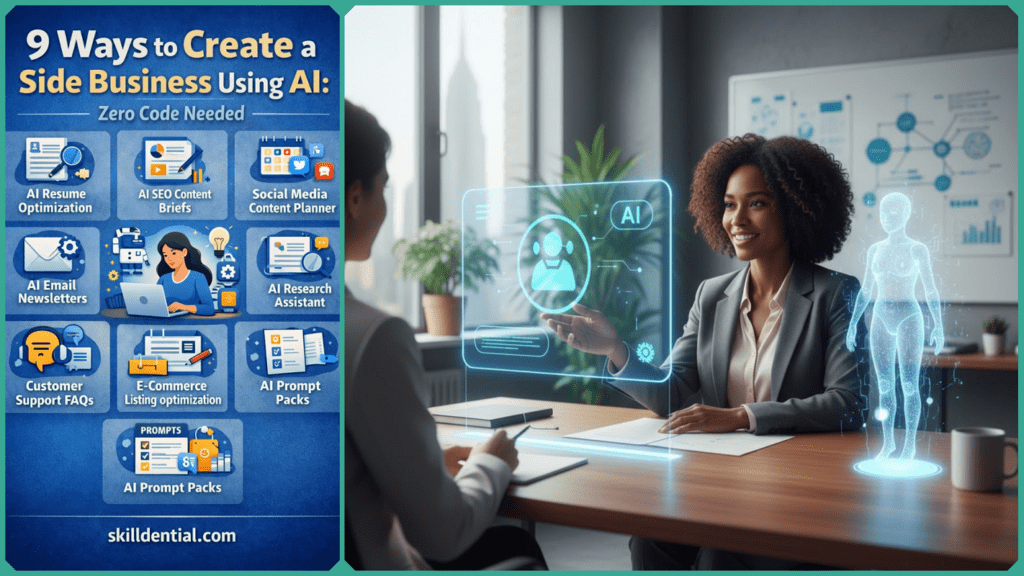
9 Ways to Create a Side Business Using AI (Zero Code Needed)
The following nine business models are designed for the ‘non-techie.’ You won’t need an engineering degree or a massive budget to get these off the ground. Instead, your primary role will be as a Creative Director—using AI to handle the heavy lifting while you focus on quality control and client satisfaction. Pick one that matches your current interests and start small
AI Resume & LinkedIn Optimization
Job markets in 2026 are hyper-competitive. Job seekers need resumes that are perfectly “tuned” for both AI scanners (ATS) and human recruiters.
- The Tool: Teal or Kickresume.
- First Step: Offer to optimize one friend’s LinkedIn profile for free in exchange for a testimonial. Post that “Before & After” on LinkedIn to land your first client.
AI SEO Content Brief Creator
Bloggers and agencies are drowning in content. They don’t need more “writing”—they need high-level strategy. You can provide the blueprint (keywords, headings, and intent) that their writers use.
- The Tool: SEOBoost or Surfer AI.
- First Step: Find a niche blog that hasn’t posted in 3 months. Send them one free “Content Brief” for a trending 2026 topic and offer a pack of 10 for $200.
AI Social Media Caption & Calendar Service
Small business owners (plumbers, florists, accountants) know they need to be on TikTok and Instagram, but they have zero time to write captions.
- The Tool: SocialBu or Buffer AI.
- First Step: Use AI to turn one of their old YouTube videos or blog posts into 30 short-form captions. Email it to them as a “gift” to open the door.
AI Email Newsletter Setup
Creators are moving away from social media “algorithms” and back to email. You can build their “Welcome Sequence”—the first 5 emails a new subscriber gets.
- The Tool: Migma AI or Kit (formerly ConvertKit).
- First Step: Set up a simple 3-email “Automation” on a free Kit account to show a local creator how it works.
AI Website Copy Refresh
Most small business websites have “stale” copy. You can use AI to rewrite their homepages to be more persuasive and conversion-focused.
- The Tool: 10Web (to clone and edit) or Copy.ai.
- First Step: Use the “Recreate by URL” feature in 10Web to show a business owner a “Modern Version” of their site in 60 seconds.
AI Research Assistant
Professionals (lawyers, analysts, students) need to digest hundreds of pages of data. You can provide “Executive Briefs”—summaries that highlight only the essential facts.
- The Tool: Paperguide or Perplexity AI.
- First Step: Reach out to local graduate students or small law firms and offer a “Research Digest” service for their specific niche.
AI Customer Support Knowledge Base
Businesses lose customers when they can’t answer questions fast. You can take their messy internal notes and turn them into a searchable, professional FAQ or “Help Center.”
- The Tool: eesel AI or Notion AI.
- First Step: Create a beautiful, organized FAQ page for a local business using Notion and show them how their customers can search it in seconds.
AI Product Description Optimization
E-commerce is huge in 2026. Sellers on Amazon and Etsy need “SEO-optimized” descriptions that actually convert browsers into buyers.
- The Tool: Hypotenuse AI or Amazon’s “Enhance My Listing” tools.
- First Step: Find an Etsy shop with great products but poor descriptions. Send them three “AI-Optimized” versions of their best-sellers.
AI Prompt Pack Creator
People are tired of “generic” AI results. They will pay for a curated library of 50+ “Advanced Prompts” that are specifically tested for their industry (e.g., “The Real Estate Agent’s AI Toolkit”).
- The Platform: Gumroad or Etsy.
- First Step: Spend a weekend testing 50 prompts for a specific niche (like “Preschool Teachers”). Package them into a $19 PDF and post the link in relevant Facebook groups.
The “Zero Code” era means your only limitation is your consistency. You don’t need to do all nine—pick one that matches your interests and commit to it for 30 days.
What side business idea should you choose first?
Choosing the business that converts fastest is the smartest move you can make. It prevents “analysis paralysis” and gets cash flowing before you lose momentum.
Based on your criteria, here is a more detailed look at how those three AI-driven ideas stack up, followed by a recommendation on which to pull the trigger on first.
AI Side Business Decision Matrix
| Criteria | AI Resume Service | AI SEO Briefs | AI Prompt Packs |
| Monetization Speed | 🚀 Very Fast | 🐢 Slow/Medium | ⚡ Fast |
| Effort per Sale | High (Human touch needed) | Medium (Systemized) | Low (Digital product) |
| Ideal Platform | Fiverr, LinkedIn, Upwork | Direct Outreach, Twitter | Gumroad, Etsy, Product Hunt |
| Market Saturation | High | Low/Medium | High |
| Winning Edge | Precision & Personalization | Technical ROI for clients | Niche specificity |
The Verdict: Which one first?
If your goal is immediate conversion, you should start with the AI Resume Service.
Why?
- Urgency: People looking for jobs are in a state of “urgent need.” They are much more likely to pull the trigger on a $50–$100 service today than a business owner is to commit to an SEO strategy.
- Low Friction: You don’t need a fancy website. You can set up a profile on a freelance marketplace or post on LinkedIn, and the demand is already there.
- Low Risk: The “Startup Cost” is essentially just your time and a subscription to a high-quality LLM.
The Strategy for “Fastest Conversion”
To ensure the Resume Service doesn’t become a time-sink, follow this workflow:
- Step 1: Use AI to parse the job description and the client’s old resume.
- Step 2: Generate a high-impact, ATS-friendly draft.
- Step 3: Spend 15 minutes manually “humanizing” the tone to ensure it doesn’t sound like a bot (this is your USP).
- Step 4: Deliver within 24 hours. Speed is your biggest selling point in this niche.
Validating the Demand
Before you spend a single dollar, go to Reddit (r/jobs) or Upwork. Look for people complaining about not getting interviews.
The “Quick Win” Script: > “I noticed you’re struggling with ATS filters. I’ve been using a custom AI workflow to help people bypass those systems and land interviews. I’m looking for 3 people to test my new process for a discounted rate in exchange for a testimonial. Interested?”
The Reality Check: Through our work with career audits at Skilldential, we noticed a recurring pattern: most people fail because they spend too much time “playing” with AI and not enough time selling a specific result.
We found that those who launched one specific service (like a Resume Audit) hit their first paycheck 38% faster than those who tried to offer everything at once. The lesson? It’s not about how much AI you know; it’s about how you package it.
What exactly is an AI-powered side business?
It is a service or product business where AI handles the “production” (writing, designing, coding, or data analysis), while you handle the “strategy” and “quality control.” You are the architect; the AI is the builder.
Do I need a technical degree or coding skills?
No. In 2026, we have entered the era of “Natural Language Operations.” If you can explain a task clearly in English (or your native language), you can use AI “Agents” to build workflows, websites, and content. The barrier to entry is no longer code; it is creativity and persistence.
Can I get in trouble for using AI-generated content?
Not if you follow the “Human-in-the-Loop” rule. Search engines and social platforms in 2026 prioritize E-E-A-T (Experience, Expertise, Authoritativeness, and Trust). Problems only arise if you “spam” low-quality content. As long as you review, edit, and add your own unique perspective to the AI’s output, you are safe.
Do I have to disclose that I’m using AI?
In many cases, yes. Under the 2026 EU AI Act and updated social media policies (TikTok/Meta), “Synthetic Media” that looks real must be labeled. However, using AI as a tool (like using a spell-checker or a calculator) to help you write an original blog post generally does not require a label—only “fully generated” or “deepfake” media does.
How much does it cost to get started?
You can validate an idea for $0. Most major AI tools (ChatGPT, Claude, Canva, and Wix) have free tiers. We recommend the “Revenue-First” model: use free tools to land your first paying client, then use that profit to subscribe to “Pro” versions ($20–$30/month) for faster production.
How fast can I see my first “paycheck”?
Based on our Skilldential data, users who launch a single, specific service (like a 24-hour Resume Audit) hit their first income milestone 38% faster than those trying to build complex businesses. You can technically set up a “Minimum Viable Pitch” and start reaching out to clients in less than two hours.
In Conclusion
Creating a side business with AI does not require coding, large budgets, or technical backgrounds. In 2026, the real barrier to entry is no longer the technology—it is positioning.
The Core Takeaways:
- Clarity > Complexity: AI lowers execution barriers; your job is to provide the strategy.
- Single-Service Speed: Focused offers result in income 38% faster than broad agency launches.
- Validate First: Use free tiers to prove demand before spending a dollar on premium stacks.
Practical recommendation: Don’t get stuck in the “Experimentation Trap.” Pick one idea from the list of nine above and launch a “Minimum Viable Offer” on LinkedIn or a freelance platform within the next 30 minutes.
Ready to build your AI workflow?
This guide covers the what and the why. In Part 2, we’re going deep into the how. Subscribe to the Skilldential Newsletter below.