
AI Engineer vs. ML Engineer: Salary Insights and 2026 Trends
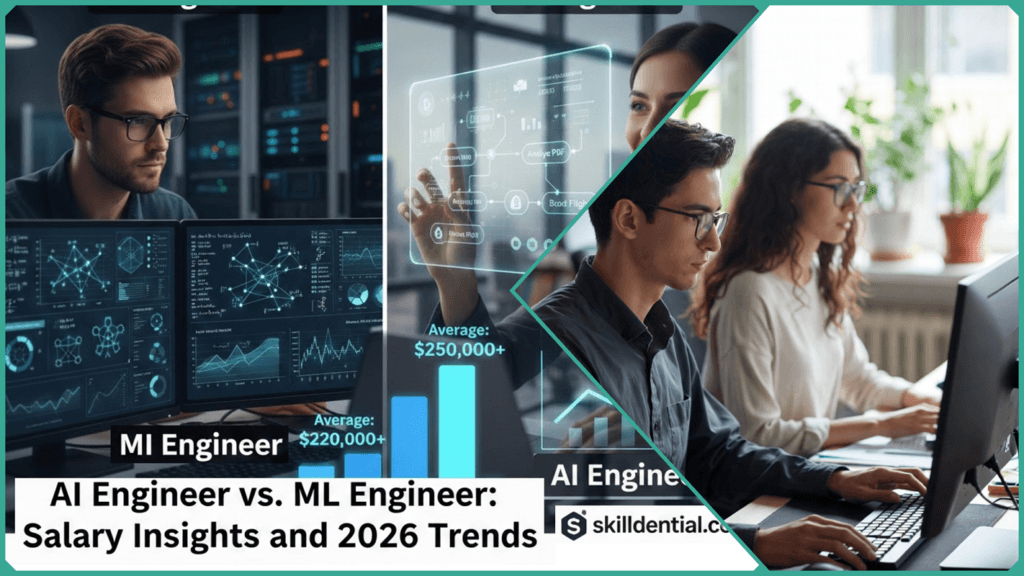
In 2026, the lines between building AI and applying AI have blurred, creating two of the highest-paying career paths in tech: the Machine Learning (ML) Engineer and the AI Engineer. While an ML Engineer focuses on the ‘engine’—designing, training, and optimizing models with median senior salaries reaching $220,000—the emerging AI Engineer focuses on the ‘vehicle,’ integrating these models into massive applications.
As AI adoption surges across finance and healthcare, choosing the right path depends on your skill set. Whether you are mastering MLOps or LLM orchestration, understanding the 2026 salary landscape is the first step toward securing a high-value role that exceeds the $250,000 mark at top-tier firms.
What Is an ML Engineer? (2026 Definition)
An ML Engineer bridges the gap between theoretical data science and robust software engineering. While a Data Scientist might build a prototype in a notebook, the ML Engineer is responsible for productionizing that model—ensuring it is scalable, reliable, and efficient in a live environment.
Core Responsibilities
In 2026, the role has moved beyond simple coding to “Model Lifecycle Management. Their primary tasks include:
- Architecting Data Pipelines: Automating the flow of massive datasets using tools like Apache Kafka or Spark.
- Model Training & Evaluation: Selecting the right algorithms and optimizing $Hyperparameters$ to maximize performance metrics (like $F1$-$Score$ or $Precision$).
- Scalable Deployment: Using Docker and Kubernetes to ensure models can handle millions of requests per second.
- Monitoring & Retraining: Building systems to detect “Model Drift“—when a model’s accuracy drops because real-world data has changed.
The 2026 Tech Stack
To command the high-value salaries ($169,000–$250,000+), modern ML Engineers must master:
- Frameworks: PyTorch (now the industry standard), TensorFlow, or JAX.
- Cloud Infrastructure: AWS SageMaker, Google Vertex AI, or Azure ML.
- MLOps Tools: MLflow, Kubeflow, or Weights & Biases for experiment tracking.
The Skilldential Insight: The highest-paying ML Engineer roles in 2026 aren’t just for those who can code—they are for those who can manage the compute costs. Optimizing models to run on cheaper GPU/TPU clusters is a multi-million-dollar skill for major enterprises.
AI Engineer vs ML Engineer Differences
In 2026, the distinction between these two roles has become a “High-Value” focal point for career strategy. While they share a foundation in Python and data, their daily outputs and the “problems” they solve are fundamentally different. The simplest way to view the split is: ML Engineers build the engine; AI Engineers build the car.
AI Engineer vs ML Engineer: Comparison
| Feature | ML Engineer | AI Engineer |
| Primary Goal | Build & Train the Model | Implement & Integrate the Model |
| Key Math | Linear Algebra, Calculus | Probability, Logic |
| Top Tool | PyTorch / Scikit-Learn | OpenAI API / LangChain |
| 2026 Focus | Efficient Model Training | Agentic Workflows & RAG |
Key Differences at a Glance
| Feature | ML Engineer | AI Engineer |
| Primary Goal | Training & optimizing new models. | Integrating & “orchestrating” existing models. |
| Core Workflow | Feature engineering, hyperparameter tuning. | RAG pipelines, Agentic workflows, API usage. |
| Mathematical Depth | High ($Gradient$ $Descent$, $Backpropagation$). | Moderate (Probability, System Logic). |
| The “Customer” | The Data Science team / Infrastructure. | The End-User / Product team. |
| Top 2026 Tools | PyTorch, TensorFlow, Kubeflow, JAX. | LangChain, LlamaIndex, OpenAI/Claude APIs. |
The ML Engineer: The Model Architect
An ML Engineer is a systems specialist. In 2026, their value lies in reliability and scale.2 They don’t just “make a model”—they build the industrial-grade pipelines that keep models running without “drifting” or breaking.
- What they do: They take a raw algorithm and refine its weights, optimize its $Loss$ $Function$, and ensure it performs efficiently on GPUs.
- High-Value Skill: MLOps. In 2026, knowing how to train a model is common; knowing how to deploy it to 1 million users while keeping cloud costs low is a premium skill.
The AI Engineer: The Product Visionary
The AI Engineer is a newer, rapidly growing role that has exploded alongside LLMs (Large Language Models). They are essentially “Software Engineers with AI Superpowers.”
- What they do: Instead of training a model for months, they use the world’s best models (like GPT-4o or Claude 3.5) and build “Agentic Workflows“—systems where the AI can browse the web, use tools, and complete complex multi-step tasks.
- High-Value Skill: RAG (Retrieval-Augmented Generation). Building a system that lets an AI “read” a company’s private documents securely is the #1 requested skill for AI Engineers this year.
The Salary Gap in 2026: A Deep Dive
In 2026, the “AI Gold Rush” has matured into a sophisticated hiring market. While ML Engineers remain the foundational architects of AI, AI Engineers are seeing a rapid surge in total compensation (TC) because they are directly tied to product revenue.
2026 Global Salary Comparison Table
| Role | Level | US Salary (Total Comp) | Nigeria (Remote/Local USD) | Key Premium Skills |
| ML Engineer | Entry | $\$120,000 – \$150,000$ | $\$15,000 – \$25,000$ | PyTorch, Data Pipelines |
| Mid | $\$149,000 – \$210,000$ | $\$22,500 – \$31,500$ | MLOps, Model Distillation | |
| Senior | $\$210,000 – \$350,000$ | $\$40,000 – \$65,000+$ | Distributed Training, CUDA | |
| AI Engineer | Entry | $\$130,000 – \$160,000$ | $\$18,000 – \$28,000$ | Prompt Eng, API Design |
| Mid | $\$150,000 – \$250,000$ | $\$22,500 – \$35,000+$ | RAG, Vector DBs, LangChain | |
| Senior | $\$280,000 – \$580,000+$ | $$70,000 – $120,000+ | Agentic AI, LLM-Ops |
Why the AI Engineer Salary Ceiling is Higher
You might notice the senior AI Engineer ceiling at companies like Google or OpenAI is significantly higher ($500k+). This is driven by three “High-Value” factors:
- Revenue Proximity: AI Engineers build the features users pay for (like ChatGPT-style agents). In product-led companies, “builders” are often prioritized over “researchers” during scaling phases.
- The “Agent” Premium: In 2026, the ability to build Agentic AI—systems that can autonomously use tools and browse the web—is the rarest skill in the market.
- Speed to Market: AI Engineers help companies ship in weeks, whereas ML training cycles can take months. Companies pay a premium for that agility.
The Nigerian Context: The Remote Advantage
For professionals in Nigeria, the gap between local and global remote pay is staggering.
- Local Market: Focused on Fintech (like Flutterwave/Interswitch), where pay is competitive but capped by local currency.
- Remote Market: US-based firms are increasingly hiring “AI Super Engineers” from Nigeria via platforms like Crossover or Toptal, offering salaries upwards of $\$100,000 – \$200,000$ for top-tier talent who can manage end-to-end AI deployment.
Skilldential Tip: If you want to break the $\$250\text{k}$ barrier in 2026, don’t just learn to “code.” Learn to evaluate. The highest-paid engineers are those who can prove their AI system is 99% accurate and cost-effective.
2026 Skill Stack: The Path to $350,000
In 2026, the “specialization premium” is the highest it has ever been. According to Skilldential career audits, engineers who pivot from general software development to these four “Power Skills” see an average salary increase of 35% within just 12 months.
The High-Value Hierarchy
The 2026 market values Deployment over Modeling. Being able to train a model is a commodity; being able to make that model work for 10 million users at low latency is a fortune.
| Power Skill | Why it Pays (2026 Trend) | Typical Senior Salary |
| Agentic Workflows | Designing AI that can act (browse, buy, book) autonomously. | $\$300,000 – \$580,000$ |
| LLMOps | Managing the lifecycle, cost, and reliability of LLMs at scale. | $\$250,000 – \$400,000$ |
| Vector DBs (Pinecone/Weaviate) | Enabling “Long-term Memory” for AI via complex retrieval. | $$200,000 – $\$320,000$ |
| RAG (Advanced) | Connecting real-time enterprise data to models without hallucinations. | $$180,000 – $\$280,000$ |
Agentic AI: The “Billion Dollar” Skill
The most significant shift in 2026 is the move from Chatbots to Agents.
- The Skill: Using frameworks like LangGraph or CrewAI to build systems where multiple AI agents collaborate.
- The Payoff: Companies are desperate for engineers who can move beyond “prompting” and build “reasoning loops” that solve business problems without human intervention.
LLMOps & Cost Engineering
As enterprises scale their AI, the #1 bottleneck is the GPU bill.
- The Skill: Optimizing model inference, using speculative decoding, and managing “Token Budgets.”
- High-Value Impact: An engineer who can reduce a company’s OpenAI or Anthropic monthly bill by 40% while maintaining performance is easily worth a $300,000+ total compensation package.
Vector Databases & RAG
Retrieval-Augmented Generation (RAG) is the “Gold Standard” for enterprise AI.
- The Skill: Mastering Pinecone, Milvus, or Chroma to handle billions of data points.
- The Difference: Entry-level developers “connect a database.” High-value AI Engineers optimize the embedding strategy and reranking logic to ensure the AI never gives a wrong answer.
Skilldential Career Audit Note: Our data shows that software engineers who spend 3 months mastering LLMOps specifically see a higher immediate ROI than those who spend 12 months learning the deep math of traditional Machine Learning.
Your Next Step: Audit Your Stack
Are you currently a “generalist” or a “specialist”? To reach the $350k bracket, you must choose one of these pillars to master this year.
2026 Job Growth: Why the AI Pivot is Non-Negotiable
The data is clear: AI Engineering roles are growing 143% faster than traditional software positions. As we move through 2026, the “Generative AI” boom has evolved into a demand for engineers who can move beyond a simple chat interface and build complex, enterprise-grade systems.
The 2026 Growth Landscape
- AI Engineers (The “Explosion”): Demand is fueled by the move toward Agentic Workflows. Companies in every sector—from mining to marketing—are hiring AI Engineers to build autonomous agents that handle internal operations.
- ML Engineers (The “Scaling”): Growth in this sector is driven by MLOps. As firms deploy more models, they need experts to manage “Model Drift,” GPU cost optimization, and high-frequency retraining pipelines.
- Traditional Software (The “Evolution”): Growth here has slowed to roughly 15%, as AI coding assistants (like GitHub Copilot and Cursor) make individual developers significantly more productive, reducing the need for massive “generalist” headcounts.
Key Hiring Trends for 2026
The “Hybrid Skill” Premium
Recruiters are no longer looking for “pure” coders or “pure” mathematicians. The most “high-value” candidate in 2026 is the Hybrid Engineer:
- AI + Cloud: Knowing how to deploy models specifically on AWS Bedrock or Google Vertex AI.
- ML + Domain Expertise: An ML Engineer who understands Healthcare regulations or Fintech fraud patterns commands a 40% higher salary than a generalist.
The Rise of “LLMOps”
While MLOps was the buzzword of 2024, LLMOps is the mandatory requirement of 2026. This involves:
- Token Management: Keeping API costs sustainable.
- Evaluations (LLM-as-a-Judge): Using one AI to check the accuracy and safety of another.
Shift from “Models” to “Systems”
In 2026, the market realized that the model itself is just 5% of the solution. The remaining 95% is the System Architecture—the data pipelines, the security layers, and the user interface. This is why AI Engineers, who focus on the whole system, are seeing the fastest career progression.
Skilldential Insight: 77% of employers now prioritize skills-based hiring over degrees. For those in markets like Nigeria, this has opened a massive “Remote-First” door. Global firms are bypassing local shortages by hiring skilled AI talent directly into remote US or EU-based teams.
The gap between “Software Engineering” and “AI Engineering” is the difference between a steady career and a high-velocity one. To reach the top salary brackets of 2026, your path is clear: stop building code and start building systems.
Which Role Fits You?
Choosing between these two high-value paths in 2026 comes down to whether you enjoy building the “Brain” (ML) or the “Product” (AI). As we’ve seen in recent 2026 market audits, the demand for both is skyrocketing, but the day-to-day experience—and the “stress” you’ll face—is very different.
The 2026 Career Matchmaker
Use this quick check to see where your natural strengths will earn the most “Skilldential” value.
Choose an AI Engineer if…
- You are a “Builder”: You get a rush from shipping a live feature that users can interact with immediately.
- You love UX: You care about how an AI “feels”—its latency, its personality, and how it solves a user’s problem.
- Your 2026 Goal: To lead product teams or launch your own AI-first startup.
- The Stress: You’ll be debugging “hallucinations” in front of angry users or managing the skyrocketing costs of API tokens.
Choose ML Engineer if…
- You are an “Architect”: You enjoy the deep technical challenge of making a system 5% faster or 10% more accurate.
- You love Data: You find peace in cleaning complex datasets and optimizing $Loss$ $Functions$.
- Your 2026 Goal: To work at the core of AI labs (OpenAI, DeepMind) or architect the infrastructure for Fortune 500 firms.
- The Stress: You’ll be on-call for broken data pipelines or defending why a model’s $Accuracy$ dropped after a week in production.
Summary Roadmap for Your Website
| Role | Ideal Background | First 90-Day Goal | 2026 “North Star” Skill |
| AI Engineer | Software Dev, Full Stack | Build a RAG-based App | Agentic Orchestration |
| ML Engineer | Data Science, CS Grad | Deploy an MLOps Pipeline | Model Distillation/Scale |
If you are looking for the fastest salary growth, current trends favor the AI Engineer. Because they sit closer to the product, they are often the first to benefit from the 143% role expansion. However, if you want long-term job security and enjoy the “under the hood” science, the ML Engineer remains the most irreplaceable role in the ecosystem.
What does an ML Engineer do daily?
In 2026, the ML Engineer’s day is dominated by Model Reliability.
Morning: Reviewing “Model Drift” alerts from MLOps dashboards to ensure production models are still accurate.
Afternoon: Optimizing data pipelines in Spark or training a new model iteration using PyTorch.
Evening: Refining CI/CD scripts to automate the next deployment, ensuring zero downtime for the product.1
AI Engineer salary vs. ML Engineer?
While both roles have high floors, AI Engineers currently have a slightly higher ceiling in product-led tech firms.
Mid-level AI Engineers: $\$150,000–\$250,000$ TC.
Mid-level ML Engineers: $$149,000–$220,000$ TC.The “AI Edge” comes from the immediate revenue impact of shipping user-facing features like Autonomous Agents.
Top skills for a 2026 AI/ML pay bump?
If you want to negotiate a 25%–47% raise, focus on these four “Specialization Premiums”:
Agentic Workflows: Designing AI that can use tools and make decisions.
LLMOps: Managing the cost and latency of large language models.
Vector Databases: Mastering Pinecone or Milvus for long-term AI memory.
RAG (Retrieval-Augmented Generation): Connecting AI to private enterprise data securely.
ML Engineer salary in Nigeria 2026?
For professionals in the Nigerian ecosystem:
Local Market (Mid-level): $\$22,500–\$31,500$ USD (typically paid by top Fintechs or Banks).
Global Remote: Top-tier talent from Nigeria can command $\$80,000 – \$120,000+$ when working for US or EU-based startups, as the global talent shortage remains acute.
How to transition to an AI/ML Engineer?
Build a “Production Portfolio”: Don’t just show code; show a deployed app on AWS or Hugging Face.
Master the Frameworks: Deep-dive into PyTorch for ML or LangChain for AI.
Get Certified: Aim for high-ROI certifications like the Google Professional ML Engineer or AWS Machine Learning – Specialty.
The Skilldential Shortcut: Focus on deployment (MLOps) over pure research. Companies in 2026 are hiring “Builders,” not just “Thinkers.”
In Conclusion
In 2026, the market has made its verdict clear: AI Engineers are the high-velocity “builders” of the product era, growing 143% faster than traditional software roles with senior total compensation (TC) frequently crossing the $\$500\text{k}$ mark. Meanwhile, ML Engineers remain the indispensable “architects,” securing stable, premium salaries of $\$220\text{k}+$ by mastering model reliability and infrastructure.
Practical Recommendation for Your Path
- For Career Pivoters: Don’t wait to be “ready.” Build a portfolio of RAG-based applications on the AWS free tier. Engineers who demonstrate deployment skills over theoretical knowledge are currently seeing 35% salary increases within their first 12 months.
- For Upskillers & New Entrants: Master the foundations of PyTorch first to understand the “why,” then quickly pivot to AI Engineering (Mastering LangGraph, Vector DBs, and LLMOps) for maximum career velocity.
- For Recruiters: The 2026 talent war is won by those who prioritize hybrid hires. Look for candidates with Vector DB certifications and a history of shipping “Agentic” workflows; these specialists are 3x more likely to drive immediate ROI.
The Nigeria Advantage: For our readers in Nigeria, 2026 is the year of the “Global Remote.” Mid-level roles are fetching $\$22\text{k}–\$35\text{k}$ locally, but top-tier talent mastering these high-value skills can access global remote contracts starting at $\$80,000+$.
Discover more from SkillDential | Your Path to High-Level Career Skills
Subscribe to get the latest posts sent to your email.