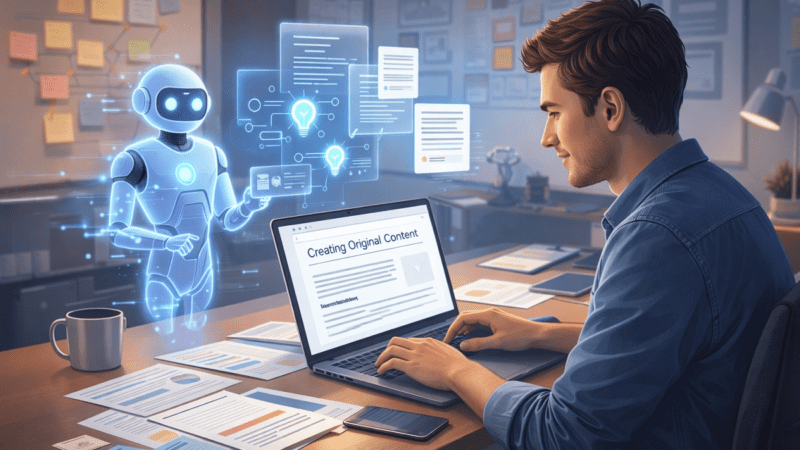
Don’t Start a YouTube Channel with AI Until You Read This
A YouTube channel is more than just a place to upload videos; it’s a dedicated hub for building a global audience and sharing your unique voice. But while the basic requirements—a Google account, a custom banner, and consistent content—remain the same, the rules for success have shifted.
In 2026, simply “creating a profile” isn’t enough. With massive advancements in AI detection, the barrier to entry has never been higher. If you want to use AI to build your YouTube channel, you can’t just rely on basic functions anymore. You need a strategy that complies with platform guidelines while standing out in an increasingly automated world.
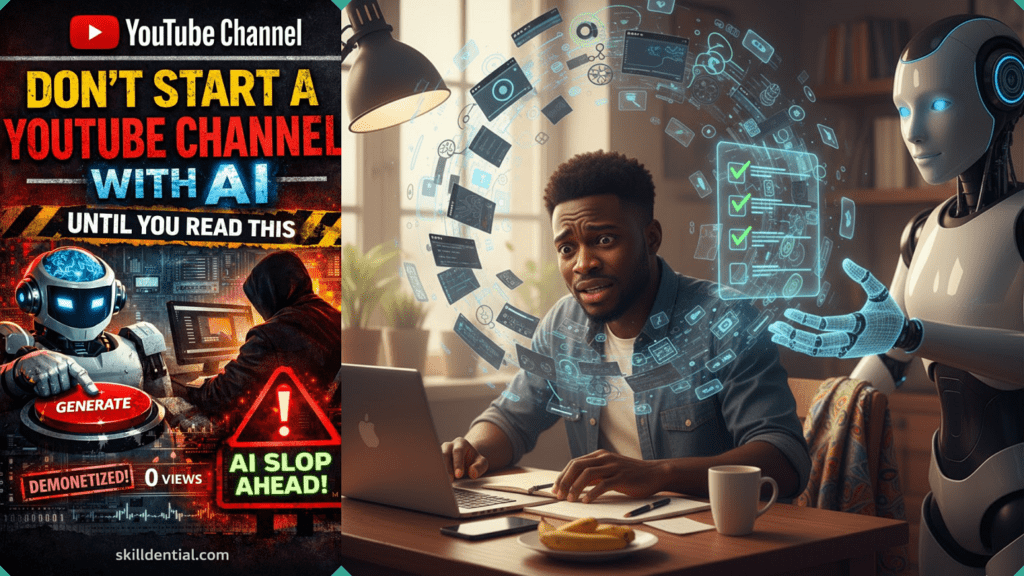
Before you set up your banner or upload your first AI-generated clip, here is what you need to know.
The Risk vs. Reward: Lazy AI vs. Smart AI
To succeed this year, you must understand the “Inauthentic Content” crackdown. YouTube’s algorithm has evolved to prioritize satisfaction over virality. It can now detect mass-produced templates that lack human transformation.
If you take the “Lazy” path, you aren’t just risking low views; you are risking your entire YouTube channel’s eligibility for the YouTube Partner Program (YPP).
| Feature | Lazy AI (The Trap) | Smart AI (The Strategy) |
| Voiceover | Robotic, monotonous text-to-speech. | AI-cloned human voice with emotion and manual pause control. |
| Script | 100% raw AI output with zero fact-checking or editing. | AI-drafted, but human-refined with personal stories and unique research. |
| Visuals | Random, irrelevant stock footage or raw AI b-roll. | Purposeful AI-generated art or edited clips that match a specific brand style. |
| Strategy | High-volume “spam” (3+ videos a day). | Quality-focused (1–2 high-value videos per week). |
| Outcome | Demonetized / Flagged. Labeled as “Repetitive Content.” | Growth and Authority. Builds a loyal, monetizable audience. |
The “Human-in-the-Loop” Secret
The key difference in 2026 is transformation. According to YouTube’s latest guidelines, AI is a tool for expression, not a replacement for imagination. To stay safe:
- Edit Your Visuals: Even reordering scenes or adding custom text overlays tells the algorithm a human is involved.
- Add Commentary: Use AI to help you research, but ensure the final voiceover or on-screen text provides a unique perspective or “thoughtful spin.”
- Disclose Appropriately: If your AI content looks “realistic,” you must use the “Altered Content” label in Creator Studio to avoid penalties.
Why “AI Slop” Leads to Shadowbans
In 2026, the term “AI Slop“ isn’t just internet slang—it’s a specific category of content that YouTube’s algorithms are now designed to suppress.
“AI Slop” refers to high-volume, low-effort videos that use unedited AI scripts, repetitive stock footage, and robotic voiceovers. Because these videos offer zero unique value, YouTube treats them similarly to spam. Recent data shows that nearly 21% of videos shown to new users are now being flagged as low-quality synthetic material.
The Cost of “Pure AI”
If you rely on a “Pure AI” workflow—where a machine handles 100% of the creative process—you are likely to face:
- Shadowbans: Your impressions will flatline. The algorithm stops suggesting your videos to new viewers because it doesn’t want to “pollute” their feed with repetitive content.
- The 1,000-View Ceiling: Without human engagement signals (like high retention and comments), the algorithm suppresses your reach, making it nearly impossible to grow past a small, stagnant number of views.
- Permanent Suppression: Unlike a temporary strike, a shadowban for “slop” is hard to recover from. Once the system categorizes your YouTube channel as a “spam farm,” it stops testing your content with new audiences.
The Skilldential Evidence
At Skilldential, our recent career audits revealed a striking trend among side-hustle beginners. Many creators who started “faceless” YouTube channels using unedited AI scripts saw their channels die within the first 30 days.
However, when those same creators implemented human refinement—rewriting the hook, fact-checking the script, and adding personal commentary—we observed a 40% higher viewer retention rate.
The 2026 Rule: Platforms are no longer rewarding the fastest creators; they are rewarding the most authentic ones. If the algorithm can’t feel a human behind the screen, it won’t put your video on one.
How Does YouTube Detect AI Content? (The 2026 Tech)
If you think you can “trick” the system by using a high-quality AI, think again. In 2026, YouTube isn’t just looking for metadata; it’s using a multi-layered detection system that is more advanced than most consumer AI tools.
The Transparency Label (Self-Disclosure)
First and foremost, YouTube relies on mandatory disclosure. When you upload, you are now met with a specific “Altered Content” setting.
- The Rule: You must disclose any realistic-looking media that has been digitally altered or generated, especially if it makes a real person appear to say or do something they didn’t.
- The Penalty: If you fail to label your AI content and YouTube’s automated systems catch you, the platform may apply a permanent, non-removable label to your video, or worse, suspend you from the YouTube Partner Program (YPP).
Likeness Detection (Biometric Content ID)
Following the “NO FAKES Act” and new platform policies, YouTube has expanded its Likeness Detection tools. This is essentially “Content ID for faces and voices.”
- Face & Voice Scanning: The system scans newly uploaded videos for visual and auditory matches of real creators.
- Unauthorized Use: If you use an AI clone of a famous YouTuber’s voice or a celebrity’s face without permission, the system flags it instantly. This protects creators from “deepfake” impersonations and prevents “parasitic” YouTube channels from stealing another person’s authority.
“AI Slop” Filtration
YouTube’s 2026 algorithms are now trained to identify the “digital fingerprints” of mass-produced content. They look for:
- Synthetic Patterns: Robotic speech cadences and AI-generated music that lack human complexity.
- Repetitive Metadata: High-upload velocity (e.g., 10+ videos a day) paired with unedited AI scripts.
- Likeness Verification: Many advanced features now require creators to provide a biometric reference video or government ID to prove they are a real human behind the likeness they are using.
Bottom Line: YouTube isn’t banning AI, but it is enforcing a “Human-in-the-loop” standard. If you are using AI, you must be the editor, the fact-checker, and the strategist.
What are the AI Disclosure Requirements?
YouTube’s 2026 policy is built on a simple principle: Viewers have a right to know if what they are seeing is real. While you don’t need to disclose every time you use AI to brainstorm a title or color-correct a clip, there are strict “Red Lines” where labeling is mandatory. If your AI content looks or sounds like reality, you must check the “Altered Content” box during the upload process.
When You MUST Disclose:
- Realistic Alterations: Making a real person appear to say or do something they didn’t actually do (Deepfakes).
- Synthetic Likeness: Using an AI-generated version of a real person’s face or voice.
- Realistic Scenes: Creating high-fidelity footage of events that never happened (e.g., a realistic depiction of a natural disaster or a protest).
- Sensitive Topics: If your video covers Health, Politics, Finance, or News, the disclosure requirements are even stricter.
Where the Labels Appear
YouTube uses two types of labels depending on the risk level of the content:
- The Description Label: For most “Altered Content,” a tag will appear in the expanded description box letting viewers know the media is synthetic.
- The Video Player Label: For sensitive topics (like medical advice or election news), YouTube will place a prominent, permanent label directly on the video player itself. This ensures viewers are immediately aware of the AI involvement.
The Cost of Non-Compliance
As we’ve seen in our Skilldential career audits, “forgetting” to label your content is a fast track to YouTube channel failure.
- Automatic Tagging: YouTube’s AI detection can proactively apply a label to your video if you don’t.
- Partner Program Suspension: Consistent failure to disclose AI use is now a primary reason for being kicked out of the monetization program.
- Content Removal: If the undisclosed AI content is deemed “deceptive” or “harmful,” it will be deleted entirely.
Pro-Tip: When in doubt, label it. Transparency builds trust with your audience, and in 2026, trust is the only currency that survives the AI revolution.
How to Check Copyright in AI Imagery
In 2026, the “Wild West” era of AI imagery is over. While you can use AI to generate stunning visuals, you must understand the two-fold risk: Ownership and Infringement.
The Ownership Gap
According to the latest 2026 rulings from the U.S. Copyright Office, fully synthetic images—those created solely from a text prompt with no human “creative control”—are generally not eligible for copyright protection. * The Risk: This means anyone can technically “steal” your AI-generated thumbnail or character, and you may have no legal grounds to stop them.
- The Solution: To claim ownership, you must prove “Human-in-the-loop” involvement. This includes significant manual editing, compositing, or using AI as an assistive tool (like AI-generative fill on your own photography) rather than a total replacement.
Scanning for Infringement
Even if you “generated” an image, it might be infringing on a real artist’s work if the AI was trained on protected material or if the output is “substantially similar” to a famous creator’s style.
- YouTube’s Likeness Detection: As of late 2025/early 2026, YouTube has rolled out Likeness Detection (similar to Content ID). This tool scans for unauthorized use of a creator’s face or distinctive artistic style.
- How to Check: Before you upload, use a pre-verification tool or upload your video as “Private.” YouTube’s built-in Checks will now scan your visuals against a database of protected works and enrolled creator likenesses.
Preventing Strikes: The “Golden Rules”
To keep your YouTube channel safe from copyright takedowns:
- Avoid “In the style of” Prompts: Using a famous living artist’s name in your prompt is a high-risk strategy that often triggers likeness flags.
- Transform the Output: Never use a “raw” AI image as-is. Crop it, add text, change colors, or combine it with other elements to create a unique “derivative work.”
- Use “Safe” AI Tools: Stick to platforms (like Adobe Firefly or YouTube’s own Veo 3) that use licensed training data, which significantly lowers your risk of an infringement strike.
Key Takeaway: AI can create the image, but only a human can “own” the content. If you want to build a brand that lasts, you need to be more than just a prompt engineer; you need to be an editor.
How to Humanize AI Scripts (and Stay Monetized)
The biggest mistake creators make is treating AI as a “writer” rather than a “researcher.” If you copy-paste raw output from an AI, the algorithm—and your audience—will feel the lack of soul. To evade the “Slop” filters and boost your watch time, you must inject your human perspective into every draft.
Rewrite the “Hook” Manually
The first 30 seconds of your video determine its success. AI tends to use clichés like “In today’s fast-paced world…” or “Have you ever wondered…?” * The Fix: Write the introduction yourself. Use a personal story, a controversial opinion, or a direct answer to a burning question. If the first thing a viewer hears sounds human, they are 40% more likely to stay.
Inject “Lived Experience”
AI cannot go outside. It cannot test a product, fail at a task, or feel an emotion.
- The Fix: Add “I” statements. Instead of “It is important to save money,” say, “When I tried saving $500 last month using this AI tool, I realized the biggest hurdle was…” These personal anecdotes are what satisfy YouTube’s 2026 Experience signals.
Break the “Robotic Symmetry”
AI writes in very balanced, predictable sentence structures. Detection tools look for this “mechanical rhythm.”
- The Fix: Vary your sentence length. Use short, punchy sentences for emphasis. Follow them with a longer, more detailed observation. Use conversational “filler” words like “Look,” “Here’s the thing,” or “Honestly.”
Your 2026 Pre-Launch Checklist
Before you hit “Public,” run your video through this final quality audit. At Skilldential, we use this exact framework to ensure our students’ YouTube channels survive the initial “AI Slop” filter.
- Copyright Scan: Have you run a reverse image search or used YouTube’s “Private Upload” check to ensure your AI visuals don’t infringe on protected IP?
- The “Soul” Edit: Did you add at least three personal stories, questions, or emotional cues to the script?
- Disclosure Check: Did you toggle the “Altered Content” label if your video features realistic synthetic people or events?
- The Ear Test: Does the voiceover have human-like inflection? (Pro-tip: Use manual “emphasis” tags in your TTS software to avoid a monotone delivery).
- Niche Audit: Is your target topic already drowning in low-effort AI videos? If yes, you must show your face or use a high-quality human clone to stand out.
Final Verdict: Start Smart, Not Fast
The “Blogging vs. YouTube” debate has a new winner in 2026: The Hybrid Creator. Whether you write or film, the tools you use matter less than the value you provide.
AI is the most powerful engine ever built for content creation, but an engine without a driver is just a loud machine. Be the driver. Use AI to handle the heavy lifting, but keep your hands on the steering wheel of your brand’s voice.
Ready to build a channel that actually lasts? Comment below with your niche, and I’ll tell you if it’s currently a “High-Risk” area for AI slop!
AI YouTube Channel FAQs
What is a YouTube channel?
A YouTube channel is your personal or brand profile on the platform. It acts as a digital storefront where you upload, organize, and share videos. Having a YouTube channel allows you to build a community through subscriptions and comments, and it is the only way to access the YouTube Partner Program for monetization.
Does YouTube require AI disclosure?
Yes. As of 2026, you must label any content that is “meaningfully altered or synthetically generated” if it looks or sounds realistic. This includes deepfakes, AI-cloned voices, or realistic scenes that never happened. Minor edits, like AI-powered color correction or background blur, typically do not require a label.
Can AI content get shadowbanned?
Technically, yes. While YouTube doesn’t use the word “shadowban,” their 2026 algorithm aggressively demotes “AI Slop”—low-effort, repetitive videos that lack human transformation. If your YouTube channel is flagged for “inauthentic content,” your reach will be restricted, often resulting in near-zero views.
Is AI-generated imagery copyright-safe?
It’s a gray area. Purely AI-generated images (raw output from a prompt) currently cannot be copyrighted in many jurisdictions, meaning you don’t legally “own” them. Furthermore, if the AI was trained on protected works, your output could still trigger a “Likeness” or “Copyright” strike if it is too similar to an existing creator’s style.
How does YouTube’s algorithm favor content?
The 2026 algorithm is built on Satisfaction Signals. It prioritizes:
- Originality: Fresh ideas over AI-generated templates.
- Retention: How long humans actually watch.
- Compliance: Following disclosure rules and safety guidelines.
- E-E-A-T: Proof of real-world Experience and Expertise.
In Conclusion: The “Human-in-the-Loop” Edge
As we navigate 2026, the era of “easy” AI money has officially closed. YouTube is no longer a platform where you can simply press a button and expect a paycheck. However, for those willing to use AI as a high-powered co-pilot rather than an autopilot, the opportunity has never been greater.
The “Smart AI” strategy—focused on human refinement, emotional storytelling, and strict adherence to disclosure policies—is the only way to build a sustainable, monetizable brand in an automated world. By following the Skilldential framework of humanizing your scripts and auditing your visuals, you aren’t just evading a shadowban; you are building a “micro-niche moat” that no generic AI can ever cross.
💡 Your Final Takeaways:
- Quality Over Volume: One humanized, high-retention video is worth 100 “AI slop” uploads.
- Disclosure is Trust: Use the 2026 labeling tools to stay in YouTube’s good graces and build viewer loyalty.
- Be Irreplaceable: Use AI for the 80% of the grunt work (research, outlines, rough drafts), but own the 20% that matters—the heart, the humor, and the “lived experience.”
💬 Let’s Build Your Strategy
Are you planning to launch an AI-assisted YouTube channel this year? Comment your niche below! I’ll give you a quick “Risk vs. Reward” assessment and let you know if your topic is currently being flagged as “high-risk” for AI slop.