
Selling Digital Products in Nigeria: From Ideas to Income
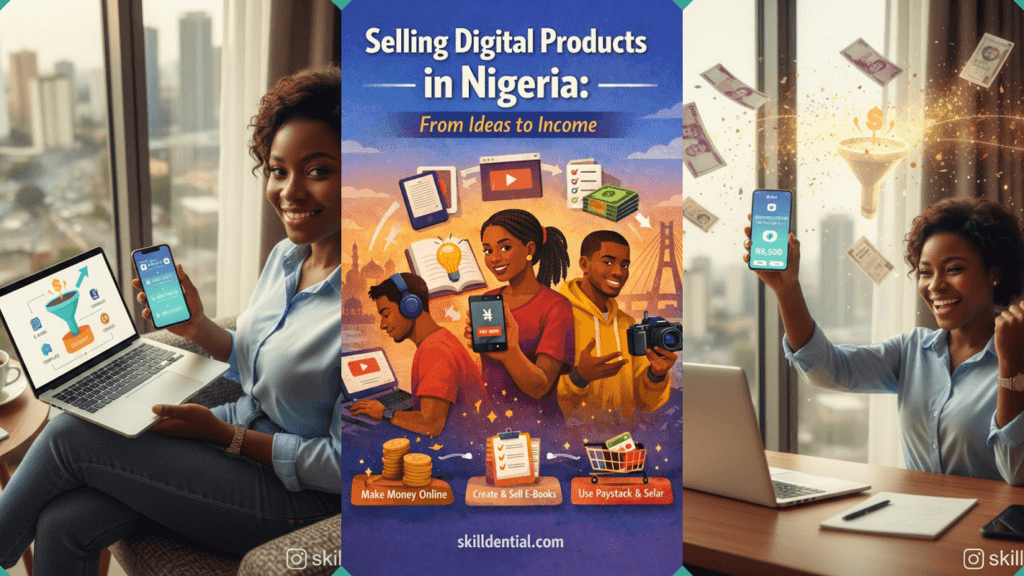
In a 2026 economy where inflation is the talk of every dinner table, Nigerians are no longer just looking for jobs—they are building digital assets. Selling digital products means creating downloadable files like e-books, templates, or courses that sell repeatedly without the headache of inventory or shipping.
With Nigeria’s e-commerce spending hitting $8.53 billion in 2025, the opportunity is massive. By using local platforms like Selar and Paystack to get paid in 24 hours, creators are turning everyday solutions—like budget trackers for inflation-hit professionals—into consistent, low-cost side hustles.
What Are Digital Products? (And Why They Break the “Time Trap”)
At its core, a digital product is any intangible good delivered electronically. You don’t need a warehouse or a delivery bike; your “inventory” lives on the cloud and is delivered via a download link.
Common examples that are currently trending in Nigeria include:
- Knowledge-based: E-books on skincare routines or “Japa” guides.
- Design-based: Canva templates for business owners or social media planners.
- Career-based: Professionally crafted resume templates for job seekers.
- Media-based: Audio files, beats, or stock photography of Nigerian scenery.
The “Skilldential” Insight: Breaking the Freelance Cycle
In our recent Skilldential career audits, we noticed a recurring theme: highly skilled Nigerian creatives (graphic designers, writers, and consultants) were stuck in the “time-for-money trap.” If they didn’t work for a client today, they didn’t get paid.
By shifting part of their energy toward digital product sales, we observed a 40% average growth in income for our participants. Instead of selling one hour of their time to one person, they began selling one digital solution to hundreds of people simultaneously.
Key Takeaway:
The beauty of digital products is that they are inclusive. If you have a smartphone and a unique way of solving a problem, you are already over 50% of the way there. You aren’t just selling a file; you are selling time and convenience to your buyer.
Why Nigeria? The Perfect Storm for Digital Creators
Nigeria’s digital economy is no longer just “emerging”—it has arrived. Several factors make 2026 the best time to launch your first digital product:
A Massive, Connected Market
With over 109 million internet users as of late 2025 and a broadband penetration rate crossing 50%, your potential audience is no longer limited to your neighborhood. ICT now contributes over 17% to Nigeria’s GDP, signaling a robust infrastructure that supports online commerce.
The Inflation Hedge
For the average 9-to-5 worker, the rising cost of living has made “passive income” a necessity rather than a luxury. Digital products allow you to earn without the overhead of a physical shop, electricity bills for a storefront, or “Oga at the top” drama.
Government & Policy Support
The National Information Technology Development Agency (NITDA) has been aggressive in promoting an inclusive digital market. Their focus on the National Digital Literacy Framework (targeting 70% literacy by 2027) is equipping more Nigerians with the skills to buy and sell online. Whether you are a hobbyist monetizing gardening advice or a student using Canva to launch a planner business, the “system” is finally working in your favor.
The Low Barrier to Entry
Unlike physical businesses, digital products offer:
- Zero Inventory: You never run out of stock.
- Global Reach: Sell to a diaspora Nigerian in London as easily as a student in UNILAG.
- Simplified Payments: Platforms like Selar and Paystack have removed the “payment wahala,” allowing for seamless USD and NGN transactions.
What Digital Products Sell Best in 2026?
You don’t need to reinvent the wheel; you just need to solve a specific problem. In the current Nigerian market, successful products generally fall into two categories: “Help me make/save money” or “Help me save time.”
Based on recent market trends, here are the top-selling categories:
The “Problem-Solver” E-books (₦2,000 – ₦7,000)
These are short, actionable guides. In 2026, Nigerians are prioritizing practical solutions over general theory.
- Examples: “
- How to Scale a Small Business with ₦50k,” “
- The 2026 Japa Guide for Techies,”
- Budget-Friendly Nigerian Meal Prep for Busy Professionals.”
Canva & Social Media Templates (₦3,000 – ₦10,000)
Small business owners (SMEs) are everywhere, but many can’t afford a full-time graphic designer.
- The Win: Sell a pack of 50 Instagram Post templates specifically designed for “Naija Vendors” (skincare, fashion, or food niches).
Digital Planners & Trackers (₦1,500 – ₦5,000)
With high inflation, productivity, and financial tracking have become high priorities.
- The Win: A “Sapa-Proof” Monthly Budget Tracker or a Notion template for JAMB/WAEC exam preparation.
Skill-Based Online Courses (₦5,000 – ₦25,000+)
If you can teach a high-income skill (coding, data analysis, makeup, or even professional laundry), a video course is your highest-margin asset.
- Pro-Tip: Start with a “Mini-Course” (1-hour long) to test the waters before building a massive 10-hour program.
Localized Content Assets
- Chefs: Selling “Secret Spice Mix” recipe PDFs.
- Coders: Offering starter code or “boilerplate” templates for local fintech integrations.
- Creatives: Selling Afrocentric stock photos or music beats for content creators.
The “Sweet Spot” Pricing
For the Nigerian market, the most effective entry-level pricing is between ₦2,000 and ₦10,000.
Why? It’s an “impulse buy” price. It’s high enough to show value, but low enough that the buyer doesn’t need to hold a family meeting before clicking “Purchase.”
2026 Digital Marketplace Comparison
Choosing the right platform is the difference between struggling with “payment wahala” and receiving smooth credit alerts. In 2026, the landscape has shifted to favor creators who want to earn both locally and globally.
Here is how the top contenders stack up for a Nigerian creator:
| Platform | Transaction Fees | Payout Speed (NGN) | Best For… | Global Support |
| Selar | ~4% + ₦100 (NGN) / 10% (USD) | 24 Hours | Local & African Creators | High (8 Currencies) |
| Paystack Store | 1.5% + ₦100 (Capped at ₦2k) | Next Working Day | Beginners & Minimalists | NGN & USD Pilot |
| Gumroad | 10% Flat + $0.50 per sale | 7–14 Days | Global Reach (Design/Art) | USD Primary |
| Payhip | 5% (Free) to 0% (Pro) | Instant (via Stripe/PayPal) | Templates & E-books | International focus |
Which One Should You Choose?
- Choose Selar if: You are selling primarily to Nigerians and Africans. It is “Naija-centric,” meaning it handles the nuances of local bank transfers and mobile money perfectly. It also allows you to host video courses directly on the platform to prevent theft.
- Choose Paystack Storefront if: You want the lowest possible fees and a very clean, simple link to put in your Instagram bio. It’s perfect for selling a single e-book or a quick digital download without any “subscription” stress.
- Choose Gumroad or Payhip if: Your audience is mostly in the US, UK, or Europe. While the 10% fee on Gumroad is higher, their “Discovery” marketplace can put your product in front of global buyers you wouldn’t otherwise reach.
Pro-Tip for 2026: Many top Nigerian creators use Selar for their local audience but mirror their products on Gumroad to capture Dollar earnings from the diaspora. This “Multi-Platform” strategy protects you from any single platform’s downtime.
Step-by-Step: From Idea to Your First Credit Alert
Creating a digital product doesn’t require a production studio. In 2026, the most successful products are often the simplest ones that solve a specific “pain point.”
Validate Before You Build
Don’t spend a month writing an e-book no one wants. Instead, use WhatsApp Polls or Instagram Stories to ask your audience about their struggles.
- Example: “What’s harder for you: finding healthy Nigerian recipes or staying under a ₦50k monthly food budget?”
- If 80% say “budget,” you have your product idea: The ₦50k Foodie Guide.
Use the “Naija Creator” Toolkit
You likely already have everything you need on your phone or laptop:
- Writing & Structure: Use Google Docs or Microsoft Word. Save the final version as a PDF to prevent formatting issues.
- Design: Use Canva to create professional covers, worksheets, or social media templates.
- Packaging: If you are selling multiple files (e.g., a guide + a checklist + a video), use a ZIP file or a Google Drive folder link for easy delivery.
Launch a “Minimum Viable Product” (MVP)
Don’t wait until you have a 10-module video course. Start with a ₦2,000–₦3,500 “Starter Guide” or a 5-page planner.
- Why? It lowers the risk for the buyer and allows you to gather real feedback.
- Once you see people are buying the mini-version, you can “iterate” (improve it) and launch a premium version later at a higher price.
Marketing Your Launch (The “Value-First” Method)
Nigerians buy from people they trust. Don’t just post “Buy my book” on your status.
- Teach a Little: Share 3 tips from your guide for free.
- Show the Result: Share a screenshot of how the planner helped you save money.
- Create Urgency: Offer a “Launch Week” discount (e.g., ₦2,000 this week, ₦5,000 next week).
How to Sell Your Digital Product in Nigeria
Selling online in 2026 is less about “shouting” and more about strategic presence. Once your product is ready, follow this roadmap to start seeing those alerts.
Set Up Your “Shop” in 5 Minutes
You don’t need a custom website. Use platforms like Selar or Paystack Storefront.
- The Process: Sign up, upload your file (PDF, Video, or ZIP), set your price, and get your unique payment link.
- Automation: These platforms handle the “send” for you. Once the customer pays via Transfer, Card, or USSD, the product is delivered to their email automatically. No “Please send me the file” messages at 2 AM!
Marketing That Speaks “Naija”
To sell to Nigerians, you must address their current reality.
- Leverage the “Urgent 2k” Hook: We all know the “Urgent 2k” slang—the small, unplanned needs that pop up. Position your product as the solution that stops people from needing to ask for Urgent 2k, or better yet, as a tool that helps them earn it daily.
- The WhatsApp Status Funnel: Over 80% of Nigerian smartphone users are on WhatsApp daily.
- Share Value: Post 3 slides of free tips.
- Share Proof: Show screenshots of happy customers (social proof).
- The Call to Action: “Click the link in my bio to get the full guide for ₦3,500 today.”
The CAC Question: “Must I Register?”
As of 2026, the Corporate Affairs Commission (CAC) has become more vocal about digital creators registering their businesses.
- Start Small: You can legally start selling with your personal name.
- Grow Big: Once you hit consistent sales, registering a Business Name (approx. ₦11,000–₦15,000) is advised. It builds massive trust, allows you to open a corporate bank account, and protects your brand name as you scale.
Pro-Strategy: The Upsell & Bundle
Don’t just sell one thing.
- The Bundle: Offer an “E-book + Template + 15-min Video” for a slightly higher price.
- The Upsell: If they buy your ₦2,000 planner, offer them a ₦5,000 “Masterclass” on the checkout page. This is how you increase your income without finding “new” customers.
What Are Legal Requirements?
To build a sustainable income, you need to move from “random hustle” to a “legitimate business.” While you don’t need a lawyer to start, staying on the right side of Nigerian law in 2026 ensures your bank accounts don’t get flagged, and your brand remains trustworthy.
Navigating the Legal Landscape
The good news is that the Nigerian government has made it easier for digital creators to “regularize” their hustle through online portals.
Corporate Affairs Commission (CAC) Registration
While many start as individuals, registering as a Business Name (Sole Proprietorship) is the gold standard for growth.
- The Benefit: It allows you to open a corporate bank account (e.g., “Kola’s Digital Hub”) instead of using a personal one, which builds massive trust with buyers.
- The Cost: In 2026, registering a Business Name via the i-CRP portal costs approximately ₦10,000. The process is now AI-powered, with approvals often coming within 24–48 hours.
- Requirement: You only need your NIN, a passport photo, and a unique name.
Tax Identification Number (TIN)
As your sales scale, the Federal Inland Revenue Service (FIRS) requires you to have a TIN.
- Individual TIN: If you sell as an individual, your NIN often doubles as your tax identity, but you can verify or generate a specific TIN for free on the Joint Tax Board (JTB) portal.
- Non-Individual TIN: Once you register with the CAC, you are automatically assigned a TIN. This is essential for filing annual returns and staying compliant with the Finance Act.
Data Protection (NDPC/NITDA)
If you are collecting emails and phone numbers for your marketing, you are a “Data Controller” under the Nigeria Data Protection Act (NDPA).
- Be Transparent: Always have a simple “Privacy Policy” on your sales page (Selar and Paystack have templates for this).
- Consent is Key: Never add people to a WhatsApp group or email list without their explicit permission. Not only is it “spammy,” but it can also attract fines from the Nigerian Data Protection Commission (NDPC).
Advertising & Consumer Protection (ARCON & FCCPC)
- Truth in Advertising: The FCCPC (Federal Competition and Consumer Protection Commission) has become very strict in 2026. If you promise your e-book will “Make you ₦1M in 2 days,” and it doesn’t, you are liable for deceptive marketing.
- Vetting: For large-scale digital ad campaigns (like Facebook/Instagram ads), the Advertising Regulatory Council of Nigeria (ARCON) technically requires vetting. For small-scale creators, the rule of thumb is: Stay truthful and avoid “get rich quick” claims.
Key Takeaway: Start as an individual, but as soon as you hit your first ₦500,000 in total sales, prioritize CAC registration. It is your shield against business identity theft and your ticket to bigger opportunities.
Selling Digital Products in Nigeria: FAQs
What exactly counts as a “digital product”?
A digital product is any non-physical item you deliver online—think e-books, Canva templates, Notion planners, or even music beats. The magic is in the scalability: you create it once and sell it thousands of times without ever needing to “restock.”
Can I really sell to people outside Nigeria?
Yes! While Selar is king for NGN and African currencies (GHS, KES, etc.), platforms like Gumroad or ThriveCart allow you to sell globally in USD. This is one of the best ways to earn “hard currency” while living in Nigeria.
Is CAC registration mandatory to start?
No, it isn’t mandatory for your first few sales. You can start as an individual. However, as you scale, registering a Business Name via the CAC online portal is highly recommended. It adds a layer of “legitimacy” that makes buyers feel safe enough to click “Pay.”
What tools do I need? (Do I need a laptop?)
A smartphone is enough to start!
- Canva (Free) for all your designs and templates.
- Google Docs or WPS Office for writing e-books.
- Notion for creating planners and trackers.
- WhatsApp Business to manage your customers and share your links.
How fast do I get my money?
If you use Selar, NGN payouts are typically processed within 24 hours. Other platforms might take 2–7 days. You’ll just need to link your local Nigerian bank account details during setup.
In Conclusion
In 2026, the data is clear: the Nigerian digital market is no longer a “future” opportunity—it is the current reality. With the e-commerce market hitting a massive $10.49 billion this year and ICT contributing over 11% to the national GDP, the infrastructure for your success is already in place.
The Final Verdict
Selling digital products is the most efficient way to turn your local expertise into a scalable income. By using tools like Selar for 24-hour NGN payouts or Gumroad for global USD reach, you are essentially removing the “Sapa” risk and replacing it with a predictable, automated business model.
🏁 Your 3-Step Launch Checklist
If you want to see your first sale by this time next week, follow this:
- Poll for Pain: Spend the next 24 hours asking your WhatsApp and Instagram audience: “What is the one thing you want to learn/fix this month?”
- Build the ‘Mini’: Don’t write a 100-page book. Create a 5-page guide or a 10-template pack using Google Docs and Canva.
- Link & Launch: Set up your Selar storefront, set a “Founder’s Price” (e.g., ₦2,500), and share the link everywhere.
Success Quote for 2026:
“In the digital economy, ‘Perfect’ is the enemy of ‘Paid.’ Launch the basic version today, and let your customers’ feedback pay for the upgrade tomorrow.”