
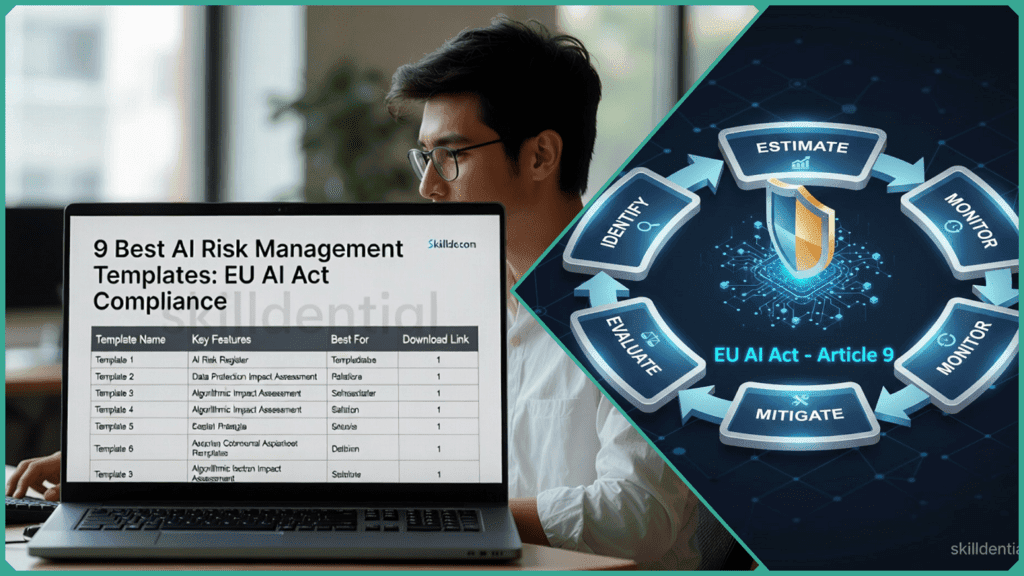
9 Best AI Risk Management Templates: EU AI Act Compliance
By August 2026, compliance with the EU AI Act won’t just be a ‘nice-to-have’—it will be a legal prerequisite for doing business in Europe. For high-risk systems, Article 9 mandates a rigorous, continuous risk management system that many organizations are still scrambling to build.
An AI risk management template serves as your blueprint for this process, transforming complex requirements into a structured workflow for identifying, evaluating, and mitigating risks. This guide provides 9 essential AI Risk Management templates designed to ensure your AI lifecycle meets Annex IV technical standards and stays audit-ready
The 9 Best AI Risk Management Templates for 2026
These nine templates stand out for EU AI Act compliance, focusing on high-risk systems enforced from August 2026, with fines up to €35 million or 7% of global turnover. Selected for audit-readiness, free access where possible, and alignment with Article 9 and Article 11 documentation needs
AI Risk Assessment Template by AIGL Blog
- Best for: Comprehensive lifecycle mapping.
- A systematic PDF framework that tracks risk from development through to post-market monitoring. It’s particularly strong for mapping specific AI model behaviors to required legal mitigations.
TrustArc AI Risk Assessment Template
- Best for: GRC and Privacy teams.
- A practical tool designed for Governance, Risk, and Compliance (GRC) professionals. It bridges the gap between traditional data privacy (GDPR) and the new security requirements of the AI Act.
EU AI Act Technical Documentation Template (AI Compliance Advisor)
- Best for: Meeting Article 11 requirements.
- A highly accessible Google Doc-style template. It is specifically designed to help you build the “Technical Documentation” required by Annex IV, covering design logic, testing phases, and monitoring protocols.
AI Risk Management Presentation by YouExec
- Best for: Executive briefings and CTOs.
- If you need to explain risk loops and governance to the board, this slide-based framework is ideal. It visualizes risk prioritization and identification in a way that non-technical stakeholders can understand.
Deel AI Acceptable Use Policy Template
- Best for: HR and internal workforce governance.
- Focuses on the “human” side of risk—establishing what employees can and cannot do with AI tools to prevent “foreseeable misuse” under Article 9.
Trail ML EU AI Act High-Risk Checklist
- Best for: Startups and SMEs.
- A high-impact, 10-point checklist that cuts through the noise. It’s perfect for smaller teams who need to verify their Quality Management System (QMS) without hiring a large consultancy.
LexisNexis EU AI Checklist
- Best for: Legal departments.
- A downloadable guide that focuses on the regulatory navigation aspect, helping legal teams identify which specific obligations apply based on the system’s risk tier.
Governance.ai EU AI Act Risk Management PDF
- Best for: In-depth Article 9 breakdown.
- This is less of a “fill-in-the-blank” form and more of a deep-dive methodology. It’s excellent for teams building their own custom internal risk software.
RadarFirst AI Risk Assessment Guide
- Best for: Mitigation workflows.
- Focuses heavily on the “Action” phase of risk management—what happens once a risk is identified and how to document the mitigation steps for an auditor.
Pro-Tip for your Blog
Note: While these AI Risk Management templates are excellent starting points, the EU AI Act requires “continuous” risk management. Using a template is the first step, but regular updates and real-world testing (Article 9, Paragraph 5) are mandatory for full compliance.
How Does Article 9 Define Risk Management?
Article 9 is the “engine room” of the EU AI Act for high-risk systems. It moves away from a one-time “safety check” and instead mandates a continuous, iterative risk management system that spans the entire lifecycle of the AI.
To be compliant, your risk management process must follow these four core requirements:
The Iterative Loop (The “Lifecycle” Requirement)
Risk management is not a “one-and-done” task. It must be planned and run throughout the entire lifecycle of the AI system, requiring regular systematic reviews and updates. This ensures that as your AI evolves or as new data becomes available, your risk assessments evolve with it.
Identifying “Foreseeable” Risks
Providers must identify and analyze:
- Known and foreseeable risks: Threats to health, safety, or fundamental rights when the system is used as intended.
- Reasonably foreseeable misuse: You are legally responsible for anticipating how a user might incorrectly—but predictably—use your AI.
- Post-market data: Evaluation of risks that emerge after the system is live, based on real-world monitoring.
The Hierarchy of Mitigation
Article 9 establishes a strict “priority list” for how you handle a discovered risk. You cannot simply “disclaim” a risk; you must address it in this order:
- Elimination by Design: Can you change the code or data to stop the risk from existing? (e.g., removing a biased dataset).
- Mitigation & Control: If it can’t be eliminated, what technical controls can you put in place?
- Information & Training: Providing clear instructions and training to the humans deploying the AI (the “deployers”).
Testing Against Defined Metrics
Before your AI hits the market, it must undergo rigorous testing to ensure it performs consistently. These tests must be measured against pre-defined metrics and probabilistic thresholds (e.g., accuracy rates or bias scores) and must specifically consider impacts on vulnerable groups, such as children.
Key Takeaway: Under Article 9, a “residual risk” is only acceptable if you have documented every effort to eliminate or mitigate it first. This documentation is what auditors will look for under Annex IV standards.
Moving from “Template” to “Compliance”
While these AI Risk Management templates are the perfect starting point, the EU AI Act is a living regulation. Using a static document once is not enough to satisfy an auditor in 2026. To ensure your business is truly protected, follow these three “Gold Rules”:
- Establish a “Risk Owner”: Templates are only effective if someone is responsible for updating them. Assign a specific lead (like a Chief Risk Officer or AI Compliance Lead) to oversee the Article 9 process.
- Integrate with Development: Don’t treat risk management as a final hurdle. Embed these assessment steps into your CI/CD pipeline so that every major model update triggers a risk review.
- Keep a “Paper Trail”: Under Annex IV, the process of how you reached a decision is as important as the decision itself. Always document why you categorized a risk as “mitigated” or “acceptable.”
Don’t Wait for the August Deadline
With potential fines of up to €35 million, the cost of “guessing” your AI risk is too high. By utilizing these 9 tAI Risk Management templates, you aren’t just checking a box—you are building a culture of Responsible AI that can scale with your business.
Pick one AI Risk Management template from the list above—perhaps the AIGL Risk Assessment or the Trail ML Checklist—and run it against your most active AI project today. You might be surprised at the “foreseeable misuses” you haven’t yet documented.
Why Use Templates for Compliance?
In the high-stakes environment of 2026 enforcement, manual or “homegrown” risk logs are no longer enough to satisfy a regulatory audit. Here is why structured AI Risk Management templates are a strategic necessity for modern businesses:
- Audit Readiness for Article 11: Templates are pre-mapped to the mandatory technical documentation requirements of Annex IV. This ensures that when an auditor asks for your design logic or testing metrics, you aren’t scrambling to find scattered documents.
- Bridge the “Resource Gap”: For SMEs, hiring a dedicated legal team to interpret every nuance of the EU AI Act is often impossible. Templates allow smaller teams to integrate compliance directly into their existing workflows.
- Proven Efficiency Gains: Real-world case studies demonstrate the impact of structure. In recent GRC (Governance, Risk, and Compliance) audits, organizations that transitioned from fragmented logs to standardized frameworks—like those provided by TrustArc—reported a 65% improvement in audit readiness and a significant reduction in time-to-compliance.
- Continuous Compliance: Because Article 9 requires an “iterative” process, AI Risk Management templates provide a repeatable rhythm. Instead of starting from scratch for every model update, you simply refresh the existing framework.
Template Comparison Matrix
| Template Name | Format | Compliance Focus | Best For | Access |
| AIGL Blog | Lifecycle Mitigation | General AI Providers | Free | |
| TrustArc | Web Tool | Article 9 GRC Mapping | Compliance Officers | Free Trial |
| AI Compliance Advisor | Google Doc | Article 11 Tech Docs | CTOs & Dev Teams | Free |
| YouExec | Slides | Governance Oversight | Board/Executive Pitch | Paid |
| Deel | Policy | Prohibited Use | HR & Operations | Free |
| Trail ML | Checklist | QMS Standards | Startups / SMEs | Free |
| LexisNexis | Checklist | Legal Obligation Map | In-House Counsel | Subscription |
| Governance.ai | Article 9 Deep Dive | Risk Specialists | Free | |
| RadarFirst | Guide | High-Risk Workflows | Incident Response | Partial |
Which Template Should You Choose?
- If you are starting from scratch, start with the Trail ML Checklist. It breaks the massive regulation into 10 manageable chunks.
- If you are preparing for a Technical Audit: Use the AI Compliance Advisor doc. It is specifically structured to help you fill out the Annex IV “Black Box” requirements that developers often struggle to document.
- If you need to train your staff, the Deel Acceptable Use Policy is the best way to ensure your employees don’t accidentally turn a “low-risk” tool into a “high-risk” liability.
A Quick Word on “Free” vs “Paid”
In 2026, many “Free” AI Risk Management templates are excellent for the assessment phase, but you may find that “Paid” tools (like TrustArc or LexisNexis) offer automated API integration. This means they can “watch” your AI models and update your risk logs automatically, which is a massive time-saver for high-growth companies.
AI Risk Management FAQs
What exactly is an AI risk management template? It is a structured framework designed to document the continuous, iterative process required by Article 9 of the EU AI Act. It helps you identify, assess, and mitigate risks to health, safety, and fundamental rights, ensuring your high-risk AI system is “audit-ready.”
When does the EU AI Act enforcement for high-risk systems begin? For most high-risk AI systems (those listed in Annex III, such as recruitment or credit scoring tools), the deadline is August 2, 2026. If your AI is part of a product already covered by EU safety laws (like medical devices), you may have until August 2027.
What specific risks does Article 9 cover? Article 9 mandates the analysis of all known and foreseeable risks when the system is used as intended, as well as risks arising from reasonably foreseeable misuse. This includes threats to physical safety, psychological health, and fundamental rights (like privacy and non-discrimination).
Are templates enough to pass a regulatory audit?
Not on their own. Templates provide the structure for your Annex IV technical documentation, but compliance requires you to actually perform the testing, maintain the logs (Article 12), and ensure continuous human oversight (Article 14). Think of the AI Risk Management template as the map, but you still have to walk the path.
Can SMEs really use free templates for high-stakes compliance?
The EU AI Act includes provisions (Article 62) to support SMEs and startups, such as priority access to “regulatory sandboxes.” Free AI Risk Management templates like the AI Compliance Advisor cover the essential Article 9 requirements, allowing smaller teams to reach a high level of readiness without an enterprise-scale budget.
In Conclusion
By August 2026, the EU AI Act will have shifted from a distant regulation to a daily operational reality. While the 9 AI Risk Management templates listed above provide the “scaffolding” you need to satisfy Articles 9 and 11, true compliance isn’t a one-time paperwork exercise—it’s a commitment to Responsible AI.
Organizations that move beyond “checking boxes” and instead weave these risk management frameworks into their core development cycles will do more than just avoid fines; they will build the radical transparency required to earn long-term user trust.
Next Step: Download your preferred AI Risk Management template today and run a “Pilot Audit” on your highest-priority AI project. Identifying one “foreseeable misuse” now is worth more than a thousand pages of documentation later.
Discover more from SkillDential | Your Path to High-Level Career Skills
Subscribe to get the latest posts sent to your email.