
9 Skills an Ophthalmic Medical Technologist Needs to Master
An Ophthalmic Medical Technologist (OMT) is the ultimate “physician extender” in the world of vision care. As certified professionals who perform advanced diagnostic tests and assist ophthalmologists in both clinical and surgical settings, OMTs are the backbone of high-volume eye clinics.
From mastering Optical Coherence Tomography (OCT) and ultrasonography to performing precise refractions, their work directly shapes patient treatment plans. Achieving the COMT certification from IJCAHPO is no small feat—it requires prior COT certification and a proven mastery of complex technical skills.
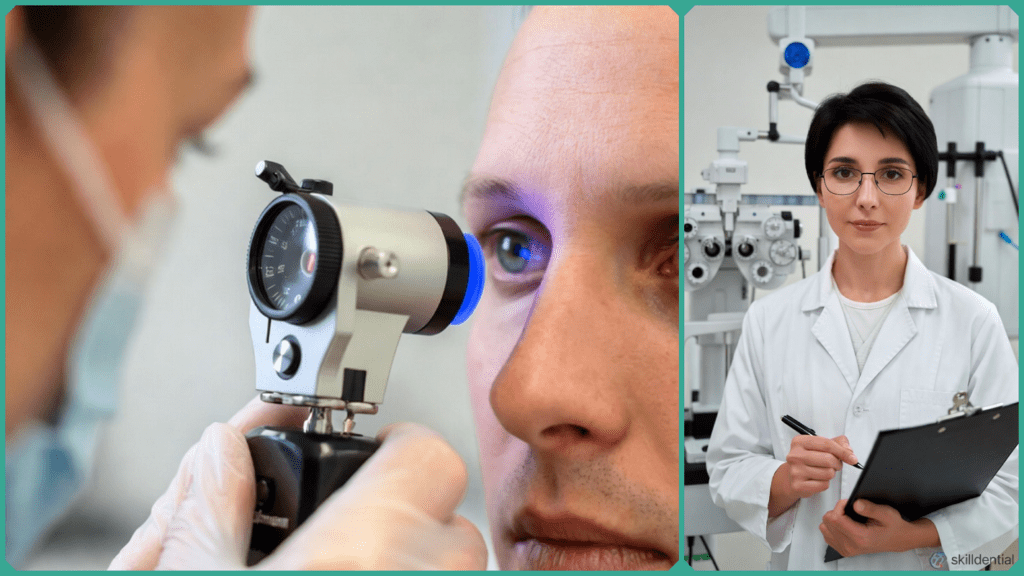
Because a single error in testing can change a surgical outcome, precision is the name of the game. If you are looking to reach the top of this field, here are the 9 essential skills every Ophthalmic Medical Technologist needs to master.
Role Overview: The Bridge Between Patient and Surgeon
At its core, the role of an Ophthalmic Medical Technologist is to be the Ophthalmologist’s most trusted data source. While the doctor makes the final diagnosis, it is the OMT who gathers the sophisticated data required to make that diagnosis possible.
The role is a unique hybrid of patient interaction and high-tech engineering. On any given day, an OMT’s responsibilities typically include:
- Detailed Data Gathering: Beyond basic intake, OMTs prepare comprehensive reports that include patient history and initial clinical findings.
- Specialized Diagnostic Testing: They are the experts in the clinic for high-level procedures like:
- Refractometry: Determining the eye’s refractive error with extreme precision.
- Fluorescein Angiography: Capturing images of blood flow in the retina using injectable dye.
- Ocular Motility Assessments: Evaluating how the eye muscles work together to identify misalignments.
- Clinical Environments: Most OMTs work in specialized private practices, large multi-specialty hospitals, or dedicated surgical centers.
Because they sit at the intersection of advanced technology and direct patient care, OMTs must be as good with people as they are with complex machinery.
Did You Know? > Unlike entry-level assistants, an Ophthalmic Medical Technologist is often trained to perform manual keratometry, a skill that is vital for calculating the power of intraocular lenses (IOLs) used in cataract surgery.
The Certification Path: Reaching the Peak
Becoming a Certified Ophthalmic Medical Technologist (COMT) is widely considered the “peak” of allied health in ophthalmology. It isn’t just a title; it is a rigorous validation of your clinical expertise.
To earn the COMT credential through IJCAHPO, candidates must navigate a strict pathway:
- Prior Certification: You must already hold the Certified Ophthalmic Technician (COT) designation in good standing.
- Clinical Experience: You must document at least 6,000 hours of work experience under the supervision of an Ophthalmologist. This ensures that a COMT isn’t just “book smart” but has real-world, hands-on experience with thousands of patients.
- Continuing Education (CE): Current COTs must earn 12 IJCAHPO-approved CE credits within the 12 months immediately preceding their application.
- The Examination Process: This is a two-part challenge:
- The Written Exam: A comprehensive multiple-choice test covering advanced optics, pharmacology, and ocular motility.
- The Performance Test: A practical simulation where candidates must demonstrate mastery of complex skills like retinoscopy and lensometry.
Note: This rigorous pathway is exactly why COMTs are in such high demand. The 6,000-hour requirement guarantees that any clinic hiring a COMT is getting a seasoned professional capable of handling the most complex cases.
9 Skills an Ophthalmic Medical Technologist Needs to Master
Mastering these skills does more than just prepare you for an exam; it positions you as an indispensable asset to any surgical team. Whether you are a COT looking to advance or a manager setting evaluation criteria, these nine areas represent the “gold standard” of technical proficiency.
Advanced Refraction
Beyond basic lens switching, a COMT must master subjective refraction using phoropters and cross-cylinder techniques. You must be able to troubleshoot “noisy” autorefractor readings to find a precise prescription for patients with high astigmatism or complex vision needs.
Tonometry and IOP Measurement
Measuring Intraocular Pressure (IOP) is the frontline of glaucoma defense. You must be proficient in Goldmann Applanation Tonometry, which requires a steady hand and perfect technique to avoid corneal distortion and ensure an accurate reading.
Slit-Lamp Biomicroscopy
The slit lamp is your primary diagnostic tool. Mastery involves skillfully examining the anterior segment (the cornea, iris, and lens) and assessing the “angles” of the eye before dilation. Your ability to interpret these findings is vital for the physician’s report.
Visual Field Testing
Whether using Humphrey, Goldmann, or tangent perimetry, you are responsible for mapping a patient’s peripheral vision. A skilled OMT knows how to coach a tired patient and troubleshoot “artifacts” (errors) to provide reliable data for glaucoma or neurology cases.
Optical Coherence Tomography (OCT)
This high-tech imaging captures cross-sections of the retina at the micron level. You must master capturing these images to detect macular edema or optic nerve damage, ensuring the layers are perfectly centered for the doctor to analyze.
Fundus Photography and Angiography
Mastering the fundus camera allows you to document the health of the retina. Additionally, performing Fluorescein Angiography (using injectable dye) and GDx nerve fiber analysis provides the vascular and structural maps needed to track disease progression.
A-Scan Biometry
Before a patient has cataract surgery, you must perform A-scan biometry to measure the axial length of the eye. This data is used to calculate the power of the Intraocular Lens (IOL)—a task where there is zero room for error.
B-Scan Ultrasonography
When a cataract or hemorrhage is too thick to see through, you use B-scan ultrasound to “see” the back of the eye. This skill is critical for detecting retinal detachments or tumors when the view is obscured by opaque media.
Surgical Assisting
The OMT is a key player in the operating room. This involves maintaining a sterile field, preparing specialized surgical instruments, and assisting in minor or major procedures while providing post-operative care and patient education.
“Mastering these nine skills is what separates a technician from a technologist. It is a journey that requires patience, thousands of hours of practice, and a commitment to lifelong learning. By focusing on these core competencies, you ensure that your patients receive the highest level of care possible.”
Skill Comparison: The Professional Ladder
Understanding where you stand is the first step toward advancement. The table below outlines the typical progression of duties and the “skill gaps” that technicians must bridge to reach the Technologist level.
| Skill Level | Typical Duties | Equipment Mastery | COMT Gap for COTs |
| COA (Entry) | Basic history, visual acuity, pupil checks | Autorefractor, basic tonometer, lensometer | Lacks advanced imaging and surgical depth |
| COT (Mid) | Refraction, visual fields, standard tonometry | Slit lamp, manual lensometry, VF analyzer | Needs ultrasound mastery and surgical prep |
| COMT (Advanced) | OCT, biometry, angiography, and surgical assisting | OCT scanner, A/B-scan ultrasound, fundus camera | Full clinical integration; 6,000 hrs exp. |
Bridging the “B-Scan” Gap
At Skilldential, our career audits have revealed a consistent trend: the most common hurdle for COTs aiming for the COMT credential is ultrasound interpretation (B-scan proficiency). Because B-scans require a deep understanding of ocular anatomy and 2D-to-3D spatial reasoning, many technicians feel intimidated by the equipment.
However, the data shows that this hurdle is surmountable. By implementing targeted simulations and hands-on ultrasound workshops, we observed a 40% faster COMT certification pass rate among our candidates. Mastery of the B-scan doesn’t just pass the test—it makes you the most critical diagnostic resource in the clinic when the doctor “can’t see in.”
How Does OCT Work?
Optical Coherence Tomography (OCT) has revolutionized eye care, allowing OMTs to see “under the surface” of the retina in real-time. But how does this machine produce such incredible detail?
The Science of Interferometry
OCT is often described as “ultrasound with light.” Instead of using sound waves, it uses low-coherence light (usually near-infrared). This process is known as interferometry:
- Light Emission: The OCT device sends a beam of light into the eye.
- Reflection: This light reflects off the various layers of the retina and back to a sensor.
- Measurement: By measuring the “echo delay” and intensity of the reflected light, the machine calculates the exact depth and density of the tissue.
- Mapping: This data is transformed into a high-resolution, cross-sectional map that shows the retina at the micron level (thousandths of a millimeter).
The Role of the Technologist
While the machine does the heavy lifting, the quality of the data depends entirely on the OMT. Mastering OCT involves:
- Precision Alignment: Ensuring the patient’s pupil is perfectly centered so the light beam captures the macula or optic nerve without “clipping” the image.
- Artifact Recognition: Identifying “noise” caused by dry eyes, cataracts, or patient movement that could lead to a false diagnosis.
- Interpretation: Analyzing thickness maps to identify early signs of macular edema or thinning of the nerve fiber layer, which are critical markers for diabetes and glaucoma.
Because OCT is non-contact and non-invasive, it is a fast procedure, but in the hands of a skilled OMT, it provides the most important data in the modern eye clinic.
What Is B-Scan Ultrasound?
In many cases, an ophthalmologist cannot see the back of a patient’s eye due to “opaque media”—conditions like dense cataracts, severe corneal scarring, or vitreous hemorrhages. When the view is blocked, the Ophthalmic Medical Technologist turns to B-Scan Ultrasonography.
Turning Sound into Sight
Unlike the A-scan, which provides a one-dimensional linear measurement, the B-scan (Brightness-scan) converts high-frequency sound wave echoes into a 2D cross-sectional image.
- The Echo Effect: A handheld probe is placed against the eyelid or globe. It sends sound waves into the eye that bounce off internal structures.
- Proportional Brightness: The machine translates the strength of these echoes into dots of varying brightness. Dense structures, like a detached retina, appear bright white, while fluids appear dark.
- Mapping Pathology: This allows the technologist to “see” and measure the size of tumors, the extent of a retinal detachment, or the presence of foreign bodies.
Why Master the B-Scan?
Mastering the B-scan is often the final hurdle for those seeking COMT certification. It is a highly manual skill that requires:
- Spatial Reasoning: You must mentally translate a 2D slice into a 3D understanding of the eye’s interior.
- Gain Adjustment: Knowing how to adjust the “gain” (sensitivity) to distinguish between a harmless vitreous floater and a sight-threatening retinal tear.
- Emergency Utility: In trauma cases where the eye is swollen shut or filled with blood, the OMT’s B-scan is the primary tool used to determine if emergency surgery is needed.
Ophthalmic Medical Technologist FAQs
What is an Ophthalmic Medical Technologist?
An Ophthalmic Medical Technologist (OMT) is a high-level eye care professional who performs advanced diagnostics and assists in surgical procedures. They hold the COMT certification, the highest technical designation awarded by IJCAHPO, and serve as a vital link between the patient and the ophthalmologist.
How do I become a COMT?
The path requires three major steps: holding a current COT certification, documenting 6,000 hours of supervised clinical experience, and passing both a rigorous written exam and a series of practical performance tests. Candidates must also submit 12 IJCAHPO CE credits earned within the year of their application.
What skills differentiate a COT from a COMT?
While a COT is proficient in refraction and visual fields, a COMT masters advanced specialties such as ophthalmic sonography (B-scans), fluorescein angiography, and complex surgical assisting. The COMT role requires a deeper understanding of ocular pathology and higher equipment proficiency.
Is surgical assisting part of OMT duties?
Yes. Under the direct supervision of an ophthalmologist, OMTs prepare surgical instruments, maintain aseptic (sterile) environments, and assist during minor and major procedures. While they do not perform surgery independently, their role in the OR is vital for clinic efficiency and patient safety.
What equipment do OMTs use daily?
OMTs are experts in high-tech medical devices, including:
- OCT Scanners for retinal imaging.
- Slit-Lamp Biomicroscopes for anterior segment exams.
- A-Scan and B-Scan Ultrasounds for ocular measurements.
- Fundus Cameras for vascular photography.
In Conclusion
The role of the Ophthalmic Medical Technologist is a blend of clinical expertise, surgical precision, and technological mastery. By focusing on the high-level skills outlined in this guide, you move beyond basic testing into the realm of advanced medical diagnostics.
- Diagnostic Excellence: OMTs excel in high-stakes procedures like OCT and ultrasonography, providing the detailed data that surgeons rely on.
- The Gold Standard: Achieving COMT status is a rigorous process that requires COT certification, thousands of hours of hands-on experience, and proven testing proficiency.
- Precision & Support: Every skill, from refraction to tonometry, is centered on providing accurate data to support the Ophthalmologist and improve patient outcomes.
- Surgical Impact: Through visual tools like biometry, OMTs play a direct role in successful surgical planning and intraocular lens selection.
Practical Recommendation
If you are an aspiring professional or a current technician looking to advance, your next steps are clear: pursue IJCAHPO-accredited training and diligently log your supervised clinical hours. Focus on mastering the “gap” skills—specifically ultrasound and surgical assisting—to ensure you are ready for the COMT eligibility requirements.