9 Best Courses for Deep Learning Engineers With Exam Preps
Deep learning is the engine behind 2026’s most advanced systems, from autonomous agents to multimodal generative models. For engineers, the challenge has shifted from simply “training a model” to architecting robust, scalable systems that can survive production environments.
The following courses represent the gold standard for deep learning engineering. They are selected because they combine rigorous theory with the exam prep required to earn industry-recognized certifications.
Why Exam Prep Matters
In the 2026 AI job market, the “certificate of completion” has been largely replaced by the “stress-tested credential.” Exam-backed certificates validate knowledge beyond a basic passive understanding, proving you can architect systems that survive production-grade pressures.
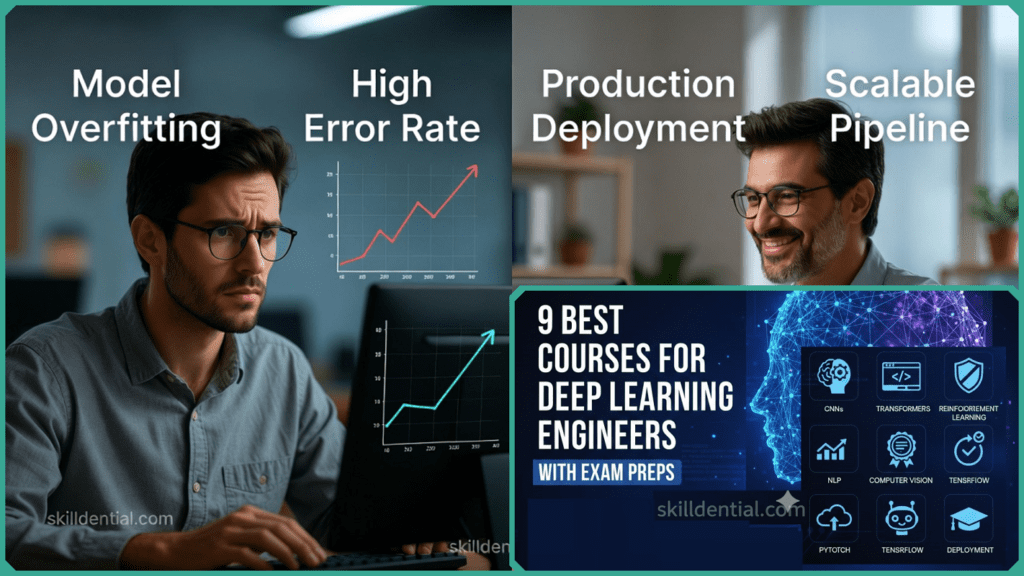
High-quality exam prep courses go beyond teaching code; they provide practice labs that simulate critical failure modes like gradient vanishing, model drift, or deployment crashes—scenarios essential for engineers handling the high-dimensional data common in agentic AI and multimodal systems.
A recent 2026 career audit by Skilldential revealed that while many mid-level engineers understand model architecture, they frequently fail at the “operations” stage. However, those who completed targeted exam prep for professional certifications saw a 40% increase in job-readiness scores, specifically in areas like MLOps pipelines and real-time inference optimization.
The ROI of Certification in 2026
Earning a professional-level badge is no longer just a “bonus” for your resume; it is a signal of technical maturity. According to the 2026 industry surveys:
- Salary Impact: Certified Professional ML Engineers earn approximately 25% higher salaries than their non-certified peers.
- Hiring Speed: Candidates with validated cloud credentials (AWS or Google Cloud) land interviews 3x faster for senior deep learning roles.
- Skill Durability: Exam prep forces a “mechanistic understanding” of how layers and gradients interact, a foundational skill that remains relevant even as new models like Blackwell-class architectures emerge.
Stack-Based Course Selection for Deep Learning Engineers
To optimize your learning path, categorize your selections by tech stack. This allows for efficient pivots: PyTorch for flexible research and agentic AI, TensorFlow for enterprise-scale systems, or Cloud Platforms for infrastructure-heavy roles. In 2026, every top-tier course includes integrated MLOps modules to teach deployment, monitoring, and scaling.
| Category | Recommended Course | Platform | Certification & Exam Prep | Best For… |
| PyTorch Lovers | PyTorch for DL Professional Certificate | DeepLearning.AI | Professional Certificate; focus on ONNX & production labs. | Up-skillers pivoting to Research & Generative AI. |
| TensorFlow Fans | TensorFlow Developer Professional Certificate | DeepLearning.AI | Preps for industry-standard TF certification; hands-on CV/NLP. | Data Scientists scaling unstructured data apps. |
| AWS Infrastructure | NEW: AWS Certified ML Engineer – Associate | AWS Skill Builder | Preps for MLA-C01 (replacing older specialty certs in 2026). | Engineers building production-ready AWS pipelines. |
| Google Cloud | Preparing for Google Cloud ML Engineer | Coursera / GCP | Google Professional ML Engineer; includes Vertex AI & MLOps labs. | Career advancers seeking high-level Senior roles. |
| NVIDIA GPU | NVIDIA DLI: Fundamentals of Deep Learning | NVIDIA DLI | NVIDIA Certified Associate; focuses on GPU acceleration. | Performance-focused pros in Video/Audio AI. |
| Practical Coders | Practical Deep Learning for Coders | fast.ai | Portfolio-based; emphasizes state-of-the-art deployment. | Software Engineers are bridging code to DL quickly. |
| Full Specialization | Deep Learning Specialization (Andrew Ng) | Coursera | 5-course certificate; the “gold standard” for fundamentals. | All tiers need a robust theoretical foundation. |
| MLOps Focus | Machine Learning Engineering for Production | DeepLearning.AI | Focuses on CI/CD, MLflow, and model monitoring. | Engineers specializing in scaling and reliability. |
| Enterprise Data | Databricks Certified ML Professional | Databricks | Databricks ML Prof. Exam tests drift detection & feature stores. | Big Data engineers using Spark and Delta Lake. |
Key Shift: The 2026 Certification Landscape
It is important to note that as of March 31, 2026, the legacy AWS Certified Machine Learning – Specialty (MLS-C01) is being retired. It has been succeeded by the AWS Certified Machine Learning Engineer – Associate (MLA-C01). This new exam shifts focus toward operationalizing ML workloads rather than just modeling, mirroring the industry’s demand for MLOps-ready engineers.
Similarly, NVIDIA has expanded its DLI certifications to include specialized tracks for Generative AI and AI Infrastructure (NCP-AII), making it the premier choice for those managing multi-GPU clusters and “AI factories.”
How to Choose?
To maximize your ROI in 2026, you must match your choice to your current professional “tier” and the specific technical stack used by your target employers.
- The Up-Skiller (Software Engineers): Start with fast.ai or the PyTorch for DL Professional Certificate. These focus on “top-down” learning, allowing you to get models running in days rather than months. They are perfect for engineers who want quick wins and a portfolio of deployed projects to show at interviews.
- The Specialized Professional (Data Scientists): If you are already handling unstructured data (medical imaging, industrial sensors, or high-fidelity audio), pivot toward NVIDIA DLI. Their focus on GPU optimization and high-dimensional data is a “moat” that protects your career from generalist automation.
- The Career Advancer (Mid-Level Engineers): Target the Google Professional ML Engineer or the new AWS Certified ML Engineer – Associate (MLA-C01). In 2026, these are the primary filters used by recruiters for senior roles. Passing these exams proves you can manage “The Operational Revolution”—handling not just the model, but the entire inference pipeline and cost-optimization strategy.
Regardless of your path, ensure the course you pick offers at least 80% hands-on labs. In a market that now values “what you can build” over “what you’ve read,” any course without rigorous MLOps modules—covering CI/CD, model drift, and containerization—is already outdated.
Pro-Tip for Engineering Managers: If you’re leading a team, don’t have everyone learn in silos. Bulk-buy Team Licenses for these platforms. It not only cuts training costs by 30-50% but also ensures your entire engineering department speaks the same “architectural language,” dramatically increasing the speed from prototype to resilient production results.
Final Verdict: Is Your Path Future-Proof?
As we move toward the 2030s, the “Deep Learning Engineer” is becoming a Systems Architect. By selecting courses that emphasize Exam Prep, you aren’t just memorizing syntax; you are building the mental frameworks needed to troubleshoot the complex, agentic AI systems of tomorrow. Check your AI Readiness Skill Assessment.
Career Impact
In 2026, the gap between “self-taught” hobbyists and certified professionals has widened into a significant financial divide. Industry trends indicate that certified Deep Learning engineers earn between 25% and 35% higher salaries than their non-certified counterparts, with senior-level AI Architects often clearing the $230,000 to $280,000 mark.
This “Certification Premium” exists because employers are moving away from hiring based on potential and toward hiring for proven reliability. Beyond the paycheck, the true value of these courses lies in their deployment labs, which address the 80% of a DL engineer’s job that doesn’t involve modeling—such as data engineering, latency optimization, and infrastructure scaling.
Recent career audits by Skilldential highlight a stark performance difference: engineers who have undergone rigorous, exam-backed training deploy production-ready systems 2x faster than those without specialized training. By mastering the ability to troubleshoot real-world failures through simulated exam environments, you aren’t just earning a badge; you are becoming the engineer who keeps systems running when they matter most.
Final Check: Is This Guide for You?
If you are ready to stop “tutorial hopping” and start building a career with measurable ROI, follow this 9-course roadmap. Choose the stack that fits your company’s infrastructure, commit to the exam date, and bridge the gap from theory to production excellence.
2026 Deep Learning Engineer: Skills Gap Checklist
Check the boxes that apply to you. If you have more than two “Missing” items in a category, that defines your starting course.
The Mathematical & Architectural Foundation
- Can you explain backpropagation and gradient descent without a library?
- Do you understand the difference between CNNs, Transformers, and State-Space Models (SSMs)?
- Can you tune hyperparameters like learning rate schedules and weight decay?
- Missing? Start with: DeepLearning.AI Specialization (Andrew Ng).
The Coding & Framework Stack
- Can you build a custom training loop in PyTorch or TensorFlow?
- Do you know how to use ONNX to move models between frameworks?
- Can you implement a “sliding window” or “attention mechanism” from scratch?
- Missing? Start with fast.ai or PyTorch for the DL Professional Certificate.
MLOps & Production Scaling
- Have you deployed a model to a production endpoint (Vertex AI, SageMaker)?
- Can you set up a CI/CD pipeline that triggers a re-training when data drifts?
- Do you know how to containerize an inference engine using Docker/Kubernetes?
- Missing? Start with: Google Professional ML Engineer or MLOps Specialization.
Hardware & Performance Optimization
- Do you know how to profile a model to find GPU bottlenecks?
- Can you use Mixed Precision Training to speed up models by 2x?
- Have you worked with CUDA or specialized kernels for high-dimensional data?
- Missing? Start with: NVIDIA DLI: Fundamentals of Deep Learning.
Deep Learning Engineer FAQs
What defines a deep learning engineer in 2026?
Deep learning engineers are the architects of modern AI. While data scientists often focus on the “recipe” (the model), engineers build the “restaurant”—designing, deploying, and scaling neural networks in production. In 2026, this role specifically requires mastering Agentic AI and Multimodal systems. They spend 80% of their time on MLOps, ensuring models remain reliable, cost-effective, and secure using tools like Vertex AI or AWS SageMaker.+1
PyTorch or TensorFlow for beginners?
It depends on your final destination. PyTorch is the undisputed king of 2026 research and Generative AI because of its “Pythonic” flexibility. However, TensorFlow remains a powerhouse in massive enterprise environments where legacy systems and rigid production pipelines are the norm. Beginners should choose PyTorch for rapid prototyping or TensorFlow if they are targeting roles in established Fortune 500 tech stacks.
Are free courses sufficient for professional certifications?
Free resources like fast.ai are world-class for building practical skills and a portfolio. However, they rarely include the specific “exam simulations” needed to pass high-stakes $200–$300 professional exams. Paid exam-prep courses provide the sandbox environments and “trick question” practice banks that are essential for first-time pass rates.
How much MLOps is actually in these DL courses?
In 2026, a deep learning course without MLOps is a hobbyist course. Industry-leading programs now dedicate 30% to 50% of their curriculum to deployment, CI/CD, and monitoring. Because model training is now largely automated (AutoML), the engineer’s value has shifted to managing the infrastructure that keeps the model alive.
NVIDIA DLI vs. Google Cloud Certification?
Think of NVIDIA DLI as “Hardware-Up” and Google Cloud as “Platform-Down.” NVIDIA is essential for those working close to the silicon (GPU optimization, CUDA, and high-performance inference). Google Cloud (and AWS) focuses on the “orchestration” level—how to manage data at scale and trigger pipelines. For a truly future-proof career, many engineers now stack both to prove they can handle the full AI stack.
In Conclusion
The transition from a learner to a high-earning Deep Learning Engineer in 2026 is defined by a shift from theoretical curiosity to production reliability. By choosing one of the “9 Best” courses, you are not just watching videos; you are building the technical resilience needed to pass industry-standard exams and manage high-stakes AI infrastructure.
Your Final Action Plan
- Takeaway 1: Prioritize Exam-Prep with Labs. Avoid “passive” certificates. In a 2026 job market saturated with AI enthusiasts, a pro-level certification (like Google Professional ML Engineer or AWS MLA-C01) backed by hands-on lab experience is your most credible “proof of work.”
- Takeaway 2: Stack-Match for Efficiency. Don’t try to learn everything. If your dream company uses AWS, focus your energy there. If you’re into cutting-edge research and agentic AI, double down on PyTorch. Efficiency comes from specializing in a stack and mastering its nuances.
- Takeaway 3: Focus on MLOps. In 2026, the model is the easy part. The “Engineering” in your title comes from your ability to deploy, monitor for drift, and scale your systems. Ensure your chosen course spends at least 30% of its time on the production lifecycle.
The Recommended “Power Path” for 2026
If you’re undecided, the highest ROI path currently remains:
- Foundation: Complete the DeepLearning.AI Specialization to master the math and architectures.
- Professionalization: Use the Google Cloud Professional ML Engineer Prep to learn how to manage those models at scale.
Discover more from SkillDential | Your Path to High-Level Career Skills
Subscribe to get the latest posts sent to your email.