
How AI is Rewriting the Cybersecurity Career Path in 2026
In 2026, the cybersecurity career path has officially moved past the era of manual log-watching. While the industry still grapples with a persistent talent gap—exacerbated by the fact that 86% of organizations faced significant breaches just two years ago—the nature of the work has fundamentally transformed.
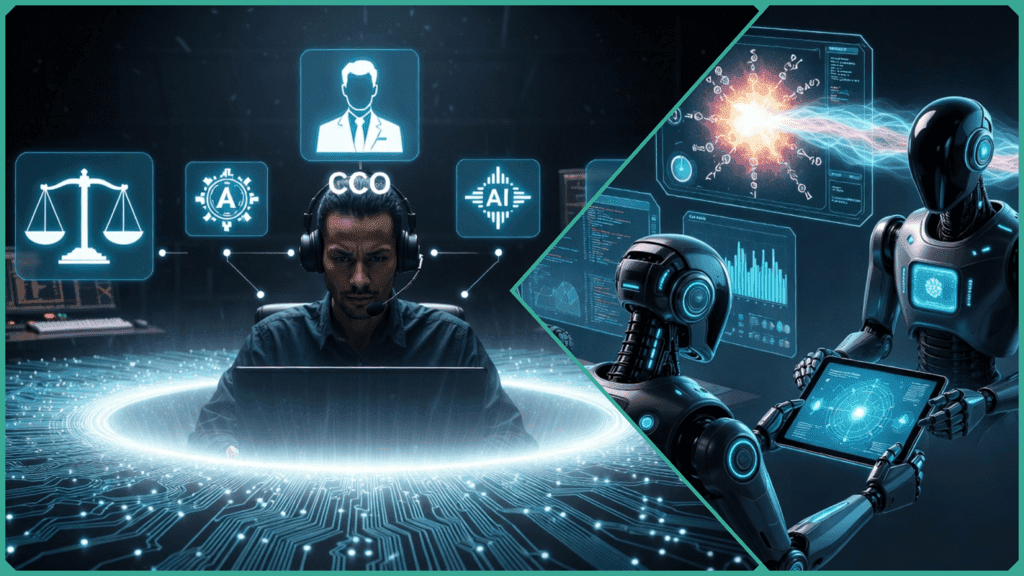
Today, AI doesn’t just assist; it operates. As autonomous agents handle the “grunt work” of threat triage and routine patching, the barrier to entry has shifted. Success no longer belongs to those who can spot a single anomaly in a sea of data, but to those who can architect, audit, and ethically govern the AI systems doing the hunting. In this new landscape, human judgment is the ultimate “fail-safe,” providing the business logic and contextual nuance that algorithms still cannot replicate.
The Agentic Shift and the Rise of “Dark AI”
In 2026, the primary driver of change isn’t just “AI” as a tool, but the transition to Agentic Workflows. Unlike the chatbots of 2023, today’s autonomous security agents can pursue complex goals—orchestrating entire investigative lifecycles from initial alert to final containment without constant human prompting.1
However, this efficiency comes with a new set of high-stakes risks.2 According to recent 2026 data, 94% of security leaders now identify AI as their top risk driver.3 This concern has sparked a massive shift in defensive strategy: 64% of organizations now perform formal security assessments on their AI tools—a figure that has doubled since 2025.4+2
The Emergence of “Dark AI”
The cybersecurity career path is being rewritten most aggressively by the arrival of Dark AI. This isn’t just a buzzword; it refers to the weaponization of large language models (LLMs) by adversaries to launch “machine-speed” attacks.5
- Adversarial Adaptive Malware: Malware that uses AI to rewrite its own code in real-time to bypass a specific target’s unique defenses.6
- Hyper-Personalized Phishing: AI agents that scrape a target’s social footprint to launch thousands of perfectly tailored social engineering attacks simultaneously.
- Model Poisoning: Attacks that target the integrity of a company’s own AI, feeding it “poisoned” data to create blind spots the hacker can later exploit.
The Oversight Mandate: Verification of Operation
In this environment, the “entry-level” job is no longer about watching logs, but about verifying AI outputs. In 2026, professionals must act as “Human-in-the-Loop” auditors, ensuring that defensive agents haven’t been hallucinating or manipulated by adversarial prompts.7 As one 2026 industry report puts it: “The job isn’t to run the tools anymore; it’s to govern the machines that run the tools.”
Comparison: 2024 vs. 2026 Operational Models
| Feature | 2024 (Manual/Automated) | 2026 (Agentic/Autonomous) |
| Response Time | Minutes to Hours (Human-led) | Seconds to Milliseconds (AI-led) |
| Threat Handling | Static Playbooks (If/Then logic) | Dynamic Reasoning (Goal-based) |
| Primary Risk | Human Error/Configuration | Adversarial AI & Model Poisoning |
| Analyst Role | Triage and Investigation | Performance Auditing & AI Ethics |
Helpful Resource
For a deeper dive into the specific “agentic” tools being deployed right now, check out this Technical Guide to the 2026 Agentic SOC. It explains how “multi-agent orchestration” is replacing traditional SOAR platforms.
Building Your “Skill Moat” Against Automation
As AI moves from a tool to an autonomous agent, the value of a cybersecurity professional is being redistributed. Data from early 2026 shows that demand for AI-literate security pros has surged by over 35%, but this demand is specific. It favors those who can protect the AI itself and those who can handle the “gray areas” where algorithms fail.
The Context Gap: Business Logic & Ethics
AI lacks a sense of “organizational nuance.” It can identify a large data transfer, but it cannot inherently know the difference between a high-stakes, emergency CEO request and a sophisticated exfiltration event.
- The Moat: Developing the ability to map technical risks to Business Impact. Professionals who can translate “The AI blocked this IP” into “This prevents $2M in potential downtime” are becoming irreplaceable.
- Ethical Governance: As seen in recent Skilldential career audits, the role of “AI Ethics Auditor” is a top-tier 2026 position. Humans must decide the risk appetite of the company—something a machine is legally and logically incapable of doing.
High-Demand Technical Pillars: Red Teaming & Cloud
While routine monitoring is gone, the “battlefield” has moved to the models themselves and the infrastructure they run on.
- AI Red Teaming: This is the breakout skill of 2026. It involves “jailbreaking” or stress-testing AI models to find vulnerabilities like prompt injection or model poisoning before attackers do.
- Cloud Security Posture Management (CSPM): As AI agents primarily live in the cloud, securing the underlying architecture is now a baseline requirement.
The “Promotion Hack”: Simulation-Based Learning
A striking trend in 2026 is the correlation between Adversarial Simulations and career growth. Mid-level professionals who engage in regular AI red-teaming simulations see 40% faster promotion rates than those sticking to traditional certifications.
“In 2026, a certification is a license to learn; a simulation is a license to lead.”
Key 2026 Skill Priorities
| Skill Category | AI Ability | Human Advantage |
| Threat Detection | Automates 90% of triage. | Handles “Zero-Day” & novel logic attacks. |
| Vulnerability Fixes | Can suggest code patches. | Verifies the patch doesn’t break business logic. |
| Compliance | Gathers and checks data. | Negotiates with regulators and stakeholders. |
| Red Teaming | Fast, pattern-based scans. | Unconventional, creative “out-of-the-box” thinking. |
Helpful Resource
To understand how these simulations actually look in practice, I recommend this guide on AI-Driven Red Teaming Workflows for 2026. It covers how to use AI to find vulnerabilities in other AI models—a core skill for the next generation of security leaders.
Top Cybersecurity Career Paths in 2026
To help you choose the right direction, we’ve broken down the most in-demand cybersecurity career paths into four key “domains” based on current 2026 hiring data.
The Defensive Domain (Blue Teaming)
These roles focus on maintaining the “shield.” In 2026, this is less about watching logs and more about tuning the machines that watch the logs.
- AI Security Analyst: Uses AI-enriched platforms to investigate complex anomalies that autonomous agents can’t solve alone.
- Incident Response (IR) Lead: Manages high-stakes breaches, focusing on containment strategy and post-incident forensics.
- Cloud Security Engineer: Specializes in securing multi-cloud architectures (AWS, Azure, Google Cloud) where most AI workloads now live.
The Offensive Domain (Red Teaming)
These “ethical hackers” find the holes before the bad guys do.
- AI Red Teamer: A breakout role for 2026. These pros specialize in “jailbreaking” LLMs and testing AI models for prompt injection or data poisoning.
- Penetration Tester: Conducts deep, creative attacks that bypass automated defenses by exploiting human error and business logic flaws.
The Architecture & Design Domain
These are the “master builders” of the security world.
- Security Architect: Designs the blueprints for an organization’s entire defense system, ensuring all layers work seamlessly.
- DevSecOps Engineer: Integrates security directly into the software development pipeline, automating checks so code is “secure by design.”
The Governance & Strategy Domain
Non-technical but highly critical roles that bridge the gap between “code” and “company.”
- AI Ethics & Compliance Officer: Ensures that the company’s use of AI meets global privacy laws (like the updated EU AI Act) and doesn’t exhibit bias.
- GRC Analyst (Governance, Risk, and Compliance): Manages the company’s overall risk posture, focusing on insurance, audits, and third-party risk.
Salary & Growth Comparison (2026 Estimates)
| Career Path | Entry-Level Salary | Senior-Level Salary | AI Automation Risk |
| Blue Team | $95k – $110k | $160k – $210k | Medium (Triage is automated) |
| Red Team | $105k – $125k | $180k – $240k | Low (Requires human creativity) |
| Architecture | $120k – $140k | $200k – $280k | Very Low (Strategic design) |
| Governance | $90k – $115k | $170k – $220k | Low (Requires ethical judgment) |
Which Career Path Should You Choose?
- Choose Governance if you are interested in law, policy, and how technology impacts society.
- Choose Defensive if you love solving mysteries and working in fast-paced, “emergency room” environments.
- Choose Offensive if you have a “hacker mindset” and love breaking things to make them better.
- Choose Architecture if you like big-picture thinking and designing complex systems from the ground up.
These cybersecurity roles highlight a critical 2026 trend: Strategic oversight is replacing tool operation. Professionals are no longer expected to manually block IPs; they are expected to design the systems that decide which IPs to block.
Why These Cybersecurity Roles Command a Premium
The 2026 salary surge (often 25-35% higher than traditional roles) is driven by the “Talent Scarcity Paradox.” While AI can do the work of 1,000 junior analysts, the industry still lacks the “Super-Analysts” capable of managing the AI itself.
- Location Impact: Tech hubs like San Jose ($175k avg) and San Francisco ($168k avg) remain the highest payers, but the rise of “Secure Remote AI Work” has leveled the field for specialist roles globally.
- The Clearance Bonus: In the 2026 government sector, roles requiring a security clearance often see an additional $20,000 premium due to the sensitive nature of adversarial AI defense.
To see how these 2026 cybersecurity roles differ from the traditional paths of just a few years ago, this Cybersecurity career guide provides an excellent breakdown of the global talent gap and where the highest demand is concentrated today.
Cybersecurity Career Paths FAQs
Is it still worth getting a traditional Cybersecurity degree in 2026?
Yes, but with a caveat. A degree provides the foundational “systems thinking” that AI lacks—understanding how networking, OS kernels, and hardware interact. However, a degree alone is no longer enough. You must supplement it with hands-on experience in AI Governance or Cloud-Native Security to be competitive in the current market.
Will entry-level SOC Analyst roles disappear completely?
They aren’t disappearing, but they are “leveling up.” The 2026 SOC Analyst doesn’t manually stare at logs; they manage a fleet of Autonomous AI Agents. The “entry-level” job now requires you to audit AI decisions and tune the models to reduce false positives. The “click-and-drag” analyst of 2022 is largely a thing of the past.
Which programming language is most important for a 2026 cybersecurity career?
Python remains the undisputed king because it is the primary language for both AI development and security automation. However, understanding SQL for data lake querying and Rust (for memory-safe engineering) has become a major “skill moat” that separates high earners from the rest of the field.
Can AI handle “Red Teaming” and Penetration Testing?
AI is excellent at “loud” vulnerability scanning and pattern-based exploits. However, it still fails at multi-step logical bypasses—where a human attacker uses social engineering combined with a physical security flaw. In 2026, the most successful Pentesters are “Centaur Hackers” who use AI to automate the reconnaissance, but perform the final “creative” exploit manually.
What is the “Zero-Trust Browser” trend I keep hearing about?
As of 2026, most work happens in the browser. Traditional VPNs are being replaced by Enterprise Browsers that use AI to detect if a user’s behavior looks “human” or “bot-like” in real-time. Learning to secure this “browser-based” perimeter is one of the fastest-growing niches this year.
In Conclusion
The cybersecurity landscape of 2026 is unrecognizable compared to the manual, reactive era of just a few years ago. While the fear of displacement once dominated the conversation, the reality has proven to be a professional evolution. AI has effectively “hollowed out” the repetitive, soul-crushing tasks of the entry-level analyst, but it has simultaneously raised the stakes for human expertise.
As we have seen, the “moat” around your career is no longer built on your ability to work faster than a machine, but on your ability to think more deeply than one. Success in this era belongs to the “Strategic Defender”—the professional who recognizes that modern Cybersecurity Career Paths now require a hybrid blend of deep technical foundations and the irreplaceable human qualities of business intuition, ethical judgment, and adversarial creativity.
The 4.5 million-person talent gap isn’t going away; it is simply becoming more specialized. Whether you are an aspiring defender or a seasoned leader, the mandate is clear: Stop competing with the machines and start orchestrating them. The traditional Cybersecurity Career Paths haven’t been erased—they have been rewritten for a new generation of leaders who view AI as a powerful ally rather than a replacement.
Key Takeaways for 2026:
- Embrace the Agent: Master the orchestration of autonomous security agents rather than fearing their speed.
- Prioritize “Human” Skills: Double down on business logic and ethical governance—the two areas where AI remains fundamentally blind.
- Stay Adversarial: Engage in AI red teaming and simulations to stay one step ahead of “Dark AI” threats.
Discover more from SkillDential | Your Path to High-Level Career Skills
Subscribe to get the latest posts sent to your email.