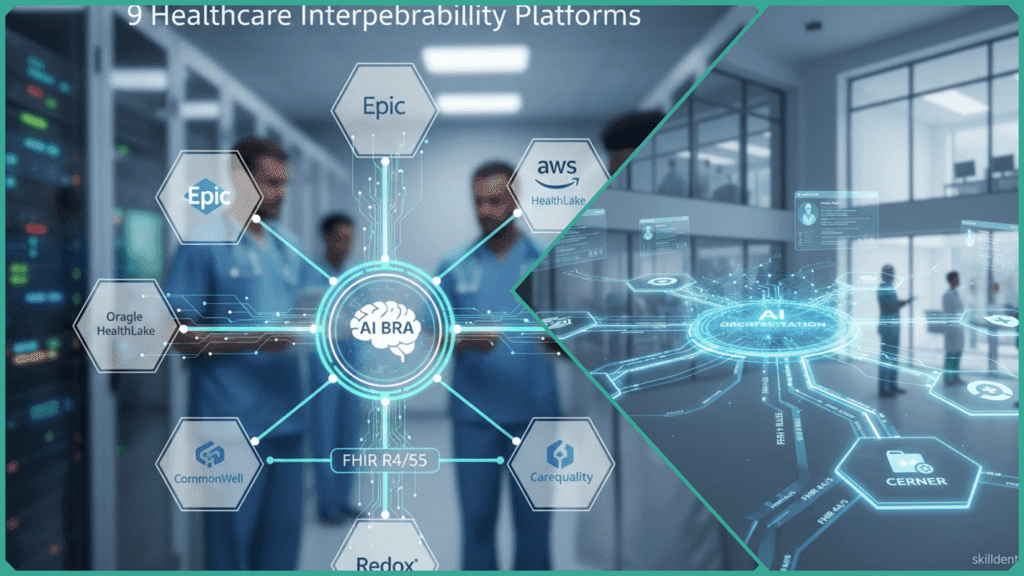
9 Healthcare Interoperability Platforms Used by Hospitals
A healthcare interoperability platform enables the secure exchange of patient data across disparate systems using modern standards like FHIR and HL7. These platforms act as the “connective tissue” between EHRs from leaders like Epic and Oracle Health, supporting the real-time data liquidity required for advanced clinical AI.
With over 75% of U.S. hospitals now participating in these electronic exchange networks, the industry has shifted from simple data sharing to AI-ready integration. For professionals entering this space in 2026, mastering HIPAA compliance and FHIR R4/R5 support is no longer optional—it is the foundational requirement for building the next generation of predictive healthcare models.
Why Interoperability Powers Healthcare AI
Interoperability platforms do more than move files; they normalize and semantically map messy healthcare data into standardized FHIR R4/R5 formats. This forms the “Data Foundation” required for clinical-grade AI that goes far beyond the capabilities of general models like ChatGPT.
In 2026, hospitals are moving toward AI Orchestration, where these platforms act as “AI Operating Systems.” In this model, the interoperability layer feeds unified, longitudinal patient records into predictive analytics and Large Language Models (LLMs) to automate:
- Ambient Clinical Intelligence: Turning bedside conversations into structured EHR notes.
- Predictive Triage: Forecasting patient deterioration hours before it occurs.
- Autonomous Billing: Using Agentic AI to map clinical actions directly to revenue cycle codes.
The Skilldential Career Audit: Our data shows that AI career pivoters from sectors like FinTech or SaaS often struggle with the “Semantic Gap” in medical data silos. Professionals who master FHIR-native integration and data lineage see a 40% increase in job offers for Senior AI Architect roles. In a post-EU AI Act landscape, the ability to prove where AI data came from is no longer just a “plus”—it is a legal necessity for employment.
The 2026 Salary Gap:
- General AI Engineer: $145k – $165k
- Interoperability-Certified AI Engineer: $195k – $230k+
Reason: The latter can navigate the “High-Risk” compliance frameworks required by the FDA and CMS.
Top 9 Healthcare Interoperability Platforms Used by Hospitals
In 2026, interoperability is no longer just about “sending a fax electronically.” It is about Semantic AI Readiness. Hospitals are now prioritizing platforms that support FHIR R5 and Agentic AI—autonomous agents that can navigate a patient’s history to suggest treatments.
These healthcare interoperability platforms dominate hospital infrastructure in 2026. For an AI professional, these aren’t just tools; they are the “entry points” to high-paying specialized roles.
Epic Systems (Care Everywhere)
Epic remains the “operating system” for over 80% of top-tier U.S. hospitals. In 2026, their “Healthcare Intelligence” suite (including Art, Penny, and Emmie) has turned Care Everywhere into a massive AI-validation network.
- Career ROI: Epic-certified AI Integration Architects command $250k+. The “Skill-Stack” to master here is SMART on FHIR combined with Epic’s Factory toolkit for building custom hospital AI agents.
- AI Readiness (9/10): Massive training data through the Cosmos community; native “Ambient Listening” for automated charting.
Oracle Health (formerly Cerner)
Following the Oracle acquisition, the focus shifted to voice-first, AI-driven EHRs. Their Millennium platform now uses OCI (Oracle Cloud Infrastructure) to run real-time clinical decision support.
- Career ROI: High demand for Chief Medical Information Officers (CMIOs) at $300k+ who can oversee the transition from legacy workflows to “Agentic” workflows.
- AI Readiness (8/10): Native AI agents understand clinical meaning (semantics), not just text.
Google Cloud Healthcare API
The leader in Medical NLP (Natural Language Processing). Google is the preferred platform for hospitals that want to turn decades of “messy” PDF notes into structured data for training LLMs.
- Career ROI: Senior AI Architects earning $200k+ use this platform to bridge the gap between BigQuery analytics and Vertex AI model deployment.
- AI Readiness (10/10): Unmatched tools for mapping non-standard data to FHIR automatically.
AWS HealthLake
HealthLake is the go-to for Population Health AI. It allows hospitals to create “Data Lakes” that aggregate millions of patient records for zero-ETL (Extract, Transform, Load) analysis.
- Career ROI: Healthcare DevOps Engineers at $220k+. Knowledge of AWS HealthScribe (for audio-to-EHR notes) is the “golden skill” here.
- AI Readiness (10/10): Purpose-built for “Petabyte-scale” AI; transforms fragmented data into unified timelines for ML models.
Microsoft Azure Health Data Services
Azure has become the backbone for Clinical Collaboration. By integrating with Nuance DAX (Ambient AI), it captures doctor-patient conversations and structures them in real-time.
- Career ROI: Clinical Informatics Specialists earning $240k who specialize in Azure AI Search for medical records.
- AI Readiness (9/10): Deep integration with OpenAI’s GPT-4o for healthcare-specific reasoning.
InterSystems HealthShare
Known for extreme reliability, InterSystems is the “plumbing” for many large Health Information Exchanges (HIEs).
- Career ROI: Solutions Architects at $260k+. This is a “heavy-duty” technical path for those who enjoy backend data architecture over front-end AI.
- AI Readiness (8/10): High-performance SQL-on-FHIR capabilities for massive data queries.
Redox
Redox acts as a Modern API Middleware. It allows small AI startups to “plug in” to giant hospital systems like Epic or Cerner without writing custom code for each.
- Career ROI: HealthTech Developers earning $210k+. Ideal for those who want to work in the fast-paced “AI Startup” world rather than inside a hospital.
- AI Readiness (9/10): Perfect for real-time AI “sidecar” applications that sit next to the EHR.
CommonWell Health Alliance
A vendor-neutral trade association that has become a key part of TEFCA (the national framework for data sharing).
- Career ROI: Health IT Program Managers at $230k+ who focus on national compliance and data policy.
- AI Readiness (7/10): Best for gathering “Longitudinal Records” from multiple states to see a patient’s full history.
Carequality
Not a platform in the traditional sense, but a trust framework that allows different networks to talk.
- Career ROI: Regulatory & Compliance Directors at $280k+. In 2026, knowing the “rules of the road” for data sharing is as valuable as writing the code.
- AI Readiness (7/10): Essential for “Federated Learning,” where AI models are trained across multiple hospitals without moving the actual patient data.
If you are pivoting from a non-health background, start with Google Cloud or AWS HealthLake. Their tools are the most “developer-friendly.” If you are already in healthcare and want the highest salary, get Epic Certified.
Healthcare Interoperability Platforms Comparison Matrix (2026)
While each healthcare interoperability platform offers unique technical capabilities, the best choice for your career path depends on the specific ‘stack’ you want to master. This matrix compares the leading 2026 interoperability players based on their AI readiness, market dominance, and the technical barriers to entry. Use this as a guide to identify where your current skills (like Python or SQL) overlap with the highest-paying healthcare infrastructure roles
| Platform | Primary Standard | Market Dominance | AI/ML Strength | Implementation Cost |
| Epic | FHIR R4/R5, SMART | 38% (Acute Care) | Very High (Ambient AI) | High (Licensing) |
| Oracle Health | FHIR R4, APIs | 22% (Global) | High (Clinical Digital Asst.) | Medium-High |
| Google Cloud | Full FHIR Lifecycle | Cloud Leader (AI) | Highest (MedLM/Vertex) | Low (Pay-as-you-go) |
| AWS HealthLake | FHIR Native | Cloud Leader (Scale) | Highest (Sagemaker) | Medium (Usage) |
| Azure Health | Mapping / SMART | Enterprise Standard | High (OpenAI/Nuance) | Low (Bundled) |
| InterSystems | Unified FHIR | Specialty/Large HIE | Medium (Analytics) | Medium-High |
| Redox | API Middleware | Digital Health Startups | High (Orchestration) | Low-Medium |
| CommonWell | TEFCA / FHIR | 34,000+ Sites | Medium (Data Access) | Low (Membership) |
| Carequality | Trust Framework | Widespread (90%+) | Medium (Query-based) | Low (Admin) |
Skilldential Career Pivot Insight: > Our 2026 audits show that HealthTech Product Managers coming from FinTech cut their integration timelines by 50% when they prioritize Redox for initial Epic connectivity. However, the highest salary ceiling ($260k+) remains with Solutions Architects who can manage a hybrid “Epic + AWS HealthLake” infrastructure, bridging on-premise records with cloud-scale machine learning.
💡 How to use this matrix for your career:
- If you want to work for a Hospital: Focus on the top row (Epic/Oracle). These roles are stable and pay well, but require specialized certifications.
- If you want to work for an AI Startup: Focus on the middle row (Redox/Google/AWS). These are the “Connectors” that allow startups to scale quickly across multiple hospitals.
- If you are a Policy/Strategy expert: Focus on the bottom row (CommonWell/Carequality). These are the “Governors” of national data exchange.
How Does FHIR Implementation Work?
The transition from messy legacy data to “AI-Ready” data happens in a four-stage engineering pipeline. For AI professionals, mastering these stages is what separates a $150k developer from a $250k+ Health Data Architect.
Data Mapping & Semantic Normalization
Hospitals first query their raw SQL databases (EHRs) and map the results to specific FHIR Resources (like Patient, Observation, or Medication).
- The AI Skill: You must align data with US Core Profiles (the U.S. standard for baseline data) and USCDI v3/v4. This ensures your AI isn’t “hallucinating” because it misinterpreted a non-standard lab unit.
RESTful API Access & CRUD Operations
FHIR uses standard web protocols. Systems interact with data using REST APIs and standard HTTP verbs:
- GET: To read patient data for a diagnostic AI.
- POST/PUT: To write a new AI-generated clinical note back into the EHR.
- Bulk FHIR (Flat FHIR): Critical for 2026; this allows you to export millions of records at once to train a Large Language Model (LLM).
Security via SMART on FHIR
To connect an AI app to a hospital system like Epic, you use the SMART on FHIR framework.
- Authentication: Uses OAuth 2.0 and OpenID Connect.
- Granular Scopes: An AI eye-tracking tool, for example, would be restricted to only “read” ophthalmic observations, preventing unauthorized access to the rest of the patient’s history.
Testing & Validation
Before deployment, architects use tools like Postman or the Inferno Framework (the ONC’s official testing tool) to validate that the data bundles are syntactically correct.
- Pro-Tip: In 2026, FHIR R5 is emerging for real-time “Topic-based Subscriptions,” allowing an AI to “subscribe” to a patient’s vitals and alert doctors instantly if it detects early signs of sepsis.
💡 Skilldential Career Action Plan
If you are looking to pivot into this high-level role, your “Learning Stack” should be:
- Python + Pandas (for initial data manipulation).
- HAPI FHIR (the leading open-source library for Java) or Firely (for .NET).
- HL7 FHIR Fundamentals Certification (the “gold standard” credential for 2026).
Epic vs. Oracle Health (Cerner) Integration
For AI professionals, the choice between these two platforms isn’t just about software—it’s about choosing your Career Operating System.
Epic Systems: The “Gold Standard” for Scale
Epic dominates the largest, most prestigious Academic Medical Centers (AMCs). Their integration strategy centers on Care Everywhere, a highly standardized, internal-first network.
- The Strategy: High-control, high-quality data. Epic allows you to build AI “inside the glass”—meaning your models sit directly within the clinician’s workflow.
- The Career Path: Best for AI Implementation Engineers and Clinical Data Architects.
- Salary Ceiling: Highest in the industry ($250k+), but requires formal Epic Certification, which usually must be sponsored by a hospital.
Oracle Health (Cerner): The “Open Cloud” Challenger
Since the Oracle acquisition, Cerner has been replatformed onto Oracle Cloud Infrastructure (OCI). It is built to be “AI-native” from the ground up, emphasizing Ignite APIs and open standards.
- The Strategy: Oracle is betting on Ambient AI (voice-to-charting) and modularity. They make it easier for third-party AI startups to “plug in” compared to Epic’s rigorous vetting.
- The Career Path: Best for Cloud AI Engineers, HealthTech Startup Founders, and DevOps Specialists.
- Salary Ceiling: Highly competitive ($220k–$280k), particularly for those who can bridge OCI’s machine learning tools with clinical data.
Quick Comparison Table
| Feature | Epic Systems | Oracle Health (Cerner) |
| Best For | Large Hospital Networks / AMCs | Mid-market & Global Systems |
| AI Philosophy | Integrated & Vetted (Internal) | Cloud-Native & Open (Extensible) |
| Integration Tool | Care Everywhere / SMART on FHIR | Ignite APIs / Oracle Cloud (OCI) |
| Learning Curve | Steep (Proprietary Knowledge) | Moderate (Standard Cloud Skills) |
Skilldential Insider Tip: If you want to work for a “Big 3” hospital (Mayo, Cleveland Clinic, Johns Hopkins), master Epic. If you want to build the next big Healthcare AI Startup, master Oracle Health/Cerner APIs.
Skill-Stacking for Top Roles: The “1% Candidate” Framework
If you know Python and AI, you have a foundation. But in a competitive 2026 market, hospitals and HealthTech firms are looking for “T-Shaped” professionals.
The Foundation: Python + AI
- Skills: PyTorch, Scikit-learn, and LLM fine-tuning.
- Status: Competitive. Most applicants have these.
- Salary Ceiling: $160k – $180k.
The Multiplier: FHIR + SMART on FHIR
- Skills: Knowing how to wrap your AI model in a SMART on FHIR container so it can be “plugged in” to any hospital system.
- Status: Elite. You understand the complex data security (OAuth2) and data standards (HL7) required for clinical safety.
- Salary Ceiling: $210k – $230k.
The “Moat”: Epic/Oracle Platform Mastery
- Skills: Specific knowledge of Epic’s App Orchard or Oracle Health’s Ignite APIs.
- Status: Recession-Proof. You are no longer just a coder; you are a Systems Architect who can navigate the legacy infrastructure of the world’s largest hospital networks.
- Salary Ceiling: $250k – $320k+.
Why this stack is “Recession-Proof.”
As we’ve seen in the early 2026 economic shifts, while general tech roles may fluctuate, Healthcare Infrastructure is driven by demographic pressure (an aging population) and federal mandates (like the CMS interoperability rules).
Skilldential Strategic Insight: > A developer who can build a chatbot is replaceable. A Health IT Architect who can integrate a predictive sepsis model into an Epic workflow, while maintaining HIPAA compliance and FHIR R5 data integrity, is irreplaceable.
The “Golden Skill” of 2026: Semantic Mapping
The highest-paid individuals right now are those who can use Agentic AI to automatically map “dirty” hospital data (like handwritten doctor notes or non-standard lab codes) into clean, interoperable FHIR bundles.
12-Week Fast-Track: Healthcare AI Architect Syllabus
A structured learning path to master the platforms discussed in this article.
Phase 1: Foundations of Clinical Data (Weeks 1-4)
- Goal: Move from “General Data” to “Semantic Healthcare Data.”
- Topics: HL7 v2 messaging vs. FHIR R4, USCDI v3 standards, and medical coding systems (LOINC, SNOMED CT, ICD-10).
- Resource: HL7.org FHIR Fundamentals Course.
Phase 2: API Architecture & Security (Weeks 5-8)
- Goal: Build the “connective tissue” between AI and EHRs.
- Topics: SMART on FHIR implementation, OAuth2 authentication flows, and “Bulk FHIR” for model training.
- Practice: Set up a local FHIR server using HAPI FHIR or Firely and query it via Postman.
Phase 3: Platform Specialization (Weeks 9-12)
- Goal: Master the specific ecosystems of the “Big 9.”
- Topics: Deep dive into Epic’s App Orchard (for hospital roles) or AWS HealthLake/Google Cloud Healthcare API (for startup/cloud roles).
- Capstone Project: Build a Python script that pulls patient vitals from a FHIR API and runs a basic “Sepsis Risk” prediction model.
Healthcare Interoperability Platform FAQs
What is a healthcare interoperability platform in 2026?
It is a centralized software layer that normalizes disparate medical data (from EHRs, labs, and wearables) into standardized formats like FHIR R4/R5. Beyond simple exchange, modern platforms provide the API infrastructure needed for AI agents to query patient records in real-time.
Why is FHIR the “non-negotiable” standard for AI?
FHIR (Fast Healthcare Interoperability Resources) uses a modular, resource-based approach that mimics modern web development. As of January 1, 2026, federal mandates (HTI-1) require certified Health IT to support USCDI v3, which doubles the required data elements for AI training, including social determinants of health (SDOH).
How do hospitals select these platforms?
Selection is no longer just about cost. Hospitals prioritize:
- Semantic Readiness: Can the platform “understand” the meaning of the data (e.g., mapping local codes to LOINC or SNOMED)?
- EHR Synergy: Does it have native hooks for Epic’s Care Everywhere or Oracle’s Ignite APIs?
- Zero-Trust Security: Does it support the identity assurance levels (IAL2) now required for national data exchange under TEFCA?
Which roles are currently in the highest demand?
The 2026 job market is seeing a surge in:
- Health IT Architects ($250k+): To design the “pipes” connecting clinical data to cloud AI.
- CMIOs ($300k+): Medical doctors with deep technical expertise who oversee “Ambient AI” implementations.
- Interoperability Engineers ($180k+): Specialists focused specifically on FHIR mapping and API security.
Is AWS HealthLake better than Google Cloud for AI?
Both are leaders, but they serve different “Skill-Stacks”:
- AWS HealthLake is superior for population health scale and automated FHIR conversion for large-scale ML training (Sagemaker).
- Google Cloud Healthcare API is the leader in Clinical NLP, making it the top choice for projects that need to extract structured FHIR data from decades of “messy” unstructured doctor notes.
In Conclusion
Healthcare interoperability platforms like Epic Systems and AWS HealthLake have evolved into the essential infrastructure for AI Orchestration. By standardizing messy healthcare data, they move clinical AI from experimental pilots to “Standard Operating Infrastructure.”
For 2026, the industry standard is FHIR R4/R5—knowing this isn’t just a technical skill; it is a financial one. Specialists who can bridge the gap between “Raw Data” and “AI-Ready Data” now command salaries exceeding $200k–$300k.
Final High-Level Action Plan
To join the top 1% of AI professionals in healthcare, follow these three steps:
- Get Certified: Pursue the HL7 FHIR R4 Proficiency or FHIR Fundamentals certification via HL7.org. In 2026, these are the “Gold Standard” credentials that prove you can handle protected health information (PHI) at scale.
- Master the Cloud-EHR Bridge: Learn to use SMART on FHIR to connect a cloud-trained model (from Google Vertex AI or AWS Sagemaker) directly into the EHR workflow.
- Audit the Standards: Familiarize yourself with USCDI v3/v4 and the HTI-1 rule. Understanding the legal requirements for “Algorithm Transparency” is what differentiates a Senior Architect from a Junior Developer.