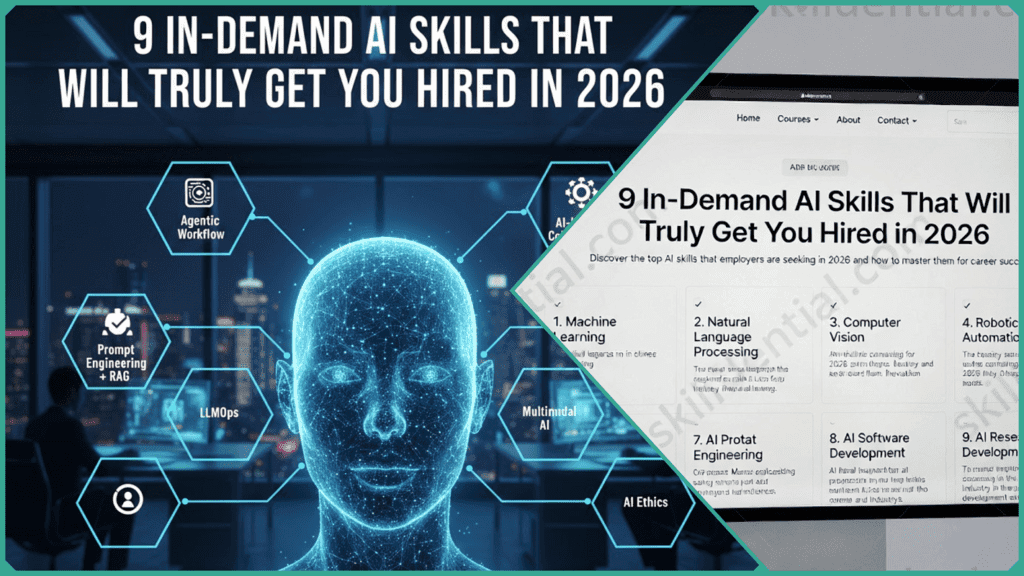
9 In-Demand AI Skills That Will Truly Get You Hired in 2026
In 2026, the definition of a “competitive candidate” has officially shifted. It’s no longer enough to simply use AI; recruiters are hunting for professionals who can orchestrate it.
Today’s in-demand AI skills encompass a sophisticated blend of agentic workflow design, machine learning fundamentals, and AI governance. These aren’t just “nice-to-haves”—they are survival tools. Recent LinkedIn data reveals that AI literacy is now the #1 requested baseline skill, driving an explosion in roles for AI engineers and strategists.
The urgency is real: industry forecasts suggest that 39% of core workplace skills will be disrupted by 2030 as automation moves from simple tasks to complex logic. To get hired in this landscape, you must move beyond basic “chatting” and prove you can manage AI systems with hands-on, verifiable expertise.
The 9 Essential AI Skills in Demand (2026 Checklist)
Recruiters in 2026 aren’t just looking for people who ‘know’ AI—they want people who can drive results with it. This checklist covers the specific, verifiable proficiencies that separate a hobbyist from a high-value hire
Advanced Prompt Engineering
Moving beyond simple questions, 2026 requires Chain-of-Thought and Multi-step Prompting. You must be able to craft prompts that act as mini-programs to automate complex workflows.
- Proof for Recruiters: Show a library of “System Prompts” you’ve built to handle specific business logic or data extraction.
AI Literacy & Systems Thinking
This is the baseline for 2026. It’s the ability to understand what AI can do, where it “hallucinates,” and how it integrates into daily collaboration.
- Proof for Recruiters: LinkedIn data shows that 8 in 10 leaders now prefer an “AI-literate” candidate over a more experienced peer who lacks these skills.
Agentic AI Orchestration
Recruiters are hunting for “AI Orchestrators“—people who can design and manage autonomous multi-agent systems (like CrewAI or AutoGPT) that handle end-to-end tasks without constant human hand-holding.
- Proof for Recruiters: Describe a workflow where you managed multiple AI “agents” to complete a project (e.g., one for research, one for drafting, one for SEO).
Machine Learning (ML) Fundamentals
You don’t need to be a data scientist, but you must understand the “why” behind the models. Knowledge of training, bias, and deployment basics allows you to fine-tune models for niche tasks.
- Proof for Recruiters: Mention experience with PEFT (Parameter-Efficient Fine-Tuning) or LoRA to customize an LLM for specific industry data.
Multimodal Tool Orchestration
In 2026, AI is no longer just text. You must be able to lead a project that moves seamlessly between text, image, and video (using tools like Veo, Sora, or Midjourney) while maintaining Authenticity Guardrails.
- Proof for Recruiters: A portfolio piece where you took a single text concept and transformed it into a full multimodal campaign.
AI-Driven Data Analysis & RAG
The World Economic Forum ranks AI and Big Data as the fastest-growing skills. Specifically, you need to understand Retrieval-Augmented Generation (RAG)—connecting an AI to private company data for hyper-accurate results.
- Proof for Recruiters: “Built a custom RAG system that allowed the team to query 500+ internal PDFs with zero hallucinations.”
LLMOps & System Monitoring
Hiring teams want “builders who can ship.” LLMOps is the skill of deploying, monitoring, and maintaining AI systems in a live environment to ensure they don’t drift or break over time.
- Proof for Recruiters: Experience with model versioning or setting up “evaluation harnesses” to score AI performance.
AI Ethics & Governance
With the EU AI Act and global regulations now in full force, recruiters are desperate for Ethical Gatekeepers. You must know how to implement safety frameworks and mitigate algorithmic bias.
- Proof for Recruiters: Familiarity with AI compliance audits and the ability to document “Explainable AI” decisions.
Technical Self-Sufficiency (No-Code/Low-Code)
Recruiters value the “Vibe Coder”—someone who can use AI to write Python scripts or build custom internal apps to solve immediate problems.
- Proof for Recruiters: A specific example of a “micro-tool” or automation script you built using an AI coding assistant.
Why These In-Demand AI Skills Drive Hiring?
We are currently living through the 2026 “skills earthquake.” According to the World Economic Forum, AI is now automating or transforming 39% of core workplace tasks.
Recent career audits from Skilldential show a stark divide: non-tech professionals who only use “basic” AI struggle to land interviews, while those who implement Agentic Orchestration have seen a 45% increase in recruiter callbacks. Employers in 2026 aren’t just hiring people; they are hiring “Human-AI hybrids” who can double a department’s output without doubling the headcount.
The 2026 Impact Matrix
This table breaks down exactly how mastering these AI skills solves the biggest “pain points” for hiring managers today.
| Segment | Your Main Pain Point (2026) | The “Hired” Solution | Outcome & Impact |
| Corporate Managers | Middle-management roles are being cut due to AI efficiency. | Agentic AI Orchestration | You lead a hybrid team of humans and AI agents, resulting in 10x output. |
| Creative & Marketing | Generative “slop” is devaluing human content. | Multimodal Orchestration | You produce high-authority, authentic content that beats AI-only bots in SEO. |
| Tech & Engineering | Basic coding has become a low-value commodity. | LLMOps & Ethics | You shift from “writing code” to systems-level governance and secure deployment. |
This matrix equips you for a strategic pivot. The best part? AI skills like RAG and Agentic Design are no longer locked behind expensive degrees—they are verifiable through hands-on projects using free tools like LangChain or GitHub.
How to Build These AI Skills Fast?
You don’t need a four-year degree to master the 2026 AI stack, but you do need a strategic mix of theory and “build-in-public” practice.
Master the Theory (Months 1-2)
Start with structured paths that provide immediate credibility on your resume:
- Google Cloud’s Generative AI Learning Path: A must-have for 2026. It covers the shift from basic LLMs to Responsible AI and Gemini orchestration in under a month.
- IBM’s RAG and Agentic AI Professional Certificate: This is the current “gold standard” on Coursera for learning how to build autonomous agents and secure data pipelines.
Practice in the “Sandbox” (Months 3-4)
Move from watching videos to writing code or building workflows:
- Agentic Workflows: Head to Hugging Face and experiment with Smolagents or LangGraph. These allow you to build “agents” that can browse the web and solve multi-step tasks for free.
- No-Code Orchestration: If you aren’t a coder, master Zapier Central. It allows you to build AI agents that connect to 6,000+ apps using only natural language.
Get Certified for the “Big Leagues” (Months 5-6)
If you are aiming for high-salary engineering or strategy roles, global cloud certifications are the final “proof”:
- AWS Certified Machine Learning – Specialty: Still the most requested cloud AI cert in 2026, as AWS powers over 60% of enterprise ML workloads.
- Google Professional ML Engineer: Ideal for those focusing on the full AI lifecycle and MLOps.
Pro-Tip: The “LinkedIn 1-Minute Update.”
Don’t wait until you’re an expert to update your profile. Recruiters use keyword filters daily. Add this to your “Skills” or “About” section today to start appearing in 2026 talent searches:
“Proficient in RAG (Retrieval-Augmented Generation) for AI accuracy and Agentic Workflow design via LangChain.”
The “skills earthquake” isn’t coming; it’s here. By focusing on orchestration rather than just prompting, you aren’t just surviving the AI transition—you are leading it.
2026 Portfolio Blueprint: The RAG Search System
If you want to prove you have “AI Skills in Demand,” build a Personal Research Agent that uses RAG to answer questions based on your own documents.
How to list this on your Resume/LinkedIn:
Project: AI-Powered Knowledge Navigator (2026)
- Objective: Developed a RAG (Retrieval-Augmented Generation) system to eliminate “hallucinations” in LLM outputs by grounding responses in a 50+ document private database.
- Tech Stack: Python, LangChain, FAISS (Vector Database), and OpenAI/Llama-3.
- Outcome: Reduced manual research time by 70% and achieved 95% accuracy in source-cited information retrieval.
The GitHub “Verification” Checklist
Recruiters in 2026 will check your GitHub. Ensure your project repository includes:
- A
README.mdthat tells a story: Don’t just list code; explain the problem you solved (e.g., “Helping HR teams search 100+ resumes in seconds”). - A Demo Link: Use Streamlit or Gradio to provide a live URL where the recruiter can actually “chat” with your system.
- Governance Note: Add a short section on how you handled AI Ethics (e.g., “Implemented data PII masking to ensure privacy compliance”).
The “skills earthquake” of 2026 is creating a massive gap between those who use AI as a toy and those who use it as a tool. By mastering these 9 AI skills—and, more importantly, documenting your builds—you aren’t just applying for a job; you are proving you are indispensable to the future of the company.
In-Demand AI Skills FAQs
What is prompt engineering?
In 2026, it is no longer just “talking to a bot.” It is the art of crafting detailed, multi-step instructions that include role-playing (e.g., “Act as a Senior Data Scientist”) and Chain-of-Thought reasoning to ensure AI handles complex business logic. It is the essential bridge that allows non-coders to build sophisticated automation.
Why should I prioritize AI ethics?
Because the EU AI Act and global regulations have made companies legally liable for AI mistakes. Recruiters are hunting for “Ethical Gatekeepers” who can mitigate bias and ensure safety. With 86% of businesses undergoing AI transformation this year, a candidate who understands governance is seen as a “safe hire” who protects the company from lawsuits.+1
How does agentic AI differ from a standard chatbot?
A chatbot is reactive (it waits for you to ask a question); an AI Agent is proactive (you give it a goal, and it executes a to-do list).
Example: A chatbot tells you your flight is delayed. An AI Agent sees the delay, searches for a new flight, checks your calendar for conflicts, and drafts a re-booking email for you to approve.
Is machine learning (ML) knowledge needed for non-tech roles?
You don’t need to write algorithms, but you do need ML Literacy. In 2026, a Marketing Manager needs to understand how “training data” affects the quality of their AI-generated campaigns. Focus on the application of ML—knowing what a model can and cannot do—rather than the deep mathematics.
What specific tools prove these AI skills on a resume?
Recruiters in 2026 look for hands-on experience with the “Power Stack”:
- For Agents: LangChain or CrewAI.
- For Accuracy: Knowledge of RAG (Retrieval-Augmented Generation).
- For Demos: Gradio or Streamlit (to show your AI tools in action).
- For Proof: A link to a GitHub repository or a portfolio site showing a working AI “mini-project” beats a certificate every time.
In Conclusion
The “skills earthquake” isn’t a future threat—it is the current reality of the 2026 job market. As the World Economic Forum and LinkedIn have confirmed, AI and big data are now the fastest-growing skill sets globally. With 39% of core workplace tasks currently being transformed by automation, the advantage belongs to the “Human-AI Hybrid.”
Success this year isn’t about being a math genius; it’s about being an AI Architect. Whether you are a “Vibe Coder” building internal tools or a Corporate Manager leading a team of autonomous agents, your value is now measured by your ability to integrate AI into real-world workflows safely and effectively.
Your 2026 Action Plan
Don’t let this be another post you just read and forget. Start your pivot today:
- Update your LinkedIn: Add “Agentic AI Orchestration” and “AI Governance” to your skills section.
- Build One Prototype: Use a free tool like LangChain or Zapier Central to build a basic RAG prototype that “talks” to your personal notes.
- Stay Ethical: Familiarize yourself with the 2026 compliance standards to show recruiters you are a responsible leader.
Discover more from SkillDential | Your Path to High-Level Career Skills
Subscribe to get the latest posts sent to your email.