ISO 9001 Certification: Requirements, Benefits & Costs
ISO 9001 certification is the globally recognized standard for Quality Management Systems (QMS). It defines the rigid requirements necessary to establish, implement, maintain, and continually improve organizational processes to ensure consistent product and service quality.
Currently, over one million ISO 9001 certifications exist across 189 countries, serving as a high-leverage framework for performance optimization, enhanced customer satisfaction, and proactive risk management.
Technical Update: ISO 9001:2026 Revision
The landscape for ISO 9001 certification is approaching a significant transition. A new revision is officially expected in September 2026. This update will necessitate a strategic transition period for organizations currently holding ISO 9001:2015 certificates to align with the updated standards and maintain compliance.
Core Components of the Standard
To achieve ISO 9001 certification, an organization must demonstrate mastery over the following technical pillars:
- Context of the Organization: Identifying internal and external issues relevant to the QMS.
- Leadership and Commitment: High-level management accountability for quality policy.
- Risk-Based Thinking: Shifting from purely reactive measures to preventive process design.
- The PDCA Cycle: Systematically applying the Plan-Do-Check-Act framework to drive continuous improvement.
ISO 9001 Requirements: Technical Framework
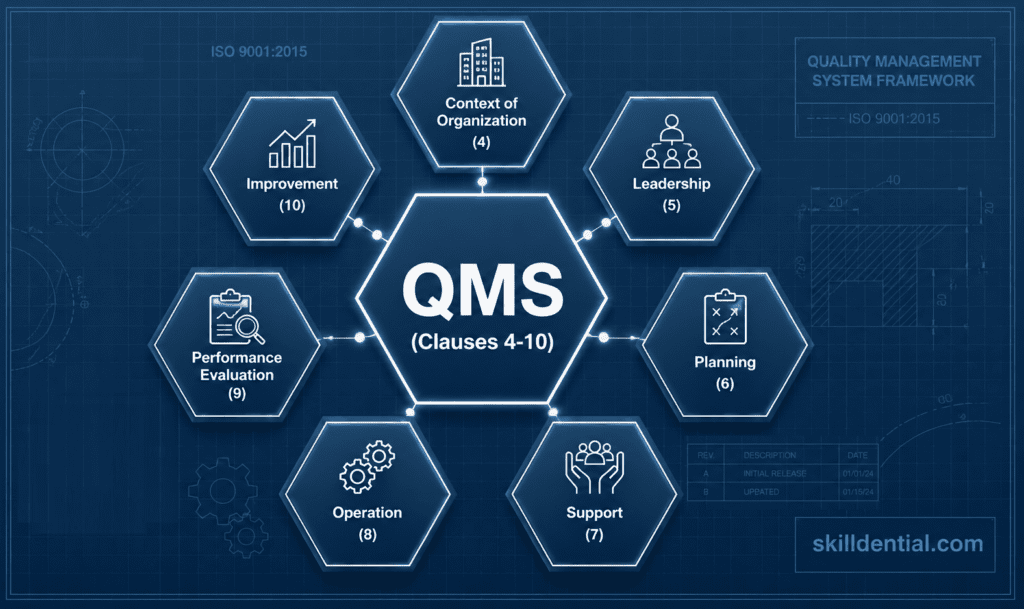
Achieving ISO 9001 certification requires strict adherence to the High-Level Structure (HLS) defined in Clauses 4 through 10. This framework follows the Plan-Do-Check-Act (PDCA) cycle, shifting the focus from static documentation to dynamic, risk-based process management.
The Seven Auditable Clauses
| Phase | Clause | Domain | High-Leverage Requirements |
| PLAN | 4 | Context | Define internal/external issues and the scope of the ISO 9001 certification. |
| 5 | Leadership | Top management must demonstrate accountability for the QMS. | |
| 6 | Planning | Identify risks and opportunities; set measurable quality objectives. | |
| DO | 7 | Support | Ensure resource availability, competence, and organizational awareness. |
| 8 | Operation | Execute operational controls, from design to product/service delivery. | |
| CHECK | 9 | Evaluation | Internal audits, management reviews, and monitoring of KPIs. |
| ACT | 10 | Improvement | Manage nonconformities and implement corrective actions. |
Critical Shift: Documentation & Risk
The current standard for ISO 9001 certification introduces two fundamental shifts in quality logic:
- Documented Information vs. Quality Manual: The rigid requirement for a “Quality Manual” has been replaced. Organizations must now maintain “documented information” only to the extent necessary to support operation and provide evidence that processes are being carried out as planned.
- Risk-Based Thinking: The concept of “preventive action” is now systemic. Instead of a separate clause, risk assessment is embedded throughout the standard, requiring organizations to address threats and opportunities proactively within every process.
Implementation Strategy
For organizations pursuing ISO 9001 certification, success is determined by the integration of these clauses into daily operations rather than treating them as a secondary compliance layer. This ensures that the QMS remains a high-leverage tool for scaling efficiency and quality.
The Roadmap to ISO 9001 Certification
Achieving ISO 9001 certification is a systematic process that validates an organization’s commitment to quality through internal development and external verification. The process typically follows a 4 to 12-month trajectory depending on organizational complexity and QMS maturity.
Phase 1: Internal Development & Implementation
Before engaging an external auditor, the organization must build and stabilize its Quality Management System.
- Gap Analysis: Compare existing processes against ISO 9001 certification requirements to identify deficiencies.
- Process Mapping: Formalize workflows to ensure consistency and repeatability.
- Training & Awareness: Ensure staff understand their roles within the QMS.
- Internal Audit: A mandatory dry run to verify that the system is functioning as intended and to identify nonconformities.
- Management Review: Top management evaluates the audit results to ensure the QMS is suitable and effective.
Phase 2: The External Audit Process
An accredited third-party certification body conducts the formal evaluation in two distinct stages.
| Audit Stage | Focus Area | Objective |
| Stage 1: Documentation | “Are you ready?” | Review of the QMS scope, policies, and documentation to ensure readiness for Stage 2. |
| Stage 2: Implementation | “Are you doing it?” | On-site verification through staff interviews, record reviews, and observation of active processes. |
Phase 3: Post-Certification Cycle
ISO 9001 certification is not a one-time event but a continuous three-year cycle designed to ensure the QMS does not stagnate.
- Year 1 & 2: Surveillance Audits: Annual “check-ups” by the certification body to confirm ongoing compliance and continuous improvement.
- Year 3: Recertification: A comprehensive audit similar to Stage 2 to renew the certificate for another three-year term.
Strategic Leverage
To accelerate the timeline, organizations often utilize high-leverage frameworks such as automated document control systems and standardized training modules. Starting with a rigorous gap analysis is the 80/20 of the certification process, as it prevents wasted effort on compliant processes and focuses resources on critical gaps.
Strategic Benefits of ISO 9001 Certification
ISO 9001 certification serves as a high-leverage framework that transforms quality from a subjective goal into a measurable operational asset. By standardizing workflows, organizations move from reactive firefighting to proactive process optimization.
Core Operational Advantages
The primary benefits of implementing an ISO 9001 certification framework can be categorized into three strategic domains:
Operational Efficiency & Cost Reduction
- Waste Elimination: Structured processes identify and remove redundancies, significantly cutting down on rework and material waste.
- Standardized Workflows: Consistent methodologies reduce variability, ensuring that output quality remains stable regardless of individual personnel changes.
- Evidence-Based Decision Making: Data-driven insights from Clause 9 (Performance Evaluation) allow management to allocate resources where they yield the highest ROI.
Market Access & Credibility
- Global Recognition: As a globally accepted benchmark, ISO 9001 certification acts as a “passport” for international trade.
- Contractual Prerequisite: Many enterprise-level and government contracts mandate ISO 9001 certification as a baseline requirement for bidders.
- Brand Authority: It signals to stakeholders and customers that the organization is committed to world-class quality standards.
Risk Management & Continuity
- Risk-Based Thinking: Shifting focus toward identifying potential failures before they occur ensures business continuity.
- Enhanced Customer Satisfaction: By meeting (and exceeding) customer requirements consistently, organizations drive higher retention rates and lifetime value.
Quantifiable Impact: The 80/20 of QMS
Data from organizational audits reveals a recurring pattern: operations lacking a structured QMS often suffer from inconsistent processes that can reduce potential output by up to 25%. Implementing an ISO 9001 certification framework typically yields efficiency gains of 20% or more by stabilizing workflows and clarifying accountabilities.
Summary Table: ROI of Certification
| Benefit Category | Impact Metric | Strategic Value |
| Internal | ↓ Rework Costs | Improved Profit Margins |
| External | ↑ RFP Success Rate | Expanded Market Share |
| Cultural | ↑ Process Clarity | Reduced Employee Onboarding Time |
By viewing ISO 9001 certification not as a compliance burden but as a “build once, scale forever” system, organizations can achieve sustainable growth and technical rigor in any industry.
ISO 9001 Certification Costs: 2026 Budgetary Analysis
The total investment for ISO 9001 certification varies significantly based on organizational headcount, operational complexity, and geographic location. For Small to Medium Enterprises (SMEs), the total Year 1 investment typically ranges from $5,000 to $40,000.
Phase 1: Preparation & Development Costs
These are the “pre-audit” expenses required to build a compliant Quality Management System (QMS).
- Consulting Fees ($3,000 – $15,000): While optional, consultants accelerate the timeline. Fees vary by expertise ($150–$300/hr) and depth of support (Gap analysis vs. full implementation).
- Internal Labor ($4,000 – $12,000): Often overlooked, this represents the “opportunity cost” of staff time dedicated to process mapping, documentation, and training.
- Documentation & Tools ($500 – $5,000): Includes the purchase of official standards (approx. $170) and potentially QMS software to manage records.
- Training ($1,000 – $4,500): Required for staff awareness and specialized Internal Auditor training.
Phase 2: Registrar & Audit Fees (Hard Costs)
These fees are paid directly to an accredited Certification Body (CB).
| Category | Cost Range | Description |
| Application Fee | $500 – $1,000 | Administrative setup and file opening. |
| Stage 1 Audit | $1,500 – $3,500 | Readiness review of documentation. |
| Stage 2 Audit | $3,000 – $12,000 | On-site implementation verification. |
| Travel & Expenses | $500 – $2,500 | Auditor travel, lodging, and meals (if not remote). |
Phase 3: Long-Term Maintenance (Years 2 & 3)
ISO 9001 certification operates on a three-year cycle. Maintaining the certificate is generally less expensive than the initial attainment.
- Surveillance Audits (Annual): Expect to pay roughly 50-60% of the initial Stage 2 audit fee in Years 2 and 3.
- Recertification (Year 3): A more comprehensive audit occurring every three years, typically costing 80-90% of the original certification fee.
Strategic Leverage: Managing Costs
To optimize the ROI of ISO 9001 certification, prioritize a Gap Analysis early. This prevents over-engineering and ensures that resources are strictly funneled into non-compliant areas. For 2026, many registrars now offer remote auditing for low-risk sectors, which can eliminate auditor travel expenses and reduce the total cost by 10-15%.
ISO 9001 Certification: Cost-Benefit Decision Matrix
To achieve a high-leverage decision on ISO 9001 certification, it is essential to analyze the investment against the projected ROI timeline. The following matrix breaks down the capital requirements based on organizational scale and complexity.
| Business Size | QMS Development | Audits & Cert | Total Est. (USD) | ROI Timeline |
| SME (1-10 emp) | $3K – $12K | $5K – $10K | $5K – $20K | 6 – 12 months |
| Mid-size (50+ emp) | $10K – $25K | $10K – $20K | $20K – $40K | 12 – 18 months |
Strategic Financial Analysis
Evaluate ISO 9001 certification as a capital allocation decision, weighing upfront implementation costs against long-term operational leverage.
SME Scaling Dynamics
For small enterprises, the lower threshold of ISO 9001 certification costs often results from a tighter organizational scope and fewer process layers. The aggressive ROI timeline (6–12 months) is usually driven by immediate access to larger contracts and the elimination of “founder-dependent” bottlenecks through standardized workflows.
Mid-size Infrastructure
Mid-sized organizations face higher QMS development costs due to the necessity of cross-departmental integration and more complex risk-based thinking frameworks. The investment is higher, but the leverage is found in the compounding efficiency gains across a larger labor force, where a 5% waste reduction translates to significant bottom-line impact.
Variable Factors
- Industry Complexity: High-risk sectors (e.g., aerospace, medical devices) require more rigorous documentation, increasing audit man-days.
- Digital Transformation: Implementing a digital QMS rather than a paper-based system increases initial costs but accelerates the ROI by reducing long-term maintenance labor.
- Geographic Scope: Multi-site ISO 9001 certification increases audit fees proportionally, though sampling techniques can sometimes be applied to optimize costs.
Choosing to pursue ISO 9001 certification is a capital allocation decision. While the upfront cost is non-trivial, the long-term strategic advantage—market credibility and operational stability—positions it as a “build once, scale forever” asset.
Is ISO 9001 Certification Worth It?
For Small to Medium Enterprises (SMEs) targeting enterprise-level contracts or operating in regulated markets, ISO 9001 certification is a high-leverage investment. Empirical data suggests that certified organizations often secure up to 7% higher payments and demonstrate superior sales growth compared to non-certified peers.
Decision Framework: DIY vs. Consultant
The path to ISO 9001 certification should be determined by operational complexity and internal technical capacity:
- DIY Implementation: Best suited for low-risk service sectors with simple, existing processes. This minimizes direct costs but requires significant internal labor to ensure the QMS meets auditable standards.
- Professional Consultants: Essential for high-risk manufacturing or complex service environments. While this increases the upfront fee, it reduces the risk of audit failure and accelerates the time-to-market.
2026 Revision Alert
Organizations pursuing ISO 9001 certification in 2026 must account for the upcoming standard revision scheduled for September. Current implementations should focus on building a flexible, modular QMS that can absorb these updates without requiring a complete system overhaul.
Final Verdict
If the goal is to “build once and scale forever,” ISO 9001 certification provides the technical infrastructure necessary for sustainable growth. It shifts the organization from person-dependent success to process-dependent excellence, ensuring long-term institutional value.
ISO 9001 Certification FAQs
Understanding the technical nuances of ISO 9001 certification is critical for maintaining high-leverage business operations. Below are the core technical clarifications regarding the standard.
What is ISO 9001?
ISO 9001 certification is based on the International Organization for Standardization’s criteria for a Quality Management System (QMS). It is the only standard in the ISO 9000 family that results in a formal certification. It focuses on the process approach, which integrates the Plan-Do-Check-Act (PDCA) cycle and risk-based thinking to ensure consistent output.
Who needs ISO 9001 certification?
While not a legal requirement, it is a strategic necessity for organizations that:
Need to demonstrate the ability to consistently provide products/services that meet customer and regulatory requirements.
Aim to enhance customer satisfaction through system improvement.
Operate in sectors where ISO 9001 certification is a mandatory prerequisite for supplier pre-qualification (e.g., manufacturing, aerospace, government contracting).
How long is the certification valid?
ISO 9001 certification operates on a three-year cycle:
Initial Certification: Year 0.
Surveillance Audits: Annual “partial” audits in Years 1 and 2 to verify ongoing compliance.
Recertification: A full system audit in Year 3 to renew the certificate for another three years.
Can small businesses afford ISO 9001?
Yes. For SMEs, the 80/20 of cost management is building a lean QMS that fits the actual operation rather than over-engineering documentation. Total Year 1 costs can start as low as $5,000 for micro-enterprises. Using cloud-based QMS tools and focusing on high-impact process mapping can significantly reduce internal labor costs.
What changes in ISO 9001:2026?
The 2026 revision is an evolutionary update, not a radical overhaul.
Key Changes Include:
Strategic Alignment: Stronger link between the QMS and the organization’s strategic direction.
Leadership & Ethics: New requirements for top management to actively promote a quality culture and ethical behavior.
Climate Considerations: Formal integration of climate change as a factor in the organizational context (carried over from the 2024 amendment).
Risk vs. Opportunity: Clearer structural separation in Clause 6.1 between managing risks and pursuing opportunities.
In Conclusion
ISO 9001 certification is a technical blueprint for organizational excellence, moving quality management from a peripheral task to a core business driver. By adopting this framework, organizations install a self-correcting system that balances operational rigor with scalable growth.
Executive Summary
- Framework: Compliance is driven by seven auditable clauses (4–10) integrated into the Plan-Do-Check-Act (PDCA) cycle.
- Impact: Implementing ISO 9001 certification yields measurable benefits in operational efficiency, market trust, and long-term cost savings through waste reduction.
- Investment: Financial requirements typically range from $5,000 to $40,000, with a projected ROI timeline of 6 to 18 months depending on organizational scale.
- Verification: The certification is validated through a rigorous two-stage external audit conducted by accredited bodies, ensuring the QMS is both documented and functionally active.
Immediate Action Items
To initiate the transition toward ISO 9001 certification, prioritize the following high-leverage steps:
- Conduct a Gap Analysis: Objectively assess your current processes against the standard to identify critical deficiencies.
- Establish Leadership Commitment: Ensure top management is accountable for the QMS policy to drive organizational buy-in.
- Select a Registrar: Consult with accredited certification bodies early to align on audit schedules and specific industry requirements.
- Monitor the 2026 Revision: Stay informed on the upcoming September 2026 update to ensure your new or existing system remains compliant through the transition period.
By viewing ISO 9001 certification as a “build once, scale forever” asset, organizations secure a competitive advantage that is recognized globally across all industrial sectors.