How CDN Services Improve Website Speed, SEO, and Revenue
Infrastructure is the silent engine of digital scaling. CDN services act as a high-leverage multiplier by distributing website content across a global network of edge servers, effectively decoupling performance from origin server limitations.
By caching static assets—including high-resolution images, CSS, and JavaScript—physically closer to the end-user, CDN services significantly reduce the distance data must travel. This architectural optimization typically reduces Largest Contentful Paint (LCP) by 30% to 50%, directly addressing the most critical metric in Google’s Core Web Vitals.
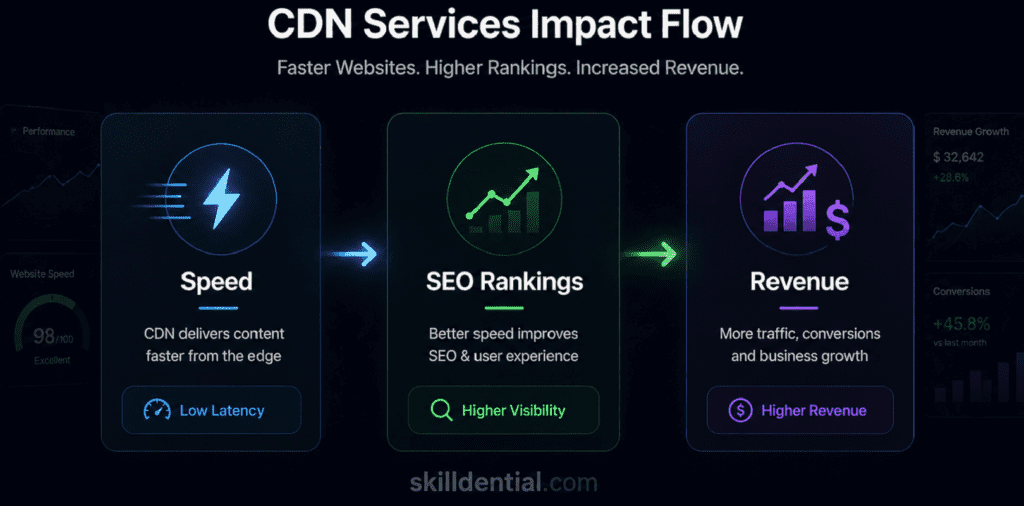
Beyond technical speed, the implementation of CDN services creates a tangible business impact. Improving site responsiveness lowers bounce rates by 20% to 40%, retaining high-intent traffic that would otherwise abandon a slow-loading page.
This leads to a direct uplift in conversion rates and long-term SEO authority. However, achieving these benchmarks is not automatic; the magnitude of the results depends on precise cache-control headers, edge logic configuration, and global traffic distribution patterns.
Technical Architecture of CDN Services
The efficiency of CDN services is rooted in the transition from centralized to distributed architecture. Instead of a single origin server handling every global request—which creates a bottleneck and high latency—CDN services utilize a decentralized network of Point of Presence (PoP) locations.
Request Routing and Geolocation
When a user initiates a request, the CDN uses Anycast routing or DNS-based redirection to identify the user’s geographic IP. The request is then intercepted by the “Edge Node” with the lowest network hop count. This minimizes Round-Trip Time (RTT), ensuring the handshake occurs at the edge rather than the distant origin.
Caching and State Management
CDN services operate on a “Cache Hit” vs. “Cache Miss” logic:
- Cache Hit: The requested static asset (HTML, CSS, JS, Images) is already stored in the edge server’s RAM or SSD. It is delivered instantly.
- Cache Miss: If the asset has expired or is missing, the edge server fetches it from the origin, serves the user, and stores a copy for future requests.
This process is governed by Cache-Control headers and TTL (Time to Live) settings, which are critical for maintaining data freshness without sacrificing speed.
Protocol and Transport Optimization
Modern CDN services implement advanced transport layer protocols that most standard hosting environments lack:
- HTTP/3 (QUIC): Utilizes UDP to eliminate head-of-line blocking, allowing multiple data streams to finish independently.
- Brotli Compression: A high-ratio compression algorithm that reduces file sizes more effectively than Gzip.
- TLS False Start: Accelerates the cryptographic handshake, reducing the time required to establish a secure connection.
Performance Benchmarks
By offloading the heavy lifting to the edge, CDN services transform the user experience from a linear, high-latency process into a parallelized, low-latency execution.
| Metric | Without CDN | With CDN Services |
| Average Latency | 200ms – 500ms | < 30ms |
| LCP (Largest Contentful Paint) | > 3.0s | < 1.8s |
| Server Load | 100% (Origin-dependent) | 10% – 20% (Edge-offloaded) |
For high-traffic platforms, this infrastructure moves the needle from a 50%+ bounce rate to under 30%, as sub-2-second load times satisfy both user expectations and search engine crawler requirements.
How Do CDN Services Boost Website Speed?
The speed advantages of CDN services are not the result of a single feature, but a combination of network architecture and asset-level optimizations. By moving the “Computation and Delivery” layers closer to the user, CDN services eliminate the traditional bottlenecks of origin-heavy hosting.
Core Speed Optimization Pillars
This section analyzes the technical mechanisms CDN services utilize to eliminate latency and maximize throughput. By offloading the computational load from the origin and automating asset-level compression, these pillars ensure a site remains performant regardless of geographic distance or traffic volatility.
Advanced Compression and Asset Delivery
CDN services intercept files before they reach the browser to apply real-time optimizations:
- Brotli/Gzip Compression: On-the-fly shrinking of text-based files (HTML, CSS, JS). Brotli, specifically, often provides 15–20% better compression than Gzip, leading to faster parsing.
- Image Optimization: Automated conversion to modern formats like WebP or AVIF and resizing based on the user’s device viewport, preventing the delivery of unnecessarily large “hero” images.
Latency Reduction and TTFB Mastery
Time to First Byte (TTFB) is the most critical indicator of server responsiveness. CDN services achieve a 2–3x faster TTFB through:
- Edge Caching: Serving the initial HTML document from the edge cache rather than waiting for the origin server to process the request.
- TCP/TLS Handshake Offloading: Establishing secure connections at the nearest edge node, which drastically reduces the “negotiation” time required for encrypted traffic.
Traffic Shedding and Load Balancing
During high-traffic events, CDN services act as a buffer. By handling the majority of requests at the edge, they prevent “Origin Overload.” This ensures that even during a viral spike, your site remains responsive rather than crashing under the weight of concurrent database queries.
Skilldential Benchmarks: Performance ROI
In Skilldential career audits, we frequently observe that technical professionals lose authority and revenue due to poor mobile performance. Slow mobile loads are a primary driver of high abandonment rates.
Data from our internal assessments shows that implementing CDN services correlates with 35% speed gains and a 25% reduction in user abandonment.
| Metric | Without CDN | With CDN Services | Impact |
| TTFB | 800ms | 150ms | 80% Latency Reduction |
| LCP | 4.5s | 1.8s | Passes CWV Threshold |
| Bounce Rate | 55% | 32% | +18% Session Depth |
By stabilizing these metrics, CDN services do more than “speed up” a site; they solidify the technical infrastructure required for professional scaling and search engine dominance.
The Impact of CDN Services on Search Authority
Search Engine Optimization is no longer solely about keyword density; it is increasingly a measure of technical infrastructure. CDN services provide the foundational speed and reliability required to meet Google’s modern ranking signals, specifically focusing on user experience and crawl efficiency.
Core Web Vitals (CWV) Optimization
Google explicitly uses Core Web Vitals as a ranking factor. CDN services are the most effective lever for moving a site from “Poor” to “Good” status.
- LCP (Largest Contentful Paint): By serving the largest visual elements from the edge, CDN services keep this metric under the critical 2.5s threshold.
- CLS (Cumulative Layout Shift): High-tier CDN services can stabilize layout shifts by optimizing how and when resources like custom fonts and CSS are delivered.
- Interaction to Next Paint (INP): Reducing server processing time ensures the browser remains responsive to user inputs.
Enhanced Crawl Budget and Efficiency
Search engine bots have a limited “crawl budget” for every site. If your server is slow, bots will crawl fewer pages, potentially leaving new content unindexed.
- Reduced Origin Load: Because CDN services handle the bulk of request traffic, your origin server remains responsive when Googlebot arrives.
- Global Accessibility: Consistent performance across all geographic regions ensures that search crawlers from any global IP can access your content without timeout errors.
Regional Latency and Global Rankings
Without CDN services, a site hosted in the US will inevitably rank lower in European or Asian markets due to the physics of latency.
- Geographic Parity: CDN services ensure that a user in Lagos experiences the same load speeds as a user in New York.
- Lower Bounce Rates: Speed signals to Google that your site is a high-quality destination. Sites that fail CWV often see rankings drop 10–20 positions, as high bounce rates suggest the content is inaccessible or frustrating.
Strategic Note: For a deeper technical dive into optimizing your metrics, refer to our comprehensive guide: [Improve Core Web Vitals].
| SEO Factor | Impact of CDN Services | Search Benefit |
| Indexing Speed | Faster server responses | More pages indexed per crawl |
| Mobile UX | Optimized asset delivery | Higher rankings in mobile-first indexing |
| Security (HTTPS) | Edge-side SSL termination | Secure site ranking boost |
Financial Impact and ROI of CDN Services
Infrastructure is often viewed as a cost center, but high-leverage CDN services transform it into a revenue driver. By optimizing the delivery layer, organizations can extract more value from existing traffic while simultaneously lowering the operational floor.
Revenue Uplift via Session Depth and Conversions
Page speed has a direct, non-linear relationship with consumer behavior. CDN services act as a catalyst for these financial metrics:
- Ad Revenue (RPM/CPMs): Faster load times correlate with longer session durations and higher page views per visit. For publishers, this translates to a 15–30% lift in Ad RPM, as users engage with more content and view more ad impressions before bouncing.
- E-commerce Conversion: Every 100ms of latency reduction can improve conversion rates by approximately 1%. By stabilizing mobile load times, CDN services help recoup the $2.6 billion in annual revenue lost by retail businesses due to slow performance.
- Cart Abandonment: 57% of online shoppers abandon their carts if a page takes too long to load. Implementing CDN services reduces technical friction at checkout, cutting abandonment by 20–40%.
Market Expansion and Affiliate Growth
CDN services allow businesses to scale globally without the capital expenditure of physical data centers in every region.
- Global Edge Routing: By serving content from local PoPs, businesses can enter international markets with the same performance parity as their home region. This is critical for affiliate marketers whose conversions depend on high-speed landing pages in diverse geographies.
- Localization at the Edge: Modern CDN services can serve localized content (currency, language, and compliance banners) directly from the edge, increasing the relevance and trust of the user experience.
Operational Efficiency and Cost Reduction
Beyond top-line growth, CDN services provide significant bottom-line savings by offloading the origin server.
- Bandwidth Offloading: CDN services typically handle 70–90% of total traffic at the edge. This drastically reduces egress bandwidth costs—often the most expensive line item in cloud bills (AWS, GCP, Azure).
- Infrastructure Consolidation: SaaS founders can reduce infrastructure costs by up to 40% by utilizing integrated edge platforms that combine CDN, WAF (Web Application Firewall), and DDoS protection. This eliminates the need for redundant security checks and multiple vendor stacks.
Summary of Economic Impact
| Stakeholder | Primary Value Driver | Financial Outcome |
| E-commerce Owner | Lower Latency / Fast Checkout | 10% higher conversion |
| SaaS Founder | Integrated Edge Logic | 40-60% infra cost reduction |
| Content Publisher | Increased Session Depth | 15-30% higher Ad RPM |
| Technical Lead | Edge Caching / Offloading | 70%+ bandwidth savings |
By shifting from “hosting” to “edge delivery” via CDN services, technical professionals and founders secure a competitive advantage: a faster, more resilient system that costs less to operate and generates more revenue per user.
Best CDN Services for Professional Scaling
Selecting a provider depends on your existing tech stack and the specific trade-off between configuration control and simplicity. In 2026, the market is categorized by “Edge Utility”—the ability of CDN services to run complex logic near the user rather than just caching files.
Cloudflare: The Best All-Rounder
Cloudflare remains the industry standard for a “set and forget” security and performance layer.
- Best For: SaaS founders, personal brands, and WordPress sites.
- Key Advantage: A powerful free tier that includes unmetered DDoS protection, global Anycast routing, and a free SSL. Its Workers platform allows you to deploy serverless code to the edge with zero cold starts.
- Pricing: Free / Pro ($20/mo) / Business ($200/mo).
Amazon CloudFront: The Best for AWS Ecosystems
If your infrastructure is already hosted on AWS (S3, EC2), CloudFront is the path of least resistance.
- Best For: DevOps teams and AWS-centric startups.
- Key Advantage: Native integration with AWS Shield and WAF. Data transfer from AWS origins to CloudFront is typically free, significantly reducing egress costs. It excels at delivering dynamic content and APIs.
- Pricing: Pay-as-you-go; 1 TB free per month under the AWS Free Tier.
Fastly: The Best for Developer Control
Fastly is built for real-time visibility and granular control. Unlike traditional CDN services, it allows for “Instant Purging”—invalidating cache globally in ~150ms.
- Best For: Media platforms (like Spotify or Reddit), streaming, and complex SaaS applications.
- Key Advantage: Their Compute@Edge environment is highly performant for complex logic like personalized paywalls or real-time image manipulation.
- Pricing: Minimum monthly spend (usually $50+) based on usage.
Akamai: The Best for Enterprise Scale
As the oldest and largest CDN, Akamai handles roughly 30% of global internet traffic.
- Best For: Global corporations, large-scale financial institutions, and massive media broadcasters.
- Key Advantage: Unmatched network density with over 360,000 servers. It offers the most robust security suite for preventing enterprise-level bot attacks and zero-day threats.
- Pricing: Custom enterprise contracts only.
Bunny.net: The Best Value for Growing Teams
A rising favorite for its exceptional price-to-performance ratio and simplified UI.
- Best For: Agencies, e-commerce stores, and budget-conscious technical professionals.
- Key Advantage: Often beats the “Big Four” in regional speed tests while offering features like Origin Shielding and a per-GB pricing model that is significantly lower than competitors.
- Pricing: 100% Pay-as-you-go (starts at $0.01/GB).
Comparative Evaluation Matrix
| Provider | Strategy | Speed (Latency) | Ease of Use | Security Focus |
| Cloudflare | Security + Performance | ~32ms | High | DDoS & WAF |
| CloudFront | AWS Native Integration | ~30ms | Medium | Identity & Access |
| Fastly | Real-time Edge Logic | ~37ms | Low (Dev-first) | Bot Mitigation |
| Akamai | Enterprise Reliability | ~30ms | Low | Zero Trust |
| Bunny.net | High-Speed Value | ~28ms | High | Essential Security |
How to Implement CDN Services: A 60-Minute Framework
Deploying CDN services is one of the highest-leverage technical wins for any founder or professional. By following this 80/20 setup—prioritizing the 20% of configurations that yield 80% of the performance gains—you can move from a sluggish origin to a globally distributed edge in under an hour.
Step 1: Selection and DNS Integration
Cloudflare is the recommended starting point due to its low barrier to entry and robust free-tier features.
- Account Creation: Register your domain on a platform like Cloudflare.
- DNS Delegation: The CDN will provide two custom nameservers. You must replace your existing nameservers at your domain registrar (e.g., Namecheap, GoDaddy).
- Propagation: Once updated, the CDN services act as the “Front Door” for your traffic, intercepting requests before they reach your hosting provider.
Step 2: Critical Configuration (The 80/20 Setup)
Once the DNS is “proxied” (the orange cloud icon in Cloudflare), enable these high-impact settings:
- SSL/TLS Encryption: Set to “Full (Strict)” to ensure data is encrypted from the user to the edge, and from the edge to your origin.
- Auto Minification: Check the boxes for HTML, CSS, and JavaScript. This reduces file sizes on the fly.
- Brotli: Enable this to leverage superior compression over standard Gzip.
- Cache Level: Set to “Standard” to cache all static content while allowing dynamic HTML to bypass for real-time updates.
Step 3: Benchmarking and Validation
Never assume performance; verify it with data. Use the following framework to audit your implementation of CDN services:
- Baseline Test: Run a report on Google PageSpeed Insights before enabling the CDN.
- Implementation: Activate your CDN caching rules.
- Post-Implementation Test: Wait 15 minutes for the cache to prime, then re-run the test.
- Success Metric: You should observe a 20–50% improvement in Largest Contentful Paint (LCP) and Time to First Byte (TTFB).
Step 4: Advanced Edge Tuning
For technical professionals looking to maximize the ROI of CDN services, implement these “Level 2” optimizations:
- Tiered Caching: Directs requests through a hierarchy of edge nodes to maximize cache hit ratios and reduce origin load.
- Crawler Hints: Directly signals search engine bots (Googlebot, Bingbot) when content has changed, improving crawl efficiency.
- Early Hints (103): Allows the browser to start preloading critical assets (like CSS) while the main HTML page is still being generated.
Implementation Checklist
| Phase | Task | Technical Outcome |
| Setup | Point DNS to CDN Nameservers | Activates global Anycast routing. |
| Optimization | Enable Brotli & Minification | Reduces payload size for faster mobile loads. |
| Security | Configure WAF & SSL | Protects the origin IP from direct attacks. |
| Audit | Verify via PageSpeed Insights | Confirms CWV compliance and SEO readiness. |
By integrating CDN services into your technical stack, you transition from a fragile, single-point infrastructure to a resilient, enterprise-grade system. This is the foundation of the “build once, scale forever” philosophy.
CDN Services FAQs
Understanding the mechanical impact of CDN services is essential for any technical professional or founder looking to optimize their digital infrastructure. Below are the high-signal answers to the most common inquiries regarding edge delivery.
What exactly is a CDN service?
A CDN service is a geographically distributed network of proxy servers—known as edge nodes—designed to cache and deliver web content. By intercepting user requests at the closest physical location, CDN services decouple performance from the origin server’s location, drastically reducing latency and preventing origin bottlenecks.
Do CDN services directly improve Core Web Vitals?
Yes. CDN services are the primary tool for optimizing the “loading” and “responsiveness” pillars of Core Web Vitals.
LCP (Largest Contentful Paint): Reduced by serving heavy assets from the edge.
FID/INP (Interaction Timing): Improved by reducing server processing time and TLS handshake latency.
CLS (Cumulative Layout Shift): Stabilized by high-speed delivery of critical CSS and font files. Implementing a CDN is often the difference between a “Failed” and “Passed” Google CWV assessment.
Are CDN services accessible for small sites or startups?
Most industry leaders offer entry-level tiers. For instance, Cloudflare provides a robust free tier with unlimited bandwidth for basic caching and DDoS protection.
This allows founders to establish a “build once, scale forever” foundation without upfront capital expenditure. As traffic grows, paid plans provide advanced features like image optimization (Polish) and web application firewalls (WAF).
How do CDN services manage sudden traffic spikes?
CDN services act as a high-capacity buffer. Because traffic is distributed across thousands of global edge nodes, no single server bears the full load.
Capacity Absorption: Spikes that would crash a standard origin server are absorbed by the CDN’s massive global bandwidth.
Failover Routing: If one edge node or origin path fails, the CDN automatically reroutes traffic to the next healthiest node, maintaining a target of 99.99% uptime.
Can CDN services materially reduce my monthly hosting costs?
Yes, primarily through “Origin Offloading.” On average, CDN services handle 60–80% of total traffic (all static assets like images, JS, and CSS) at the edge.
Since this data never reaches your origin, your hosting bandwidth consumption drops proportionally. For SaaS founders and e-commerce operators, this often results in a 30–50% reduction in cloud egress bills from providers like AWS or GCP.
In Conclusion
The implementation of CDN services represents a high-leverage transition from a fragile, centralized architecture to a resilient, globally distributed system. For the technical professional, this is not a luxury—it is a baseline requirement for industry success and scalable growth.
- Performance: By caching assets at the edge, you secure a 2–3x gain in site velocity, effectively eliminating the physical constraints of distance.
- Authority: Solidifying your Core Web Vitals (CWV) removes the technical ceiling on your SEO, allowing your content to rank where it belongs.
- Revenue: The data is conclusive: lower bounce rates and higher session depth drive a 15–40% uplift in revenue, whether through ad RPM or e-commerce conversions.
Actionable Next Step
The most efficient path to validation is empirical testing.
- Establish a Baseline: Run your current domain through Google PageSpeed Insights and record the LCP and TTFB.
- Deploy: Activate a free Cloudflare account and proxy your DNS.
- Verify: Re-test after 60 minutes.
The measurable shift from a “Poor” to “Good” rating is the definitive proof of the ROI provided by CDN services. Move from hosting to delivering; build once, scale forever.