
9 Most Secure Jobs for the Future in the Healthcare Sectors
The most secure jobs for the future are those rooted in strong projected growth, high demand from an aging population, and a natural resistance to automation. Healthcare occupations lead this category, with the Bureau of Labor Statistics projecting 1.9 million annual openings through 2034—a rate of growth that outpaces almost every other sector.
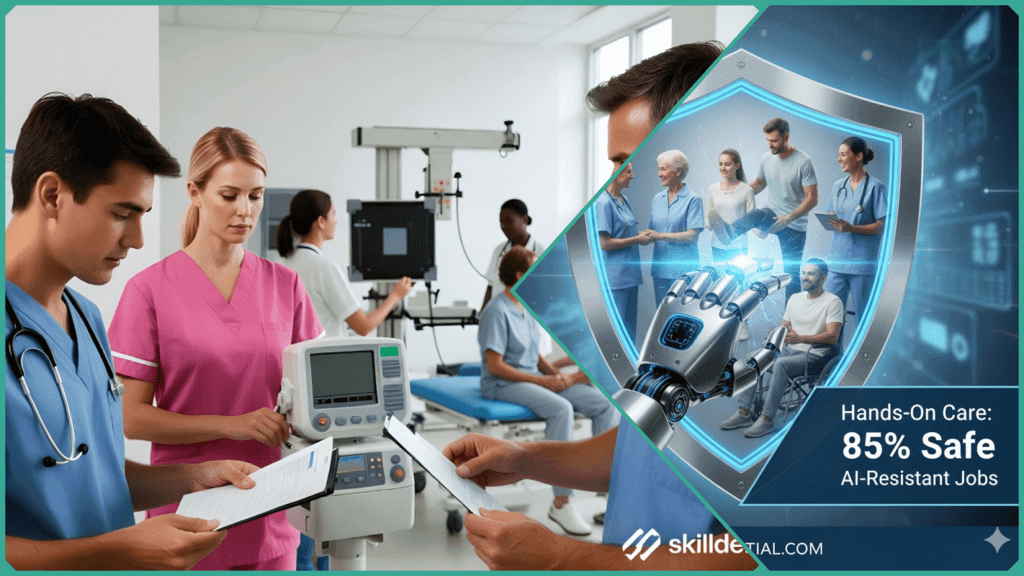
Nurse practitioners remain the gold standard for stability with a projected 40% growth rate, followed by physician assistants at 20%. Ultimately, this security stems from a “human touch” requirement; while AI can assist with data, it cannot fully replace the complex, hands-on patient care and clinical judgment that these roles provide.
The 9 Most Secure Jobs for the Future in Healthcare (2024–2034)
These nine roles are selected based on three criteria: projected growth over 15% (well above the national average), median salaries exceeding $60,000, and low automation risk.
| Job Title | Projected Growth | Median Pay (2024) | Entry Education |
| Nurse Practitioners | 40% | $132,050 | Master’s degree |
| Medical & Health Services Managers | 23% | $117,960 | Bachelor’s degree |
| Physical Therapist Assistants | 22% | $65,510 | Associate’s degree |
| Physician Assistants | 20% | $133,260 | Master’s degree |
| Speech-Language Pathologists | 19% | $95,410 | Master’s degree |
| Occupational Therapy Assistants | 19% | $66,050 | Associate’s degree |
| Home Health & Personal Care Aides | 17% | $34,900* | High school diploma |
| Physical Therapists | 11% | $101,020 | Doctoral degree |
| Registered Nurses | 6% (High Volume) | $93,600 | Bachelor’s degree |
Note: While Home Health Aides have a lower median pay, they are included due to the sheer volume of job security—with over 500,000 new jobs expected—and their immunity to AI replacement.
Nurse Practitioners (NPs)
Nurse Practitioners are currently the fastest-growing occupation in the United States. As we move through 2026, their role has shifted from “support staff” to primary care leaders. With a projected growth of 40% through 2034, this career offers a level of stability that few other industries can match.
Why the Demand is Skyrocketing
- The Physician Gap: As more primary care physicians retire or move into specialized surgery, NPs are filling the void. In many states, NPs now have “Full Practice Authority,” allowing them to open their own clinics and prescribe medication independently.
- The Aging Population: The “Silver Tsunami” (the aging Baby Boomer generation) requires complex, chronic disease management that fits perfectly within the NP’s holistic care model.
- Cost-Efficiency: Healthcare systems are prioritizing NPs because they provide high-quality outcomes at a lower cost to the system than traditional MDs.
2026 Earning Potential
While the national median is $132,050, your location and specialty significantly impact your paycheck. In 2026, certain niches are seeing even higher premiums:
- Psychiatric-Mental Health (PMHNP): Often commands $145,000+ due to the national mental health crisis.
- California & New York: Leading the nation with average salaries exceeding $160,000.
- Virtual Care: “Telehealth NPs” are seeing a surge in demand, offering the ability to work from home while maintaining six-figure earnings.
Resistance to Automation
While 2026 has seen an explosion in “AI Scribes” and diagnostic tools, the NP role remains safe. AI can suggest a diagnosis based on data, but it cannot perform a physical exam, interpret the nuance of a patient’s lifestyle, or provide the emotional support necessary for a “whole-person” treatment plan.
Key Takeaway: If you want a career that blends high-tech diagnostic tools with high-touch human care, the Nurse Practitioner path is the ultimate “future-proof” choice.
Medical and Health Services Managers
As healthcare systems become more complex and data-heavy, the people who run them are more essential than ever.
- Why it’s secure: This role is the “brain” of the operation. In 2026, managers will be needed to navigate the transition to AI-integrated diagnostics and strict new data privacy laws.
- The “Moat” Against AI: While AI can organize a spreadsheet, it cannot lead a team of burnt-out doctors, negotiate with insurance companies, or make ethical decisions regarding facility policy.
- Insider Tip: Many in this field are moving into Health Information Management, ensuring electronic health records (EHR) stay secure and accurate.
Physical Therapist Assistants (PTAs)
PTAs work under the direction of Physical Therapists to help patients regain movement and manage pain.
- Why it’s secure: Hospitals are increasingly using PTAs to provide high-quality care at a lower cost. In 2026, the shift toward outpatient rehab for the aging population is driving massive demand.
- Economic Advantage: With only a 2-year Associate’s degree, you can earn a median salary of over $65,000, making this one of the best returns on investment (ROI) in the sector.
Physician Assistants (PAs)
PAs are licensed to practice medicine, prescribe medication, and even assist in surgery.
- Why it’s secure: Like Nurse Practitioners, PAs are the answer to the physician shortage. They are increasingly being utilized in emergency rooms and specialized surgical teams.
- 2026 Trend: We are seeing a “Surgical PA” boom—PAs specializing in orthopedics and cardiology are commanding salaries well above the $133,000 median.
Speech-Language Pathologists (SLPs)
SLPs diagnose and treat communication and swallowing disorders in patients ranging from infants to the elderly.
- Why it’s secure: There is a growing awareness of early-childhood developmental needs, combined with a rising number of stroke and dementia cases in older adults that require speech and swallowing therapy.
- Virtual Care: This is one of the most successful “hybrid” roles in 2026; many SLPs now offer sessions via telehealth, providing great work-life balance.
Occupational Therapy Assistants (OTAs)
OTAs help patients develop, recover, and improve skills for daily living (like dressing or using tech).
- Why it’s secure: Occupational therapy is highly “tactile.” An AI cannot help a stroke survivor learn how to cook in their own kitchen or adapt their home for a wheelchair.
- Job Growth: At 19% growth, this is a “low-stress” alternative to nursing with high job satisfaction.
Home Health & Personal Care Aides
These professionals provide essential daily support to people with disabilities or chronic illnesses in their own homes.
- Why it’s secure: The sheer volume. By 2034, we will need over half a million new aides. It is a job that simply cannot be offshored or fully automated.
- 2026 Update: While traditionally lower-paid, many states are passing legislation in 2026 to increase the minimum wage for these “frontline” workers due to the extreme shortage.
Physical Therapists (PTs)
PTs are doctoral-level experts in human movement who help patients avoid surgery and reduce opioid reliance.
- Why it’s secure: The 2026 medical trend is “Conservative Care“—doctors are prescribing PT before surgery or pills.
- The Stability Factor: Even with a slower growth rate than assistants, PTs have ultimate job security because they are the ones who create the treatment plans and supervise the entire rehab process.
Registered Nurses (RNs)
RNs are the backbone of the entire medical infrastructure.
- Why it’s secure: Don’t let the 6% growth rate fool you—because there are already millions of RNs, that small percentage equals nearly 200,000 new jobs every year.
- High-Demand Settings: In 2026, the highest demand is observed in Critical Care (ICU) and Geriatrics. If you are a nurse, you will never be without a job offer.
The healthcare sector is the safest harbor in the 2026 economy. Whether you want to spend 8 years in school to become a Physical Therapist or start your career in 2 years as a PT Assistant, the demand for human-centered care is only going up.
Why are these roles “Future-Proof”
The data above isn’t just about numbers; it’s about the shift in how care is delivered.
- The Rise of the Assistant: You’ll notice that Physical and Occupational Therapy Assistants have higher growth rates than the therapists themselves. Hospitals are increasingly using assistants to manage costs while meeting the needs of an aging population.
- The “Mid-Level” Explosion: Nurse Practitioners and Physician Assistants are seeing the highest growth because they fill the gap left by a physician shortage, offering a faster route to high-paying, autonomous work.
- Administrative Stability: Medical Managers are the backbone of the “Digital Health” era, ensuring that hospitals stay compliant with 2026 data privacy and insurance regulations.
Why Healthcare Jobs Resist Recession and AI?
The resilience of healthcare careers in 2026 is not a coincidence; it is built into the very fabric of how society functions. While other sectors fluctuate with the stock market or technological breakthroughs, healthcare remains steady due to two primary “anchors”: Inelastic Demand and Human-Centric Complexity.
Recession-Proof: The “Non-Discretionary” Factor
Unlike luxury goods, travel, or even certain tech services, healthcare is a fundamental necessity. Patients cannot “postpone” a heart condition or an infection until the economy improves.
- The “Silver Tsunami”: By 2026, the aging Baby Boomer generation is reaching peak healthcare utilization. This demographic shift creates a floor for demand that no economic downturn can break.
- Government Support: A large portion of healthcare revenue is tied to Medicare and Medicaid. These government-backed programs provide a level of financial stability to hospitals and clinics that private-sector businesses simply don’t have.
AI-Resistance: The Empathy Gap
While AI is revolutionizing diagnostics and administrative tasks in 2026, it faces a hard wall when it comes to “tactile” and “emotional” care.
- Empathy & Judgment: Roles like Mental Health Counselors or Nurse Practitioners require emotional intelligence and ethical decision-making. AI can analyze data, but it cannot “read the room” or build trust with a frightened patient.
- Physical Dexterity: High-level physical care is incredibly difficult to automate. According to 2026 automation risk assessments, roles involving complex physical manipulation—like Surgeons or Physical Therapists—score as high as 96/100 for AI resistance.
The 2026 Reality: In a world where AI can now write code and generate marketing plans, the ability to physically touch, heal, and empathize with a human being has become the most valuable—and secure—skill set in the global labor market.
How to Enter These Roles: A Roadmap for 2026
The beauty of the healthcare sector is that it offers entry points for every level of education and experience. Whether you have two weeks or four years, there is a path to a secure role.
For Career Switchers: The “Fast-Track” Entry
If you are moving from a different industry, you don’t always need a four-year degree to find security.
- The Associate Degree Path: Roles like Physical Therapist Assistant (PTA) or Occupational Therapy Assistant (OTA) require a two-year associate degree. In 2026, many community colleges offer these for under $10,000, providing an immediate jump into a $60k+ career.
- The “Micro-Credential” Strategy: For those who need to start working immediately, Home Health Aide or Medical Assistant certifications can often be completed in 6–12 months.
For Students: Maximizing ROI
For those starting their educational journey, the goal is to choose a degree that pays for itself quickly.
- The BSN Advantage: Pursuing a Bachelor of Science in Nursing (BSN) is the most versatile move. It serves as the foundation for almost all high-paying leadership and advanced practice roles.
- Accelerated Programs: If you already have a degree in another field (e.g., Biology or even English), look for Accelerated BSN (ABSN) programs. These allow you to earn a nursing degree in as little as 11 to 16 months.
For Up-Skillers: The “Bridge” to Higher Pay
If you are already in healthcare, “bridging” is the fastest way to increase your salary and security.
- LPN to RN/NP: Transitioning from a Licensed Practical Nurse to a Nurse Practitioner is one of the most profitable moves you can make. According to Skilldential career audits, up-skillers moving into NP roles saw average salary gains of 45% immediately following certification.
- Leadership Certifications: Clinical staff moving into Medical and Health Services Management often add a Certified Professional in Healthcare Quality (CPHQ) or an MHA (Master of Healthcare Administration) to pivot into a desk-based, high-stability role.
Free Resources & Financial Aid
In 2026, the shortage of healthcare workers has led to unprecedented support:
- HRSA Grants: The Health Resources and Services Administration offers State Loan Repayment Programs and scholarships for students committing to work in underserved areas.
- Employer Sponsorship: Many hospital systems now offer “Tuition Reimbursement” where they pay for your advanced degree (like an MSN or MHA) while you work for them.
- BLS Pathways: Use the Bureau of Labor Statistics “Occupational Outlook Handbook” to see exactly what certificates are required for your state.
Pro-Tip: Don’t go it alone. Before enrolling, check if your local “Workforce Development Board” has 2026 grants specifically for healthcare training—many of these programs are fully funded by state taxes.
Paths for Career Switchers: Fast Entry, Long-Term Security
For those transitioning from volatile fields like retail, hospitality, or entry-level tech, the barrier to entry in healthcare is often lower than perceived. You don’t always need a four-year degree to start building a “future-proof” resume.
The “Entry-Level” Jump: Home Health Aides
If you need to move into a secure sector immediately, Home Health Aide (HHA) roles are the most accessible.
- Requirements: Most positions require only a high school diploma and provide comprehensive on-the-job training.
- The Draw: With 17% growth, these roles are virtually everywhere, allowing you to secure employment in your local community almost instantly.
The “Stepping Stone” Strategy: CNA to RN
Many successful healthcare professionals started as Certified Nursing Assistants (CNAs). This is widely considered the “entry gate” to the medical field.
- Timeline: CNA certification typically takes only 4 to 12 weeks.
- The Career Ladder: Once you are a CNA, many hospitals will offer tuition reimbursement to help you climb the ladder to become a Registered Nurse (RN) and eventually a Nurse Practitioner (NP).
Why Switch Now?
In 2026, the labor market is rewarding “human-to-human” skills over “human-to-screen” skills. If you are coming from a customer service or management background, your soft skills—communication, empathy, and crisis management—are highly transferable to patient care. By taking a short-term certification now, you are essentially buying insurance against the next economic downturn.
Your Future is in Healthcare
The data is clear: the most secure jobs for the next decade are in the healthcare sector. Whether you are aiming for the high-level autonomy of a Nurse Practitioner or the quick entry of a Home Health Aide, you are entering a field that values human touch over algorithms.
Next Steps for You:
- Identify your timeline: Do you have 3 months or 3 years to train?
- Audit your local market: Check the BLS data for your specific city to see which of these 9 roles is in the highest demand near you.
- Take the first step: Contact a local community college or explore “bridge programs” to see how your existing credits might transfer.
Advice for Students: High ROI and Low Debt
For students entering the workforce, the goal is to find the “sweet spot” between high growth and manageable education costs. You don’t always need a doctorate to earn a high-stability salary.
- Prioritize the “Assistant” Path: Degrees like Physical Therapy Assistant (PTA) are among the smartest moves for 2026. With only a 2-year Associate’s degree, you can enter a field with 22% growth and start earning a mid-to-high five-figure salary while your peers are still halfway through a traditional four-year program.
- Volume Over Prestige: While high-level roles get the headlines, the Bureau of Labor Statistics (BLS) notes that roles requiring a high school diploma or equivalent dominate the total volume of job openings. There are 326 high-volume pathways that allow you to enter the workforce early and let an employer pay for your further specialization.
- The “Clinical” Requirement: When choosing a program, ensure it is accredited and offers robust clinical hours. In the 2026 job market, licensing boards and employers prioritize candidates who have “floor time” over those with purely digital or classroom-based certificates.
Student Tip: Look for “Work-Study” partnerships between community colleges and local hospital systems. These often guarantee you a job upon graduation, effectively eliminating the stress of a post-grad job search.
Up-Skilling Opportunities: Leveling Up in 2026
For those already working in the healthcare trenches, the path to greater security and higher pay often lies in “bridging” your current experience with advanced credentials. In 2026, the industry is making these transitions faster and more accessible than ever.
The Nursing “Bridge”
If you are a Licensed Practical Nurse (LPN) or a Registered Nurse (RN), you are sitting on a goldmine of experience.
- LPN to NP: Accelerated “bridge” programs now allow LPNs to reach Nurse Practitioner status in approximately 2–3 years of year-round study.
- The Payoff: According to Skilldential career audits, LPNs who successfully transitioned to NP roles saw an average salary gain of 45% almost immediately.
Transitioning to Leadership
Many clinical workers are choosing to move “behind the scenes” into administrative roles where the physical toll is lower, but the security is higher.
- Health Services Managers: This field is growing at a staggering 23%. Most successful managers today start with a Bachelor’s degree and a few years of clinical experience.
- Digital Health Pivot: With the 2026 boom in telehealth, many workers are up-skilling in Health Informatics or Digital Care Coordination to manage the technical side of patient care.
Take the Next Step
Don’t let your career plateau. The difference between a “job” and a “future-proof career” is a clear plan.
Free Resource: Download the Healthcare Career Checklist to see personalized paths based on your current experience and goals.
What makes a healthcare job “secure” in 2026?
Security is defined by three factors: projected growth (15% or higher), high replacement volume (even lower-growth roles like Nursing have thousands of openings due to retirements), and human-touch requirements. According to 2026 labor audits, jobs that require physical manipulation and emotional empathy are the most insulated from economic shifts.
Can AI replace Nurse Practitioners?
While AI in 2026 has become highly efficient at augmenting diagnostics (handling about 15% of data-heavy triage), it cannot perform a physical exam or provide the complex clinical judgment required for 85% of an NP’s duties. This is why the NP role is still growing at a massive 40% rate despite advances in tech.
What are the education requirements for a Physician Assistant?
To become a PA, you generally need a Master’s degree from an accredited program, which typically includes 2,000 hours of clinical rotations. In 2026, PAs are seeing a 20% growth rate and a median salary of $133,260, making it one of the highest-paying master’s-level roles in the country.
Are Home Health Aide (HHA) jobs really stable?
Yes. Although they have lower starting pay, they offer the highest level of “recession-proof” security. The demand for in-home care is constant and unaffected by the stock market. With 17% growth and no college degree required, it is the most stable entry-level role for those needing immediate employment.
How long does it take to become a Physical Therapist Assistant?
Most PTA programs take two years (Associate’s degree), followed by passing the NPTE-PTA exam. It is a popular choice for 2026 students because it offers a 22% growth rate—higher than the growth for Physical Therapists themselves—due to hospitals’ focus on cost-effective care models.
In Conclusion
As we navigate the labor shifts of 2026, one thing is certain: the healthcare sector remains the most reliable engine for job growth in the global economy. Whether it is the 40% explosion in demand for Nurse Practitioners or the rock-solid stability of Home Health Aides, these roles share a common “safety net”—they cannot be outsourced, and they cannot be fully replaced by AI.
Choosing a healthcare career isn’t just about finding a paycheck; it’s about positioning yourself in a field where human empathy and physical care are the most valuable currencies. By choosing any of the nine roles listed above, you are not just getting a job—you are future-proofing your life against economic and technological volatility.
What’s Your Next Move?
Don’t let “analysis paralysis” keep you from a more secure future. Here is your 3-step action plan:
- Audit Your Timeline: Decide if you want a fast-track certification (4–12 weeks) or a high-ROI degree (2–4 years).
- Check Local Demand: Use the BLS pathways to see which of these roles is hiring most aggressively in your specific zip code.
- Get the Roadmap: Download the Healthcare Career Checklist to see exactly which certifications and bridge programs will get you to your goal the fastest.
Which of these nine roles caught your eye? Let us know in the comments below, and we’ll point you toward the best starting resources!
Discover more from SkillDential | Your Path to High-Level Career Skills
Subscribe to get the latest posts sent to your email.