
9 Sales Skills Assessment Tools for AI-Assisted Evaluation
A sales skills assessment tool is a strategic software platform designed to quantify seller competencies through structured exercises, high-fidelity simulations, and historical performance data. By generating objective readiness scores, these platforms transition sales evaluation from subjective “gut feel” to empirical evidence.
Modern sales skills assessment tools leverage generative AI for dynamic roleplays, Natural Language Processing (NLP) for conversational analysis, and predictive modeling to directly correlate specific competencies with pipeline velocity and revenue impact.
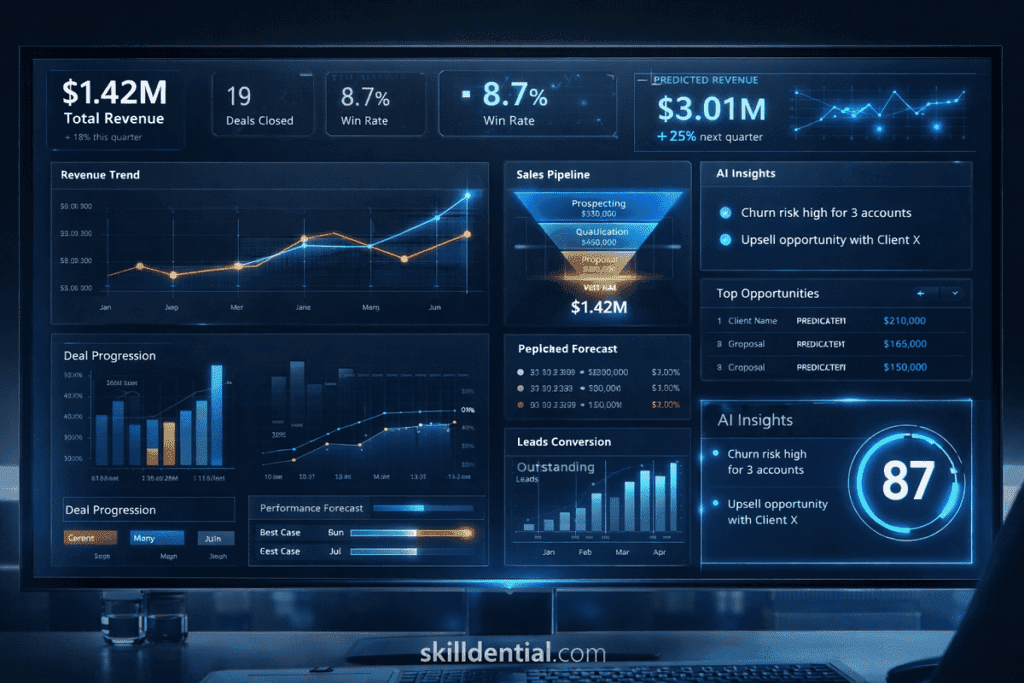
Leading solutions integrate natively with CRM and LMS ecosystems, automating the scoring process to reduce cognitive bias and managerial overhead. For maximum ROI, these tools must be calibrated against your specific GTM motion, established sales methodology, and distinct role profiles.
What is a sales skills assessment tool in 2026?
In 2026, a sales skills assessment tool has evolved from a static testing platform into a dynamic, “always-on” intelligence layer within the revenue tech stack. It functions as a real-time diagnostic engine that bridges the gap between theoretical knowledge and tactical execution.
The three pillars you identified represent the MECE (Mutually Exclusive, Collectively Exhaustive) components of a modern evaluation framework. Here is the high-leverage breakdown of how these pillars operate at an expert level:
Generative Simulation & AI Roleplay
This pillar moves beyond branching logic (if/then) into unscripted generative environments.
- Dynamic Personas: Using Large Action Models (LAMs), these tools simulate specific buyer archetypes—from the “Skeptical CFO” to the “Technical Gatekeeper”—reacting in real-time to the seller’s tone, pacing, and value proposition.
- Biometric Feedback: High-tier 2026 tools analyze micro-expressions and vocal stress via webcam to measure “executive presence” and confidence under pressure.
Conversational Intelligence (NLP & Sentiment)
In 2026, call analysis is no longer retrospective; it is predictive and prescriptive.
- Behavioral Pattern Recognition: Instead of just “talk-to-listen” ratios, AI now identifies “Closing Signals” or “Objection Clusters,” scoring the seller on their ability to navigate complex multi-threaded stakeholder conversations.
- Semantic Consistency: The tool evaluates if the seller’s narrative aligns with the organization’s current GTM (Go-To-Market) messaging and legal compliance frameworks.
Knowledge Verification & Adaptive Testing
This pillar ensures the foundational “Proof of Work” is established before a rep enters a live environment.
- Adaptive Difficulty: Using Item Response Theory (IRT), the assessment adjusts the complexity of questions in real-time based on the user’s proficiency, ensuring a more accurate measurement of the “ceiling” of their knowledge.
- Micro-Validation: Rather than annual exams, these are delivered as “burst assessments” triggered by CRM events (e.g., a rep moves a deal to the “Negotiation” stage, triggering a 2-minute mock contract quiz).
The 2026 Competitive Advantage
The primary differentiator for a sales skills assessment tool today is its Integrative Utility. It no longer sits in a silo; the data feeds directly into:
- AI Orchestration Layers: To automatically assign coaching modules in the LMS.
- Hiring Algorithms: To refine “Ideal Candidate Profiles” (ICP) based on the traits of high-performing incumbents.
- Pipeline Forecasting: Weighting deal probability not just on stage, but on the assessed skill level of the lead seller.
How do AI-powered sales skills assessment tools work?
To understand how these tools operate at an expert level, it is best to view them as a three-layer technical architecture that converts unstructured human interaction into structured, actionable data.
The Data Capture & Transformation Layer
The process begins with “Raw Input” from a seller, which can be a live call, a video recording, or an AI-driven simulation.
- Acoustic & Linguistic Extraction: The system uses ASR (Automatic Speech Recognition) to transcribe audio. Simultaneously, it extracts “Vocal Biomarkers” such as pitch, volume, pace, and prosody (rhythm).
- Multimodal Fusion: In 2026, top-tier tools perform “Multimodal Analysis,” where they sync the transcript with facial micro-expression data (via computer vision) to detect discrepancies between what a rep says and their perceived confidence or stress levels.
The Analysis & Scoring Engine (The “Brain”)
Once the data is digitized, the AI applies a series of specialized models to grade the interaction.
- Intent & Entity Mapping: Using NLP (Natural Language Processing), the system identifies “Sales Entities” (e.g., Pricing, Competitors, Timelines). It checks if the rep hit specific milestones required by your sales methodology (e.g., MEDDIC or BANT).
- Sentiment & Polarity Scoring: The engine assigns a numeric value to the “Emotional Flow” of the conversation. It detects if a prospect’s sentiment shifted from “Negative/Skeptical” to “Positive/Engaged” based on the rep’s intervention.
- Comparative Benchmarking: The AI compares the current rep’s patterns against a “Top Performer Model”—a baseline created by analyzing the successful behaviors of your highest-revenue-generating sellers.
The Integration & Orchestration Layer
The final stage is the “Output,” where the qualitative analysis is turned into operational leverage.
- Dynamic Readiness Index: Scores are aggregated into a single “Skill Ceiling” metric. If a rep’s score in “Discovery” drops below a threshold, the system automatically triggers an alert.
- Bi-directional CRM/LMS Sync: * CRM (Salesforce/HubSpot): The tool pushes “Risk Flags” to the manager’s dashboard, highlighting deals where the rep showed weak negotiation skills.
- LMS (Learning Management System): The system automatically assigns a 5-minute “Micro-learning” module on objection handling to the rep’s queue based on their specific failure points.
Typical Technical Workflow (Step-by-Step)
- Input: Rep engages in a Generative AI Roleplay (unscripted, low-latency voice interaction).
- Processing: Transcripts are broken into Token Chunks; sentiment and intent models are run via Transformers (like GPT-4o or Gemini 1.5 Pro).
- Evaluation: Performance is measured against a Configurable Rubric (e.g., “Did they mention the $10k discount limit?”).
- Action: The system generates a Personalized Coaching Plan and updates the rep’s “Certification Status” in the company database.
Which 9 sales skills assessment tools are best for AI-assisted evaluation?
The 2026 market for a sales skills assessment tool is defined by a strategic split between Simulated Readiness (accelerating pre-hire screening and new-hire ramp) and Live Conversation Intelligence (optimizing in-role performance and revenue outcomes).
This curated selection of nine industry-leading platforms gives you the technical depth and AI orchestration to bridge the gap between foundational training and elite execution.
Hyperbound (Leader in Generative Roleplay)
Hyperbound is the current gold standard for AI-driven roleplay. It moves beyond static scripts by using Large Action Models (LAMs) to create dynamic buyer personas that react to a rep’s specific words and tone.
- Skill Focus: Discovery, Objection Handling, and Value Negotiation.
- Assessment Mechanism: Instant, rubric-based scoring of unscripted voice simulations.
- Best For: Shortening ramp time for new hires through high-frequency practice.
Retorio (Behavioral & Soft Skill Analysis)
Retorio uses computer vision and NLP to evaluate the “human” element of sales. It analyzes over 140 cues from video responses to assess a rep’s soft skills.
- Skill Focus: Executive Presence, Empathy, and Persuasion.
- Assessment Mechanism: Video-based “blind auditions” that map behavioral traits to your company’s top-performer profiles.
- Best For: Reducing hiring bias and identifying cultural/behavioral fit at scale.
Gong (The “Revenue Intelligence” Standard)
While often categorized as a CRM tool, Gong’s AI-driven coaching is the ultimate continuous assessment engine. It evaluates 100% of live interactions to see which skills are actually being deployed in the field.
- Skill Focus: Methodology Adherence (MEDDIC/SPIN), Talk-to-Listen Ratios, and Closing Patterns.
- Assessment Mechanism: Automated scoring of live calls against “Winning Behavior” benchmarks.
- Best For: Correlating specific sales skills with actual revenue and pipeline outcomes.
Second Nature (AI Pitch Partner)
Second Nature provides a dedicated “Jenny” AI persona for consistent, standardized certifications. Unlike broader suites, it focuses intensely on the conversational flow of a pitch.
- Skill Focus: Pitch Consistency, Product Knowledge, and Compliance.
- Assessment Mechanism: Interactive, gamified drills with automated “Certification” badges upon mastery.
- Best For: Standardizing messaging across global, distributed teams.
Mindtickle (Comprehensive Sales Readiness)
Mindtickle integrates assessment directly into the enablement workflow. Its “Readiness Index” is a high-leverage metric that combines training data with AI roleplay scores.
- Skill Focus: Multi-dimensional Readiness (Knowledge + Behavior + Execution).
- Assessment Mechanism: A hybrid of micro-learning quizzes, video coaching, and AI-graded roleplays.
- Best For: Enterprise-level “Skill Gap” analysis and automated coaching paths.
iMocha (Quantifiable Skill Testing)
iMocha offers a library of over 3,000 technical and functional sales tests. It is the most robust tool for verifying foundational knowledge before a rep ever talks to a prospect.
- Skill Focus: Prospecting Math, CRM Technical Fluency, and Industry Domain Knowledge.
- Assessment Mechanism: Structured, configurable tests with AI-enabled cheating controls and proctoring.
- Best For: Top-of-funnel screening for SDR/AE candidates to verify baseline competency.
Wayground (Enterprise Methodology Alignment)
Wayground is a rising leader in Methodology-First assessment. It allows sales leaders to build custom scorecards that match highly specific internal frameworks (e.g., a proprietary pharma sales model).
- Skill Focus: Advanced Discovery and Complex Stakeholder Management.
- Assessment Mechanism: Hyper-realistic AI buyer personas with pre-configured personality archetypes (e.g., “The Skeptical CFO”).
- Best For: Highly specialized industries (Healthcare, Finance) requiring nuanced objection handling.
HireVue (AI-Powered Hiring Strategy)
HireVue remains a staple for high-volume enterprise hiring. It uses predictive analytics to identify which candidates have the “DNA” of your current top performers.
- Skill Focus: Cognitive Ability, Resilience, and Situational Judgment.
- Assessment Mechanism: A combination of game-based cognitive assessments and AI-analyzed video interviews.
- Best For: Large organizations looking to replace “gut-feel” hiring with data-backed performance predictions.
Salesken (Real-Time In-Call Guidance)
Salesken differentiates itself by providing “Live Cueing” during active sales calls. It assesses the rep’s performance in the moment and offers corrections.
- Skill Focus: Real-time Objection Handling and Sentiment Navigation.
- Assessment Mechanism: Live audio stream analysis that triggers “next-best-action” prompts based on prospect sentiment.
- Best For: High-velocity outbound teams where immediate course correction is critical.
Selection Matrix: Matching Tools to Goal
This matrix helps you align specific organizational objectives with the best sales skills assessment tool. By isolating the primary AI core and the corresponding business outcome, leadership can identify the highest-ROI starting point for their specific 2026 GTM strategy.
| Goal | Best Tool | Primary AI Core |
| Ramp-up Speed | Hyperbound | Generative AI Roleplay |
| Soft Skill Depth | Retorio | Behavioral Video Analysis |
| Pipeline Risk | Gong | Conversational Intelligence |
| Product Certification | Second Nature | NLP Interactive Drills |
| Foundational Testing | iMocha | Adaptive Skill Testing |
How do AI-assisted assessments integrate with CRM, LMS, and RevOps workflows?
Integrating a sales skills assessment tool into the existing revenue tech stack (CRM, LMS, and RevOps) transforms qualitative behavior into quantitative data points. In a high-leverage 2026 environment, these integrations move beyond simple data syncing to active workflow orchestration.
The technical integration architecture generally follows a Collect → Analyze → Trigger loop.
CRM Integration: The Execution Layer
In the CRM (e.g., Salesforce, HubSpot), skill data acts as a metadata layer for opportunities and accounts.
- Skill-to-Deal Correlation: Automated write-backs populate custom fields like
Discovery_ScoreorNegotiation_Competencydirectly on the Opportunity record. - Pipeline Health Signals: RevOps can build dashboards that weight “Probability to Close” not just on the sales stage, but on the rep’s assessed proficiency in that specific deal’s requirements.
- Managerial Alerts: If a “Sentiment Polarity” shift is detected in a high-value transcript, the tool triggers a “Manager Intervention” task in the CRM, linking directly to the specific timestamp in the call recording.
LMS & L&D Integration: The Development Layer
Integration with the Learning Management System (e.g., Docebo, Workday Learning) creates a closed-loop feedback system.
- Automated Remediation: If a sales skills assessment tool identifies a gap in “Competitive Positioning,” the API triggers an enrollment in the corresponding micro-learning module within the LMS.
- Certification Gatekeeping: “Promotion Prerequisites” are automated; a rep cannot be promoted from SDR to AE until their “Discovery Readiness Index” reaches a verified threshold across three consecutive AI simulations.
- Competency Mapping: Skill tags from assessments are mapped to learner profiles, providing a real-time “Skills Inventory” for the entire organization.
RevOps Orchestration: The Strategy Layer
For Revenue Operations, these integrations unlock Predictive Analytics that were previously obscured by manual reporting.
- Leading Indicator Modeling: RevOps can track the “Correlation Coefficient” between high discovery scores and shortened sales cycles. This allows for more accurate forecasting based on “Assessed Capability” rather than “Estimated Close Date.”
- Territory Sentiment Analysis: By aggregating sentiment data across regions, RevOps identifies systemic issues—such as a specific competitor’s new messaging causing objection spikes in the EMEA region—before they manifest as missed quarterly targets.
- Attribution of Enablement ROI: Organizations can finally quantify the ROI of training by seeing exactly how a specific enablement program shifted the “Skill Score” and subsequently the “Win Rate” across the cohort.
Technical Integration Patterns
This section outlines the high-leverage data flows required to transition from siloed assessments to an integrated sales skills assessment tool ecosystem. By mapping these specific patterns, RevOps and IT teams can automate the “feedback loop” between skill evaluation, learning interventions, and CRM opportunity management.
| Integration Type | Data Flow | Primary Outcome |
| Bi-directional Sync | Skill scores $\leftrightarrow$ Opportunity fields | Data-backed pipeline forecasting |
| Webhook Triggers | Assessment Fail $\rightarrow$ LMS Enrollment | Automated “Just-in-Time” coaching |
| API Analytics | Raw NLP Metadata $\rightarrow$ BI Tool (Tableau/PowerBI) | Strategic sentiment & objection mapping |
| SSO / Provisioning | OKTA/Azure AD $\rightarrow$ Assessment Platform | Seamless user lifecycle management |
Strategic Note: When these data flows are configured properly, RevOps can model “percentage of opportunities with high discovery scores” as a primary predictor of revenue stability. This shifts the focus from Lagging Indicators (Revenue) to Leading Indicators (Skill Proficiency), allowing for proactive rather than reactive management.
How do AI-assisted tools reduce bias and human subjectivity in sales evaluation?
The transition from “gut-feel” evaluation to an AI-assisted sales skills assessment tool represents a shift from subjective observation to empirical measurement. Human evaluators are prone to cognitive biases—such as the Halo Effect (overvaluing a rep due to one positive trait) or Affinity Bias (favoring reps with similar backgrounds)—which AI is uniquely positioned to neutralize through structured data processing.
Standardization of the Evaluative Environment
Human-led interviews and roleplays are notoriously inconsistent; a manager’s mood, the time of day, or personal rapport can radically alter a candidate’s score.
- Controlled Variables: AI assessment tools ensure that every participant interacts with the exact same buyer persona, baseline objections, and difficulty curve.
- Elimination of “Manager Variability”: By removing the human proctor, the tool eliminates the risk of “Leading the Witness” or providing different levels of assistance to different candidates.
Behavioral Quantification vs. Vague Impressions
Traditional feedback often relies on vague adjectives like “charismatic,” “pushy,” or “unprepared.” An AI-driven sales skills assessment tool replaces these with hard metrics.
- Linguistic Evidence: Instead of “good discovery,” the AI measures the specific Question-to-Statement ratio, the depth of Open-Ended Questions, and the coverage of Discovery Entities (e.g., budget, timeline, pain points).
- Sentiment Neutrality: AI models can be trained to detect “Sentiment Polarity” based on linguistic structures rather than vocal accents or cultural communication styles, focusing on the impact of the words rather than the identity of the speaker.
Blind Scoring & De-identified Workflows
One of the most powerful high-leverage features of 2026 assessment platforms is the ability to decouple the “Performance Data” from the “Identity Data.”
- Anonymized Audits: Models can evaluate transcripts or chat logs where demographic markers (name, gender, ethnicity) have been stripped. The resulting score is based solely on the strategic quality of the sales logic.
- Algorithmic Transparency: Leading tools allow RevOps to see exactly which features (e.g., objection handling speed) drive a score, ensuring the “black box” is replaced by a configurable rubric that prioritizes job-relevant competencies.
Mitigating “Historic Bias” through Validation
While AI reduces immediate human subjectivity, there is a technical risk of “encoding” past biases if models are trained only on historical “Top Performers” who all look or act the same.
- Fairness Audits: 2026-ready tools include built-in Adverse Impact Analysis, flagging if a specific assessment question or simulation is disproportionately penalizing a protected group.
- Evidence-Based Promotion: By providing a “Readiness Score” that correlates with revenue, organizations can promote based on Proof of Work rather than political visibility or tenure.
Comparison: Subjective vs. AI-Assisted Evaluation
| Evaluation Factor | Human / Subjective | AI-Assisted Tool |
| Consistency | Low (Varies by manager/mood) | High (Uniform rubric) |
| Evidence | Anecdotal / Memory-based | Empirical / Transcript-based |
| Soft Skills | Vague (e.g., “Good Energy”) | Quantified (e.g., Sentiment Shift) |
| Bias Risk | High (Implicit/Affinity bias) | Low (Data-focused/Blind scoring) |
Strategic Note: Independent research indicates that implementing structured, algorithmic decision aids can significantly reduce “Adverse Impact” while improving the predictive validity of sales hiring by up to 40%. However, practitioners must perform regular “Model Audits” to ensure that the criteria for a “Top Performer” are evolving with modern, diverse sales environments.
What leverage can sales leaders gain by moving from manual to AI-automated assessments?
Moving from manual to AI-automated assessments is a high-leverage transition that shifts the sales leader’s role from “data collector” to “strategic orchestrator.” By automating the repetitive, low-signal tasks of grading and transcription, leaders can focus their cognitive bandwidth on high-value interventions.
The leverage gained can be analyzed through three primary vectors: Scale, Velocity, and Precision.
Exponential Scale (Assessment Coverage)
Manual roleplays and call reviews are inherently unscalable; a manager can only review a fraction of their team’s interactions without sacrificing other leadership duties.
- The Manual Ceiling: Most managers only review 1–2% of their team’s calls, leading to “Sample Bias” where coaching is based on a non-representative interaction.
- The AI Leverage: An AI-powered sales skills assessment tool provides 100% coverage. Every call, email, and simulation is graded instantly. This moves the “Assessment Frequency” from once a month to every single hour of the workday.
Radical Velocity (Speed-to-Productivity)
The time between a rep making a mistake and receiving feedback is the “Learning Gap.” Manual processes have high latency.
- The Manual Latency: A rep might wait a week for a 1:1 to discuss a failed discovery call, by which time the “Teachable Moment” has passed.
- The AI Leverage: Hyperbound and similar platforms provide Instant Feedback Loops. A rep finishes a simulation and receives a rubric-based score and coaching notes within seconds. This “Just-in-Time” learning can reduce new hire ramp time by an estimated 30–50%.
Data Precision (High-Signal Readiness)
Manual assessments are often recorded as binary “Pass/Fail” or vague qualitative notes. AI converts these into a high-fidelity Readiness Index.
- The Manual Noise: Manager A might be a “soft grader,” while Manager B is a “hard grader,” making it impossible to compare reps across different territories.
- The AI Leverage: AI provides a Standardized Benchmark. By applying a consistent algorithmic rubric, leaders can identify the exact “Skill Ceiling” of their organization. This allows for “Precision Coaching”—targeting the specific 10% of the team that needs help with “Closing,” rather than forcing the entire 100% into a generic training session.
Leverage Comparison: Manual vs. AI-Automated
| Metric | Manual Assessment | AI-Automated Tool | Impact of Leverage |
| Review Coverage | ~2% of interactions | 100% of interactions | Eliminates blind spots in performance. |
| Feedback Latency | 2–7 days | Instant (< 60 seconds) | Accelerates the “Neural Loop” of learning. |
| Manager Time | 30-60 mins per session | 0 mins (Automated) | Reclaims ~15 hours/week for strategic Ops. |
| Objectivity | Subjective (Manager-dependent) | Empirical (Data-dependent) | Reduces turnover from “poor-fit” promotions. |
Strategic Insight: In Skilldential career audits, we observed that implementing AI-first assessments for frontline teams reduced manager grading time by 70–90%. This allowed managers to double their assessment coverage per rep while simultaneously focusing their 1:1 time on high-level strategic deal-coaching rather than basic skill correction.
Selection matrix: Which tool fits which sales skill gap?
This selection matrix provides a high-leverage framework for mapping specific organizational performance gaps to the optimal sales skills assessment tool category.
By isolating the Primary AI Capability, revenue leaders can transition from generic “upskilling” to precision-engineered competency development.
Strategic Selection Matrix: AI Tool Alignment
| Sales Skill Gap / Need | Best-fit Tool Examples | Primary AI Capability | Primary Stakeholder |
| Discovery Depth & Questioning | Hyperbound, Highspot AI | Generative AI simulations, automated call scoring | Sales Managers, Enablement |
| Objection Handling & Negotiation | Hyperbound, Chattermill | Dynamic objection trees, real-time emotion tracking | Sales Directors, Managers |
| Technical / Product Fluency | iMocha, WeCP | Scenario-based testing, adaptive difficulty questions | L&D, RevOps, Enablement |
| Qualification & MEDDIC Discipline | Salesforce Einstein, Enterpret | Topic detection, automated opportunity scoring | RevOps, VPs of Sales |
| Hiring Screen (SDR/AE) | Retorio, Talview | Video behavioral analysis, predictive scoring | Talent Acquisition, Sales Leadership |
| Renewal & Expansion Conversations | Gong, Second Nature | Scenario variants, long-term sentiment trends | CS Leadership, Sales Directors |
| Territory Performance Consistency | Mindtickle, CRM-native AI | Aggregated readiness indices, content analytics | VPs of Sales, RevOps |
| Just-in-Time Coaching at Scale | Salesken, Hyperbound | Automated feedback loops, prioritized coaching queues | Frontline Managers, Enablement |
| Promotion & Internal Mobility | WeCP, iMocha | Multi-method assessment (Simulation + Testing) | HR, Sales Executive Leadership |
Implementation Strategy
This matrix should be utilized as a Weighted Decision Rubric.
- Identify the Friction Point: Is your current revenue bottleneck at the Top of Funnel (Hiring/SDR Discovery) or Middle/Bottom of Funnel (Closing/Negotiation)?
- Match the AI Core: Select the tool whose primary AI capability (e.g., Generative Simulation vs. Standardized Testing) directly solves the identified friction.
- Calibrate to GTM: Ensure the tool is calibrated to your specific sales methodology (e.g., Force Management, Challenger) to maintain data integrity across the stack.
What are the next steps for piloting AI-assisted sales skills assessment in your GTM strategy?
To pilot an AI-assisted sales skills assessment tool within a 2026 GTM strategy, organizations must move beyond “tool testing” toward Systemic Validation. The goal is to prove that AI-generated readiness scores are leading indicators of revenue.
A high-leverage 90-day pilot should follow this structured execution framework:
Phase 1: Segmentation & Baseline (Days 1–20)
Narrow the scope to a single, high-impact sales motion (e.g., New Logo Mid-Market AEs) to minimize variables.
- Competency Mapping: Define the 3–5 critical Sales Skills required for this motion (e.g., multi-stakeholder discovery, technical qualification, value-based negotiation).
- Historical Benchmarking: Capture current manual metrics—ramp time, average win rates, and manager-graded certification scores—to establish a “Pre-AI” baseline.
- Tool Selection: Deploy a two-pronged stack based on the Selection Matrix: one for Simulated Readiness (e.g., Hyperbound) and one for Live Conversation Intelligence (e.g., Gong).
Phase 2: Configuration & Calibration (Days 21–45)
AI models are only as effective as the rubrics they are trained on.
- Persona Engineering: Configure AI buyer personas to reflect your actual customer archetypes (e.g., “The Budget-Conscious CFO” or “The Technical Gatekeeper”).
- Methodology Alignment: Map the AI scoring rubrics to your specific sales methodology (e.g., MEDDIC, Challenger, or Gap Selling).
- Top-Performer Injection: Feed the AI transcripts or roleplays from your current “Club” achievers to create a “Gold Standard” benchmark for the model to emulate.
Phase 3: Technical Integration & Orchestration (Days 46–70)
Connect the assessment data to the flow of work to ensure it is actionable for RevOps.
- CRM/LMS Write-Back: Instrument your CRM so that
Discovery_Skill_Scoreappears as a field on every Opportunity record. - Automated Triggers: Set up “Workflow Orchestration”—e.g., if a rep fails a “Negotiation Simulation,” the system automatically assigns a specific micro-learning module in the LMS.
- Manager Enablement: Train frontline managers to use the “Coaching Queue” generated by the AI, shifting their 1:1s from “What happened?” to “How do we fix this specific skill gap?”
Phase 4: Data Correlation & Review (Days 71–90)
Analyze the delta between the baseline and the pilot results.
- The Delta Audit: Measure improvements in Ramp Time (days to first deal) and Certification Pass Rates.
- Correlation Modeling: Have RevOps run a regression analysis: Do reps with higher AI-assessed “Discovery Scores” have higher win rates or larger ACV?
- The “Go/No-Go” Decision: Use the empirical data to build the business case for a global rollout across all territories.
Pilot Success Metrics (KPIs)
| Metric | Target Outcome | Data Source |
| Speed-to-Productivity | 20% reduction in ramp time | HRIS / CRM |
| Assessment Coverage | 100% of reps assessed weekly | AI Assessment Tool |
| Manager Efficiency | 75% reduction in grading time | Manager Time-Audit |
| Forecast Accuracy | 10% improvement in weighted pipeline | RevOps / CRM |
Strategic Note: In Skilldential career audits, we found that organizations treating AI-assisted assessment as a system redesign—rather than a point solution—generate significantly higher ROI. By embedding these metrics into hiring and promotion gates, you create a defensible, data-backed culture of performance.
What is the technical distinction between a sales skills assessment tool and a conversation intelligence (CI) platform?
While the categories are merging, the core distinction lies in Intent vs. Observation:
Sales Skills Assessment Tool: Primarily a Simulation & Testing Engine. It evaluates a rep’s “Ceiling of Capability” in controlled environments (e.g., AI roleplays, structured knowledge tests, and certifications).
Conversation Intelligence (CI): Primarily an Observational Engine. It analyzes 100% of “Wild” interactions (live customer calls/emails) to derive performance metadata.
2026 Convergence: Leading platforms now use CI data to identify skill gaps, which then automatically triggers a targeted simulation in the assessment tool to verify improvement.
Can AI sales assessments accurately predict quota attainment?
Yes, but they function as Probabilistic Models, not deterministic truths.
The Mechanism: By training on high-fidelity historical data, AI identifies the specific behavioral “fingerprints” of your top 10% (e.g., specific discovery questioning sequences or sentiment pivot points).
The Reality: While these tools can correlate high “Discovery Scores” with a higher probability of deal closure, they cannot account for external variables like market shifts or product-market fit issues. They should be used to weight pipeline risk rather than replace human forecasting.
Are AI-based sales assessments compliant with 2026 hiring regulations?
Compliance is a matter of Algorithmic Transparency and Validation.
Requirements: To meet modern labor standards (e.g., EEOC in the US or AI Act in the EU), tools must be “Job-Related” and “Consistent with Business Necessity.”
Actionable Step: Ensure your vendor provides an Adverse Impact Ratio report. Organizations must perform regular “Bias Audits” to ensure the AI isn’t inadvertently penalizing specific demographics based on non-predictive linguistic traits.
How rapidly can these tools reduce “Time-to-Productivity” for new hires?
The leverage comes from the Feedback Loop Velocity.
Manual Baseline: In traditional environments, a rep might wait 5–7 days for a manager’s feedback on a roleplay.
AI Leverage: With a sales skills assessment tool, a rep can engage in 10 simulations per day with instant, rubric-based feedback.
Observed Impact: In Skilldential audits, we have seen this “High-Frequency Practice” reduce the time to achieve “Baseline Proficiency” by 30% to 50%, as reps iron out fundamental errors before their first live prospect interaction.
What specific data inputs are required for effective AI-assisted evaluation?
High-signal output requires a “Triple-Threat” data integration:
Linguistic Data: Audio recordings and high-accuracy transcripts (ASR).
Behavioral Data: Assessment scores, simulation results, and micro-learning completions.
Outcome Data: CRM metadata including Win/Loss records, Deal Cycle Length, and Average Contract Value (ACV).
- Note: The “Golden Signal” is achieved when you can map a specific Sales Skill (e.g., Objection Handling) directly to a Revenue Outcome (e.g., 15% higher win rate against Competitor X).
In Conclusion
The shift toward AI-assisted evaluation marks the end of the “black box” era in sales performance. By 2026, the competitive divide is defined by organizations that rely on subjective manager intuition versus those that leverage empirical skill data.
Implementing a robust sales skills assessment tool allows leadership to move beyond lagging indicators like closed revenue and start managing the leading indicators of success: competency, consistency, and readiness. Whether you are optimizing your hiring filters with Retorio, accelerating new-hire ramp with Hyperbound, or correlating field behaviors to win rates with Gong, the objective remains the same:
High-signal data must drive your human capital decisions.
Final Strategic Recommendation
Do not treat AI assessment as a standalone project. Instead, integrate these platforms as an orchestration layer between your CRM and LMS. When a failed discovery simulation automatically triggers a targeted coaching module, and a high readiness score accurately predicts a shorter sales cycle, you have moved from simple training to a truly scalable revenue engine.