
Why Nigerian Degrees Aren’t Enough for the Global Economy
A Nigerian degree, traditionally defined as an academic qualification awarded by domestic universities or polytechnics, is increasingly viewed through the lens of a “utility gap” in the 2026 global economy. While these undergraduate and postgraduate programs provide a foundational theoretical framework, they face significant global employability challenges due to a structural mismatch between classroom output and market demand.
Current data indicates a staggering 85% digital competency deficit among graduates, a critical failure in an era of rapid tech sector expansion. This misalignment is further evidenced by a “credential inversion” in the labor market: holders of a postgraduate Nigerian degree experience a 9% unemployment rate, notably higher than the 6.9% seen among those with only a secondary education.
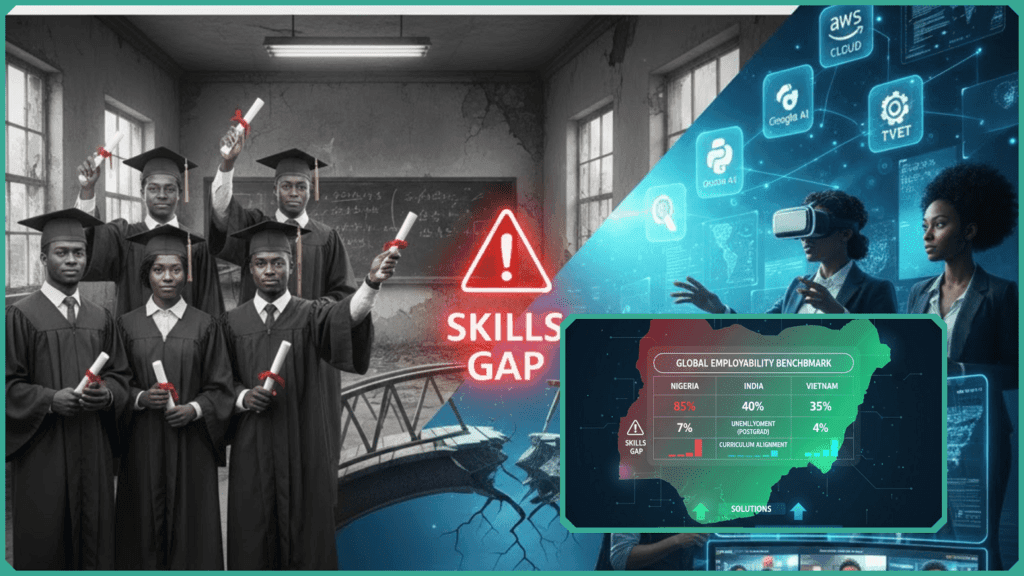
Despite these systemic hurdles, elite private institutions like Covenant University demonstrate a path forward, leveraging robust industry links to achieve a 48% employability rate, signaling that the value of a Nigerian degree is increasingly dependent on institutional agility rather than the certificate alone.
Why Do Nigerian Degrees Lag in Global Employability?
The diminishing global return on a Nigerian degree is primarily a function of “Pedagogical Obsolescence.” While the global economy has transitioned into a Fourth Industrial Revolution (4IR) framework, the Nigerian tertiary system remains largely anchored in 20th-century methodologies.
The Rote Memorization Trap vs. 2026 Demands
A Nigerian degree is frequently criticized for prioritizing “regurgitation” over “application.” In 2026, where AI-driven workflows and data interpretation are baseline requirements, the traditional Nigerian focus on rote memorization creates a significant friction point.
- The Skills Mismatch: While global roles demand Analytical Thinking and Complex Problem Solving, many Nigerian syllabi are still built around static textbooks and theoretical examinations.
- The Digital Chasm: Despite the growth of Nigeria’s tech hubs, a staggering 85% of graduates exit the university system without basic digital fluency, rendering their Nigerian degree functionally “analogue” in a digital world.
The Underemployment Crisis: Beyond Headline Statistics
While official unemployment figures hover between 4.3% and 4.9%, these numbers mask a deeper crisis of Underemployment, which affects over 60% of graduates.
- Labor Underutilization: Underemployment occurs when a holder of a Nigerian degree is forced into low-skill informal work because they lack the specific “tech stacks” or soft skills (e.g., cross-cultural collaboration, remote project management) required for high-value global roles.
Benchmarking Against Global Peers: India and Vietnam
The competitive disadvantage of a Nigerian degree is most visible when compared to emerging market peers:
| Feature | Nigeria (Public Sector) | India & Vietnam |
| Curriculum Age | Often 1980s/90s Syllabi | Real-time Industry Integration |
| Industry Links | Minimal/Ad-hoc | Mandatory Internships & Co-ops |
| Certification | Degree-only focus | Degree + Industry Certifications (AWS, Python, Cisco) |
| Tech Integration | Theory-based computer science | Lab-intensive, AI-integrated learning |
The “1980s Syllabus” Bottleneck
Despite recent attempts by the NUC to roll out the Core Curriculum Minimum Academic Standards (CCMAS), implementation remains uneven. Many students pursuing a Nigerian degree in 2026 are still being taught legacy programming languages or business models that have been obsolete for decades. This “time-lag” in education ensures that by the time a graduate receives their certificate, their knowledge base is already out of sync with the 2026 global economy.
The core failure is not a lack of student capability, but a systemic rigidity. A Nigerian degree acts as a credential of persistence, but without the integration of Industry 4.0 skills, it remains a “local” asset in an increasingly “borderless” job market.
What Infrastructure Limits Practical Training?
The chasm between a Nigerian degree and global employability is not merely a pedagogical failure but a physical one. In 2026, the transition from “learning to know” to “learning to do” is stalled by a pervasive infrastructure deficit that confines education to the chalkboard.
The Laboratory Deficit: Theory Without Application
For the majority of students pursuing a Nigerian degree, “practical” classes are often reduced to observational sessions.
- Secondary Foundation: The crisis begins before the university level; only 35% of public secondary schools possess functional science laboratories.
- Institutional Neglect: This trend continues into tertiary institutions, where 65% lack adequate libraries and modern research equipment. Consequently, engineering and science graduates often receive their certifications without ever handling the industry-standard equipment their global peers use daily.
Digital Paralysis: The 17% Connectivity Barrier
In an economy where AI and cloud computing are the new industrial tools, digital access is a mandatory prerequisite for a competitive Nigerian degree. However:
- Connectivity Gaps: Only 17% of schools have reliable internet access, effectively locking students out of the global digital commons.
- STEM Stagnation: Without stable high-speed data, hands-on practice in Python, AutoCAD, or Data Analytics becomes impossible. Students are forced to learn “programming on paper,” a method that the global market no longer recognizes as valid training.
The Energy Crisis and the Cost of Practice
Frequent power shortages add a “participation tax” to every Nigerian degree.
- Unreliable Power: Consistent electricity is the lifeblood of modern STEM education. In Nigeria, the lack of stable power forces laboratories to remain dormant and limits the use of specialized software that requires high-performance computing.
- Economic Barrier: Students are often forced to visit private tech hubs or “cybercafés” to complete basic assignments, turning what should be a standard academic experience into an additional financial burden.
Summary of Infrastructural Realities
| Infrastructure Component | Status in Public Institutions (2026) | Global Benchmark Requirement |
| Functional Labs | 35% Coverage | 100% Core Course Integration |
| Reliable Internet | 17% Accessibility | Ubiquitous 5G/Fiber Access |
| Software Mastery | Limited to “Theory Only” | Proficiency in Python, AutoCAD, etc. |
| Power Supply | Intermittent/Manual Generators | Uninterrupted Grid/Solar Backup |
The current structural framework ensures that a Nigerian degree remains a “theory-first” credential. Without bridging this physical gap, the degree will continue to struggle against global qualifications that are built on a foundation of daily, hands-on application.
How Does Certificate Culture Impact Graduates?
In the 2026 labor market, the “Certification Craze” has led to a critical phenomenon known as Credential Inflation. While a Nigerian degree remains a prerequisite for social and professional entry, its status as a “paper qualification” has created a trust deficit among employers who prioritize demonstrable competency.
The Employer Dissatisfaction Paradox
Despite the high volume of graduates, there is a profound mismatch between “certified” and “qualified.”
- Systemic Dissatisfaction: Recent data suggests that over 60% of Nigerian employers report significant difficulty in finding candidates with job-ready skills.
- The Soft Skills Deficit: HR professionals highlight a specific “Communication Gap,” with 67.7% of candidates lacking the emotional intelligence, teamwork, and cross-cultural communication skills required for 2026’s remote and hybrid global roles.
The Underemployment Trap
The “Certificate Culture” forces graduates into a cycle of underutilization. Because the Nigerian degree focuses heavily on theory, many graduates find themselves “over-educated” on paper but “under-skilled” for technical roles.
- Informal Sector Dominance: Approximately 85% to 92% of the Nigerian workforce—including degree holders—operate within the informal economy.
- Deskilling: When a graduate takes a low-skill job (e.g., gig-driving or petty trading) due to lack of technical placement, they experience “deskilling,” where their academic knowledge further erodes due to lack of use.
The Credentials vs. Competency Table
This table highlights the divergence between what the culture celebrates and what the global market demands in 2026.
| Focus Area | Certificate Culture Priority | Global Market Requirement |
| Primary Goal | Attaining the Paper (B.Sc/M.Sc) | Demonstrable “Proof of Work” |
| Validation | Examination Grades (GPA) | Portfolios and Tech Stacks |
| Communication | Formal/Rote Syntax | Adaptable/Professional Soft Skills |
| Learning Path | Linear/Degree-only | Continuous/Skill-based Hiring |
The Rise of “Skills-Based Hiring” as a Threat
Global giants like Microsoft and Google have officially shifted toward “Skills-First” recruitment. For the holder of a Nigerian degree, this means the certificate is no longer a gatekeeper. If the degree does not come with a verifiable portfolio or secondary certifications (e.g., 3MTT initiatives or global tech certs), the graduate is effectively invisible in the global talent pool.
The “Certificate Culture” creates a false sense of security. To remain relevant, the Nigerian degree must transition from a “terminal achievement” to a “foundational credential” that is immediately supplemented by practical, industry-aligned skills.
What Fuels the Japa Talent Exodus?
In 2026, the “Japa” syndrome—a term derived from the Yoruba word jápa (to flee)—has transitioned from a mere trend to a calculated survival strategy for the Nigerian middle class. This mass exodus is fueled by a profound “valuation gap”: the realization that the effort required to earn a Nigerian degree does not yield a commensurate standard of living within the country.
The Degree-Value Disparity
Graduates increasingly view the Nigerian degree as a “foundational certificate” that only gains significant economic utility when exported.
- Rational Response to Instability: With economic uncertainty and double-digit inflation devaluing domestic salaries, skilled professionals see emigration not as a choice, but as a “self-care” response to national decline.
- Brain Drain in Tech: Nigeria’s burgeoning tech startups are the hardest hit. As developers and data scientists gain the very “global skills” currently missing in traditional curricula, they immediately become targets for international recruiters offering salaries in stable foreign currencies.
The Healthcare Collapse: A 2030 Projections Audit
The most critical impact of the Japa syndrome is felt in the health sector. The Nigerian degree in medicine is highly respected globally, making Nigerian doctors prime candidates for “talent poaching” by the UK’s NHS, Canada, and the Middle East.
- The Shortage Crisis: Current projections indicate a deficit of 50,120 doctors by 2030 if current migration rates persist.
- Systemic Strain: As of early 2026, the doctor-to-patient ratio in some regions has deteriorated to 1:8,000, far exceeding the WHO’s recommended 1:600. This creates a “negative feedback loop”: worsening work conditions drive even more doctors to leave, further destabilizing the system.
The “Innovation Void” and Economic Stagnation
The Japa phenomenon creates a “hollowing out” of Nigeria’s intellectual capital. When the brightest holders of a Nigerian degree emigrate, they take with them the “institutional memory” and innovative potential required to solve local challenges.
| Sector | Impact of Japa Syndrome (2026) | Long-term Consequence |
| Tech/Startups | Loss of Senior Developers/Engineers | Stalled product innovation & R&D |
| Healthcare | 16,000+ doctors emigrated in 5 years | Rising maternal/infant mortality rates |
| Academia | Shortage of PhD-level researchers | Decline in university ranking & teaching quality |
| Banking/Finance | Exodus of Risk & IT specialists | Increased vulnerability to cyber-threats |
From Brain Drain to “Brain Circulation”?
While the immediate effect is a “brain drain,” some analysts in 2026 point toward a potential “brain circulation.” This occurs when the Nigerian diaspora influences the domestic economy through remittances (which provide short-term liquidity) and knowledge transfer. However, without structural reforms to make the domestic market attractive, this “circulation” remains lopsided, benefiting the host nations far more than Nigeria.
The Japa syndrome is a symptom of a Nigerian degree that is disconnected from a viable domestic market. To reverse this, Nigeria must move beyond “tokenism” and implement deep reforms in remuneration, infrastructure, and political stability to ensure that its brightest minds see a future within its borders.
Comparison of Graduate Employability (2026 Data)
To contextually ground the value of a Nigerian degree, we must evaluate it against global benchmarks. In 2026, the competitive landscape has shifted toward “Skill-Stacking,” where traditional degrees are merely the baseline, and technical certifications provide the competitive edge.
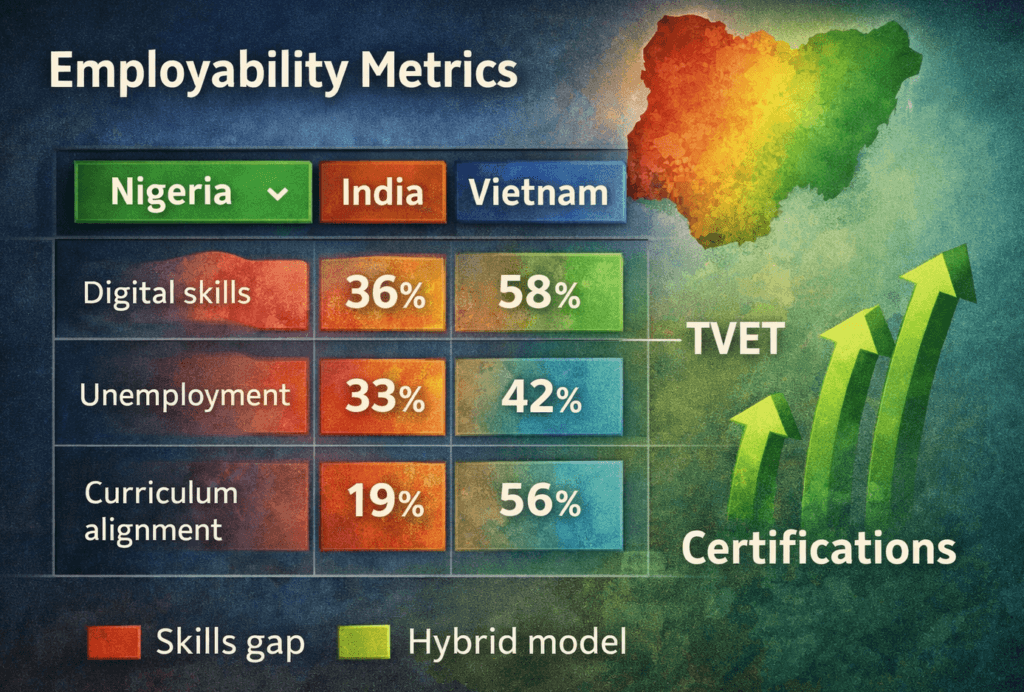
The following table benchmarks the Nigerian degree against emerging market leaders like India and Vietnam, highlighting the specific areas where Nigerian graduates face the steepest hurdles.
| Metric | Nigeria | India | Vietnam |
| Digital Skills Deficiency | 85% | 40% | 35% |
| Employability Rank (Top Universities) | 48% (Covenant) | 70%+ (IITs) | 65% (Hanoi Universities) |
| Unemployment (Postgraduate) | 9% | 7% | 4% |
| Industry-Aligned Curriculum | Low (Siloed) | High (Tech-Integrated) | Medium-High (Manufacturing-Linked) |
Skilldential Career Audit Findings
Analysis from Skilldential—a 2026 framework for auditing graduate readiness—reveals a significant “Transition Friction” for Nigerian alumni. The audit identified that while Nigerian graduates possess high theoretical intelligence, they struggle with AI Workflow Transitions—the ability to use generative AI and automated tools to execute professional tasks.
- The “Theory Paradox”: Graduates can define complex concepts but cannot deploy them using modern software “tech stacks.”
- The Certification Multiplier: Skilldential data shows that when a Nigerian degree is supplemented with AWS, Google, or Microsoft professional certifications, the graduate’s employability score jumps by 40%.
The India and Vietnam Lessons
- India (The Tech-Stack Model): Indian institutions like the IITs have mandated “Industry Tech Stacks” (e.g., Python, SQL, and Cloud Architecture) as core graduation requirements since 2023. This has ensured that their 70%+ employability rate remains stable despite global economic cooling.
- Vietnam (The Manufacturing-Digital Pivot): Vietnam has successfully integrated digital literacy into its vocational and university tracks to support its burgeoning electronics and manufacturing sectors, keeping postgraduate unemployment as low as 4%.
For the Nigerian degree to regain parity with global peers, the focus must shift from “Academic Purity” to “Market Readiness.” The Skilldential audit proves that the problem is not a lack of talent, but a lack of tooling. Nigerian graduates are essentially “racing in analogue” while the global market is “driving in digital.”
How Can TVET and Certifications Bridge the Gap?
For a Nigerian degree to regain its status as a competitive global asset in 2026, it must transition from a standalone credential to a “hybrid stack.” By integrating Technical and Vocational Education and Training (TVET) and global industry certifications, the Nigerian educational system can pivot from theoretical saturation to market-aligned competence.
The “Dual Mandate” Model: Lessons from Germany
A key strategy for 2026 is the adoption of the German Dual Education Model, which Nigeria has recently begun piloting through partnerships with German Chambers of Commerce.
- Work-Integrated Learning (WIL): This model mandates that students spend approximately 70% of their training in industry and 30% in the classroom.
- Outcome: This ensures that by the time a graduate receives their Nigerian degree, they already possess 2–3 years of verifiable “on-the-job” experience, directly addressing the 60.6% employer dissatisfaction rate mentioned earlier.
Global Certifications as Digital Currency
In a borderless “Gig Economy,” a Nigerian degree is significantly amplified when “stacked” with specialized global certifications. These act as universal proof of digital fluency.
- Tech Stack Mastery: Certifications such as AWS (Cloud), Google Data Analytics, or Python Institute credentials bridge the 85% digital gap. Data from Skilldential audits shows that graduates with these “add-ons” see a 40% increase in employability.
- Financial Credibility: For finance graduates, pairing a degree with the CFA (Chartered Financial Analyst) or ACCA provides the cross-border recognition required to secure high-paying remote roles in global markets.
Policy Reforms: 3MTT and Curriculum Modernization
The 2026 landscape is being shaped by aggressive policy interventions like the Three Million Technical Talent (3MTT) program.
- Scaling Impact: As of early 2026, over 1.8 million Nigerians are in the pipeline for digital training in AI, Cloud, and Software Development.
- Closing the STEM Shortage: By mandating that universities update their syllabi to include AI-assisted workflows, the National Universities Commission (NUC) is attempting to turn the Nigerian degree into a “talent export” tool, moving Nigeria from a passive consumer of technology to an active contributor to the global tech ecosystem.
Comparative Value: The Hybrid Approach
| Traditional Nigerian Degree | The 2026 “Hybrid” Degree | Resulting Market Value |
| Focus: Theory & Exams | Focus: Skill-Stacking & TVET | Global Ready |
| Outcome: 9% Unemployment | Outcome: High Remote Gig Access | Economically Mobile |
| Reach: Local Markets | Reach: International Talent Hubs | Japa-Proof (Remote Work) |
The bridge across the “Global Gap” is built on application. When a Nigerian degree is no longer the final destination but the foundation for practical TVET training and global certifications, the Nigerian graduate evolves from a “certificate holder” to a “globally competitive talent.”
What is a Nigerian degree?
A Nigerian degree is an academic qualification awarded by NUC-accredited universities or polytechnics. As of 2026, there are 309 accredited universities (54.2% private). These degrees traditionally emphasize theoretical frameworks and are increasingly criticized for lacking the “Industry 4.0” practical components required for global markets.
Why are Nigerian graduates underemployed?
While the headline unemployment rate is approximately 5.3% (Q1 2024–2026 baseline), the real crisis is underemployment, affecting over 60% of graduates. This occurs because the Nigerian degree often fails to provide digital fluency and soft skills, forcing graduates into informal, low-skill work despite their qualifications.
What is Japa syndrome?
“Japa” refers to the mass emigration of skilled Nigerians. Driven by a desire for competitive pay and economic stability, this trend has created a critical talent void. By 2030, the healthcare sector is projected to face a shortage of over 50,000 doctors, while the tech ecosystem struggles with a loss of senior-level “brain power.”
How does TVET improve employability?
Technical and Vocational Education and Training (TVET) bridges the gap between theory and practice. By aligning training with industry needs—similar to the German Dual Model—TVET ensures that the holder of a Nigerian degree also possesses the hands-on competency required for immediate employment in sectors like renewable energy, manufacturing, and AI.
Are Nigerian degrees worthless globally?
No. However, the Nigerian degree now acts as a foundation rather than a final destination. In the 2026 global talent market, “Skills-First” hiring is the standard. Top-tier Nigerian graduates successfully compete globally by supplementing their degrees with professional portfolios and global certifications (e.g., AWS, Google, or CFA).
Comparative Summary: The Value Shift
| Feature | The Traditional Nigerian Degree | The 2026 “Global-Ready” Path |
| Primary Goal | Certificate Acquisition | Competency & Portfolio Building |
| Market Scope | Primarily Domestic | Transnational/Remote Work |
| Key Metric | Graduation GPA | Skill-Stack (e.g., Degree + AI Cert) |
| Economic Role | Potential Unemployment | Net Talent Exporter |
In Conclusion
The Nigerian degree in 2026 stands at a critical crossroads. While it remains the foundational credential for domestic advancement, its global “purchasing power” is under severe pressure from a triple threat: theory-heavy curricula, infrastructure deficits, and a pervasive “certificate culture” that values paper over performance.
Final Synthesis of the Crisis
- The Utility Deficit: The disconnect between classroom theory and the 2026 global demand for AI-integrated workflows and data literacy has rendered 85% of graduates digitally deficient.
- The Credential Paradox: Postgraduates face higher unemployment (9%) than secondary school leavers (6.9%), signaling that traditional higher education is currently misaligned with the speed of the modern market.
- The Infrastructure Barrier: Limited access to functional labs (35%) and reliable internet (17%) ensures that many students learn “programming on paper,” a method obsolete in the global talent pool.
- The Japa Exodus: Emigration remains a rational response to domestic market friction, draining innovation and creating a projected shortage of over 50,000 doctors by 2030.
The Path Forward: The Hybrid Model
To bridge this gap, the Nigerian degree must be reimagined as a component of a larger “Skill Stack.” The evidence from top-performing institutions and global peers suggests a clear roadmap:
- Integration of TVET: Adopting dual-model vocational training to ensure hands-on competence.
- Global Certification Layering: Supplementing degrees with industry-recognized credentials (AWS, Google, CFA) to prove market readiness.
- Policy Realignment: Sustaining initiatives like the 3MTT program and the NUC’s CCMAS to modernize syllabi in real-time.
Ultimately, the goal is to transform the Nigerian graduate from a passive recipient of a degree into a proactive, globally competitive talent capable of driving both domestic innovation and international excellence.