Why Ethical AI Certification is a Career High-Leverage Move
Ethical AI certification is no longer an elective credential; it is a strategic necessity for navigating the transition from experimental AI to enforceable global governance. This certification validates technical expertise in risk management and algorithmic accountability, specifically the capacity to audit autonomous systems for bias and transparency.
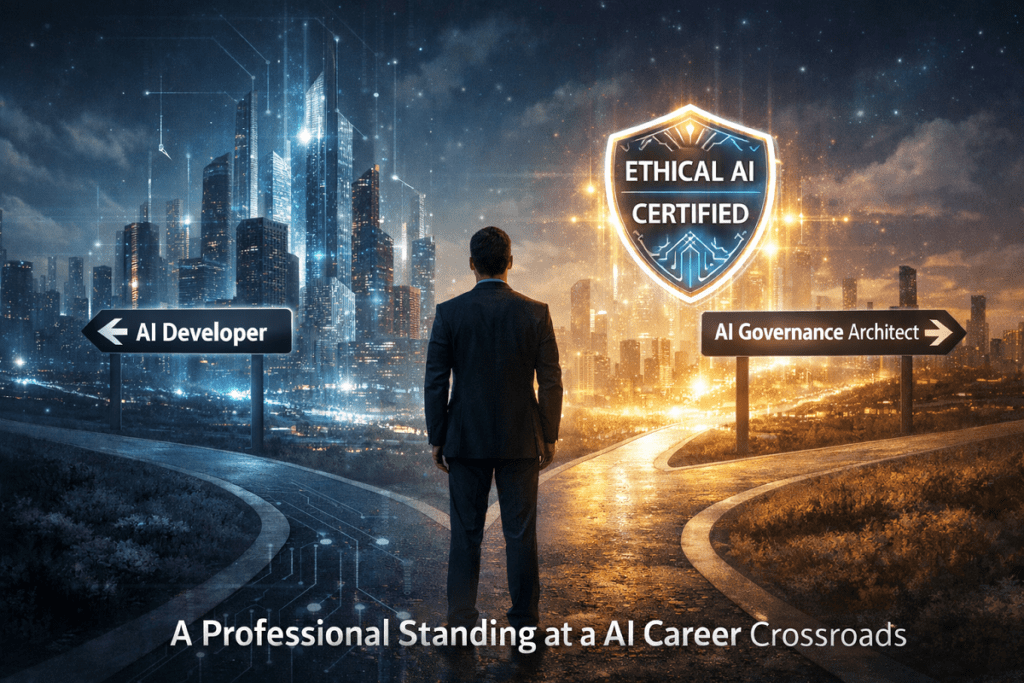
As 2026 regulatory frameworks move from guidelines to mandates, human oversight is a legal requirement for high-risk deployments. For the technical professional, this verified proficiency translates into a quantifiable market premium, often yielding salary increases of 25% or more. Ultimately, the high-leverage value of the credential lies in its ability to bridge the gap between technical execution and institutional trust.
Why is Ethical AI Certification a Strategic Career Advantage?
Ethical AI certification has transitioned from a niche credential to a baseline requirement because AI systems are now classified as regulated infrastructure rather than experimental software. As 2026 global governance frameworks move from voluntary guidelines to enforceable mandates, organizations are legally required to prove that their algorithmic outputs are explainable, fair, and auditable.
This creates a high-leverage opportunity for professionals who can bridge the gap between technical implementation and regulatory compliance. Three structural forces drive this market shift:
Mandatory Oversight of High-Risk AI
In jurisdictions like the EU and the US, AI deployed in healthcare, financial services, recruitment, and critical infrastructure is classified as High-Risk. These systems require documented human oversight and rigorous bias testing. Ethical AI certification serves as the technical validation that a professional can manage these compliance workflows.
Technical Risk Mitigation (ERM)
Unmonitored autonomous systems represent significant Enterprise Risk Management (ERM) liabilities. Opaque or biased models in hiring or credit scoring now result in direct litigation and multi-million dollar regulatory fines. Certified professionals provide the “Technical QA” necessary to mitigate these operational risks before they reach production.
Trust as a Market Multiplier
Enterprises are increasingly utilizing AI governance credentials as Trust Signals. In a crowded SaaS and AI market, having a certified team is a competitive advantage used to secure institutional investors, satisfy auditors, and win enterprise-grade contracts.
What Does Ethical AI Certification Actually Teach?
Professional Ethical AI certification programs are structured around three technical governance layers. These layers align with the ISO/IEC 42001 (AI Management Systems) and NIST AI RMF 1.0 standards, providing a universal language for technical and legal stakeholders.
Technical Algorithmic Accountability
This layer focuses on the “Hard QA” of model development. Certified professionals are trained to move beyond black-box implementations by mastering:
- Bias Detection & Mitigation: Using statistical parity and equalized odds to identify and neutralize historical or sampling bias in datasets.
- Explainable AI (XAI): Implementing techniques like SHAP (SHapley Additive exPlanations) or LIME to make complex model outputs interpretable for auditors and regulators.
- Dataset Lineage: Documenting the provenance and “lifecycle” of data to ensure compliance with privacy and intellectual property laws.
Lifecycle Risk Management Frameworks
Governance is not a one-time event; it is a continuous monitoring process. Certification programs introduce frameworks for managing risk from inception to decommissioning:
- Pre-Deployment Auditing: Establishing “Red Teaming” protocols to stress-test models for jailbreaking or adversarial prompt injections.
- Operational Monitoring: Setting thresholds for “Model Drift”—where an AI’s performance degrades or becomes biased after it goes live.
- Incident Response: Developing protocols for “Human-in-the-Loop” overrides when autonomous systems deviate from safety or ethical parameters.
Translation of Global AI Regulations
A critical skill taught in these programs is the ability to translate technical architecture into regulatory documentation. This includes:
- AI Management Systems (AIMS): Designing organizational structures that satisfy the EU AI Act and other emerging jurisdictional mandates.
- Documentation Standards: Creating “Model Cards” and “Data Sheets” that provide the transparent technical audit trail required by global standards bodies.
- Cross-Functional Communication: Acting as the “Bilingual Lead” who can explain a Gradient Boosting model’s risk profile to a Chief Compliance Officer or legal counsel.
Strategic Breakdown (80/20 of Learning)
- The 20% effort: Mastering the terminology of the NIST AI RMF and ISO 42001.
- The 80% result: The ability to lead an AI audit that protects the organization from multi-million dollar fines and reputational collapse.
The Economic Value of Ethical AI Certification
Ethical AI certification is entering a high-leverage salary band because global regulation has created an artificial scarcity of qualified oversight. In the 2026 labor market, the “Build at all costs” era has been replaced by the “Deploy with accountability” mandate, shifting the economic advantage to those who can de-risk AI investments.
Industry reports, including the PwC 2025 Global AI Jobs Barometer, indicate that professionals with specialized AI skills command a 56% wage premium over non-AI roles—a figure that has more than doubled since 2024. For those in governance and technical auditing, median compensation now frequently exceeds $180,000, with senior-level “Privacy + AI Governance” leads reaching $220,000+.
Three structural advantages drive this premium:
Unlocking High-Risk Revenue Streams
Certain AI deployments—specifically in healthcare diagnostics, credit scoring, and autonomous recruitment—are legally prohibited in many jurisdictions without documented human oversight. Ethical AI certification is the “security clearance” required to lead these high-value projects. Without certified staff, organizations are locked out of these regulated markets.
Hedging Against Automation Risk
While traditional implementation and “prompting” roles are increasingly commoditized by Agentic AI and automated coding tools, governance is inherently resilient. Governance requires human-in-the-loop judgment, multi-jurisdictional legal interpretation, and ethical reasoning—capabilities that remain high-leverage because they cannot be fully offloaded to a model.
Enterprise-Level Risk Mitigation (The “Fine” Hedge)
The economic value of a certified professional is often measured by the cost of failure avoided. With the EU AI Act and local mandates (like NYC’s AEDT law) imposing fines of up to 7% of global turnover, the ROI on a certified auditor is instantaneous. You aren’t just an employee; you are a structural safeguard for the balance sheet.
How Ethical AI Certification Scales Across Career Paths
The leverage of an Ethical AI certification is not uniform; its value is dictated by how it solves the specific “bottleneck” of your professional background. In the 2026 market, this credential acts as a bridge between specialized silos.
| Career Segment | Primary Pain Point | High-Leverage Strategic Advantage |
| Technical Professionals | Risk of being commoditized as “implementation-only” engineers in an era of automated coding. | The Pivot to Architecture: Transition from building models to auditing system integrity, safety, and alignment—roles that command a 56% wage premium. |
| Founders & Executives | Extreme exposure to regulatory penalties (e.g., EU AI Act) and opaque, “black box” decision-making. | Institutional Trust Signal: Certification provides the verified “Governance Alpha” required to win enterprise contracts and satisfy institutional investors. |
| Career Switchers | Inability to compete with legacy ML engineers who have 10+ years of deep mathematical experience. | Niche Arbitrage: Governance is a new field. Certification allows switchers to enter the AI ecosystem as Policy or Risk Leads without needing a PhD in Linear Algebra. |
| Compliance & GRC | Difficulty translating abstract legal requirements into actionable technical workflows. | The Bilingual Lead: Certification provides the technical vocabulary to bridge the gap between “Legal” and “DevOps,” becoming the primary architect of a firm’s AI Management System (AIMS). |
Segment-Specific ROI Analysis
To maintain a high-signal flow, the ROI analysis should move beyond generic benefits and focus on the economic levers specific to each professional vertical. In the 2026 market, “leverage” is defined by the ability to solve the primary bottleneck of your specific career track.
The following breakdown utilizes a First Principles approach to quantify the value of an Ethical AI certification based on your current professional trajectory.
For the Technical Lead: From Dev to Auditor
For engineers, the goal is to escape the “feature factory.” By 2026, many mid-level implementation tasks will be offloaded to agents. An Ethical AI certification elevates you to an AI Lead Validator or Responsible AI Architect. You are no longer just writing code; you are signing off on its safety and legality.
For the Executive: De-Risking Innovation
Founders often face the “Innovation Paradox”—the faster you deploy, the higher your legal risk. Certification equips leadership with frameworks like the NIST AI RMF, allowing them to implement “Safety by Design.” This reduces the likelihood of catastrophic model drift and secures the brand’s reputation as a trustworthy AI provider.
For the GRC Professional: Proactive Risk Intelligence
Traditional GRC (Governance, Risk, and Compliance) is reactive. An AI-specialized certification transforms these professionals into Predictive Risk Managers. You move from checking boxes on a spreadsheet to auditing real-time data streams for bias and privacy violations, ensuring the organization stays ahead of shifting global regulations.
How to Choose the Right Ethical AI Certification
Selecting a certification in 2026 is a strategic resource allocation decision. To maximize your career leverage, you must align the credential with your specific “bottleneck”—whether that is technical validation, regulatory authority, or executive oversight.
The evaluation of a program can be simplified using three primary high-leverage criteria.
Governance vs. Technical Focus
The most critical choice is whether you need to policy-manage the AI or technically-audit the code.
- Governance Certifications: (e.g., IAPP AIGP) target professionals in legal, privacy, and product leadership. They focus on the AI lifecycle, risk intake, and accountability structures.
- Technical Auditing Certifications: (e.g., ISACA AAIA or IEEE CertifAIEd) are designed for engineers and security leads. They focus on adversarial attacks, bias mitigation in training data, and technical control implementation.
Institutional Credibility & Industry Recognition
In a “Compliance Gold Rush,” not all credentials carry equal weight.
- Established Bodies: Organizations like IAPP, ISACA, and IEEE have decades of standards-setting credibility. Their certifications are often recognized by insurers and enterprise auditors.
- Vendor-Specific: Credentials from Google (AI Essentials) or Microsoft (Azure AI Engineer) are high-leverage if your organization is heavily integrated into those specific ecosystems, but they may offer less “portability” across platforms.
Regulatory Alignment (The “2026 Enforcement” Check)
Ensure the curriculum is updated for the 2026 regulatory cliff. A high-leverage program must go beyond abstract “fairness” and reference specific enforceable frameworks, such as:
- The EU AI Act: Documentation requirements for “High-Risk” systems (fully enforced as of 2026).
- ISO/IEC 42001: The international standard for AI Management Systems (AIMS).
- NIST AI RMF 1.0: The foundational risk management framework for US-based enterprise.
2026 Certification Positioning Matrix
| Certification | Target Audience | Primary Focus | Prerequisite |
| IAPP AIGP | Privacy, Legal, & Product Leads | AI Governance, Laws, & Life Cycle | None |
| ISACA AAIA | IT Auditors & Risk Managers | Controls, Assurance, & Technical Audits | None |
| ISACA AAISM | Senior Security Managers | AI Security, Threats, & Response | CISM or CISSP |
| IEEE CertifAIEd | Engineers & AI Practitioners | Transparency, Accountability, & Bias | Technical Exp. |
| MIT CSAIL | Senior Executives | Responsible AI Strategy & Ethics | None |
Strategic Summary: Your Next Move
If you are looking to secure a high-leverage leadership role in the next 12 months, the IAPP AIGP currently serves as the “Gold Standard” for cross-functional governance. If your goal is technical system validation, the ISACA AAIA (Advanced in AI Audit) is the definitive choice for 2026.
What Problems Does Ethical AI Certification Actually Solve?
The most common bottleneck in enterprise AI adoption is the “translation gap” between engineering implementation and corporate governance. Most organizations struggle to move from a prototype to a production environment because they cannot reconcile technical performance with legal and ethical safety standards.
In Skilldential career audits, we observed that technical professionals often plateau in implementation-only roles because they cannot translate model performance into the language of risk and compliance. This “Implementation Ceiling” prevents skilled engineers from reaching the high-leverage positions where the most critical—and most highly compensated—decisions are made.
The leverage provided by Ethical AI certification comes from becoming a bilingual operator who can navigate three distinct domains simultaneously:
- Algorithmic Systems: Understanding the technical mechanics of model weights, training data, and inference.
- Regulatory Frameworks: Navigating the legal mandates of the EU AI Act, NIST AI RMF, and sector-specific requirements.
- Enterprise Risk Management (ERM): Quantifying technical anomalies in terms of financial, legal, and reputational liability.
The 32% Career Advantage
Professionals who develop governance literacy and pursue certification pathways see a direct impact on their career trajectory. Internal data suggests that those in these roles increased access to architecture or oversight positions by 32% within 12–18 months.
By bridging the gap between “how it works” and “how it’s governed,” you move from being a resource to becoming an indispensable strategist.
When is Ethical AI Certification Most Valuable?
The “High-Leverage” value of Ethical AI certification is not distributed equally across all sectors. Its utility scales with the level of regulatory oversight and the potential for “High-Risk” impact. In the 2026 market, certification is a non-negotiable asset in four specific industry contexts where the cost of failure is catastrophic.
Healthcare & Life Sciences
AI-driven diagnostics and personalized treatment plans are subject to stringent patient safety regulations. In this sector, Ethical AI certification is the technical validation that a professional can implement the explainability and bias controls required to satisfy health authorities and insurance auditors.
- Leverage Point: Moving from “Data Scientist” to “Clinical AI Auditor.”
Financial Services & FinTech
Credit scoring, fraud detection, and automated trading algorithms must demonstrate “Fairness by Design.” Under current 2026 banking mandates, organizations must prove their models do not perpetuate systemic bias.
- Leverage Point: De-risking the “Black Box” to prevent multi-million dollar regulatory fines and litigation.
Enterprise SaaS & AI Orchestration
As companies transition from simple LLM wrappers to autonomous AI agents, enterprise buyers now require proof of governance before signing contracts. Certification acts as a “Trust Signal” that your product has built-in guardrails for data privacy and algorithmic accountability.
- Leverage Point: Accelerating the sales cycle by satisfying the “Security and Governance” requirements of Fortune 500 clients.
The Public Sector & Government Contracting
Government deployments of AI—from urban planning to public benefit distribution—require the highest levels of documented oversight and transparency. In many jurisdictions, having certified “Responsible AI” leads is becoming a prerequisite for winning government tenders.
- Leverage Point: Securing high-value, long-term government contracts through verified compliance.
Strategic Summary: The High-Pressure Map
These four sectors represent the 80/20 of AI Governance demand. If your career path intersects with these industries, Ethical AI certification is the single most effective tool for bypassing the implementation plateau.
What is Ethical AI Certification?
It is a strategic credential validating your expertise in the three pillars of modern AI oversight: Governance, Risk Management, and Algorithmic Accountability. Unlike general AI certifications, it focuses on your ability to audit autonomous systems for bias, transparency, and adherence to global regulatory standards like the EU AI Act and ISO 42001.
Do you need technical experience for Ethical AI Certification?
Not exclusively. The market has bifurcated into two distinct tracks:
Governance Tracks: Designed for legal, policy, and executive leads; these focus on framework implementation and institutional risk.
Technical Auditing Tracks: Designed for engineers and data scientists; these require a working knowledge of machine learning pipelines to perform bias testing and explainability audits.
Are Ethical AI certifications recognized by employers?
Yes. In the 2026 labor market, “Responsible AI” is a line-item requirement for enterprise-grade deployments. Organizations increasingly prioritize candidates with verified credentials from recognized bodies (e.g., IAPP, ISACA) to satisfy auditors, secure insurance, and mitigate the risk of regulatory fines.
Can Ethical AI certification help career switchers enter AI?
Yes. Governance and risk roles represent a significant market arbitrage opportunity. These positions value cross-disciplinary skills—such as legal interpretation, auditing, and ethical reasoning—more than deep mathematical modeling. This allows professionals from non-technical backgrounds to enter the AI ecosystem at a high-leverage seniority level.
Is Ethical AI certification relevant outside tech companies?
Absolutely. The highest demand currently exists in regulated sectors such as healthcare, financial services, and the public sector. Any organization deploying AI in a “high-risk” context must maintain documented oversight, making these certifications universally applicable across the global economy.
In Conclusion
Ethical AI certification is emerging as a high-leverage credential because AI systems have successfully transitioned from experimental tools to regulated infrastructure. In the 2026 market, the ability to build a model is common; the ability to govern it is rare.
Three core realities define its strategic value:
- Legal Mandates: High-risk AI systems now require documented, human-in-the-loop oversight to remain operational.
- Economic Premium: Professionals who bridge the gap between AI literacy and governance expertise currently command the highest salary premiums in the tech sector.
- Institutional De-risking: Organizations require bilingual specialists who can translate technical architecture into regulatory compliance to satisfy auditors and investors.
For professionals seeking long-term leverage, the most practical step is selecting a certification aligned with your specific trajectory. Engineers should prioritize technical auditing credentials like the ISACA AAIA, while Compliance and Strategy professionals should focus on governance certifications such as the IAPP AIGP.
In the agentic AI era, auditable intelligence is no longer just a safeguard—it is a primary competitive advantage.
Discover more from SkillDential | Path to High-Level Tech, Career Skills
Subscribe to get the latest posts sent to your email.