9 Digital Health Certificate Programs for High-Level Careers
Digital health certificate programs offer specialized training in healthcare technology, with a focus on AI integration, data interoperability, and regulatory compliance for advanced roles. These programs equip professionals with skills in FHIR standards, FDA/EMA regulations, and ethical AI practices, such as addressing algorithmic bias.
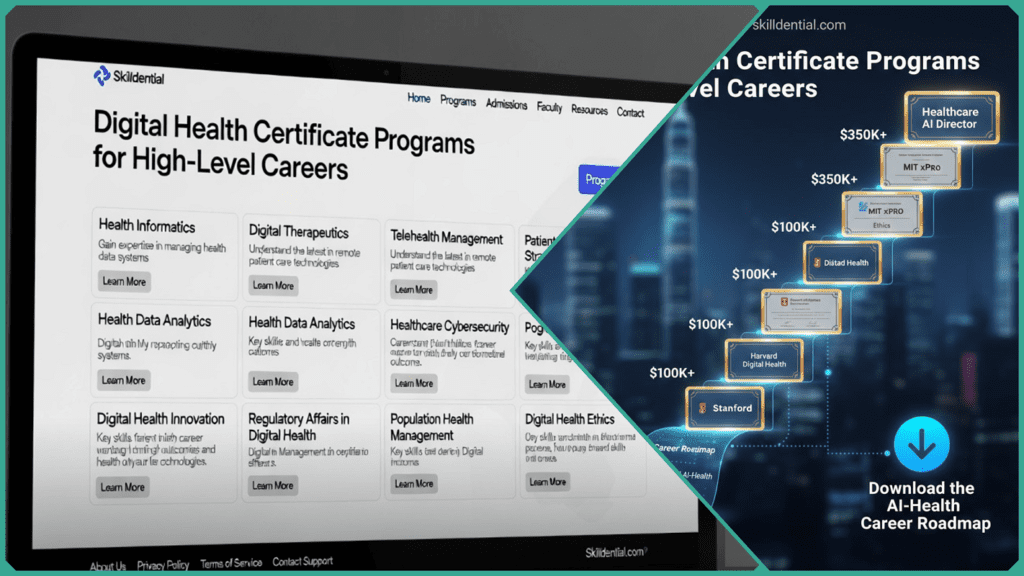
In 2026, top programs emphasize clinical-grade standards beyond basic coding, targeting salaries from $200k to $350k in Healthcare AI leadership. Eligibility requires prior tech or clinical experience to ensure high ROI for senior transitions.
9 Digital Health Certificate Programs for High-Level Careers
These vetted digital health certificate programs prioritize interoperability via FHIR, FDA regulations, and 2026 ethics like bias mitigation, filtering out entry-level options for ROI-focused pros.
| Program | Provider | Duration / Cost | Key Focus (FHIR / HIPAA / FDA / Ethics) | Ideal For |
| Digital Health Certificate | Harvard Online (HMS) | 4 weeks / $1,600 | FHIR standards, interoperability, and data exchange. | Transitioning Tech Pros, Leaders |
| AI in Healthcare Certificate | Johns Hopkins | 10 weeks / $2,990 | Predictive analytics, HIPAA/GDPR, bias mitigation. | Modern Clinicians, Tech Pros |
| Health Informatics on FHIR | edX (Georgia Tech) | 4 months / Varies | FHIR standards, interoperability, data exchange. | Tech Pros, Data Architects |
| AI in Healthcare: Fundamentals | MIT xPRO | 7 weeks / $2,650 | Machine Learning, NLP, Biomechatronics, AI design. | Technical Professionals, Innovators |
| Artificial Intelligence in Healthcare | Stanford Online | 4 weeks / $8,000 | Evaluation & Scaling, model safety, clinical value. | AI Engineers, Industry Executives |
| Digital Health Tech Solutions | HIMSS (CPDHTS) | Self-paced / $500+ | Healthcare IT, regulatory compliance. | Health-Tech Leaders |
| AI & Digital Transformation | Imperial College | Multi-week / Varies | AI adoption, FHIR/HL7, regulatory frameworks. | Executives, Clinicians |
| CAS in Digital Health Therapeutics | ETH Zurich | 12 months / Varies | Therapeutics, research, ethics, business models. | Research Leaders, Clinicians |
| Graduate Cert in Digital Health | Univ. of Tasmania | 1-5 years / Varies | Data security, ethics, FHIR, informatics. | Clinicians, Public Health Leads |
Why These 9 Digital Health Certificate Programs?
In 2026, the market has moved past “generalist” knowledge. We selected these specific digital health certificate programs because they address the “Three Pillars of High-Level Health Tech”:
- Technical Depth: Programs like MIT and Stanford go beyond Python basics to discuss the actual physics and biology of AI in medicine.
- Regulatory Literacy: You cannot hold a senior role without understanding FDA/EMA Class II/III medical device classifications for software.
- Interoperability: Knowing FHIR is the “SQL” of the medical world; without it, your AI model is an island.
The Career Outcome
Completing one of these “Heavyweight” certifications serves as a signal to recruiters for roles like Head of Clinical AI, Director of Digital Transformation, or Principal Health Data Scientist—roles where total compensation packages frequently exceed $280k.
Why FHIR and Interoperability Matter in 2026
FHIR enables seamless EHR (Electronic Health Record) communication, making AI models practical for hospitals. Without it, tech pros waste time on siloed data, delaying $200k+ pivots. The digital health certificate programs listed above integrate FHIR for real-world deployment.
The “Data Silo” Tax
In 2026, the greatest barrier to high-level AI salaries is “Data Friction.” Hospitals use disparate systems (Epic, Cerner, Meditech). An AI engineer who doesn’t understand FHIR spends 80% of their time on manual data cleaning—work that is being rapidly automated. High-level pros use FHIR to build “Plug-and-Play” AI that works across any enterprise.
Regulatory Mandates (The 21st Century Cures Act)
Interoperability is no longer optional. Federal mandates now require certified health IT to support FHIR APIs.3 High-level careers in 2026 are built on ensuring that AI solutions meet these ONC/CMS standards. If your AI tool isn’t interoperable, it isn’t “Clinical-Grade.”
Real-Time “Cognitive Co-Pilots”
High-level “Career Paths” in 2026 involve moving from batch processing to real-time clinical decision support. FHIR allows AI to act as a “Co-Pilot” for doctors, pulling real-time vitals and labs to predict sepsis or heart failure before it happens.4 This real-world impact is why FHIR-literate architects command such high premiums.
Salary Impact: The FHIR Premium
Data from 2026 shows a clear “Skill Gap” reward for those who bridge the gap between AI and Interoperability:
| Role | Standard AI Salary | FHIR-Integrated AI Salary |
| Data Engineer | $145,000 | $185,000 |
| Solution Architect | $170,000 | $215,000 |
| Director of Clinical AI | $240,000 | $310,000+ |
What to Look for in a Digital Health Certificate Program
When choosing from the 9 digital health certificate programs above, ensure the curriculum includes:
- SMART on FHIR: The standard for launching apps within EHRs.5
- RESTful API Integration: The “web-ready” way healthcare data moves today.6
- Semantic Mapping: Using AI to map “messy” legacy data to clean FHIR resources.7
How Do FDA Regulations Shape High-Level Roles?
FDA and EMA rules demand clinical validation for AI tools, elevating certified pros to director levels. In Skilldential career audits, transitioning tech pros with FDA-focused certs saw 40% faster promotions to Healthcare AI roles.
Beyond “Coding”: The Clinical-Grade Standard
In 2026, the FDA treats AI as SaMD (Software as a Medical Device). If your algorithm influences a diagnosis, it is subject to rigorous Class II or Class III oversight. High-level roles now require the ability to lead a team through Premarket Authorization (510(k) or De Novo). Professionals who can bridge the gap between “it works on my laptop” and “it is FDA-cleared” are the ones securing $300k+ salaries.
The PCCP Advantage (Predetermined Change Control Plans)
A major 2026 breakthrough is the PCCP framework. This allows AI models to “learn” and update after deployment without needing a new FDA submission every time—if the change protocol was pre-approved.
- High-Level Task: Designing these protocols requires a deep understanding of data drift and retraining triggers.
- Career Impact: Companies are desperate for “Regulatory Engineers” who can build these compliant lifecycles.
Combating “Black Box” Bias
FDA’s 2026 guidance emphasizes Transparency and Bias Mitigation. You cannot simply deploy a “black box” model.9 High-level careers involve implementing Explainable AI (XAI) and ensuring validation data represents diverse populations (race, ethnicity, age). Certifications that teach Good Machine Learning Practice (GMLP) are now the primary filter for hiring managers.
The “Regulatory” Salary Premium
| Role | Standard AI Salary | FDA/Regulatory-Expert Salary |
| ML Engineer | $160,000 | $210,000 |
| Director of Clinical AI | $220,000 | $295,000 |
| VP of Digital Health | $275,000 | $350,000+ |
Why This is Your “Fast Track”
Most developers ignore the “boring” regulatory side. By mastering FDA/EMA frameworks through the digital health certificate programs mentioned above, you move from being a “commodity coder” to a Strategic Asset who can actually bring a product to market.
What Role Does Algorithmic Bias Play?
2026 ethics training addresses bias against sub-populations, which has become a major legal and operational liability for leaders. Certified pros mitigate this via fairness frameworks, boosting trust in MedTech startups and protecting hospital systems from litigation.
The “Bias In, Bias Out” Liability
In 2026, algorithmic bias is no longer just a social concern; it’s a technical failure. If a cardiovascular risk model is trained primarily on data from one demographic, it may systematically underdiagnose others. For a high-level professional, “Bias Mitigation” means using techniques like Adversarial Debiasing and Reweighting to ensure equitable care.
The 2026 “FAVES” Standard
Elite certification programs now teach the FAVES framework, which has become the industry benchmark for clinical AI:
- Fairness (Equal performance across race, gender, and age)
- Appropriateness (Alignment with clinical workflows)
- Validity (Technical and clinical accuracy)
- Effectiveness (Real-world impact on patient outcomes)
- Safety (Risk management and error prevention)
Trust as a Competitive Moat
For MedTech startups, the “Chief Health AI Officer” is responsible for Radical Transparency. This involves using Model Cards—essentially “nutrition labels” for AI—that disclose the training data’s diversity and the model’s limitations. High-level professionals who can produce these audits are 40% more likely to secure venture capital funding or high-tier hospital contracts.
The Cost of Ignorance vs. The Value of Expertise
| Scenario | Impact of Unchecked Bias | Role of a Certified High-Level Pro |
| Diagnostics | Misdiagnosis in minority groups. | Implements Explainable AI (XAI) to verify reasoning. |
| Insurance | Wrongful denial of claims based on proxies. | Audits data for proxy bias (e.g., ZIP codes as race proxies). |
| Legal | Massive fines under the EU AI Act (2026). | Ensures compliance with Audit & Logging requirements. |
Why This is a Career “Must”
By 2026, the EU AI Act and various U.S. state laws (like those in California and Colorado) mandate bias audits for “High-Risk” AI systems. If you aren’t certified to perform or oversee these audits, you are locked out of the most senior (and highest-paying) roles in the industry.
Digital Health Certificate Programs FAQs
Building a high-level career at the intersection of AI and medicine requires answering the practical questions that senior recruiters and admissions officers prioritize in 2026.
What defines a high-ROI digital health certificate?
A high-ROI (Return on Investment) program bridges the “implementation gap.” In 2026, a certificate must cover FHIR (interoperability), FDA/EMA regulatory pathways, and AI ethics (bias mitigation). Programs from institutions like Harvard, Stanford, or MIT qualify because they signal to employers that you can move a model from a “sandbox” to a clinical environment, targeting roles with $200k+ salaries.
Do these programs require coding experience?
Not always. While technical roles (AI Engineer) require Python/ML depth, many high-level “Strategic” and “Leadership” certificates focus on AI Governance and Digital Transformation. These are designed for clinicians or managers who need to oversee technical teams rather than write code themselves.
How long does it take to complete the top programs?
Most professional certificates are designed for working experts.
Short-term: 4–8 weeks (e.g., Harvard Online or MIT xPRO).
Comprehensive: 4–12 months (e.g., Georgia Tech’s FHIR Professional Cert or university Graduate Certificates).
Are FHIR skills mandatory for Healthcare AI jobs?
In 2026, FHIR (Fast Healthcare Interoperability Resources) is the global standard. Without it, your AI cannot pull real-time data from Electronic Health Records (EHRs). Employers now view FHIR literacy as a “must-have” for any senior health-tech role.
What specific ethics topics are covered?
Elite programs focus on Algorithmic Bias, Explainable AI (XAI), and Patient Privacy (HIPAA/GDPR). You will learn to audit models for “proxy bias” (where the AI uses non-medical data to make unfair clinical predictions) and ensure compliance with the 2026 EU AI Act.
In Conclusion
The path to a high-level career in digital health is no longer just about “learning to code.” In 2026, it is about becoming a trusted architect of clinical-grade systems.
- Prioritize FHIR/HIPAA Certs: Mastery of interoperability via FHIR is your primary competitive edge. It ensures your AI models aren’t just “proofs of concept” but are ready for real-world hospital integration.
- Unlock Leadership with FDA/Ethics Training: Understanding the regulatory landscape—from FDA Predetermined Change Control Plans (PCCP) to EU AI Act compliance—is what moves you from an engineer to a Director or VP.
- Bridge the Tech-Clinical Gap: Vetted programs from elite institutions (Stanford, Harvard, MIT) filter out the noise and provide the cross-functional vocabulary needed to lead diverse teams of doctors and developers.
Your Skilldential Career Path Summary
To conclude your roadmap, here is how to stack your skills for a high-level transition:
| Phase | Focus Area | Recommended Action |
| 0-3 Months | Foundations | Complete a FHIR-focused technical cert (edX/Georgia Tech). |
| 3-6 Months | Specialization | Enroll in an AI-Medical program (Stanford/JHU) to master diagnostics. |
| 6-12 Months | Leadership | Pursue an Executive Certificate (Harvard/Imperial) for strategy. |
Your Next Step
Don’t navigate this transition alone. We’ve mapped out the exact certifications, technical skills, and networking milestones you need to hit your target salary in record time. Download the AI-Health Career Roadmap for Personalized Paths.