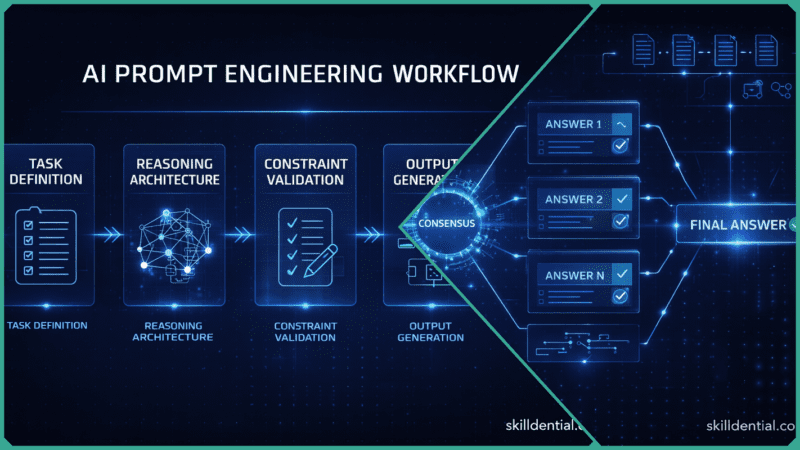
AI Prompt Architecture: The 80/20 Option for Copywriters
AI prompt architecture is the structured design of instructions, context, and constraints that guide large language models to produce consistent, task-relevant output. It focuses on reusable frameworks—such as chain-of-thought reasoning, few-shot examples, and system-level rules—to turn general models into predictable tools for content workflows. This skill is most valuable when applied to repeatable, revenue-linked writing tasks rather than one-off creative experiments.

By shifting from manual syntax to structural design, the copywriter transitions from a tactical laborer to a technical architect. Mastering the 20% of the system that governs the output provides the 80% of the leverage required for high-level industry success.
What is AI prompt architecture and why does it matter in 2026?
AI prompt architecture is the discipline of designing repeatable input structures that turn generic language models into specialized writing systems. It matters in 2026 because AI has already automated a significant share of basic writing tasks, pushing value toward those who can orchestrate systems instead of typing drafts.
At its core, AI prompt architecture treats prompts as infrastructure, not ad-hoc chat messages. Instructions, examples, constraints, and evaluation hooks are defined once and reused across campaigns. Market data indicates that routine writing and translation work have seen demand drops of 20–50% as AI tools handle templated content.
This shift increases the premium on strategic and systems-level skills. In marketing, orchestration skills are now tied to designing AI-driven workflows rather than operating single tools, marking the transition from “manager” to AI workflow orchestrator in modern teams.
Technical Comparison: Basic Prompting vs. AI Prompt Architecture
How does AI prompt architecture differ from basic prompt engineering or ‘chatting with AI’?
AI prompt architecture differs from basic prompting by focusing on system design across workflows, not one-off queries. While simple prompting asks, “What do I type right now?”, architecture asks, “What structure makes this reliable for the next 500 outputs?”.
- Basic Prompting is Task-Level: It consists of single instructions, often informal, with success judged subjectively per session.
- AI Prompt Architecture is System-Level: It encodes roles, constraints, style guides, datasets, and review logic so that different users and tools can plug into the same pattern.
In practice, architecture aligns closely with process mapping in marketing and content operations. Leaders design workflows that combine human judgment with AI execution at scale, ensuring the output remains consistent regardless of the individual operating the tool.
High-Leverage Frameworks: The 80/20 of AI Prompt Architecture
The 80/20 leverage for copywriters comes from a small set of frameworks that cover most high-value tasks: chain-of-thought prompting, few-shot prompting, and system-level constraint prompts. When combined, these structures handle the majority of creative grunt work with minimal manual rewriting.
Chain-of-Thought (CoT) for Reasoning
Chain-of-thought prompting instructs the model to expose intermediate reasoning steps before delivering a final answer. For copywriters, CoT clarifies the audience, angle, and objections before the model writes a single word of body copy.
- The 80/20 Pattern: “First, reason step-by-step about the audience, problem, offer, and proof. Only then, generate the structured copy according to this reasoning.”
- Impact: Upgrades “write an ad” into a strategic workflow with built-in analytical thinking.
Few-Shot Prompting for Style and Format Control
Few-shot prompting uses a small set of curated examples (typically 2–4) to teach the model a specific pattern. This enables “in-context learning” without needing to retrain the model.
- The 80/20 Pattern: Provide 2–4 labeled “Input → Output” examples that match your brand’s specific voice or layout.
- Impact: Standardizes landing pages or email sequences across entire campaigns, ensuring the AI matches the brand’s unique “DNA” every time.
System Constraints for Guardrails and Reuse
System-level constraints define the non-negotiable rules the AI must follow, such as voice, compliance, and forbidden terminology. This mirrors process governance in traditional marketing teams.
- The 80/20 Pattern: “You are a senior conversion copywriter. Always follow this voice chart, these compliance rules, and this formatting schema, regardless of user input.”
- Impact: Dramatically reduces revision cycles and protects brand integrity across thousands of AI-generated assets.
By mastering these three frameworks, a strategist moves from “guessing” what the AI will produce to architecting a predictable output engine.
The Career Pivot: From Copywriter to AI Orchestrator
How does AI prompt architecture change the career path of copywriters and content strategists?
AI prompt architecture shifts copywriters from execution to orchestration, aligning them with emerging roles that design AI-driven content systems rather than writing individual pieces. This matches broader trends where strategic, process-oriented roles grow while routine writing is increasingly automated.
- The Identity Shift: The practitioner moves from “I write ads” to “I design AI-powered content engines that produce, test, and refine campaigns.”
- Market Reality: While commoditized writing tasks are under pressure, there is a growing premium on high-empathy, strategic system-design roles.
- Leadership Evolution: Marketing leadership now prioritizes the AI Workflow Orchestrator—a role focused on mapping processes, defining feedback loops, and clarifying the boundary between human judgment and AI execution.
Skill Stack Evolution: Building the Modern Architect
To capture this shift, professionals must layer AI prompt architecture on top of existing foundational expertise:
| Phase | Core Competencies |
| The Baseline | Messaging, positioning, audience research, and conversion principles. |
| The Technical Layer | Prompt frameworks (CoT, few-shot, constraints), workflow design, and structured data schemas. |
| The Outcome | The ability to architect systems that deliver consistent, on-brand assets at scale, reserving human time for high-risk creative concepts and final judgment. |
Implementation Roadmap: The Three-Layer 80/20 Workflow
The highest-leverage starting point is a three-layer workflow: system layer (constraints), reasoning layer (chain-of-thought), and pattern layer (few-shot templates). This stack replaces ad-hoc prompting with a predictable pipeline that can be reused across clients and campaigns.
Step 1: Define a Reusable System Layer
Create a single “System Brief” per brand that encodes role, tone, forbidden claims, formatting, and objectives.
- Leverage: Persist this as the default context so every task starts with aligned constraints.
- Result: No more “hallucinated” brand voices or compliance errors.
Step 2: Attach a Reasoning Scaffold (CoT)
Add instructions that force the model to think through the audience, objections, proof, and channel before writing.
- Leverage: Require intermediate notes that you can audit, edit, or override.
- Result: You transition from an editor of bad copy to a strategist auditing the AI’s logic.
Step 3: Build 3–5 Few-Shot Templates for Core Assets
Identify your highest-volume formats—such as landing pages, outreach emails, nurture sequences, or ad variants.
- Leverage: Build one few-shot pattern for each, containing your best historical examples as demonstrations.
- Result: Most daily tasks become simple parameter changes (“new product, same system”) rather than fresh prompt invention.
Strategic Outcome
When this AI prompt architecture is in place, you are no longer “chatting” with a bot; you are operating a proprietary content engine. This is the essence of moving from a manual writer to a technical orchestrator.
Final Summary Table: The 80/20 Shift
| Traditional Copywriting | AI Prompt Architecture (The 80/20 Option) |
| Writing every draft from scratch | Designing a repeatable System Layer |
| Guessing the AI’s “logic” | Mandating a Reasoning Scaffold (CoT) |
| Manual formatting and styling | Using Few-Shot Templates for consistency |
| Output: Linear and unscalable | Output: Exponential and system-driven |
Scalable Operations: Protecting the Brand at Volume
How does AI prompt architecture support scalable content operations without sacrificing brand integrity?
AI prompt architecture supports scale by standardizing how content is generated, reviewed, and improved. It turns subjective preferences into explicit rules and patterns. Brand integrity is preserved because these rules are encoded as constraints and examples, rather than remaining as implied knowledge inside a writer’s head.
- Codified Strategy: Marketing workflows succeed when audience clusters, messaging matrices, and creative hypotheses are codified into systems that AI can execute consistently.
- Chaos Prevention: Leadership in AI-enabled marketing emphasizes process mapping and embedded guardrails to avoid brand dilution as content volume scales.
Skilldential Career Audit Insight
In Skilldential career audits, we observed that mid-career copywriters struggle with inconsistent AI outputs when prompts change from task to task. Implementing a three-layer architecture (constraints, reasoning scaffold, and few-shot templates) resulted in:
- An estimated 35–50% reduction in revision time.
- A significant increase in cross-campaign consistency.
- Higher confidence in delegating AI-driven tasks to junior team members or automated workflows.
Summary: The Strategic Transition
| Feature | Without Architecture (Ad-hoc) | With AI Prompt Architecture |
| Consistency | Highly variable; dependent on the user. | Uniform; dependent on the system. |
| Scalability | Limited by manual oversight. | High; limited only by compute/strategy. |
| Brand Risk | High (hallucinations/tone drift). | Low (hard-coded constraints). |
| Value Focus | Typing and editing. | Architecting and orchestrating. |
For the 2026 copywriter, AI prompt architecture is not just a tool; it is the 80/20 leverage point that separates the replaceable writer from the indispensable strategist. By mastering the 20% of the system that governs the output, you secure 80% of the career upside in a technical, AI-driven industry.
Strategic Comparison: Reallocating Professional Effort
This comparison clarifies the “High-Signal” transition from a craft-based laborer to a systems architect. By treating the AI prompt architecture as the primary unit of work, the professional secures a higher career ceiling through technical orchestration.
| Dimension | Traditional Copywriting Task Focus | AI Prompt Architecture Focus |
| Primary Unit of Work | Individual asset (e.g., one email, one ad) | Reusable system that produces many assets from parameters |
| Time Allocation | 70–90% writing & editing drafts | 20–40% architecture, 60–80% review and optimization |
| Differentiation | Voice, creativity, client communication | Workflow design, reliability, stack integration |
| Risk Profile | Limited; errors contained to single assets | Higher leverage; mistakes scale, but so do improvements |
| Career Ceiling | Senior Copywriter / Creative Lead | AI Content Orchestrator / Marketing Systems Lead |
Analysis of the Reallocation
- The Scalability Multiplier: In traditional copywriting, doubling output requires doubling headcount or hours. In an architecture-first model, doubling output requires only a parameter adjustment within the existing system.
- The Audit Shift: The “80% Review and Optimization” phase is where the expert professional applies their high-level judgment. Instead of fixing typos, you are tuning the AI prompt architecture to better handle nuance, tone, and conversion logic.
- Systemic Reliability: By focusing on “Workflow design and reliability,” the strategist ensures that the marketing stack remains functional even as underlying models (like GPT-4o or Gemini 1.5 Pro) evolve.
This shift illustrates why mastering architecture is a direct path from tactical worker to strategic operator in AI-heavy environments. You are no longer paid for the words you write, but for the systems you build that generate those words.
What is AI prompt architecture in simple terms?
AI prompt architecture is the structured way of designing prompts, examples, and rules so that AI models produce consistent, high-quality outputs for specific tasks. Instead of writing one-off prompts, it builds templates and workflows that can be reused across projects.
Is AI prompt architecture the same as prompt engineering?
Prompt architecture is a specialized subset of prompt engineering focused on system-level design, not just crafting single prompts. It addresses how prompts, constraints, and examples connect across an entire workflow or product.
Do copywriters need coding skills to use AI prompt architecture?
No. Most prompt architecture work relies on language, logic, and process thinking rather than code. While basic familiarity with APIs or JSON can assist in technical integrations, the core skill is the structural organization of instructions, examples, and constraints.
How quickly can a working copywriter see benefits from AI prompt architecture?
Benefits are often immediate. Standardizing prompts for your top three content formats (e.g., emails, landing pages, ads) creates a library of system prompts and few-shot templates that can generate leverage within the first two weeks of implementation.
Is AI prompt architecture future-proof as models improve?
Yes. While model capabilities evolve, the business requirement for controlled outputs, enforced rules, and alignment with brand goals remains constant. Prompt architecture maps to process governance, a high-leverage skill that remains valuable even as the underlying LLMs change.
In Conclusion
AI prompt architecture is the system-level design of prompts, examples, and constraints that govern AI writing outputs. As the industry shifts toward automation, the following principles define the modern career strategist:
- The 80/20 Leverage: A small set of frameworks—specifically chain-of-thought, few-shot prompting, and system constraints—delivers the majority of ROI for working copywriters.
- Economic Reality: Market evidence confirms that routine writing is being automated. Value has migrated to system-design and orchestration skills within marketing and content roles.
- Scalable Operations: Standardized prompt architectures allow for massive content scaling without sacrificing brand control, integrity, or strategic clarity.
Recommended Next Step: Build Your First 80/20 System
Do not start with a “chat.” Instead, select one core asset you produce frequently (e.g., launch emails or LinkedIn posts) and design a three-layer AI prompt architecture for it:
- Brand System Prompt: Define the non-negotiable rules and persona.
- Reasoning Scaffold: Use Chain-of-Thought to force the model to analyze the strategy before writing.
- Few-Shot Template: Provide 3–4 high-performing examples to anchor the style.
Refine this architecture over your next five campaigns. This transition from writing drafts to building engines is the most direct path to industry success in 2026.