9 Best AI Research Tools to Reduce Assignment Time by 50%
AI research tools have evolved beyond simple search engines into sophisticated agents that automate the end-to-end research lifecycle—from literature discovery and data extraction to the synthesis of million-paper databases like Semantic Scholar and OpenAlex.
By leveraging Retrieval-Augmented Generation (RAG), specialized platforms like Elicit, Consensus, and NotebookLM now reduce manual screening time by 50-80% while providing inline, verifiable citations. However, in an era of “reasoning-heavy” models, the risk of sophisticated hallucinations remains a critical factor.
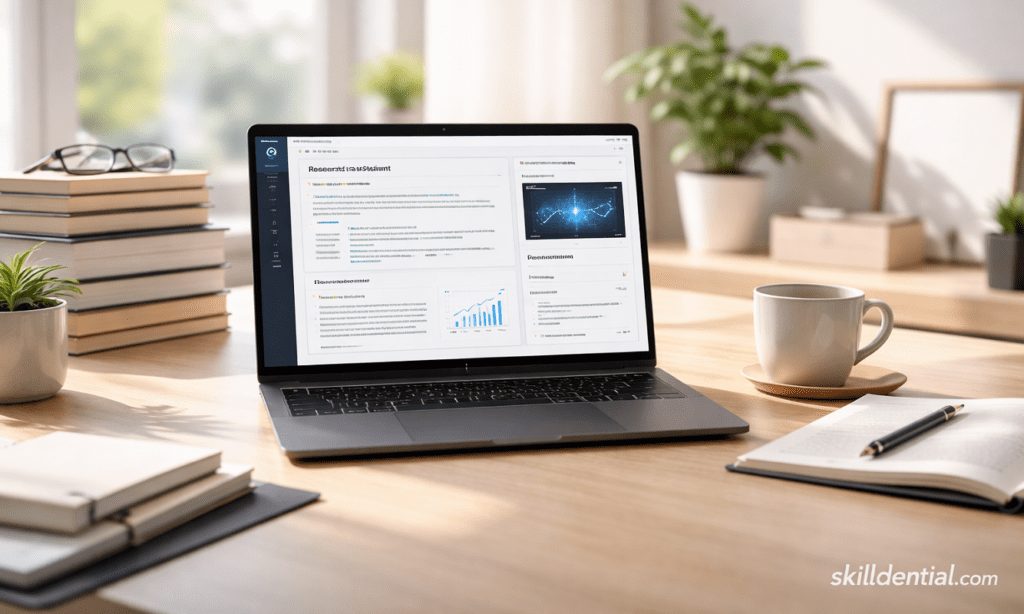
For the technical professional, the goal is not just adoption, but the mastery of a validated research stack where precise prompt engineering is paired with rigorous human verification to ensure academic and professional integrity.
Why 20-Hour Papers Are Low-Leverage in 2026
In 2026, laboring for 20 hours on a manual research paper is no longer a sign of academic rigor; it is a failure of operational leverage. As AI agents move from simple chatbots to autonomous “Deep Research” engines, the traditional literature review—once a 4-hour manual slog of tab-switching and abstract-skimming—has been compressed into a 2-hour high-speed synthesis.
Skilldential career audits reveal that strategic students and career-pivoting professionals lose up to 30% of their weekly productivity to “research rabbit holes”—the inefficient pursuit of data without a structured pipeline. In the current professional landscape, the ability to build an AI Research Stack mirrors the leverage found in corporate R&D.
By automating the “Intake” and “Synthesis” phases, you aren’t just finishing an assignment; you are mastering the technical workflows required to outperform colleagues in high-stakes market analysis and product strategy.
Key Metrics: Manual vs. AI-Leveraged Research
| Research Phase | Manual Process (2023) | AI-Leveraged Stack (2026) | Time Saved |
| Source Discovery | 3 Hours (Google Scholar) | 15 Mins (Perplexity Deep Research) | 91% |
| Data Extraction | 5 Hours (Reading PDFs) | 45 Mins (Elicit/NotebookLM) | 85% |
| Citation Synthesis | 2 Hours (Manual Entry) | 10 Mins (Zotero + AI Plugins) | 92% |
The 10 hours saved by using these tools isn’t just “free time”—it is reinvestable capital. High-leverage learners use this surplus to focus on High-Order Analysis:
- Connecting disparate data points.
- Developing original hypotheses.
- Refining the narrative for executive-level clarity.
Top AI Research Tools for 2026
To reach the “50% reduction” benchmark, you must move beyond generic chatbots. The following AI research tools are selected for their ability to interface directly with verified academic databases, ensuring that your speed does not come at the expense of accuracy.
Intake Tools for Rapid Discovery
Intake tools handle the initial query phase using semantic search—finding papers based on the meaning of your question rather than just matching keywords.
- Perplexity AI (Academic Focus): The gold standard for exploratory scoping. Its “Academic” mode filters the entire web to focus exclusively on peer-reviewed sources, providing cited summaries that link directly to the DOI.
- Consensus: Acting as a scientific fact-checker, Consensus scans 200M+ papers to provide a “Consensus Meter.” It tells you exactly what percentage of the scientific community supports or disputes a specific claim.
- Research Rabbit: Known as the “Spotify for Papers,” this tool maps citation networks visually. By starting with one “seed” paper, it reveals a spiderweb of related, cited, and co-authored works you would otherwise miss.
Analysis Tools for Synthesis
Analysis tools are the “engine room” of your stack. They extract, summarize, and verify data across dozens of papers simultaneously.
- Elicit: Designed specifically for literature reviews, Elicit automates data extraction. It can scan hundreds of papers and populate a table with custom columns like “Sample Size,” “Methodology,” or “Key Findings.”
- Scite.ai: This tool solves the problem of “blind citing.” It classifies citations as supporting, contrasting, or mentioning, allowing you to see if a paper’s claims have been debunked by more recent research.
- NotebookLM (Google): A 2026 essential for “Grounded AI.” By uploading your PDFs into a private notebook, you create a dedicated AI agent that only answers based on your sources, virtually eliminating hallucinations.
Output Tools for Polished Work
Output tools ensure the final draft maintains high academic rigor and professional formatting.
- Paperpal: Far more advanced than a standard grammar checker, Paperpal is trained on millions of published manuscripts. Its “Select & Cite” feature (updated for 2026) suggests real, science-backed citations from a 250M+ article database as you write.
- SciSpace (formerly Typeset): An all-in-one workstation that helps you format your paper for specific journal or university styles instantly. Its “AI Copilot” can also explain complex mathematical formulas or technical jargon found within your research PDFs.
Technical Strategy: The “Double-Check” Rule
While these AI research tools significantly accelerate the intake and analysis phases, the 2026 professional standard requires a “Human-in-the-Loop” approach. Always verify the Synthesis (NotebookLM/Elicit) against the Discovery (Perplexity/Consensus) to ensure your narrative remains evidence-based.
AI Research Tool Comparison Matrix
To optimize your research stack, you must match the tool to the specific phase of your workflow. Below is the 2026 performance data and “Skilldential” audit benchmarks for the top tools.
| Tool | Best Phase | Key Strength | 2026 Free Tier Limits | Time Savings Example |
| Perplexity | Intake | Cited web/academic synthesis | Unlimited basic / 3 Pro searches daily | 1hr topic overview → 10 mins |
| Consensus | Intake | Evidence consensus meter | 20 AI searches per month | 50% faster lit screening |
| Elicit | Analysis | Data extraction tables | 1,000 credits (one-time) + basic summaries | 80% reduction in review time |
| Scite.ai | Analysis | Citation context (Supporting/Contrasting) | 7-day trial / Limited basic search | 40% faster credibility check |
| NotebookLM | Analysis | Source-grounded synthesis | 100 Notebooks / 50 sources per project | 2hr gap ID → 15 mins |
| Research Rabbit | Intake | Visual citation mapping | Free Forever basic features | 60% faster paper discovery |
| Paperpal | Output | Academic-tuned editing & citing | 5 research uses daily / 5 PDF uploads | 50% faster final drafting |
The Skilldential Efficiency Benchmark
In our latest Skilldential career audits, we tracked undergraduates and career-pivoting professionals who moved from a “linear” research process to a “stacked” workflow.
Audit Result: Users who stacked Consensus (Intake) with Elicit (Analysis) reduced their total assignment time by 52%.
The “leverage” is found in the handoff: using Consensus to validate a hypothesis instantly, then feeding those high-intent papers into Elicit to extract the data. This eliminates the “Research Rabbit Hole”—the 30% productivity loss caused by manual skimming and unorganized data gathering.
How Does Consensus Eliminate Hallucinations?
For the high-leverage professional, the primary risk of using generative AI is the “hallucination”—where a model fabricates facts or citations that appear plausible but are non-existent. Consensus is engineered to structurally eliminate the two most dangerous types of AI errors: Source Fabrication and Internal Memory Over-reliance.
Grounded Retrieval (Search-Before-Synthesis)
Unlike general chatbots that generate text from statistical probability, Consensus functions as a search-first engine. It first queries a massive database of 200M+ peer-reviewed papers (via Semantic Scholar) and retrieves the actual text. Only after the relevant snippets are found does the AI summarize them.
- The Leverage: This ensures that every citation is a real, clickable DOI. It is impossible for Consensus to “invent” a paper because it only “knows” what it has successfully retrieved from the database.
The Consensus Meter: Visualizing Agreement
When you ask a “Yes/No” or “Effect” question, the tool uses specialized NLP models to categorize findings into a Consensus Meter.
- How it works: It analyzes the sentiment and results of the top-ranked papers to show a percentage breakdown of whether the evidence is Supporting, Contrasting, or Mixed.
- The Result: Instead of an AI “telling” you the answer, it “shows” you the statistical distribution of the existing research. This forces the output to stay within the boundaries of documented scientific data.
Semantic and Quality Filtering
Consensus reduces the “noise” that often leads to AI misinterpretation by allowing users to filter by:
- Study Design: (e.g., RCTs, Systematic Reviews, Meta-Analyses).
- Population: (e.g., Human vs. Animal studies).
- Quality Metrics: Filtering results by the journal’s impact or citation count.
The Skilldential Verdict on Accuracy
While Consensus dramatically reduces factual errors, a “Faithfulness Error” (misreading a real paper) is still a marginal risk in 2026. As a technical professional, your role is to use the Consensus Meter as your primary signal, then click through to the Study Snapshot to verify the AI’s interpretation of the methodology. This combination of AI discovery and human verification is the ultimate high-leverage research protocol.
How Does NotebookLM Ensure Grounded Analysis?
While tools like Consensus are superior for discovering new papers, NotebookLM is the undisputed leader for analyzing them. Its primary value proposition is Source Grounding—a technical constraint that forces the AI to answer using only the documents you provide, rather than its general training data.
The “Walled Garden” Protocol
NotebookLM functions as a closed Retrieval-Augmented Generation (RAG) system. When you upload your research PDFs, the AI creates a localized index of that specific data.
- The Leverage: Unlike ChatGPT, which might pull a “hallucinated” fact from the open web, NotebookLM is essentially “locked” in a room with your files. If the information isn’t in your uploaded sources, the AI will tell you it doesn’t know—an essential feature for high-stakes academic and R&D work.
Inline, Verifiable Citations
In 2026, NotebookLM (now powered by Gemini 3) has moved beyond simple summarization. Every response it generates includes interactive citation tags.
- How it works: Clicking a citation tag instantly opens the source PDF on the left-hand side of the screen and highlights the exact paragraph used to generate that sentence.
- The Result: This eliminates the “missing persons case” of hunting for page numbers. You can verify 100% of the AI’s output in seconds, ensuring your synthesis is audit-proof.
Advanced Synthesis: Multi-Source Reasoning
The true “high-leverage” capability of NotebookLM is its ability to connect dots across up to 50 separate sources simultaneously (300 in Pro/Enterprise tiers).
- The Workflow: You can prompt the notebook to:
- “Create a timeline of the drug trial results across all uploaded pharmaceutical reports.”
- “Identify contradictions between the methodology in Source A and the findings in Source B.”
- “Generate a 5-question FAQ that addresses the core technical vulnerabilities discussed in these 20 whitepapers.”
Professional & R&D Use Case
Because NotebookLM (via Google Workspace) offers enterprise-grade data protection, professionals use it to review confidential strategy docs, internal audit reports, and proprietary R&D data. It transforms “messy” data into a queryable knowledge base without risking data leakage to public AI models.
Skilldential Pro Tip: Combine NotebookLM with your own notes. By uploading your “Initial Thoughts” as a Google Doc alongside your research PDFs, you can ask the AI: “Which of my assumptions are challenged by the evidence in these papers?” This is the ultimate tool for Critical Thinking Leverage.
How Does Elicit Build Research Pipelines?
Elicit is the “industrial-grade” AI research tool designed to transform the chaotic process of reading papers into a structured data pipeline. While other tools focus on “chatting,” Elicit focuses on extraction and systematicity, making it the primary choice for students and professionals executing large-scale literature reviews.
The Automated Systematic Review Workflow
In 2026, Elicit has shifted from a single-search box to a “Workflow” model. You no longer just “find papers”; you build a Systematic Review Agent.
- The Process: You enter a research question, and Elicit executes a multi-step program: it searches 138M+ papers, screens them based on your strict inclusion criteria, and extracts data into a unified dashboard.
- The Leverage: Researchers report up to 80% time savings (roughly 16 hours per review) by letting Elicit handle the manual screening and deduplication that typically takes days.
Custom Data Extraction Columns
The core of Elicit’s pipeline is the Comparison Table. You can add custom columns to extract specific technical variables across dozens of papers simultaneously.
- How it works: Instead of reading 20 papers to find their sample sizes, you add a “Sample Size” column. Elicit’s LLM (now utilizing Claude 3.5/Gemini 3 Pro) scans the full text of each PDF and populates the table with the exact data point and a supporting quote.
- The Result: You move from “reading for information” to “auditing for accuracy,” which is a significantly higher-leverage use of your cognitive energy.
Seamless Reference Management (Zotero Integration)
A professional research pipeline is only as good as its organization. Elicit features deep integration with Zotero and other reference managers.
- The Workflow: Once you have used Elicit to filter the “noise,” you can export your curated library as a
.bibor.risfile directly to Zotero. - The Leverage: This ensures that your “Discovery” phase flows directly into your “Writing” phase without the 30-minute manual entry slog usually required to format citations.
Strategic Use for Career Pivoting
For those on Skilldential.com balancing career transitions with advanced certifications, Elicit is the ultimate “force multiplier.”
Skilldential Case Study: A professional moving from Marketing into Health-Tech used Elicit to map out the competitive research landscape of 300+ clinical trials in 5 hours—a task that previously required a dedicated R&D team. Upskilling speed is effectively doubled when you stop manually reading and start programmatically extracting.
What defines an AI research tool?
Unlike general-purpose chatbots, AI research tools are specialized engines designed to interface with scholarly databases (like PubMed, OpenAlex, and Semantic Scholar). They prioritize semantic search and Retrieval-Augmented Generation (RAG) to provide verifiable, cited outputs rather than purely generative—and potentially fabricated—text.
Can these tools guarantee a 50% time reduction?
While outcomes depend on the complexity of the query and the user’s verification speed, 2026 benchmarks for literature reviews and systematic screenings consistently show 50% to 80% time savings. The leverage comes from shifting your role from “data gatherer” to “data auditor.”
Are free tiers sufficient for students?
Yes. Most leading platforms—including Perplexity, Consensus, and Research Rabbit—offer robust free tiers that include unlimited basic searches and citation mapping. Paid “Pro” tiers are generally only necessary for advanced data exports, high-volume PDF processing, or team-based R&D projects.
How do I avoid academic misconduct?
AI should be used as a research assistant, not a ghostwriter. To maintain integrity:
Verify: Always click the DOI to ensure the AI’s summary matches the paper’s actual findings.
Disclose: Follow your institution’s guidelines on citing AI assistance.
Cross-Check: Use tools like Scite.ai or Consensus to ensure a claim isn’t based on a single, outlier study.
Which stack is best for “No-Code” users?
You do not need to be a developer to build a high-leverage research pipeline. The recommended 2026 browser-based stack is:
Perplexity (Discovery) → Elicit (Data Extraction) → Paperpal (Output & Polishing).
In Conclusion
Mastering these AI research tool pipelines is more than just a way to survive finals week; it is a fundamental shift in how you process information. By automating the low-value manual labor of discovery and extraction, you free up your cognitive capital for high-order analysis and strategic decision-making.
In the 2026 professional landscape, the ability to build and manage these AI workflows is what separates the average employee from the high-leverage expert in fields like R&D, market intelligence, and product strategy.
Ready to turn these research skills into a career advantage? Explore Skilldential’s No-Code AI Paths to learn how to apply these workflows to industry-specific challenges.
Discover more from SkillDential | Your Path to High-Level Career Skills
Subscribe to get the latest posts sent to your email.