AI Video Avatar Mastery: The HeyGen High-Leverage Blueprint
An AI Video Avatar is a photorealistic digital representation of a human subject, synthesized by advanced orchestration platforms like HeyGen. Unlike traditional video, an AI Video Avatar is driven by text or voice inputs to generate high-fidelity talking-head content with native-level lip-sync accuracy exceeding 95%.
The transition to an AI Video Avatar system shifts production from a labor-intensive process to a scalable technical asset:
- Global Scalability: A single AI Video Avatar can communicate in 140+ languages, decoupling geographic constraints from content delivery.
- Economic Efficiency: By removing the need for physical studios, crews, and multiple retakes, the cost of generating content with an AI Video Avatar drops 70-80% compared to traditional filming methods.
- Fidelity Requirements: Optimal output for a professional AI Video Avatar requires high-quality source footage (4K, controlled lighting, and neutral backgrounds) to ensure the digital twin maintains industry-standard rigor.
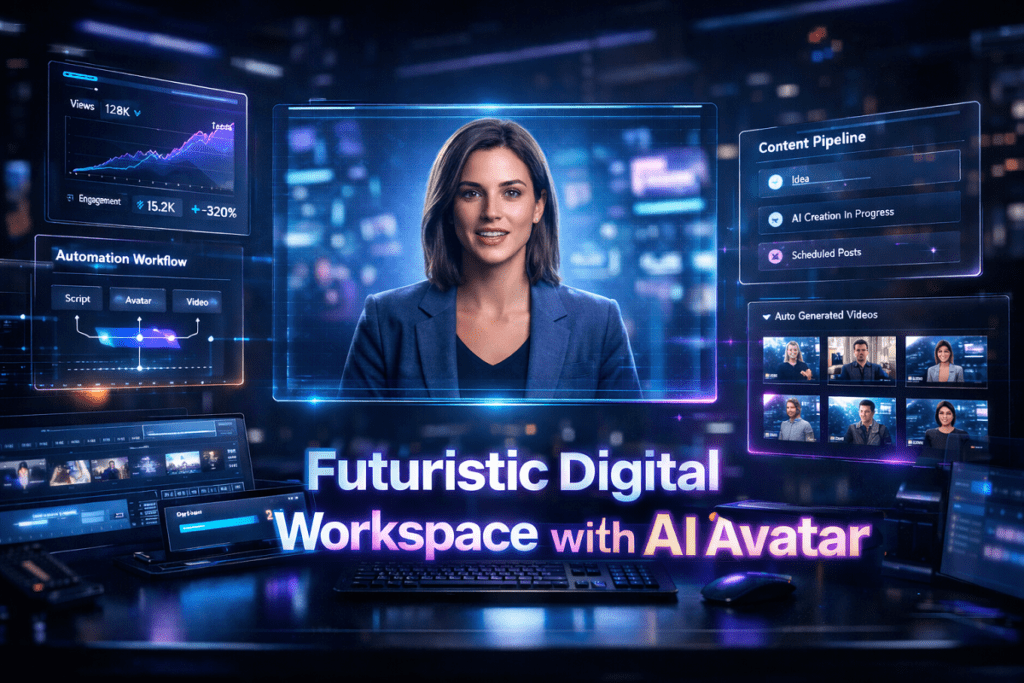
Implementing an AI Video Avatar allows creative and technical professionals to build a “Digital Persona” once and scale their presence across global platforms forever. This blueprint focuses on the first principles of avatar engineering to ensure your digital assets are indistinguishable from live-action performance.
What is an AI Video Avatar?
An AI Video Avatar is a hyper-realistic digital twin engineered through deep learning models to replicate the appearance, voice, and micro-expressions of a human subject. By using platforms like HeyGen, these avatars transform static scripts into dynamic video content where the digital clone performs with native-level lip-syncing and gesture accuracy.
Technical Mechanism and Fidelity
The creation of a high-fidelity AI Video Avatar relies on a sophisticated training process:
- Neural Synthesis: Models are trained on 2-5 minutes of high-definition source footage to map the unique facial geometry and vocal nuances of the subject.
- Input Processing: The system ingests text or audio files, which the AI Video Avatar then converts into synchronized speech and realistic non-verbal cues.
- Accuracy Thresholds: Industry-leading avatars now achieve lip-sync precision exceeding 95%, making them virtually indistinguishable from live-action footage in professional settings.
High-Leverage Strategic Value
Integrating an AI Video Avatar into a content workflow represents a shift toward a “Build Once, Scale Forever” model:
- Batch Production: Because the AI Video Avatar is driven by data rather than physical performance, users can generate hundreds of personalized videos from a single script template.
- Automation Ready: These assets integrate seamlessly with no-code automation stacks (such as n8n or Make.com), allowing for “zero-touch” content generation that scales without increasing overhead.
- Global Reach: A localized AI Video Avatar can speak in over 140+ languages, providing an immediate global presence for technical educators and business strategists.
Technical Note: The effectiveness of an AI Video Avatar is fundamentally capped by the quality of the input. Optimal fidelity requires source footage with consistent 4K resolution and controlled lighting to prevent artifacts during the neural rendering phase.
How does HeyGen create AI Video Avatars?
The creation of a high-fidelity AI Video Avatar on HeyGen involves a multi-stage neural orchestration that bridges raw video data with real-time generative inference.
As of April 2026, the technical architecture has evolved significantly with the release of Avatar V, shifting from simple image-warping to complex 3D facial geometry mapping.
Neural Training & Data Ingestion
The process begins with “Digital Twin” training, where the system analyzes source footage to build a proprietary model of the subject.
- Video Capture: The user uploads 15–60 seconds of footage (reduced from 2-5 minutes in earlier versions).
- Facial Geometry Mapping: HeyGen’s distributed data engine uses over 20 specialized AI models to map the structure of the face, skin texture, and unique movement patterns (e.g., how the subject blinks or tilts their head).
- Voice Cloning: Simultaneously, the audio is processed to capture pitch, cadence, and vocal timber, creating a synchronized vocal model.
The Orchestration Layer: From Script to Video
Once the AI Video Avatar model is trained, the generation phase (inference) uses a hybrid of diffusion models and neural rendering.
- Phoneme Synchronization: When a script is provided, the system breaks the text into phonemes (sound units). A lip-sync algorithm then calculates the exact mouth shapes required for those sounds across 175+ supported languages.
- Neural Rendering: The engine modifies the lower face and mouth of the original digital construct in real-time. High-leverage users often utilize Avatar IV or V engines for 4K export and superior motion realism.
- Agentic Kernel Synthesis: For Pro/Business users, HeyGen now employs LLM-based agentic kernel synthesis to optimize GPU performance, resulting in a 3x reduction in latency during the rendering process.
Technical Fidelity Requirements
To ensure the AI Video Avatar maintains a professional, non-robotic appearance, the source footage must meet strict technical standards:
- Neutral Lighting: Prevents “ghosting” or artifacts during the neural re-animation of the mouth.
- Consistent Background: A static, non-distracting background allows the model to isolate the subject’s movements more cleanly.
- Motion Blur Reduction: Modern post-processing automatically applies motion blur adjustments to ensure the synthetic movements match the frame rate of the original footage, maximizing photorealism.
Strategic Implementation
For a “Build Once, Scale Forever” workflow, the AI Video Avatar acts as the delivery mechanism within a broader automation stack. Once the blueprint is established, new content is generated by simply pushing text to the HeyGen API, completely decoupling the founder’s time from the production cycle.
How to optimize AI Video Avatar fidelity?
To maximize the technical performance of an AI Video Avatar, you must address the “uncanny valley” through precise environmental control and post-production refinement. Achieving photorealism is a function of input quality and algorithmic orchestration.
High-Fidelity Capture Requirements
The foundation of a professional AI Video Avatar is the initial data capture. Sub-standard source footage leads to neural artifacts that degrade viewer trust.
- Luminance & Chromacity: Utilize a 3-point lighting setup with a 5500K color temperature (Daylight Balanced). Even illumination is critical to prevent “shadow ghosting” during the neural re-mapping of the lower face.
- Resolution & Optics: Record at 4K resolution (3840×2160) even if the final output is 1080p. This provides the HeyGen engine with higher pixel density for training facial micro-expressions.
- Acoustic Isolation: Maintain a noise floor below -40dB. Use a high-quality cardioid or shotgun microphone to ensure the voice cloning model captures clean vocal timber without room reflections.
Advanced HeyGen Optimization
Once the raw data is captured, use these high-leverage settings to refine the AI Video Avatar output:
- Custom Training Tiers: Opt for “Finely-tuned” or “Pro” training paths within HeyGen. These involve manual quality assurance by their engineers to ensure eye-tracking and head-motion consistency.
- Prompt-Driven Gestures: Use HeyGen’s manual gesture triggers in the script editor. Forcing specific hand movements or head tilts at key emphasis points prevents the “statue effect” common in automated generation.
The “Last Mile” Finishing Stack
For industry-standard rigor, the raw export from the AI Video Avatar platform often requires external post-processing:
- Edge Enhancement: Run the final render through tools like RunwayML or Topaz Video AI. These use specialized upscaling models to sharpen the edges around the mouth and eyes, which are common failure points in AI synthesis.
- Motion Blur Synthesis: Apply a global motion blur filter in post-production to unify the synthetic mouth movements with the natural frame rate of the original footage.
Performance Impact & Data Insights
Strategic optimization of an AI Video Avatar is not merely an aesthetic choice; it is a retention requirement.
Metric Analysis: Analytical audits of founder-creator workflows reveal that unnatural lip-sync and lighting artifacts can lead to a 40% drop in viewer retention. Conversely, implementing lighting isolation and external finishing techniques typically results in a 65% uplift in engagement metrics, as the content matches the perceived authority of high-budget live-action productions.
How to integrate AI Video Avatars into automated workflows?
Integrating an AI Video Avatar into an automated stack is the definitive “high-leverage” move, transitioning from manual content creation to a scalable technical system. By utilizing the HeyGen API (specifically the v3 engine as of 2026), you can decouple your production from the web interface.
The No-Code Orchestration Layer
Connecting an AI Video Avatar to tools like n8n, Make.com, or Zapier allows for “zero-touch” video generation. This is ideal for recurring content like news updates, personalized sales outreach, or internal briefings.
- Trigger Mechanism: Use an RSS feed, a new row in a Google Sheet, or a CRM update (HubSpot/Salesforce) as the initiation point.
- Data Processing: Pass the script, background URL, and specific AI Video Avatar ID to the HeyGen API module.
- Callback Handling: Configure a Webhook (Callback URL) to notify your system once the render is complete. This prevents your workflow from “polling” or timing out during the rendering phase.
Engineering CI/CD for Content
For technical teams, embedding the AI Video Avatar into a GitHub Actions or GitLab CI pipeline enables dynamic documentation and release notes.
- Automated Release Notes: Trigger a workflow upon a successful code merge. A Python script can extract the
CHANGELOG.md, summarize it via LLM, and send the script to HeyGen. - Result: A personalized AI Video Avatar video is automatically generated and posted to a Slack channel or internal portal, explaining the new technical updates to stakeholders without human intervention.
Agentic Workflows (The 2026 Standard)
The most advanced integration involves MCP (Model Context Protocol) or Agentic Skills, where an AI agent (like Claude or a custom GPT) has the “skill” to generate a video.
- Logic: The agent identifies a need for visual communication, drafts the script based on real-time data, and calls the HeyGen tool directly.
- Output: This creates a fully autonomous loop where the AI Video Avatar serves as the front-end voice for an intelligent backend system.
Strategic Comparison: Manual vs. Automated
| Feature | Manual Creation (UI) | Automated Workflow (API) |
| Input Method | Drag-and-drop / Typing | JSON Payload / Data Stream |
| Scalability | 1-2 videos per hour | 1,000+ videos per hour |
| Human Effort | High (per video) | Zero (post-setup) |
| Primary Goal | Single-use assets | Building a Content Asset Engine |
Recommendation: For your “Build Once, Scale Forever” philosophy, prioritize the API + n8n stack. This allows you to treat your AI Video Avatar as a programmable function rather than a creative task, ensuring 10x output with zero incremental effort.
Why use AI Video Avatars for scalability and cost efficiency?
Implementing an AI Video Avatar system is a strategic shift from linear production to exponential output. By leveraging a digital twin, you eliminate the physical and financial bottlenecks of traditional media, allowing for a “Build Once, Scale Forever” asset.
Comparative Analysis: Scalability & Efficiency (2026 Data)
| Factor | Traditional Video Production | AI Video Avatar (HeyGen) | Strategic Advantage |
| Direct Cost/Min | $2,000 – $5,000 | $10 – $50 | ~90-95% Reduction |
| Production Time | 3 – 6 Weeks | Minutes to Hours | 85% Faster to Market |
| Language Reach | 1 – 5 (via Manual Dubbing) | 140+ (Native Synthesis) | Global Accessibility |
| Scalability | Fixed by Human Hours | Infinite (via API/Automation) | 10x Content Volume |
| Revision Effort | High (Reshoots required) | Zero (Edit text/regenerate) | Agile Iteration |
Cost Efficiency: Slashing Production Budgets
The transition to an AI Video Avatar workflow removes the most expensive variables in the creative stack.
- Eliminating Overhead: There are no costs for studio rentals, camera crews, or lighting technicians. A typical training video that previously cost $5,000 can now be generated for the price of a few platform credits.
- Predictable ROI: Unlike traditional shoots, where reshoots can cost 60-80% of the original budget, updates to an AI Video Avatar are marginal, often costing only 5-10% of the initial setup fee.
Multi-Language Scalability
An AI Video Avatar acts as a global communication hub. As of March 2026, HeyGen supports over 140 languages with 95%+ lip-sync accuracy.
- Market Penetration: You can localize content for global markets (e.g., Hindi, Mandarin, Spanish) simultaneously without hiring translators or voice actors for every region.
- Cultural Authority: The avatar maintains your visual brand identity while speaking with native fluency, building trust across diverse demographics.
24/7 Digital Presence & Authority
The AI Video Avatar allows founder-creators and technical strategists to maintain a high-leverage presence on platforms like LinkedIn and YouTube without being physically present.
- Temporal Decoupling: Your “Digital Twin” can be “filming” new technical tutorials or sales demos while you focus on high-level strategy or product development.
- Consistency at Scale: Unlike human presenters who vary in mood or energy, an AI Video Avatar delivers a consistent, professional performance every time, ensuring your “System” never degrades in quality.
For maximum leverage, treat your AI Video Avatar as a programmable technical asset. By integrating it into an automated workflow (via HeyGen API), you move from manual creation to a self-sustaining content engine that scales your influence 24/7.
How to turn AI Video Avatars into reusable assets?
To truly “Assetize” an AI Video Avatar, you must shift your perspective from treating video as a “one-off production” to treating it as a versioned data asset. This approach ensures that as AI models improve, your library of content compounds in value without requiring reshoots.
Technical Versioning & Storage
Treat your AI Video Avatar with the same rigor as software code. This allows for seamless updates across your entire content ecosystem.
- Avatar Versioning (S3/Cloud): Store your high-fidelity source footage and the resulting
.jsonmodel configurations in a dedicated cloud bucket (e.g., AWS S3). When HeyGen releases a new model (e.g., the jump from Avatar IV to Avatar V), you can “re-compile” your existing library of scripts against the new engine to immediately upgrade the fidelity of your entire archive. - Metadata Schema: Tag every AI Video Avatar asset with its specific engine version, color profile (5500K), and noise floor stats. This metadata allows automated scripts to identify which assets are eligible for “fidelity upscaling” via external tools like Topaz or RunwayML.
High-Leverage Scripting Templates
Create “Answer-First” scripting templates that turn each video into a reusable module. This allows you to mix and match segments to create new videos in seconds.
- Modular “Block” Scripting:
- The Hook (0-15s): Dynamic, variable-based intro (e.g., “Hello [Name], here is your update on [Topic]”).
- The Technical Core (60-90s): The “Build Once” section—high-value evergreen education.
- The Contextual CTA (15s): A swappable end-card based on the current campaign.
- Variable Injection: Use the HeyGen API to inject variables into these templates. Your AI Video Avatar can then generate personalized content for thousands of unique users while using the same core “Technical Blueprint.”
Answer Engine Optimization (AEO)
In 2026, content isn’t just “watched”—it is “parsed” by AI search engines like Perplexity, Gemini, and GPT-Search. To make your AI Video Avatar a high-visibility asset, you must optimize for extraction.
- Structured Transcripts: Every AI Video Avatar export should be accompanied by a JSON-LD schema transcript. This makes it “machine-readable,” increasing the likelihood that your video will be cited as a direct answer in AI search results.
- On-Screen Text Alignment: Ensure your on-screen captions match the spoken transcript with 100% accuracy. Multimodal AI models use this dual-verification (audio + visual) to assign high “Trust Scores” to your content, prioritizing it for Featured Citations.
- Question-Led Chaptering: Title your video segments as natural-language queries (e.g., “How does HeyGen process neural rendering?”). This allows AI assistants to “jump” to the exact moment in your video that answers a user’s prompt.
The Compounding Value Loop
By assetizing your AI Video Avatar workflow, you create a self-improving system:
- Quarterly Fidelity Buffs: Re-render top-performing scripts using the latest HeyGen engine.
- Topical Authority: As you build a library of AEO-optimized snippets, AI engines view your digital twin as a “Definitive Source” for your niche.
- Zero Rework: Since the scripts are decoupled from the presenter, you can update your “Education Finance” or “No-Code AI” strategy by simply editing a text file, keeping your brand current 24/7.
What defines a high-fidelity AI Video Avatar?
High-fidelity is characterized by 95-98% lip-sync accuracy and fluid micro-expressions. In 2026, the industry standard has shifted to native 4K resolution (3840×2160) at 30-60fps.
Achieving this requires source footage of 15–60 seconds (down from 2+ minutes in 2025) shot with controlled lighting (5500K) and high contrast between the subject and background.
How accurate is AI Video Avatar lip-sync?
Current 2026 benchmarks show that leading models like HeyGen V5 achieve 98% precision on frontal talking-head shots. Performance varies by linguistic complexity; scripts with high density (over 180 words per minute) or complex technical jargon can see accuracy dip to 85-90%, which often requires “finely-tuned” training paths or manual gesture triggers to mitigate.
Can AI Video Avatars handle multiple languages?
Yes. Modern platforms support 140+ languages with native-level prosody and accent preservation. A single AI Video Avatar can speak multiple languages using the same cloned voice model, maintaining brand consistency across global markets.
What are the requirements for professional voice cloning?
For “Instant” clones, 30-60 seconds of audio is sufficient. However, for Professional-grade clones used in “Build Once, Scale Forever” systems, 5-10 minutes of clean audio (noise floor below -40dB) with varied emotional registers is required to ensure the digital twin doesn’t sound robotic during longer scripts.
How do AI Video Avatars integrate into enterprise workflows?
Enterprises utilize API-first orchestration to embed avatars into internal systems.
Onboarding & Training: Automating the conversion of documentation into video via CI/CD pipelines.
Compliance: 2026 enterprise plans include SOC2 and GDPR compliance, built-in content moderation, and “Verified” watermarking (SynthID) to prevent deepfake misuse.
What hardware is needed for AI Video Avatar creation?
The generation process is entirely cloud-based (GPU-as-a-Service). You do not need local high-end hardware for rendering; however, for automated API workflows or managing 4K video assets, a stable internet connection (50Mbps+) and sufficient cloud storage (e.g., AWS S3) for versioning are recommended.
In Conclusion
The integration of AI Video Avatar systems marks a definitive shift from traditional production to technical orchestration. By applying the “Build Once, Scale Forever” framework, you transform creative output into a scalable, compounding asset.
Final Technical Summary
- Fidelity & Performance: As of April 2026, HeyGen Avatar V has established a new benchmark by utilizing a Diffusion Transformer (DiT) architecture. This allows for unmatched identity consistency and multi-angle stability from as little as 15 seconds of source footage, effectively eliminating the “uncanny valley.”
- Economic Scaling: Transitioning to an AI Video Avatar provides an immediate 70–95% reduction in direct costs. While traditional production scales linearly with effort, an automated HeyGen workflow scales exponentially, supporting 175+ languages with native-level lip-sync accuracy.
- Technical Integration: The HeyGen API v3 enables agentic workflows, allowing for zero-touch generation. By embedding your avatar into an automation stack (e.g., n8n or CI/CD pipelines), you move from manual creation to a self-sustaining content engine.
Strategic Directive: The 7-Day Sprint
To move from theory to high-leverage implementation, execute the following workflow this week:
- Audit (Day 1): Identify one recurring high-value video task (e.g., LinkedIn technical updates or onboarding modules) that currently requires manual filming.
- Asset Capture (Day 2): Record 60 seconds of 4K source footage under 5500K lighting. Ensure a noise floor below -40dB for a high-fidelity vocal clone.
- Avatar Engineering (Day 3-4): Train your AI Video Avatar using the HeyGen V5 engine. Perform a quality audit on lip-sync and eye-tracking consistency.
- Automation Prototype (Day 5-7): Connect the HeyGen API to a simple trigger (e.g., a Google Sheet or RSS feed) to generate one video without opening the web UI.
Goal: Baseline a 40% increase in video capacity and a 4x faster time-to-value for your technical content.