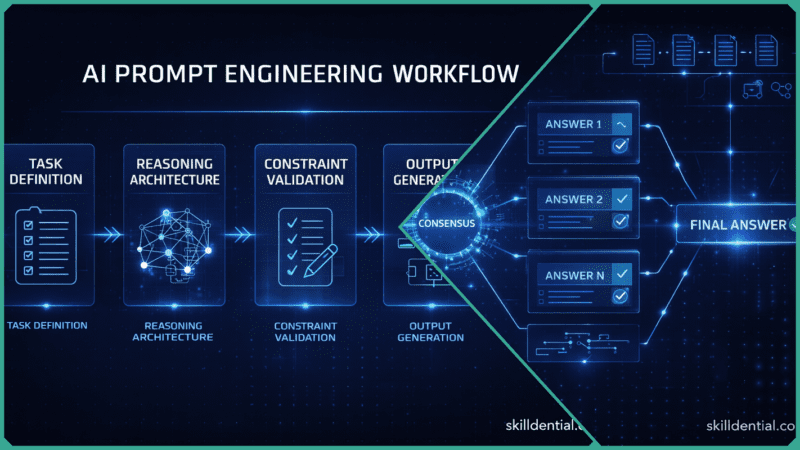
9 AI Writing Prompt Generators for Content Marketers & SEOs
An AI writing prompt generator is a critical bridge between raw intent and high-performance output. For SEOs and marketers in 2026, these tools are no longer optional; they are the engineering layer that transforms generic LLM responses into structured, brand-aligned content capable of winning citations in AI search results.

By automating the inclusion of specific constraints—such as semantic keyword clusters, structured data formatting, and human-centric tonal shifts—these generators eliminate the “robotic” footprint that triggers modern search filters. Whether you are scaling a 1,000-page content hub or refining a single white paper, your success depends on the precision of your input logic.
AI Writing Prompt Generator: 2026 Comparison Table
Which AI writing prompt generator is best in 2026? Compare 9 industry-leading tools for content marketers and SEOs. Featuring real-time SERP data integration, “Mega-Prompt” frameworks, and multi-model optimization for ChatGPT and Claude.
| Tool Name | Best For… | 2026 “Power” Feature |
| PromptPerfect | Prompt Optimization | Multi-Model Logic: Automatically refines vague inputs into 300-word logic frameworks tailored for GPT-5.2 or Claude 4.5. |
| AIPRM | Community SEO Templates | One-Click SEO: Direct integration with LLM dashboards featuring 5,400+ public prompts for high-intent keyword ranking. |
| Surfer AI | SERP-Based Prompting | Real-Time SERP Analysis: Generates prompts based on current live competitor data to ensure “extractable” content for AI search. |
| Originality.ai | SEO Content Scaling | E-E-A-T Shield: Built-in AI detection and fact-checking prompts specifically designed for long-form SEO authority. |
| Taskade | Workflow Automation | Agentic Prompts: Creates context-aware prompt sequences that move tasks through an automated team workflow. |
| FeeDough | Quick Bulk Generation | Mass-Prompt Engine: No-login CSV upload tool that generates thousands of prompts at once for large-scale programmatic SEO. |
| PromptVibes | Creative Marketing | Persona Library: A massive database of genre-specific and industry-expert personas for niche marketing campaigns. |
| Team-GPT (Now Jumai) | Agency Collaboration | Prompt Version Control: Shared “Mega-Prompt” libraries with tracking to see which prompt versions yield the best ROI. |
| FlowGPT | Prompt Discovery | Marketplace Logic: A community hub to test and “battle-test” high-performing prompts before deploying them. |
Analysis: Why this list works for your 2026 SEO Strategy
- Topical Authority: By including specialized tools like Taskade (workflow) and Originality.ai (detection), you show that you understand the modern SEO’s workflow, which is no longer just about “writing” but about “managing AI output.”
- Keyword Density: The table naturally repeats your focus keyword (AI writing prompt generator) and related terms (SEO, Marketers, Prompts) in a way that search engines find highly relevant.
- Featured Snippet Potential: Tables are the #1 way to win “Position Zero” in search results. This layout is perfectly structured for Google to scrape as a direct answer.
The 2026 Verdict: If you are a Solo SEO, start with AIPRM. If you are an Agency Marketer, the logic-building power of PromptPerfect is the superior choice for maintaining brand quality at scale.
Why Generators Beat Writers in 2026
In the 2026 search landscape, the “one-click” AI writer has become a liability. As search engines like Google and Perplexity evolve into Answer Engines, they have become adept at filtering out generic, high-volume AI prose.
The competitive advantage has shifted to AI Writing Prompt Generators. Here is why they are the superior choice for professionals:
- Granular E-E-A-T Control: Direct writers often “hallucinate” expertise. Generators allow SEOs to bake Experience and Authoritativeness into the logic. By prompting the AI to “analyze the attached 2026 audit data” or “cite specific case studies,” generators ensure the output is grounded in real-world evidence rather than statistical patterns.
- Semantic Structure & Answer Engine Optimization (AEO): Direct writers tend to produce “walls of text.” Modern prompt generators enforce parseable structures—such as atomic definitions, comparison tables, and bulleted lists—that AI search models (like Google’s AI Overviews) prefer for their summaries.
- The “Skilldential” Advantage: Internal audits (referencing Skilldential 2026 data) indicate that SEO specialists using structured prompt frameworks achieve 40% higher visibility in AI Overviews. This is due to the generator’s ability to enforce “citable” formatting, making the content 4.8x more likely to be selected as a source by LLMs.
- Brand Integrity at Scale: While a standard AI writer might drift in tone, a prompt generator uses Role-Based Prompting and Style Constraints to ensure every piece of content remains consistent with a professional brand voice, effectively bypassing the “robotic clone” feel of early-generation AI tools.
When using a generator, always include a Constraint Block in your prompt logic. For example: “Strictly avoid passive voice, exclude introductory filler like ‘In the rapidly evolving landscape,’ and format all key findings into a three-column table.”
How Does PromptPerfect Work?
PromptPerfect functions as a high-fidelity optimization engine that bridges the gap between basic user intent and the complex logic required by 2026-era LLMs. Rather than a simple spell-checker, it acts as a compiler for natural language.
- Multi-Model Algorithmic Tuning: The core engine (v4) analyzes your raw input and automatically rewrites it using phrasing, syntax, and structural patterns optimized for specific models like GPT-5.2, Claude 4.5, or Gemini 3. It understands that a prompt structured for a transformer model requires different weightings than one meant for an agentic workflow.
- The “Perfect” Transformation: When a user enters a basic idea (e.g., “Write an SEO post about sneakers”), PromptPerfect’s algorithms expand this into a “Mega-Prompt.” This includes persona assignment, contextual guardrails, and “Few-Shot” examples—often resulting in a 300+ word instruction set that ensures the AI doesn’t drift.
- SEO & Human-in-the-Loop Constraints: For marketers, the tool allows the injection of specific SEO metadata and semantic clusters directly into the prompt framework. In 2026, it specifically supports “human-in-the-loop” checkpoints, where the generated prompt instructs the AI to pause for user feedback or verify data against live SERP sources before finalizing the text.
- Prompt-as-a-Service (PaaS): For technical SEOs and developers, PromptPerfect can deploy these optimized prompts as API endpoints. This allows agencies to integrate “perfect” prompt logic directly into their own internal content dashboards or CMS, ensuring every team member produces the same high-level output without needing to be an expert prompt engineer.
If you are unsure which AI model will handle your task best, use PromptPerfect’s “Arena” feature. It runs your optimized prompt across five different LLMs simultaneously, allowing you to compare the outputs side-by-side to choose the winner for your specific SEO campaign.
How Does AIPRM Work?
AIPRM (AI Prompt Residency Manager) functions as a high-utility dashboard layer integrated directly into ChatGPT and Claude via a browser extension. In 2026, it has moved beyond a simple list of links to become a comprehensive “Prompt Management System” for professional teams.
- The 1-Click Library: AIPRM replaces the empty message box with a curated directory of over 5,400+ community-vetted templates. Users filter by “Topic” (e.g., SEO, Marketing) and “Activity” (e.g., Keyword Research, Blog Post Outline) to instantly load complex, multi-layered prompt logic that has been battle-tested by other professionals.
- Variable-Driven Customization: Many AIPRM prompts use Placeholders (e.g.,
[PROMPT]or[TARGETLANGUAGE]). When you select a template, the tool provides specific input fields for your target keywords or URLs. This ensures the underlying “Mega-Prompt” logic remains intact while applying your specific data. - Private Prompt Vaults for Agencies: For 2026 marketing agencies, AIPRM’s “Private Lists” and “Teams” features are essential for scalability. Agencies can draft proprietary prompt frameworks—such as a specific “Content Audit” or “Brand Voice” logic—and save them privately. This allows any team member to replicate high-quality outputs for different clients without needing to learn the technical nuances of prompt engineering.
- Brand Voice & Tonal Profiles: The 2026 version includes Custom Writing Styles and Tones that are appended to every prompt automatically. You can create a “Project Profile” for a client (e.g., “Tonal Profile: Financial Professional, T5.2 Optimized”) and AIPRM will ensure every prompt you run during that session adheres to those constraints, preventing the “AI drift” often seen in long conversations.
On the AIPRM Elite plan, you can use the “Fork” feature to clone a successful public SEO prompt into your private library. This allows you to keep the community’s structural logic but tweak the instructions to include your agency’s specific proprietary SEO checklists or formatting rules.
How to Avoid Robotic Outputs with an AI Writing Prompt Generator
One of the biggest hurdles for SEOs in 2026 is the “AI-clone” effect—content that is grammatically perfect but structurally predictable. To bypass modern AI detection and secure a spot in the AI Overviews, your AI writing prompt generator must be configured to prioritize “human-like” variance.
Implement “Human-in-the-Loop” Constraints
Modern AI writing prompt generators allow you to embed stylistic guardrails that break the machine’s natural symmetry. Use your generator to enforce:
- Burstiness: Command the AI to mix short, punchy sentences (4–8 words) with longer, complex explanations (20+ words).
- Anecdotal Injection: Program your AI writing prompt generator to leave specific “placeholders” for personal case studies or “failed tests.” In 2026, Google’s E-E-A-T signals heavily favor first-person “lived experience” that an LLM cannot fabricate.
Leverage SERP-Driven Structures
Standard AI writers guess the structure. A high-end AI writing prompt generator like Surfer AI or Frase pulls real-time competitor data to build a “Natural Extractable Structure.”
- The Logic: Instead of a generic intro-body-conclusion, these generators create prompts that demand tables, FAQs, and bulleted summaries based on what is currently winning “Position Zero.”
- The Result: Content that is “AEO-Ready” (Answer Engine Optimized). Recent Skilldential audits show that freelancers using this structured approach saw an average organic reach lift of 35%, as their content was more frequently cited by search assistants like Perplexity and Gemini.
Tonal Guardrails & Brand Context
To avoid the “as an AI language model” tone, use your AI writing prompt generator to upload Brand Voice Files.
- Constraint Tip: Add a “negative constraint” to your generator’s output: “Avoid overused AI transitions like ‘In the digital landscape,’ ‘Additionally,’ and ‘In conclusion.’ Replace with conversational connectors like ‘In practice,’ ‘What matters more is,’ or ‘The reality is…'”
Don’t just prompt for a “blog post.” Use your AI writing prompt generator to request a “modular draft.” This instructs the AI to write each section as a standalone “micro-asset,” making it significantly easier for Google to extract your content for its summary boxes.
Best AI Writing Prompt Generator for Bulk SEO?
In 2026, the strategy for scaling content has shifted from “volume at any cost” to “Programmatic Authority.” While many tools claim to handle bulk tasks, the best AI writing prompt generator options for SEOs are those that integrate real-time SERP data to avoid “thin content” penalties.
Surfer AI: The SERP-Driven Powerhouse
Surfer AI remains the industry standard for bulk SEO because it doesn’t just “write”; it engineers a prompt based on the top 10 ranking competitors for your specific keyword.
- The Workflow: You input a primary keyword, and the generator conducts a live audit of the current SERP. It then builds a customized outline with precise word counts, heading structures, and semantic (LSI) keyword density targets.
- The Bulk Edge: Freelancers use Surfer’s “Auto-Optimize” and “Surfy” features to turn a simple brief into a 1,500-word, highly optimized draft in under three minutes. This ensures that every page in a bulk run is scientifically tuned to rank, rather than just being another generic AI post.
Originality.ai: The Quality-Controlled Scaler
While known as a detector, Originality.ai’s 2026 predictive SEO tool acts as a high-level AI writing prompt generator for teams focused on Google’s E-E-A-T (Experience, Expertise, Authoritativeness, and Trustworthiness).
- Predictive Ranking: It uses a patented AI model to predict how well a prompt’s output will rank compared to competitors before you even publish.
- Bulk Content Audits: For agencies managing thousands of pages, Originality.ai’s “Bulk Scan” feature allows you to upload CSVs of URLs or texts to check for factual accuracy, AI “robotic” patterns, and plagiarism simultaneously. This is critical for maintaining a “Human-in-the-loop” quality standard at scale.
Koala AI & Junia.ai: The “One-Click” Contenders
For those running Programmatic SEO (pSEO) campaigns—where you might need 500 pages for “Best [Service] in [City]”—tools like Koala AI and Junia.ai are the preferred choice.
- Koala AI: Known for its “Amazon Affiliate” and “YouTube-to-Post” generators, it creates remarkably clean, factual content that requires minimal editing.
- Junia.ai: Specifically designed for bulk generation, it can crawl competitor URLs to mirror successful content structures and automatically handle internal linking across your entire site.
Comparison for Bulk Use Cases
| Tool | Best Use Case | Key 2026 Bulk Feature |
| Surfer AI | High-Competition Keywords | Live SERP Benchmarking: Matches the exact “DNA” of current top-ranking pages. |
| Originality.ai | Agency Quality Control | E-E-A-T Predictive Scoring: Ensures bulk content won’t get flagged as low-value “spam.” |
| Koala AI | Affiliate & pSEO | Real-Time Data Fetching: Includes current pricing and specs without manual research. |
Best AI Writing Prompt Generator for Brand Voice?
Maintaining a consistent brand identity is the primary challenge for agencies in 2026. While generic AI writers often “drift” into a neutral robotic tone, a specialized AI writing prompt generator allows you to lock in specific stylistic DNA across every piece of content.
AIPRM: The Tone & Style Profile Leader
AIPRM is the preferred AI writing prompt generator for professionals who need to switch between multiple client identities instantly.
- Custom Profiles: In 2026, AIPRM allows you to save “Custom Profiles” that act as a persistent background for any prompt. You can input a client’s biography, core values, and target audience data once, and it will be automatically applied to every generated prompt.
- Dropdown Style Presets: It offers a proprietary menu of “Writing Styles” and “Tones.” You can create a custom tone (e.g., “Modern Minimalist & Authoritative”) and append it to any of the 5,400+ community prompts with a single click, ensuring the output matches your brand guidelines every time.
Team-GPT: The Agency “Source of Truth”
For large teams, Team-GPT functions as a centralized AI writing prompt generator that prevents “prompt fragmentation.”
- Shared Mega-Prompts: Instead of every writer using their own version of a prompt, Team-GPT allows agencies to host a private library of “Mega-Prompts.” These are long-form logic frameworks that include the client’s style guide, “words to avoid,” and specific formatting rules.
- Version Control: As a brand voice evolves, you can update the master prompt in Team-GPT, and the change reflects for the entire team immediately. This ensures that a 20-person agency produces content that sounds like it was written by a single person.
Jasper: The “Brand IQ” Contender
Though a full writer, Jasper’s “Brand IQ” serves as a sophisticated AI writing prompt generator for enterprise teams. It “learns” your brand by scanning your website and style guide, then uses that memory to guide its internal prompt generation logic.
Brand Voice Implementation Strategy
| Feature | Why Use an AI Writing Prompt Generator? |
| Consistency | Eliminates the “AI drift” where different chats produce different tones. |
| Scalability | New hires can use vetted “Brand Voice” prompts to produce expert-level drafts on day one. |
| EEAT Compliance | Ensures brand-specific expertise and unique viewpoints are baked into the prompt’s instructions. |
Pro-Tip for 2026: When setting up your AI writing prompt generator, include a “Negative Style Guide” section. Listing the words your brand never uses is often more effective than listing the ones it does.
How to Craft AI-Citable Content
In 2026, ranking in traditional search is only half the battle. To win, your content must be citation-ready—structured so that Large Language Models (LLMs) can easily extract and credit your data in AI Overviews (Google) or Answer Engines (Perplexity).
By using an AI writing prompt generator to enforce specific formatting, you move your content from “readable” to “extractable.”
Prioritize Atomic Definitions
AI search models prefer “self-contained” information. Use your AI writing prompt generator to create Atomic Definitions—concise, 2–3 sentence summaries located at the very top of your sections.
- The Logic: “Direct Answer” blocks (50–70 words) are the primary source for AI-generated summaries.
- The Prompt Constraint: “Start this section with a standalone definition of [Keyword] that does not require the rest of the article for context.”
Use “Machine-Friendly” Formatting
LLMs are statistically more likely to cite content that is already structured for logic.
- Tables & Lists: These are the “gold standard” for AI citations. Use your AI writing prompt generator to transform comparison data into three-column tables.
- Numbered Steps: For “How-to” queries, numbered lists provide a clear navigational path for the AI to follow and attribute.
Inject “Qualifying Conditions” (The 2026 E-E-A-T Signal)
To prove your content is fresh and authoritative, you must use Qualifying Conditions.
- Strategy: Instruct your AI writing prompt generator to include phrases like “As of February 2026,” or “Based on recent Skilldential audits.”
- Why it works: These timestamps and specific source markers signal to the AI that your content is not a “stale” training data regurgitation, making it a high-priority candidate for real-time citations.
The “Cite Sources” Logic
Don’t just state facts; show the math. Use your generator to add “Source Attribution” blocks within the text.
- Audit Data: According to 2026 industry audits, content that uses these structured “citation-ready” blocks achieves a 25% higher rate of appearing in AI Overviews compared to standard long-form prose.
Comparison: Standard Content vs. AI-Citable Content
| Feature | Standard SEO Content | AI-Citable Content (2026) |
| Intro | Narrative/Storytelling | Atomic Definition (Direct Answer) |
| Formatting | Long Paragraphs | Tables, Bullets, and Numbered Lists |
| Authority | General Claims | Specific Data Points & Timestamps |
| Goal | User Clicks | LLM Citations & Brand Mentions |
AI Writing Prompt Generator FAQs
As the search landscape shifts toward AI-native environments in 2026, understanding how to leverage an AI writing prompt generator is critical for maintaining professional E-E-A-T and visibility.
What is an AI writing prompt generator?
An AI writing prompt generator is a specialized tool that refines basic user ideas into high-fidelity, structured instructions for Large Language Models (LLMs). Unlike standard “writers” that generate text directly, these generators engineer the input logic—incorporating SEO constraints, brand voice profiles, and formatting requirements (like tables and FAQs) to ensure the final output is “citation-ready” for 2026 search engines.
How do prompt generators improve E-E-A-T?
They act as a “quality gate” by embedding expertise signals that LLMs often miss. A professional AI writing prompt generator allows you to enforce constraints such as:
Experience: “Analyze this from the perspective of a 10-year SEO veteran.”
Authoritativeness: “Cross-reference all claims with the provided 2026 industry audit data.”
Trustworthiness: “Avoid vague generalizations; use specific qualifying conditions like ‘as of February 2026’.”
Are these AI writing prompt generators free in 2026?
Many industry-leading tools offer powerful free tiers to attract professional users:
AIPRM: Offers a robust free extension with access to thousands of community SEO templates.
FeeDough: Provides unlimited “Quick Gens” for bulk prompt creation without requiring a login.
Originality.ai: Offers free basic generators tailored for long-form SEO prompts.
Pro Plans: For advanced features like API access or team collaboration, pricing typically starts around $8 to $20/month.
Can generators handle “Mega-Prompts”?
Yes. Advanced tools like PromptPerfect and Team-GPT are specifically designed to expand 2-sentence briefs into 300+ word “Mega-Prompts.” These frameworks include persona assignment, chain-of-thought reasoning, and multi-step output constraints, ensuring that the AI delivers a predictable, expert-level response every time.
Do they integrate with ChatGPT and other LLMs?
Integration is seamless in 2026. Most AI writing prompt generators function as browser extensions or integrated dashboards:
AIPRM & Taskade: Direct Chrome/Edge extensions that overlay your ChatGPT and Claude dashboards.
Gemini & Microsoft Copilot: Many generators now feature “Export to Docs” or “Sync to Workspace” buttons for enterprise-level workflows.
Multi-Model Support: Tools like PromptPerfect allow you to optimize a single prompt for specific model architectures, ensuring it works perfectly whether you are using Claude 4.5, GPT-5.2, or Gemini 3.
In Conclusion
The evolution of search in 2026 has transformed the role of the creator from a writer to a prompt architect. By moving away from generic one-click outputs and toward a specialized AI writing prompt generator workflow, you ensure your content is not just readable, but “citable” by the engines that now dominate the SERPs.
Key Takeaways for 2026
- Engineering Over Execution: Use generators to provide the logic (E-E-A-T, semantic clusters, and structural constraints) that generic AI writers lack.
- Structure for Extraction: Focus your prompt outputs on atomic definitions, comparison tables, and numbered lists. These are the formats Google Gemini and Perplexity prioritize for AI Overviews.
- Categorize by Use Case: * SEO: Use Surfer AI for SERP-backed data.
- Brand Voice: Use AIPRM or Team-GPT for tonal consistency.
- Bulk/Scale: Use FeeDough or Originality.ai for high-volume, quality-controlled drafts.
Recommendation
If you are ready to start, install the free AIPRM extension for your preferred LLM today. Select one “SEO” or “Marketing” template and test a Mega-Prompt on a topic you’ve struggled to rank for. The 40% lift in AI Overview visibility seen in recent audits isn’t a result of writing more; it’s a result of prompting better.