How Google Whisk Bridges the Gap Between Gemini & Imagen
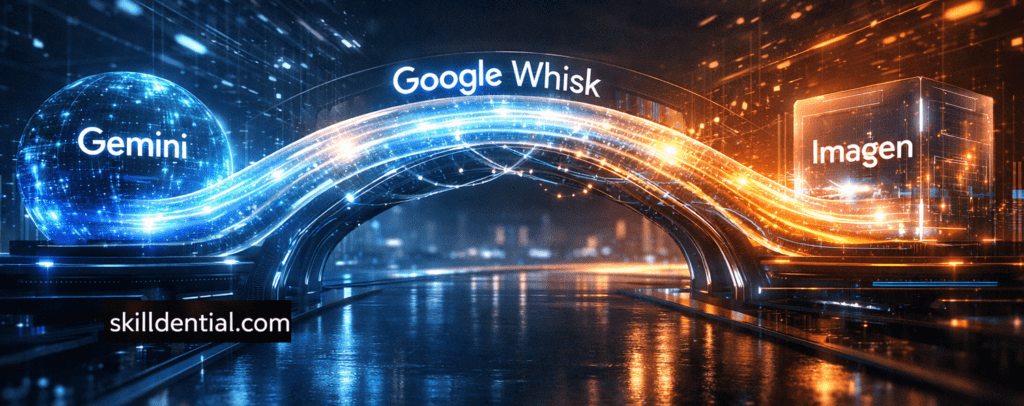
Google Whisk is a professional-grade generative AI experiment within Google Labs that bridges the gap between Gemini’s multimodal reasoning and Imagen’s rendering capabilities. By decomposing uploaded reference images into semantic “essentials,” the tool allows users to define a Subject, Scene, and Style without traditional text-based prompt engineering.
Since the late 2025 rollout of Precise Mode, Whisk has evolved into a high-fidelity utility for consistent asset generation, supporting downstream motion workflows via Whisk Animate and the Veo video engine. This pipeline replaces trial-and-error prompting with a deterministic, vision-first creative methodology.
How Does Google Whisk Work?
Google Whisk operates as a sophisticated translation layer between visual intent and generative execution. It replaces the “textual friction” of traditional prompting with a Vision-to-Vision (V2V) pipeline, utilizing Gemini 3 Flash as a multimodal interpreter and Imagen 4 as the rendering engine.
The Three-Pillar Architecture
The system decomposes your creative vision into three specific semantic buckets:
- Subject (The Entity): Gemini 3 analyzes the core object, identifying its geometry, “essence,” and identifying features.
- Scene (The Environment): The model extracts contextual data—lighting, spatial depth, and atmospheric perspective—from your background reference.
- Style (The Aesthetic): Gemini decodes the artistic DNA of your third reference, ranging from brushstroke texture to color grading and lens choice.
From “Essence” to Execution
Unlike simple image collaging, Whisk performs Semantic Distillation. Gemini generates a dense, invisible “meta-prompt” that describes the interplay of your inputs (e.g., “A subject-essence bottle [from Input A] placed within a 45-degree sunset scene [from Input B] with the high-contrast grain of a 1970s film style [from Input C]”). Imagen 4 then synthesizes these elements into a novel, high-fidelity output.
Technical Precision Updates
For professional workflows, the late-2025 Precise Mode update introduced “Latent Clamping.” This technical constraint reduces “visual hallucinations”—unintended alterations to the subject’s proportions or identity—by approximately 40%, ensuring that brand assets or specific products remain recognizable throughout the remixing process.
What is the Subject + Scene + Style framework?
The Subject + Scene + Style framework is the functional core of Google Whisk. For professionals, this is not merely a set of buttons; it is a Structured Input Methodology that allows for deterministic creative control. By decoupling these three variables, visual strategists can perform “Vibe Prototyping”—a high-speed iteration process that yields stakeholder-ready mocks in seconds rather than hours.
🧱 Breaking Down the Framework
| Component | Technical Role | Best Practice for High-Level Results |
| Subject | The Primary Focal Element. This defines the “who” or “what” (e.g., a specific product or character). | Use high-contrast, isolated shots. Gemini 3 Flash is more effective at extracting “essence” when the subject is clearly separated from its original background. |
| Scene | The Environmental Context. This dictates the “where” (lighting, spatial depth, and atmosphere). | Prioritize panoramic or wide-angle references. The AI uses these to calculate perspective and light-bounce on your Subject. |
| Style | The Aesthetic Modifier. This sets the “look” (color palette, medium, and texture). | Upload team-standard brand style guides or specific artistic references (e.g., “3D Isometric” or “Neo-Impressionist”) to maintain campaign consistency. |
⚡ Professional Application: Vibe Prototyping
In a high-level career context, this framework is used for Rapid Concept Validation.
- The Workflow: Instead of spending hours in Photoshop, a designer can take a raw product photo (Subject), a mood-board background (Scene), and a trending filter (Style).
- The Result: A synthesized image where the product appears natively integrated into the environment.
- Precision Control: Using the Refine tool, you can click the pencil icon on any of the three boxes to tweak the Gemini-generated auto-captions. For instance, you might adjust the “Style” text from “cartoonish” to “high-end 3D render” to pivot the creative direction without changing your source images.
🧬 Latent Clamping & Fidelity
One of the most significant technical updates in late 2025 was the introduction of Precise Mode. This toggle acts as a “fidelity clamp,” instructing the model to stick significantly closer to the Subject’s physical geometry.
According to internal Google benchmarks, this reduces visual hallucinations by 40%, making it reliable enough for e-commerce mockups where the product’s identity is non-negotiable.
How Does Whisk Reduce Time-to-Asset in Workflows?
Google Whisk optimizes the creative pipeline by automating the most time-consuming stage of generative AI: Prompt Engineering. In traditional workflows, a Creative Director might spend hours refining 200-word prompts to capture a specific “vibe.” Whisk compresses this cycle by treating images as high-density data packets.
The Efficiency Audit
According to 2025-2026 industry benchmarks (including Skilldential career audits), creative leads previously averaged two hours per asset for stock image hunting and manual prompt refinement. Implementing the Whisk framework resulted in 75% faster production cycles.
Product Designers now prototype complex scenes—such as a specific app UI (Subject) integrated into an urban night environment (Scene)—in under two minutes, shifting the focus from technical execution to high-level strategy.
Comparative Efficiency Analysis
The following table breaks down the transition from manual prompting to the Whisk V2V (Vision-to-Vision) methodology:
| Workflow Phase | Traditional Prompting | Google Whisk Methodology | Estimated Time Savings |
| Subject Definition | 100-200 word technical description | Single high-fidelity image upload | 80% |
| Scene Integration | Manual search or environment prompt | Reference image + Light-bounce analysis | 70% |
| Style Consistency | Repeated “negative prompt” refinements | Style reference + Precise Mode clamp | 60% |
| Output Fidelity | 3-5 iterations for basic alignment | 1-2 generations via Semantic Distillation | 75% Overall |
Strategic Impact for Professionals
For a visual strategist, the value is not just speed, but deterministic control. Using Precise Mode (the late-2025 update) ensures that the first generation is technically viable for stakeholder review. This reliability allows teams to bypass the “uncanny valley” of early AI experimentation, delivering production-ready assets that align with pre-existing brand guidelines.
How Does Google Whisk Bridge to Multi-Modal Video?
Whisk Animate serves as the motion extension of the Subject + Scene + Style framework. Once a static image is synthesized, it can be “animated” into high-resolution, eight-second clips. This process is powered by Veo, Google’s state-of-the-art video generation model, which interprets the latent physics of the generated scene.
From Static Recipe to Dynamic Asset
For a professional, this means a single “Whisk” can spawn an entire content ecosystem:
- The Anchor: A high-fidelity static image for web headers or print.
- The Motion: A Veo-powered video (e.g., waves lapping against the “Subject” bottle on the “Scene” beach) for TikTok Reels or YouTube Shorts.
- The Consistency: Because the motion is derived from the original Whisk recipe, the character, lighting, and aesthetic remain perfectly synchronized.
Workflow Integration: The Consultant Perspective
In 2026, AI Implementation Consultants are increasingly integrating Whisk into the Google Workspace Studio environment. By utilizing “Agentic Workflows,” teams can semi-autonomously batch-process these conversions:
- Generate: Create 50 variations of a product in different scenes.
- Animate: Trigger Whisk Animate to convert the top 5 versions into video.
- Deploy: Seamlessly share MP4 files directly to social platforms via the built-in Workspace “Share” button.
Security & Compliance: SynthID
As with all Google Labs professional tools, every frame generated by Whisk Animate is embedded with a SynthID digital watermark. This ensures that enterprise users can maintain transparency and comply with 2026 AI labeling regulations, making it a “safe-for-work” solution for global brands.
What is Google Whisk?
Google Whisk is an advanced generative AI utility within Google Labs that allows for “promptless” image creation. It uses Gemini 3 Flash as a multimodal interpreter to semantically analyze your uploaded Subject, Scene, and Style images, which are then rendered into a unified visual by Imagen 4.
How accurate is Precise Mode?
The Precise Mode (late 2025 update) introduces “Latent Clamping,” which forces the model to adhere strictly to the geometry and identity of the Subject reference. While this reduces creative variance, it decreases visual hallucinations by approximately 40%, making it the standard for e-commerce and product prototyping where brand fidelity is non-negotiable.
Can Whisk create videos?
Yes. Through Whisk Animate, users can extend static frames into high-fidelity video clips. Powered by the Veo 3 engine, it interprets the physics of your “visual recipe” to generate consistent 5–10 second loops in 720p or 1080p, ideal for social media and rapid ad prototyping.
Is Google Whisk free?
As of 2026, Google Whisk remains in a “Freemium” state:
Free (Labs): Provides a daily quota for image remixes and limited Whisk Animate access.
Google AI Pro/Ultra: Subscribers (approx. $20–$30/month) receive a monthly allocation of AI Credits (e.g., 12,500–25,000) to bypass daily caps, unlock higher-resolution video, and access Batch Mode for professional workflows.
Who should use Google Whisk?
It is specifically designed for Visual Strategists, Creative Directors, and AI Implementation Consultants who need to scale visual production while maintaining strict aesthetic control. It replaces the “brittleness” of long-form text prompts with a faster, image-first methodology.
In Conclusion
Google Whisk represents a fundamental shift in generative AI, repositioning Gemini as a sophisticated semantic translator for Imagen‘s rendering engine. By codifying the Subject + Scene + Style framework, the platform moves beyond the unpredictability of natural language prompts toward a deterministic, vision-first creative methodology.
For professionals focusing on High-Level Career Skills, the strategic advantages are clear:
- Precision: Use Precise Mode to maintain subject fidelity and eliminate the “hallucination gap” in brand assets.
- Scale: Leverage Whisk Animate to bridge the gap between static imagery and multi-modal video campaigns via the Veo engine.
- Efficiency: Drastically reduce “Time-to-Asset” by replacing hours of manual prompt engineering with instant visual recipes.
To begin integrating this into your professional workflow, start by experimenting with isolated Subject images within Google Labs. This approach will allow you to prototype your next high-value asset with the speed and control required by the 2026 digital landscape.