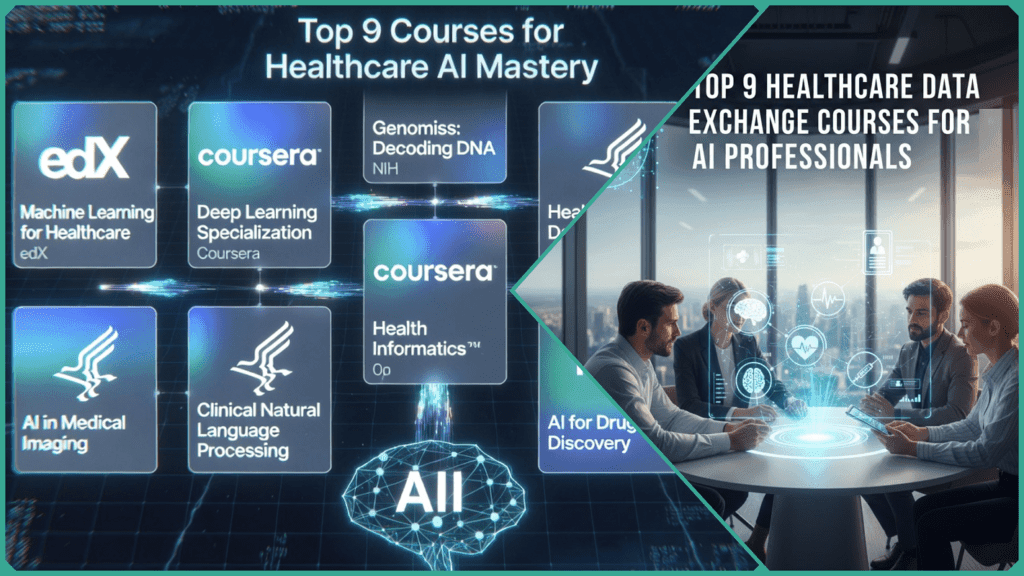
Top 9 Healthcare Data Exchange Courses for AI Professionals
In the world of healthcare AI, the greatest hurdle isn’t the algorithm—it’s the data. While AI professionals are experts at building sophisticated models, those models are often starved for high-quality, structured data. This is due to the fragmented nature of medical records, where critical information is trapped in proprietary silos or inconsistent formats.
Mastering Healthcare Data Exchange is the solution to this “data debt.” By understanding the core protocols that govern how clinical information moves, AI engineers can build more robust, scalable, and compliant pipelines.
What These Healthcare Data Exchange Courses Cover
Top-tier exchange courses provide the technical bridge between software engineering and clinical medicine by focusing on:
- Interoperability Standards: Deep dives into HL7, FHIR (Fast Healthcare Interoperability Resources), and DICOM for imaging, ensuring your model speaks the same language as the hospital’s EHR.
- Semantic Consistency: Using SNOMED-CT and LOINC to ensure that “heart rate” in one system means the same thing in another.
- Privacy & Compliance: Practical methods for de-identification and HIPAA-compliant data flows that protect patient identity without sacrificing data utility.
- Real-Time Integration: Moving beyond static CSVs to leverage APIs and streaming data from wearables for real-time predictive analytics.
To truly succeed in HealthTech, an AI professional must move past theoretical data science and gain hands-on experience with the messy, fragmented reality of global healthcare datasets. The following nine Healthcare Data Exchange Courses are designed to help you do exactly that.
Top 9 Healthcare Data Exchange Courses
Here is the breakdown of the top nine Healthcare Data Exchange courses. These have been selected specifically for their ability to help AI professionals bridge the gap between “standard data science” and the highly regulated, fragmented world of clinical data.
Health Informatics: Data and Interoperability Standards
- Provider: Georgia Tech (available via edX or GTPE)
- Best For: Data Architects and Backend Engineers
- The AI Edge: This course focuses on the “plumbing.” It covers the history of HL7 but moves quickly into SMART on FHIR, which is the gold standard for building apps that sit on top of EHRs. It’s essential for anyone building AI tools that need to “read and write” directly to hospital systems.
Healthcare Data Management and Interfaces
- Provider: Coursera (Digital Healthcare Informatics & AI Specialization)
- Best For: AI Engineers handling “messy” legacy data
- The AI Edge: You’ll explore the transition from legacy HL7 V2 (unstructured/pipe-delimited) to modern FHIR. It specifically addresses USCDI (U.S. Core Data for Interoperability), which defines the minimum dataset required for nationwide exchange—a must-know for training generalizable models.
Introduction to FHIR for Research
- Provider: NIH Office of Data Science Strategy
- Best For: Clinical Data Scientists and Researchers
- The AI Edge: This is uniquely modular. It covers Bulk FHIR APIs, which are critical for extracting large-scale datasets for model training. It includes hands-on exercises in Python and R to demonstrate how to pull medical data for drug-drug interaction research and population health.
FHIR Training for Developers
- Provider: CloudFoundation
- Best For: Software Developers new to HealthTech
- The AI Edge: A 10-hour deep dive into FHIR design. What makes this stand out for AI pros is the focus on real-time streams and implementation exercises. If your AI model needs to process patient data as it happens (e.g., ICU monitoring), this course covers the necessary triggers.
HL7 FHIR Training (Programmer Focused)
- Provider: Microtek Learning
- Best For: Engineers building production pipelines
- The AI Edge: This 3-day course is highly technical. It teaches you how to construct FHIR messages and resources using VS Code and Postman. This is the practical “how-to” for building the ingestion engines that feed your data lakes.
DICOM / HL7 / IHE Standards Overview
- Provider: HL7 UK
- Best For: Computer Vision and Medical Imaging AI Pros
- The AI Edge: If you work with X-rays, MRIs, or CT scans, you cannot ignore DICOM. This course explains how imaging metadata (DICOM) interacts with clinical data (HL7) via the IHE framework, ensuring your imaging AI has the right clinical context.
SNOMED CT Foundation Course
- Provider: SNOMED International
- Best For: NLP Engineers and Semantic Specialists
- The AI Edge: AI is only as good as its labels. This course teaches you the global “grammar” of medicine. For NLP professionals mapping free-text doctor notes to standardized codes, understanding the SNOMED CT hierarchy is the difference between a model that works and one that fails in the real world.
Regional Digital Health Interoperability Bootcamp
- Provider: SSCP / WHO (Regional)
- Best For: IoT and Wearable AI Engineers
- The AI Edge: This bootcamp is heavily focused on HIE (Health Information Exchange) and analytics for decentralized data. It uses simulated labs for maternal health and IoT, perfect for those building AI for remote patient monitoring.
Data Standards with Nurse Informatics
- Provider: Nursing CE Central
- Best For: Product Managers and Ethics/Compliance Officers
- The AI Edge: While aimed at informatics, this course is excellent for understanding PHI scrubbing (de-identification). It provides a unique perspective on how data is actually recorded at the bedside, helping AI pros understand the “noise” and bias inherent in nursing documentation.
Healthcare Data Exchange Courses Comparison
| Course | Focus Area | Duration | Platform | Best For | Cost (Approx.) |
| Health Informatics on FHIR | HL7/FHIR basics & SMART apps | 15 weeks | Georgia Tech (edX) | Data Architects | Free audit / $297 Cert |
| Data Management & Interfaces | Standards evolution & USCDI | 3 Modules | Coursera | AI Engineers | Subscription (~$49/mo) |
| FHIR for Researchers | AI/ML integration & Bulk Data | Modular | NIH | Data Scientists | Free |
| FHIR Training | Developer APIs & REST | 10 hours | CloudFoundation | Developers | ~$500 |
| HL7 FHIR Intermediate | Implementation & Facades | 2-3 Days | Microtek | Pipeline Builders | ~$1,599 |
| DICOM/HL7/IHE Overview | Imaging & Clinical Workflows | 2 half-days | HL7 UK | Computer Vision Pros | ~£500 – £700 |
| SNOMED CT Foundation | Semantic mapping & NLP | 3.5 Credits | SNOMED Int’l | NLP Specialists | ~€60 |
| Digital Health Bootcamp | Real-time HIE & IoT | Immersive | SSCP (Regional) | Product Managers | Varies by Region |
| Data Standards & PHI | Terminologies & Scrubbing | 2-4 Hours | Nursing CE | Compliance/Product | ~$50 – $150 |
Key Takeaways for Selection
- For High-Volume Training: If you need to train models on millions of records, the NIH FHIR for Researchers is the best choice because it focuses specifically on Bulk Data Export.
- For Computer Vision: Choose the HL7 UK course. It is one of the few that explicitly bridges the gap between clinical text (HL7) and medical imaging (DICOM).
- For EHR Integration: The Georgia Tech course is the gold standard for engineers who need to build “SMART on FHIR” applications that live inside systems like Epic or Cerner.
How Does FHIR Work?
In the world of healthcare AI, FHIR (Fast Healthcare Interoperability Resources) has become the definitive language for data exchange. Unlike legacy standards that treat medical records as static documents, FHIR treats data as modular, computable objects.
The Building Blocks: Resources
FHIR breaks down health data into discrete “Resources.” For an AI professional, these are essentially standardized JSON objects that serve as your model’s input features.
Patient: Contains demographics (age, gender, location).Observation: The “workhorse” for AI, capturing vital signs, lab results, and social determinants.Condition: Documents diagnoses (using codes like ICD-10 or SNOMED-CT).Encounter: Provides the temporal context of when and where care was delivered.
The Exchange: RESTful APIs
FHIR leverages the same technology that powers the modern web. Developers interact with Electronic Health Records (EHRs) using standard HTTP verbs:
GET: Retrieve a patient’s history for real-time inference.POST/PUT: Feed AI-generated insights (like a sepsis risk score) back into the clinician’s workflow.Bulk Data Export: Allows AI teams to extract millions of records at once via a single “kick-off” request, essential for large-scale training.
Why it Matters for AI Accuracy
Traditional data exports often flatten clinical data, losing the “time-series” nature of a patient’s journey. FHIR preserves this temporal resolution. By querying specific resources via APIs, AI models can analyze the exact sequence of events—such as how a specific medication (MedicationRequest) preceded a change in lab values (Observation).
This structured approach also enables Federated Learning. Instead of moving sensitive patient data to a central server, AI professionals can send their models to “query” local FHIR servers at different hospitals. The model learns from the standardized JSON resources without the raw data ever leaving the secure hospital environment.
Key Technical Terminology
SMART on FHIR: A framework that allows your AI application to “plug in” to any EHR (like Epic or Cerner) using a single, secure authentication standard (OAuth2). It ensures your AI tool is portable across different hospital systems.
Why Navigate Data Silos?
In the landscape of 2026 HealthTech, data is the most valuable asset, yet it is often trapped in inaccessible “silos.” For an AI professional, these silos represent the single greatest obstacle to moving a model from a prototype to a production-ready life-saving tool.
The 80/20 Trap: Why Silos Waste Your Time
Data scientists traditionally spend up to 80% of their time on data “janitorial” work—cleaning, merging, and deduplicating fragmented records.
- The Problem: Hospitals, pharmacies, and labs often use different Electronic Health Record (EHR) vendors. A single patient’s data might be split across three systems, each using slightly different definitions for “blood pressure” or “medication start date.”
- The AI Cost: Fragmented data leads to “Data Debt,” where your model is trained on incomplete snapshots, significantly increasing the risk of algorithmic bias and poor real-world performance.
Aggregation via HIEs and Bulk APIs
Modern Health Information Exchanges (HIEs) act as a central hub, connecting these disparate silos. By layering FHIR Bulk APIs on top of HIE infrastructure, AI teams can now perform “push-button” population health.
- Streamlined Ingestion: Instead of individual API calls for every patient, Bulk FHIR allows you to export entire cohorts as NDJSON files—a format optimized for high-speed AI training pipelines.
- Federated Access: You can query diverse data sources without moving the raw data into a single warehouse, preserving privacy while maximizing the diversity of your training set.
The “Skilldential” Impact: Cutting Data Debt
Recent career audits by platforms like Skilldential have highlighted a massive skill gap. Their 2025 research found that AI professionals who lacked training in interoperability standards struggled significantly with EHR integration.
- The Training ROI: AI engineers who completed specialized Healthcare Data Exchange Courses reported a 40% reduction in data cleaning time.
- The Result: Teams can shift their focus from fixing broken data pipelines to fine-tuning model architectures and improving clinical outcomes.
Regulatory Compliance Essentials?
In the highly regulated world of healthcare AI, your ability to move data is only as good as your ability to protect it. Regulatory compliance is not just a legal “checkbox”—it is a core engineering requirement for any production-level AI pipeline.
De-Identification: Safe Harbor vs. Expert Determination
Under HIPAA, clinical data must be de-identified before it can be used for secondary purposes like AI training. Most courses teach the two primary pathways defined by the HHS:
- Safe Harbor Method: The systematic removal of 18 specific identifiers (e.g., names, specific geographic subdivisions, and all elements of dates except the year). This is the standard “engineer’s approach” to cleaning a dataset.
- Expert Determination Method: A more flexible, statistical approach where a qualified expert certifies that the risk of re-identification is “very small.” This is vital for AI models that require specific temporal data (like exact time-stamps) to maintain predictive accuracy.
Federated Learning and GDPR
For global AI development, the GDPR (Europe) and other privacy laws have made traditional data centralization difficult. Healthcare data exchange courses now emphasize Federated Learning (FL) as a compliance strategy.
- The Workflow: Instead of moving massive amounts of raw clinical data to a central cloud, you move the model to the data.
- The Result: Only encrypted model updates (weights and gradients) are shared, ensuring that raw patient data never leaves its original jurisdictional silo. This aligns with the NIST guidelines for privacy-preserving machine learning.
Consent Management via FHIR
Ethical AI requires traceable patient consent. Modern standards have moved beyond paper forms to computable consent.
- FHIR Consent Resource: This specific resource type allows AI systems to check, in real-time, whether a patient has opted in for their data to be used in “Research” or “Machine Learning.”
- Dynamic Opt-Out: If a patient withdraws consent, the FHIR API can automatically exclude their records from the next training epoch, ensuring your dataset remains compliant without manual auditing.
Pro-Tip: NIST Guidelines
Look for courses that reference the NIST AI Risk Management Framework (AI RMF). It provides the industry-standard “Map, Measure, and Manage” approach to identifying privacy risks, specifically in generative AI and large-scale healthcare models.
Healthcare Data Exchange Courses FAQs
What is healthcare data exchange?
Healthcare data exchange is the secure, standardized transmission of clinical and administrative information between disparate IT systems. For AI professionals, it is the mechanism that allows models to pull real-time data from an Electronic Health Record (EHR) or a laboratory system. By using standards like FHIR (Fast Healthcare Interoperability Resources), systems can share “meaningful” data (like blood pressure or medications) rather than just flat documents, ensuring interoperability across the entire healthcare ecosystem.
How does FHIR differ from HL7 V2?
The difference is primarily architectural:
- HL7 V2: A legacy, message-based standard (introduced in the 1980s) that uses pipes and delimiters (e.g.,
PID|1|...) to send data in batches. It is event-driven and often requires significant custom coding for each integration. - FHIR: A modern, resource-based standard that uses RESTful APIs and JSON. It is designed for the “app economy,” allowing AI developers to query specific data points (like just the last 10 glucose readings) instantly. This makes FHIR the superior choice for real-time AI inference.
What is semantic interoperability?
While “structural” interoperability ensures the data gets to its destination, semantic interoperability ensures the system actually understands what that data means. This involves mapping unstructured or local clinical notes to global standardized terminologies like SNOMED-CT (for clinical concepts) or LOINC (for lab tests). For NLP-driven AI, semantic interoperability is what allows a model to recognize that “heart attack,” “MI,” and “Myocardial Infarction” all refer to the same clinical entity.
Why is it necessary to de-identify PHI?
Under regulations like HIPAA and GDPR, Protected Health Information (PHI) cannot be used for research or AI training without explicit patient consent. De-identification involves stripping 18 specific identifiers (Safe Harbor method) or using statistical “Expert Determination” to ensure the risk of re-identification is negligible. This process is essential for building large, diverse datasets for model training while maintaining patient privacy and avoiding multi-million dollar regulatory fines.
Can wearables integrate via these standards?
Yes. Modern wearable platforms (like Apple Health or Fitbit) increasingly support FHIR-based APIs. This allows “Patient-Generated Health Data” (PGHD) to flow into Health Information Exchanges (HIEs) or directly into AI monitoring models. By using FHIR for IoT streams, AI professionals can build models that provide continuous, real-time risk assessments rather than relying on a patient’s infrequent visits to a clinic.
In Conclusion
In 2026, the bottleneck for healthcare AI is no longer the complexity of the neural network, but the friction of the data pipeline. Transitioning from a general AI professional to a specialized HealthTech expert requires a shift from viewing data as “files” to viewing it as standardized, interoperable resources.
Final Takeaways
- The 70% Advantage: Mastering FHIR APIs and HL7 protocols doesn’t just make you more knowledgeable; it fundamentally accelerates your development cycle. Teams that leverage native interoperability standards report up to 70% faster pipeline deployment by eliminating custom “one-off” data connectors.
- Scale with Bulk Data: Moving away from individual patient queries to Bulk FHIR access allows your models to ingest population-level data at scale, providing the volume necessary for high-accuracy training while maintaining clinical context.
- Compliance as an Asset: By prioritizing de-identification and federated learning from the start, you turn regulatory hurdles like HIPAA and GDPR into a competitive advantage, enabling you to partner with larger health systems that demand the highest levels of data security.
Your Next Step
If you are ready to move from theory to implementation, the best place to start is the Health Informatics on FHIR Professional Certificate from Georgia Tech on edX. It is a self-paced, industry-standard program that will give you the hands-on “SMART on FHIR” experience needed to build production-ready healthcare AI