How to Combine AI and Human Skills to Increase Your Income
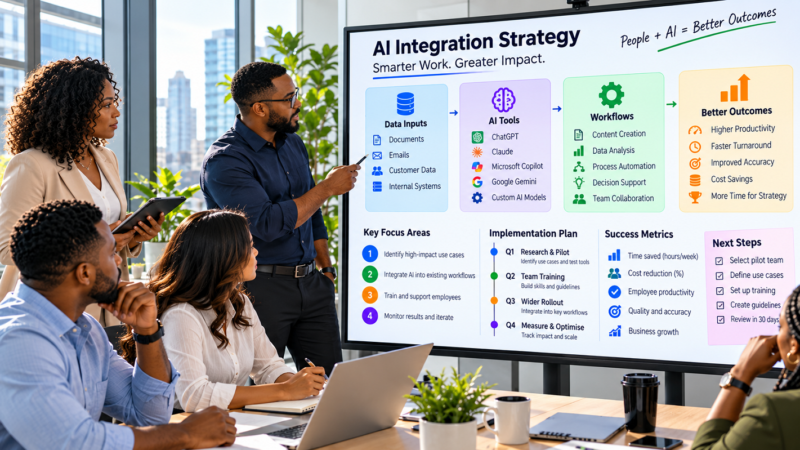
The modern economy is undergoing a radical shift in how value is produced and rewarded. While AI is often viewed as a replacement for labor, its most significant function is as a cost-reduction engine that automates the 80% of repetitive, low-variance tasks. However, automation alone leads to commoditization. To achieve a competitive edge, human skill must act as the high-leverage strategic layer that directs AI outputs toward high-value objectives.
By applying human skill as the orchestration layer, professionals can create a form of economic arbitrage. AI reduces production costs by 70–90% through rapid execution, while your specific judgment amplifies the final output value via context-heavy refinement. This synthesis is the primary driver for income growth in 2026, yielding 2–5x income multipliers for freelancers and career professionals who move beyond manual execution.
To capture this upside, you must transition from a “doer” to an “architect.” Success requires a consistent workflow architecture that integrates AI efficiency with the irreplaceable nuance of human skill, ensuring that your output remains scarce, premium, and scalable.
How Does Combining AI and Human Skills Increase Income?
To understand how combining AI and human skill drives financial growth, you must view the interaction through the lens of Resource Arbitrage and Efficiency Frontiers.
The Mechanics of Economic Arbitrage
Income growth is fundamentally a function of the gap between production cost and market value.
- Cost Compression: AI acts as a deflationary force on the “cost of production.” By automating the 80% of tasks characterized by high volume and low variance (data synthesis, initial drafting, basic coding), the time cost per unit of output drops by 70–90%.
- Scarcity Creation: Human skill acts as an inflationary force on the “value of output.” High-leverage skills—such as strategic intuition, ethical judgment, and complex orchestration—are scarce. When you apply this human skill layer to AI-generated drafts, you transform a commodity into a premium, context-specific asset.
The result is Economic Arbitrage: You produce at the cost of an algorithm but sell at the price of an expert.
The 80/20 Leverage Framework
The increase in income is not linear; it is exponential due to the decoupling of time from output.
| Component | Function | Contribution to ROI |
| AI Engine | 80% Grunt Work | Volume & Velocity |
| Human Skill | 20% Strategic Layer | Quality & Premium Pricing |
By freeing human skill from the “execution trap,” professionals can shift their focus toward high-value decisions, such as prioritization and refinement. In a Skilldential audit, we observed that professionals who moved from manual execution to AI-human workflows increased their output by 250%. This allowed them to capture the “surplus profit” that was previously lost to inefficient manual labor.
Practical Application: The Consultant Model
Consider a management consultant:
- Phase 1 (AI): Uses LLMs to analyze 500 pages of raw client data and generate a structured report skeleton in minutes.
- Phase 2 (Human Skill): Applies deep industry expertise to identify specific risks and nuanced opportunities that the AI missed.
- The Result: The consultant delivers a high-tier product in 4 hours that previously took 20. By charging based on value delivered rather than hours worked, they effectively triple their hourly rate.
Sustainability through Workflow Architecture
To sustain these gains, you must treat your human skill as the architect of a system. Scaling to $15,000/month or higher in side income requires a consistent workflow architecture where AI agents handle the infrastructure, while your human skill ensures the final output meets the industry-standard rigor required for high-stakes career growth.
What Human Skills Remain Non-Commoditizable?
In an economy saturated with automated outputs, human skill functions as a premium differentiator. As routine tasks reach a near-zero marginal cost, the market value shifts toward high-leverage abilities that AI cannot replicate due to the “context gap.”
The following human skills remain non-commoditizable and command significant market premiums in 2026.
Complex Problem Solving (Strategic Layer)
AI is proficient at pattern recognition within closed datasets, but it struggles with “ambiguous data” where variables are volatile or ethical implications are high. Human skill is required to integrate cross-disciplinary insights to make high-stakes decisions.
- Market ROI: ~4x baseline premium.
- Non-Commoditizable Factor: Strategic intuition. AI can suggest 100 paths; human judgment selects the one that aligns with long-term vision and stakeholder sentiment.
Agentic Orchestration (Operational Layer)
While individual AI agents can perform specific tasks, the ability to sequence, audit, and direct multiple agents toward a cohesive business outcome is a rare and valuable human skill.
- Market ROI: ~3x baseline premium.
- Non-Commoditizable Factor: Outcome ownership. Organizations in 2026 are shifting from “task automation” to “outcome orchestration,” where the human acts as the Lead Architect of an AI workforce.
High-Stakes Communication (Relational Layer)
Empathy and cultural nuance remain the “empathy gap” for AI. In negotiations, conflict resolution, or leadership, human skill is the mechanism for building trust—a prerequisite for high-margin business.
- Market ROI: ~5x baseline premium.
- Non-Commoditizable Factor: Lived experience and narrative authority. Trust cannot be synthesized; it must be demonstrated through consistent, human-to-human interaction.
Comparative Skill Analysis (2026 Projections)
| Skill Type | AI Vulnerability | Est. Income Premium | 2026 Application |
| Complex Problem Solving | Low (Needs real-world context) | 400% | Pivoting business models during market volatility. |
| Agentic Orchestration | Medium (Needs sequencing) | 300% | Designing and auditing multi-agent AI sales pipelines. |
| High-Stakes Communication | Low (Empathy gap) | 500% | B2B negotiations yielding 20%+ profit margins. |
As AI saturates the “execution” layer of the workforce, your human skill in these three categories becomes the “bottleneck” for quality. By mastering orchestration and complex judgment, you move from a commodity worker to a high-leverage strategist, securing your position at the top of the income hierarchy.
How Do You Architect AI-Human Workflows for Economic Arbitrage?
Designing a workflow for economic arbitrage requires a fundamental shift in how you view “work.” You are no longer the primary laborer; you are the System Architect. The goal is to maximize the delta between the near-zero cost of AI execution and the high-premium value of human skill.
Follow this three-step framework to build high-leverage workflows.
Step 1: Execute 80/20 Task Decomposition
Identify every task in your business or job function and categorize it based on “Judgment Density.”
- The 80% (Commodity Tasks): High-volume, repetitive tasks like data entry, initial research, transcription, or first-draft coding. These are assigned to AI to minimize input costs.
- The 20% (High-Leverage Tasks): Critical decision points where human skill is required—prioritization, strategic pivots, and context-specific refinement.
Step 2: Build Multi-Agentic Chains
Instead of using a single AI prompt, create a “sequenced chain” where AI agents handle the bulk of the work, but human skill acts as the mandatory quality gate.
Example Content Pipeline:
- AI Input (GPT-4o/Manus): Analyzes raw data and produces a structured 2,000-word draft (Cost: <$1.00; Time: 30 seconds).
- Human Skill Intervention: You edit for brand voice, factual nuance, and strategic “hooks” (Cost: High; Time: 30 minutes).
- AI Validation (Claude 3.5 Sonnet): Reviews the human-edited draft for logical consistency and SEO optimization (Cost: <$1.00; Time: 1 minute).
This chain ensures that the “final mile” of quality is always human-driven, maintaining the output’s premium status.
Step 3: Pivot to Value-Based Pricing
To capture the surplus profit created by your workflow, you must decouple your income from your time.
- The Old Model (Time-Bound): 40 hours of manual labor at $100/hr = $4,000.
- The Arbitrage Model (Value-Bound): 8 hours of human skill (orchestrating AI) to produce the same 40-hour result. Because the value to the client remains identical, you charge $4,000 for 8 hours of work.
[Image showing the decoupling of time and value in professional services]
By cutting delivery time by 80% while using your human skill to justify premium fees, you effectively create a 5x income multiplier. This surplus is the “build once, scale forever” engine that powers modern technical career growth.
What Is the Build Once, Scale Forever Roadmap?
The Build Once, Scale Forever roadmap is a high-leverage framework designed to decouple your income from linear time. The objective is to transition from a manual “service provider” to a “system architect” where human skill acts as the quality bottleneck, while AI handles the volume.
By following this 4-phase blueprint, you can transform bespoke consulting into a scalable income engine.
Phase 1: The High-Leverage Audit (Week 1)
Identify the specific human skill interventions that drive the highest ROI.
- Process: Map out your current workflow. Use a MECE (Mutually Exclusive, Collectively Exhaustive) approach to separate “execution tasks” from “strategic decisions.”
- Goal: Pinpoint the 20% of your activity—such as high-stakes judgment or unique orchestration—that accounts for 80% of the client’s perceived value.
Phase 2: Input Automation (Weeks 2–3)
Deploy AI to handle the “commodity 80%” of your workload.
- Tooling: Use no-code orchestration layers (e.g., Zapier, Make.com) integrated with LLMs (OpenAI, Claude) to automate data ingestion, initial drafting, and administrative logistics.
- Result: You reduce the “cost of production” to near-zero, freeing up your bandwidth to focus purely on human skill application.
Phase 3: Agentic Orchestration (Ongoing)
Develop sophisticated “Human-in-the-Loop” (HITL) workflows. Instead of manual labor, you build a sequence of AI agents that perform the work, while you act as the Orchestrator.
- Mechanism: Build “Chain-of-Thought” pipelines where AI outputs are automatically sent to you for a 5-minute strategic review before the next agent proceeds.
- Benefit: This ensures that every deliverable retains your unique industry-standard rigor without requiring you to do the manual heavy lifting.
Phase 4: Productized Scaling
The final stage is Economic Arbitrage through productization. You turn your AI-human system into a “Productized Service” or a digital asset.
- Strategy: Create consulting packs, templates, or specialized AI-driven systems that clients buy as a package.
- The Multiplier: Because the system is already built, selling to 100 clients costs you nearly the same in time as selling to one.
Case Study: Technical founders utilizing the Skilldential roadmap have successfully scaled from $5,000 to $25,000/month by shifting from bespoke labor to productizing their AI-orchestrated consulting frameworks.
Roadmap Summary
| Phases | Focus | Primary Tool | Outcome |
| Phase 1. Audit | Strategy | First Principles | Defined Value |
| Phase 2. Automate | Inputs | No-Code/AI | Time Freedom |
| Phase 3. Orchestrate | Quality | Human Skill | System Reliability |
| Phase 4. Scale | Leverage | Productization | Passive Income |
Human Skill FAQs
Navigating the transition from manual labor to AI orchestration requires a clear understanding of where value is created. Below are the most frequent strategic questions regarding the integration of human skill and artificial intelligence.
What defines a non-commoditizable human skill?
A non-commoditizable human skill is any ability that requires high-variance contextual judgment, ethical nuance, or deep empathy—areas where AI models remain unreliable or “flat.” While AI excels at the “what” (data synthesis), human skill defines the “why” and the “so what.”
Key Indicators: High-stakes decision-making, ambiguous problem-solving, and complex stakeholder negotiation.
Sustainability: These skills become more valuable as AI saturates routine execution, shifting market demand toward those who can provide “the final mile” of quality.
How does AI create economic arbitrage with human skill?
Economic arbitrage occurs when you decouple your production costs from your market value. AI functions as a deflationary force, automating the 80% “grunt work” and reducing your time-per-project by 70–90%.
When you apply your human skill to refine that output, you maintain the scarcity and premium quality of the final deliverable. By pricing based on value delivered rather than hours worked, you capture the “profit surplus” created by the efficiency gap.
What is agentic orchestration?
Agentic orchestration is the advanced human skill of sequencing and managing multiple AI agents to achieve a complex, multi-step business objective. Instead of interacting with a single chatbot, an orchestrator builds a “chain” where one AI handles research, another handles drafting, and a third handles validation.
Human Role: You act as the System Architect, providing the strategic direction, quality gates, and final auditing to ensure the system doesn’t drift from the objective.
Can AI fully replace human skills in freelancing?
No. AI is an “input optimizer,” not a “nuance generator.” In a professional service context, AI can handle the commoditized inputs, but it lacks the industry-standard rigor and client-specific empathy required for high-stakes outcomes.
The most successful freelancers in 2026 use a Hybrid Model: they let AI handle the volume (the 80%) while focusing their human skill on the 20% strategic value that justifies premium fees.
What ROI can I expect from AI-human workflows?
Based on Skilldential career audits and industry performance data, professionals who implement consistent workflow architecture see significant financial and operational gains:
Income Multiplier: A typical increase of 2–5x in effective hourly rates by shifting to value-based pricing.
Output Gain: An average 250% increase in total output volume without a proportional increase in working hours.
Leverage: The ability to scale side ventures to $15K+/month by automating execution and “bottlenecking” quality on strategic human skill.
In Conclusion
The integration of human skill with agentic AI represents the most significant shift in professional leverage in decades. Success is no longer determined by the speed of execution, but by the quality of orchestration. By positioning your human skill as the strategic layer above the AI engine, you effectively transition from a commodity laborer to a high-value system architect.
Strategic Summary
- The Arbitrage Engine: Use AI to compress input costs and human skill to elevate output scarcity, capturing a 2–5x income multiplier.
- High-ROI Competencies: Prioritize non-commoditizable skills: Complex Problem Solving, Agentic Orchestration, and High-Stakes Communication.
- The 80/20 Rule: Continuously audit your workflows to identify the 80% of “grunt work” that can be automated, freeing your bandwidth for the 20% of decisions that drive 80% of the value.
Immediate Action Plan
To move from theory to economic gain, execute the following within the next seven days:
- Select One Workflow: Identify a high-repetition task that currently consumes more than 5 hours of your week (e.g., report writing, lead qualification, or technical documentation).
- Conduct an 80/20 Audit: Deconstruct the task. Identify which parts are rote data processing (AI) and which require your specific expertise (human skill).
- Deploy an AI Chain: Set up a simple multi-step sequence (e.g., GPT for drafting → Human review → Claude for validation) to handle the 80% “commodity” phase of that workflow.
By bottlenecking quality on your unique human skill while scaling volume through AI, you create a career system that is built once and scales forever.