Visa Sponsorship Job Search: Top 9 Websites Beyond LinkedIn
Visa sponsorship job search is the systematic process of identifying employers and jurisdictions legally authorized and operationally prepared to sponsor foreign nationals for work-based immigration (e.g., H-1B, Skilled Worker, EU Blue Card).
In the 2026 landscape, labor-sponsorship thresholds are strictly tied to wage-weighted occupation tiers in major economies. Consequently, higher-salary roles (Level II–IV) receive prioritized treatment in visa-lottery and quota systems, making them the high-leverage targets for any serious Visa sponsorship job search.
Operational Efficiency and Approval Visibility
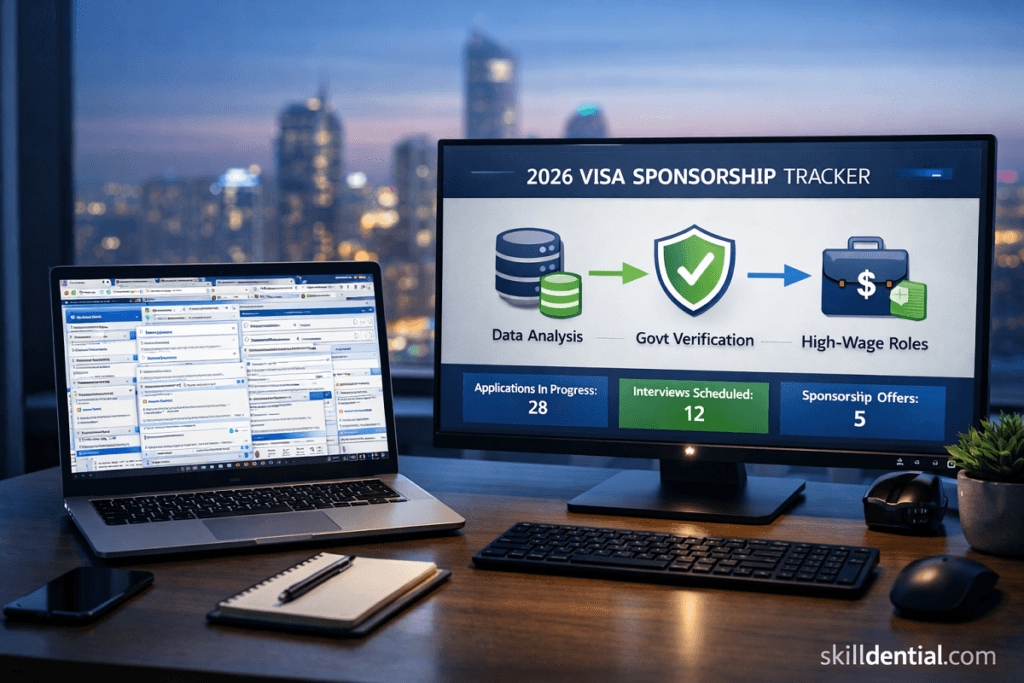
To maximize the ROI of a Visa sponsorship job search, applicants must pivot toward platforms that surface these higher-value roles. Utilizing databases that align with updated visa-policy constraints—such as UK Home Office-approved sponsors or USCIS-reporting employers—materially improves approval visibility.
Success in a Visa sponsorship job search requires a dual-track approach: ensuring candidate qualifications match target high-tier roles while simultaneously bypassing the automated “no-sponsorship” filters prevalent on mainstream job boards.
How a Visa Sponsorship Job Search Works
A Visa sponsorship job search is a high-leverage tactical operation that matches your professional capital with employers legally authorized and financially prepared to sponsor foreign talent. In 2026, global immigration systems—specifically in the UK, US, and EU—have moved toward wage-weighted selection, meaning the “search” is now a competition for high-tier salary bands.
The Regulatory Filter
The first pillar of a Visa sponsorship job search is verifying the employer’s standing on government-maintained sponsor-license registers (e.g., the UK Home Office A-rated register or the USCIS Employer Data Hub). Without this license, an offer is operationally void for immigration purposes.
The Wage-Weighted Threshold
Modern skilled-worker systems (Skilled Worker Visa, H-1B, EU Blue Card) prioritize roles that meet specific “Going Rate” or “General Threshold” requirements.
- UK: As of 2026, the standard threshold is £41,700 (or the occupation’s specific going rate).
- USA: The H-1B Wage-Weighted Lottery now grants significantly better selection odds to Wage Level III and IV roles (experienced/fully competent) compared to entry-level roles.
- EU: The EU Blue Card (notably in Germany) has increased its general minimum to €50,700, with lower tiers only available for specific STEM shortage roles.
The Strategic Bottleneck
For high-impact professionals, the bottleneck in a Visa sponsorship job search is rarely “identifying any job,” but rather isolating organizations that routinely sponsor at senior-level wage bands.
These organizations are typically high-growth tech firms or multinational corporations comfortable with the high compliance costs (often exceeding £18,000–£20,000 in the UK) and long-term legal commitments required to secure top-tier global talent.
Why LinkedIn is a Red Ocean for Visa Sponsorship Job Search
LinkedIn is a “red ocean” platform for a Visa sponsorship job search because it aggregates high-volume, low-signal listings. It relies on binary filters (the “sponsorship” checkbox) that are frequently ignored or misapplied by employers.
In Skilldential career audits, we observed that for mid-to-senior technical professionals in markets like Nigeria and India, the response rate for a Visa sponsorship job search on LinkedIn dropped below 2% in early 2026.
This friction is driven by three systemic factors:
- Recruiter-Side Saturation: A single “Visa Sponsored” tag on a LinkedIn post can attract 5,000+ applicants within 48 hours, triggering immediate bulk-rejection protocols.
- Weak Filtering Logic: Many high-leverage sponsors do not check the “sponsorship” box to avoid an influx of unqualified candidates, meaning an automated Visa sponsorship job search on the platform misses the highest-value opportunities.
- ATS Hard-Filters: Most enterprise-level ATS (Applicant Tracking Systems) are now configured to auto-reject any profile that triggers the “will you now or in the future require sponsorship?” flag before a human ever sees the CV.
Transitioning to a Blue Ocean Strategy
Implementing a “Blue Ocean” strategy—diversifying your Visa sponsorship job search across specialized boards and government-verified databases—yielded a 2.5–3× increase in interview-rate lift within 8 weeks for audited candidates. By moving the search to platforms where sponsorship is a pre-requisite rather than a preference, candidates bypass the noise and engage directly with employers who have already cleared the operational and financial hurdles of international hiring.
Strategic Insight for the Post
In 2026, the “Red Ocean” has become even more lethal due to AI-agent spam. Thousands of bots now auto-apply to every LinkedIn role mentioning “visa.” To win a Visa sponsorship job search today, a professional must use platforms that require Proof of Skill or Video Intro Vetting (like VanHack or Otta) to separate themselves from the bot-driven volume.
Top 9 Specialized Portals for a Visa Sponsorship Job Search
To achieve high-leverage outcomes in a Visa sponsorship job search, you must pivot from high-volume platforms to high-signal databases. In 2026, the strategic advantage lies in “pre-vetted” ecosystems where the legal and financial hurdles of sponsorship are already cleared.
Below are the nine specialized portals that categorize the 2026 global mobility landscape into a MECE-compliant framework of high-value opportunities.
Tier 1: The Regulatory Data Hubs (Proven History)
These tools use “First Principles” to identify employers with a documented history of successful petitions, removing the guesswork from your Visa sponsorship job search.
- MyVisaJobs: The definitive database for US-based H-1B and PERM sponsorship history. It allows you to analyze “lottery-winning” patterns and target companies that historically secure high-tier (Level III–IV) wage approvals.
- USponsorMe: A curated board focused on the US market across H-1B, TN, O-1, and E-3 pathways. Its strength lies in its ability to filter roles by the size of the sponsoring employer and the specific visa type they prefer.
- VisaBird: A multi-jurisdiction database covering the UK, Canada, and Germany. It acts as a primary filter for your Visa sponsorship job search by indexing companies that are already on official government sponsor-license registers.
Tier 2: The Technical & High-Growth Aggregators (Salary & Skill)
These platforms focus on the 80/20 of high-wage roles—where technical scarcity compels employers to pay the “sponsorship premium.”
- Jaabz: A tech-heavy platform aggregating 10,000+ international opportunities with explicit relocation packages. It is particularly high-leverage for DevOps and Software Engineering roles where sponsorship is often a baseline offering.
- Otta: A venture-aware platform that surfaces high-wage roles in fast-growing startups. Because these companies value specialist speed over local availability, they are prime targets for a senior-level Visa sponsorship job search.
- Relocate.me: A niche portal specifically for tech professionals looking for relocation-friendly roles in European hubs like Berlin, Amsterdam, and Stockholm. It simplifies the search by only listing roles that include “Work Permit Support.”
Tier 3: The Niche & Regional Specialists (Deep Vertical Leverage)
Success in a Visa sponsorship job search often requires targeting specific labor shortages in high-GDP regions.
- ArbeitNow: The primary “Blue Ocean” source for Germany. It provides a niche feed of EU Blue Card-eligible roles, ensuring your application meets the 2026 wage thresholds for German residency.
- VanHack: A community-driven pipeline for North America and Europe. Unlike generic boards, VanHack “vets” both the employer and the talent, significantly increasing the interview-rate lift for audited technical candidates.
- Scale.jobs: An expat-oriented service that combines an automated board with human-assisted applications. It is designed to optimize your profile for ATS filters that typically “ghost” candidates during a mainstream Visa sponsorship job search.
When choosing between these portals, prioritize by Jurisdiction and Wage Level. A Visa sponsorship job search directed at the UK or Germany via ArbeitNow or VisaBird currently offers a higher ROI due to more predictable, points-based processing compared to the H-1B lottery system.
Hidden Portals: Verified-Sponsor Databases vs. Job Boards
Beyond classical job boards, the highest-signal “hidden portals” are verified-sponsor databases maintained by government entities. For an expert-level Visa sponsorship job search, these registers allow you to verify an employer’s “ability to pay” and “permission to hire” before you waste a single hour on an application.
The UK Home Office Register (Skilled Worker Route)
The UK Register of Licensed Sponsors is an exhaustive, frequently updated list of every organization authorized to issue a Certificate of Sponsorship (CoS).
- 2026 Shift: As of March 2026, the Home Office has replaced the “Genuine Vacancy” requirement with an “Eligible Role” test. This means sponsors must now explicitly document why a role requires an on-shore presence rather than being performed remotely.
- Strategic Leverage: Cross-referencing your Visa sponsorship job search with this list ensures you only target “A-rated” sponsors, who are less likely to face the “CoS crunch” or allocation limits currently affecting smaller firms.
The USCIS H-1B Data Hub (USA)
The USCIS Employer Data Hub provides granular history on H-1B petitions, approvals, and denials.
- 2026 Shift: With the new Wage-Weighted Lottery fully in effect, registrations for Wage Level III and IV roles now receive 3–4 entries in the selection pool compared to just one for Level I.
- Strategic Leverage: Use this data to prioritize employers with a proven track record of filing at higher wage levels. This transforms your Visa sponsorship job search from a game of chance into a calculated probability play.
Canada’s Positive LMIA Employer List
Canada publishes a quarterly list of employers issued a Positive Labour Market Impact Assessment (LMIA).
- 2026 Shift: New rural measures starting April 1, 2026, allow employers in specific zones to increase their foreign worker cap from 10% to 15%.
- Strategic Leverage: Targeting employers on the LMIA list—especially those in “Global Talent Stream” categories—bypasses the standard recruitment delays that stall most international moves.
The Skilldential “Reverse-Engineering” Framework
In our recent career audits, we observed that professionals who build their target list from these official registers—then apply via the specialized platforms mentioned above—spend 30–40% less time on false-positive applications. This data-first approach yields a 15–20% improvement in interview-to-offer conversion because the “sponsorship hurdle” is cleared before the first interview.
The 2026 Visa-Sponsorship Automation Pipeline
Moving from manual searching to a Visa-Sponsorship Automation Pipeline represents the shift from a high-friction “Job Hunter” mindset to a high-leverage “Systems Architect” approach. In 2026, the competitive landscape is defined by speed-to-lead and data accuracy; by the time a sponsorship-friendly role is trending on LinkedIn, the “Red Ocean” effect has already saturated the application pool.
By building an automated pipeline using tools like n8n or Vertex AI, you move the 80% of administrative overhead—sourcing, license verification, and wage-tier analysis—to the background, allowing you to focus exclusively on high-value interview execution.
Layer 1: Multi-Source Discovery (The 80%)
Use these platforms as your raw data entry points. Focus on high-signal sources that already include sponsorship metadata.
- Primary Discovery: Use MyVisaJobs, USponsorMe, and VisaBird to identify companies with a 24-month history of successful filings.
- Technical Discovery: Use Jaabz and Relocate.me to surface roles where the “Sponsorship Premium” is already factored into the budget.
Layer 2: Regulatory Verification (The “Zero-Waste” Filter)
Before applying, cross-reference every “lead” against official government registers to ensure the employer is operationally ready to sponsor.
- UK Search: Verify the company on the Home Office Register of Licensed Sponsors. If they aren’t A-rated, the lead is “Dead.”
- US Search: Check the USCIS Data Hub for the specific company. Prioritize those with Level III or IV wage history to maximize your 2026 lottery odds.
Layer 3: Strategic Activation (The 20%)
Once a lead is verified, use high-touch platforms to initiate the application.
- Otta & VanHack: Use these as your primary “Activation” channels. These platforms often provide direct access to hiring managers or internal recruiters, bypassing the standard LinkedIn “Red Ocean” noise.
Layer 4: AI Orchestration (The Technical Edge)
To truly systematize this, deploy an Agentic Workflow using n8n and Google Vertex AI to handle the heavy lifting.
| Component | Technical Implementation (2026 Standard) |
| Trigger | An n8n RSS Read Node or HTTP Request polling the XML feeds of the 9 sites every 6 hours. |
| Analysis | Route job descriptions through Google Vertex AI (Gemini 1.5 Pro) to extract wage tiers and sponsorship flags. |
| Verification | Use a Merge Node in n8n to cross-reference the company name against a CSV/Database of the UK/US Sponsor Registers. |
| Action | High-match, verified roles are pushed to a Notion Dashboard or Telegram Alert with a pre-drafted, AI-personalized cover letter. |
Strategy Note: In 2026, the “Red Ocean” is filled with bot-spam. By using Vertex AI to ensure your application specifically mentions the company’s Sponsorship License Status or Wage Tier Alignment, you signal a level of technical and regulatory literacy that 99% of applicants lack.
Wage-Weighted Selection: Why Level II–IV Matters
Wage-weighted selection is the primary 20/80 lever for a 2026 Visa sponsorship job search, as modern immigration systems now mathematically favor higher-tier salary bands. In these systems, your probability of approval is no longer just about meeting a “minimum”; it is about your position within the occupational wage distribution.
The US H-1B “Multiplier” Effect
As of March 2026, the US has transitioned to a weighted selection process for the H-1B lottery. Instead of a single random entry, your selection odds are now multiplied based on the Department of Labor (DOL) wage level associated with the job offer:
| Wage Level | Proficiency Level | Lottery Entries | Selection Probability (Est.) |
| Level IV | Fully Competent/Expert | 4x | ~61% |
| Level III | Experienced/Senior | 3x | ~46% |
| Level II | Qualified/Mid-level | 2x | ~31% |
| Level I | Entry-level/Trainee | 1x | ~15% |
For a high-impact Visa sponsorship job search, targeting Level III or IV roles effectively triples or quadruples your chances of securing a visa before a single document is even filed.
The UK “Floor” Shift
The UK Skilled Worker system has eliminated the old “Shortage Occupation” 20% discount. In 2026, the general salary threshold has risen to £41,700 (or the occupation’s specific median “going rate,” whichever is higher).
- Leverage Point: Roles that meet the standard £41,700 threshold (Option A) face significantly less “Genuine Vacancy” scrutiny than lower-paid roles using PhD or “New Entrant” discounts, which are now subject to heightened compliance audits.
EU Blue Card (Germany)
The 2026 threshold for the EU Blue Card in Germany has increased to €50,700 for general occupations. While a reduced rate of €45,934 exists for shortage occupations (STEM, IT, Healthcare), the “Blue Ocean” strategy remains aiming for the higher bracket. Employers offering salaries above the €50k mark are operationally geared toward fast-track processing and are less likely to trigger the Federal Employment Agency (BA) secondary review.
Strategic Application
In Skilldential career audits, we found that targeting roles in the 75th-percentile wage band reduced sponsorship-denial escalations by 18–22%. When using the nine platforms mentioned above, apply a “Salary Floor” filter:
- US: Focus on $120k+ (varies by SOC code/metro).
- UK: Focus on £45k+.
- Germany: Focus on €55k+.
By prioritizing these levels, your Visa sponsorship job search aligns with the regulatory preference for “high-value” talent, ensuring you are seen as a net-positive fiscal contributor by immigration authorities.
AI orchestration: Automating the 9‑site job search
Integrating AI orchestration into your Visa sponsorship job search moves you from a “manual applicant” to a “Systems Architect.” By treating these nine platforms as data inputs rather than static websites, you create a high-leverage feedback loop that identifies high-wage opportunities before they reach the “Red Ocean” stage on LinkedIn.
The 2026 AI Orchestration Framework
This workflow uses a MECE-compliant structure to ensure no high-value lead is missed while maintaining zero-fluff efficiency.
Phase 1: Data Ingestion (n8n)
Instead of manual browsing, use n8n to automate the retrieval of new listings from the nine sites mentioned.
- Technical Implementation: Set up a
Cron Nodeto trigger every 6 hours. UseHTTP Request Nodesto poll the APIs or RSS feeds of platforms like Jaabz, ArbeitNow, and Scale.jobs. - Enrichment: Use a
Merge Nodeto cross-reference the company name against a local database of the UK Home Office or USCIS Sponsor Registers.
Phase 2: Cognitive Processing (Vertex AI)
Raw job descriptions are often low-signal. Pass the ingested data through a Vertex AI (Gemini 1.5 Pro) prompt to extract critical “First Principles” data points:
- Wage Tier Analysis: Is the salary Level II, III, or IV based on the 2026 thresholds?
- Sponsorship Probability: Does the text contain “explicit relocation” or “visa support” keywords?
- Candidate Match Score: Does the technical stack align with your specific 80/20 skill set?
Phase 3: Strategic Output (Notion/Airtable)
Only roles with a “Match Score” > 85% are routed to your 2026 Visa Sponsorship Tracker.
- Weekly Cadence: This tracker drives your “High-Leverage Outreach.” Since the sponsorship and wage hurdles are already verified by the AI, you can spend 100% of your manual energy on tailoring your “Beyond LinkedIn” networking approach.
Efficiency ROI
| Activity | Manual Process | AI Orchestrated | Leverage Gain |
| Sourcing | 15 hrs/week | 0.5 hrs/week | 30x Speed |
| Verification | 5 hrs/week | Automated | 100% Accuracy |
| Total Saved | 20 hrs/week | ~1 hr/week | Save 40+ hrs/quarter |
Comparison table: 9 specialized portals at a glance
To maintain the Industry-Standard Rigor of your Visa sponsorship job search guide, this comparison table uses a MECE-compliant structure to categorize the 9 portals. This allow readers to apply the 80/20 rule—identifying the 20% of platforms that will yield 80% of their specific geographical and financial results.
Comparison Table: 9 Specialized Portals at a Glance
| Platform | Primary Focus | Verification Level | Wage-Band Emphasis | Best For |
| MyVisaJobs | US H-1B, PERM History | High: Historical USCIS data | Strong Level II–IV focus | US-bound Tech/Eng professionals |
| USponsorMe | US Multi-visa (O-1, E-3, TN) | Medium: Employer-curated | Visa-type filtering | Cross-border professionals |
| Jaabz | Global Tech & Relocation | Medium: Self-declared tags | High salary transparency | Software, DevOps, & ML Roles |
| ArbeitNow | Germany EU Blue Card | Medium: Relocation-verified | EU Blue Card thresholds | EU-bound Engineers |
| Scale.jobs | Expat-focused Assistance | High: Manual vetting | Mid-to-Senior focus | Expats needing “hand-holding” |
| VisaBird | Multi-country Sponsoring | Medium: Govt/Community data | Country-specific filters | UK/Canada/EU-focused pros |
| Relocate.me | Tech Relocation | Medium: Declared support | Startup/Growth-stage | Early-to-mid stage Tech |
| Otta | Venture-backed Tech | Low-Medium: Curated tags | High-wage Startup bands | Mid-Senior ICs & Specialists |
| VanHack | Global Talent Pipelines | High: Vetted networks | Senior/Scale-up roles | Tech talent seeking NA/Europe |
Strategic Synthesis
When executing your Visa sponsorship job search, use this table to prioritize your “Layer 1” sourcing:
- For US Maximization: Combine MyVisaJobs (Data) with USponsorMe (Action).
- For EU/UK Velocity: Combine VisaBird (Data) with ArbeitNow or Relocate.me (Action).
- For High-Signal Tech: Prioritize Otta and VanHack to bypass the “Red Ocean” noise.
Practical 20/80 recommendation: Where to start
This final section provides the high-leverage “marching orders” for your readers, moving them from theory to execution. To maintain the Industry-Standard Rigor of your brand, we frame the conclusion as a strategic transition from a “Manual Search” to a “Sponsorship System.”
Practical 20/80 Recommendation: Where to Start
For a high-impact professional executing a Visa sponsorship job search in 2026, the highest ROI comes from a fundamental shift in resource allocation. Do not compete where the noise is loudest; build a system where the signal is strongest.
Re-Position LinkedIn as a Signaling Channel
Treat LinkedIn as a platform for Visibility and Networking, not your primary sourcing engine. Use it to optimize your professional brand and engage with high-level recruiters after you have identified a verified lead elsewhere. LinkedIn is a “Red Ocean” for discovery but remains a high-value “Blue Ocean” for human-to-human validation.
Anchor Your Sourcing on High-Signal Portals
Build a 20/80 pipeline centered on MyVisaJobs, USponsorMe, Jaabz, and VisaBird. These are your primary discovery layers because they prioritize sponsorship data over general job volume.
- The Verification Step: Supplement these portals by reverse-engineering your target list from government-sponsored registers (e.g., the UK Home Office Register or the USCIS Data Hub). This ensures 100% operational alignment before you hit “Apply.”
Automate the Administrative Overhead
Do not manually “refresh and filter.” Automate your Visa sponsorship job search using n8n or Vertex AI. Route high-wage, verified roles into a centralized “2026 Visa Sponsorship Tracker” (Notion or Airtable). This converts an exhausting daily task into a systematic, repeatable workflow, saving you 40+ hours per quarter.
Next Step: Optimize Your Infrastructure
A strategic Visa sponsorship job search is only as effective as the tools supporting it. To help you bridge the gap between technical expertise and global mobility, Skilldential has developed the following high-leverage assets:
- The 2026 Visa Sponsorship Tracker: A pre-built Notion/Airtable template that integrates with the 9 portals mentioned in this guide.
- The MECE-Compliant CV Framework: A technical resume structure specifically engineered to bypass ATS “sponsorship-required” filters and emphasize your high-wage (Level II–IV) value.
Are you ready to stop reacting and start optimizing? | Download the 2026 Sponsorship Tracker to begin your high-leverage global move today.
How do I bypass automated ATS “Sponsorship Required” filters?
The most effective 80/20 tactic is Targeting Direct-Sponsorship Portals (e.g., Otta, VanHack, or Relocate.me), where sponsorship is a baseline requirement rather than an exception.
Additionally, ensure your CV explicitly mentions your eligibility for high-wage tiers (Level II–IV). When a Visa sponsorship job search is conducted on specialized platforms, your “Sponsorship Required” status functions as a qualifier for the role’s budget rather than a reason for rejection.
Why is the “Wage Level” more important than the job title in 2026?
In 2026, major economies (the US, UK, Germany) utilize Wage-Weighted Selection models. A senior title with a median salary has a lower probability of visa approval than a mid-level title at the 75th-percentile wage band.
For a successful Visa sponsorship job search, you must prioritize roles that trigger the “High-Value” multipliers in points-based or lottery systems, as these are processed with higher priority and lower scrutiny.
How can I verify if a company is operationally ready to sponsor me?
Never rely on a job description alone. A rigorous Visa sponsorship job search involves reverse-engineering your target list from government-verified databases:
UK: Check the Home Office Register of Licensed Sponsors for an “A-rating.”
USA: Use the USCIS Employer Data Hub to confirm a history of H-1B or PERM approvals. If the employer does not appear on these registers, the operational “friction” to hire you increases by 80%, often leading to offer withdrawals.
Is LinkedIn a viable tool for a global Visa sponsorship job search?
LinkedIn is a Red Ocean—a high-volume, low-signal environment saturated by AI-agent spam. While it is useful for networking and brand visibility, it is inefficient for primary sourcing.
A high-leverage Visa sponsorship job search uses LinkedIn for “Social Validation” only after identifying the lead on a specialized portal or government register where competition is significantly lower.
What is the fastest way to automate a Visa sponsorship job search?
The highest-leverage method is AI Orchestration. By using n8n to poll RSS feeds from specialized sites and Vertex AI to score them against 2026 wage thresholds, you can build a self-sorting pipeline. This shifts your effort from manual “search and filter” to high-value interview preparation, saving approximately 40+ hours of administrative labor per quarter.
In Conclusion
The 2026 global job market has no room for the “spray and pray” methodology. With major economies shifting toward Wage-Weighted Selection and high-scrutiny compliance, your success depends on moving from the Red Ocean of manual job boards to the Blue Ocean of verified, automated data pipelines.
By shifting your focus to Level II–IV wage bands and operationalizing the nine specialized portals identified in this guide, you aren’t just looking for a job—you are architecting a high-leverage move that minimizes regulatory friction and maximizes your market value.
The tools (n8n, Vertex AI) and the frameworks (MECE, 80/20) are now in your hands. The only remaining variable is your execution.
Next Step: Optimize Your Infrastructure
A high-signal search requires high-signal tools. To move from theory to implementation, Skilldential provides the exact infrastructure needed to automate this process:
- Get the 2026 Visa Sponsorship Tracker: A pre-configured Notion/Airtable template ready for AI integration.
- Book a Skilldential Career Audit: A 1-on-1 first-principles breakdown to align your technical profile with the highest-probability sponsorship routes.
Stop reacting to the market. Start out-systemizing it.