How Nigerian Education Can Prepare Students for AI Careers
Nigerian education follows a traditional 6-3-3-4 structure—comprising primary, junior secondary, senior secondary, and tertiary levels. However, tertiary curricula often lag behind global demands, emphasizing theoretical computer science while lacking practical AI integration, using outdated programming languages, and overlooking hands-on data skills.
While reforms since 2014 intended to introduce a vocational focus, youth unemployment persists, driven largely by a stark mismatch between academic instruction and industry requirements for modern AI careers.
Current State of Nigerian Education
Nigeria’s tertiary system comprises over 170 universities, where entry is primarily governed by the Senior Secondary Certificate Examination (SSCE). While enrollment has surged to over 2 million students, the system faces a critical “readiness gap” in the face of the global AI revolution.
Theoretical Dominance over Practical Application
Most Computer Science programs currently prioritize academic theory over industry-standard tools.
- Curriculum Lag: Students often spend significant time on legacy languages like Fortran or basic C++, while modern machine learning frameworks such as PyTorch, TensorFlow, and Scikit-learn remain absent from the core curriculum.
- Elective Status: In many institutions, Artificial Intelligence is relegated to an elective 400-level course rather than being integrated as a foundational pillar of modern computing.
Infrastructure and Skill Barriers
Massive enrollment numbers have not been matched by the technical infrastructure required for AI development.
- Hardware Deficits: AI training requires high-performance computing (GPUs) and reliable cloud access, both of which are scarce in public laboratories.
- Unstable Utilities: Persistent power supply instability and high data costs hinder the consistent “hands-on” practice necessary to master complex data models.
- The Faculty Gap: There is a notable shortage of lecturers with practical experience in deploying AI solutions in commercial environments, leading to a cycle of “theory teaching theory.”
Emerging Policy Shifts
There are signs of reform. As of September 2025, the Federal Government introduced a new secondary school curriculum that includes AI, Robotics, and Data Science modules at the senior level. However, for tertiary students to be truly “career-ready,” these institutional shifts must move faster than the speed of bureaucratic reform to meet the immediate demands of the global labor market.
What Is the AI Skills Gap in Nigeria?
The AI skills gap in Nigeria is the disconnect between the academic output of Nigerian universities and the technical requirements of the global and local tech industry. While students graduate with high theoretical intelligence, they often lack the “deployment readiness” required for modern AI roles.
The Practicality Deficit
Data from Skilldential career audits indicates that the primary bottleneck is not a lack of aptitude, but a lack of application. Students are proficient in passing exams but struggle with the “messy” reality of data handling. By implementing project-based learning, Skilldential observed a 40% increase in hireability feedback, proving that practical experience is the missing link in the current educational framework.
Comparison: University Curriculum vs. Industry Reality
| Skill Area | Nigerian University Curriculum | Employer Demand (AI Careers) |
| Programming | Theoretical focus on outdated languages (e.g., legacy C++ or Java). | Mastery of Python, TensorFlow, and PyTorch. |
| Data Handling | Minimal coverage; often limited to basic database theory. | ETL pipelines, data cleaning, and big data management. |
| AI/ML | Introductory/History-based modules (400-level). | Model training, optimization, and production deployment. |
| Projects | Exam-focused or purely academic research papers. | Open-source contributions, GitHub portfolios, and real-world builds. |
The Nigerian education system produces computer scientists, but the industry requires AI Practitioners. To bridge this gap, the focus must shift from “knowing what a neural network is” to “knowing how to build, clean, and deploy one.”
Where Are AI Jobs in Nigeria?
AI roles are thriving across several high-impact sectors, primarily clustered in the tech hubs of Lagos and Abuja. By 2030, an estimated 28 million digital jobs are projected to emerge in Nigeria, with AI-related competencies being the primary driver for high-value placements.+1
Industry Distribution
- Fintech: Companies like Paystack, Flutterwave, and Moniepoint utilize AI for real-time fraud detection, credit scoring, and automated customer support. This is the highest-paying and most active sector for AI talent.
- Agritech: Startups such as Releaf and Vendease use predictive analytics for crop yield forecasting and supply chain optimization.
- Healthtech: Firms like Helium Health and LifeBank are integrating AI for medical diagnostics and predictive logistics for blood delivery.
- Creative Industries: Content generation and marketing automation are being revolutionized by AI, creating a surge in demand for specialists who can manage Generative AI workflows.
Salary Benchmarks and Roles (2026 Estimates)
Based on current market data and Skilldential career audits, here is the annual compensation outlook for AI careers in Nigeria:
| Job Title | Average Annual Salary (NGN) | Key Responsibility |
| Data Analyst | 5M – 10M | Interpreting complex datasets to drive business decisions. |
| ML Engineer | 8M – 18M | Designing and deploying self-learning models and algorithms. |
| AI Prompt Engineer | 4M – 9M | Optimizing LLM outputs for business processes and content. |
| AI Business Strategist | 10M – 20M | Bridging the gap between technical AI and corporate ROI. |
The Geographic Advantage
While remote work is increasing, Lagos remains the “AI Testing Ground” for Africa, housing over 600 tech startups. Abuja follows closely, with a focus on AI for governance, data-led policymaking, and NGO-driven diagnostics.
Why This Matters for Nigerian Education
The exponential growth in these sectors highlights why the “theory-only” approach of many Nigerian universities is no longer sufficient. To capture these salaries, students must move beyond the classroom to master the specific frameworks (like PyTorch and Scikit-learn) that these industries actually use.
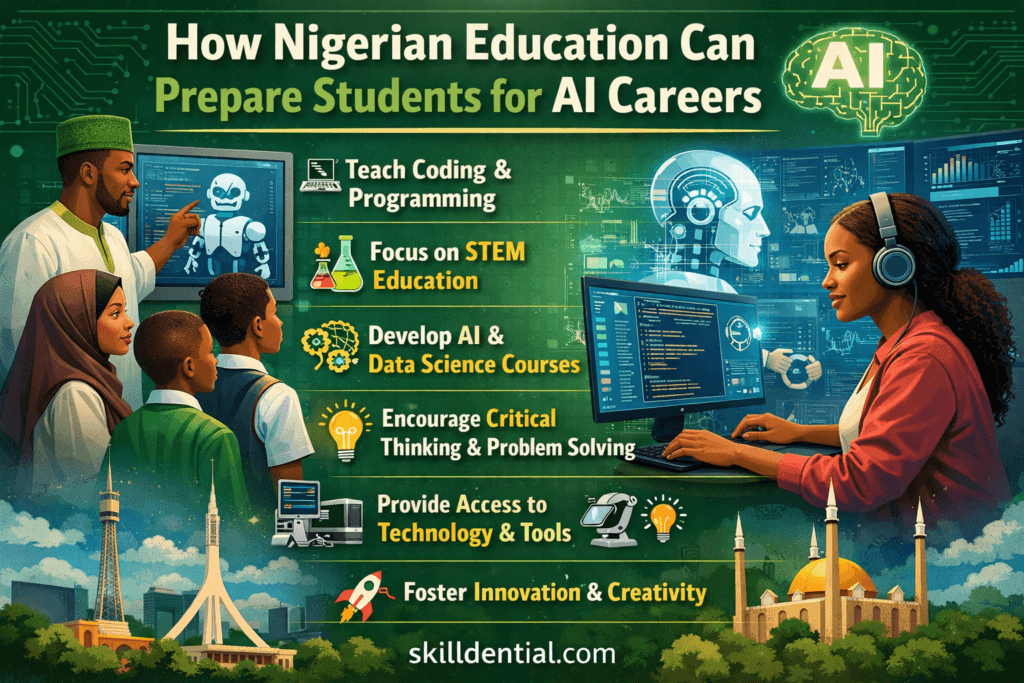
How to Bridge the Gap for AI Careers?
To become truly employable, students must adopt a hybrid learning model that combines academic foundational knowledge with specialized technical skills.
Supplement Degrees with Practical Bootcamps
University curricula move slowly, while the tech industry moves fast.
- Action: Enroll in intensive bootcamps such as Data Science Nigeria (DSN), Andela, or Decagon. These programs provide the hands-on experience, mentorship, and project-based learning missing from traditional classrooms.
Pursue Industry-Recognized Certifications
Certifications provide standardized proof of competence to employers.
- Action: Focus on certifications directly tied to industry tools:
- Data Analytics: Google Data Analytics Professional Certificate.
- Machine Learning/Cloud: AWS Certified Machine Learning – Specialty or Microsoft Certified: Azure AI Engineer Associate.
- Specialization: Coursera specializations in Deep Learning or Natural Language Processing.
Build a Portfolio on GitHub
Employers need to see what you can build, not just what you know.
- Action: Create projects that solve real Nigerian problems.
- Fintech: Build a loan risk prediction model using simulated Nigerian banking data.
- Agritech: Develop a computer vision model for crop disease detection.
Participate in Kaggle Competitions
Kaggle allows you to test your skills against a global community and work with real datasets.
- Action: Look for datasets related to the Nigerian context, such as fraud detection datasets from local fintech companies, and contribute to open-source solutions.
Summary Table: From Student to Professional
| Traditional Pathway | Required AI Pathway |
| Focus: Exam Grades | Focus: Portfolio Projects |
| Tools: Legacy languages (C++, Java) | Tools: Python, PyTorch, TensorFlow |
| Environment: Isolated Classroom | Environment: Community & Competitions |
| Outcome: Degree | Outcome: Hireability |
What Changes for Stakeholders?
Preparing Nigerian students for the AI job market requires immediate, coordinated action from three distinct groups. Here is the roadmap for what students, educators, and policymakers must do to close the skills gap.
Students: The Proactive Learner
Students must embrace a paradigm shift from passive knowledge consumption to active skill acquisition.
- Self-Paced Learning: Utilize platforms like fast.ai, Coursera, and Udemy to learn modern frameworks that universities may not cover.
- Targeted Certifications: Focus on acquiring specialized, industry-recognized certifications (e.g., Google Data Analytics, AWS Machine Learning) within 3-6 months of completing core coursework.
- Portfolio Building: Instead of focusing purely on theoretical exams, students must build a GitHub portfolio showcasing practical projects tailored to Nigerian contexts, such as fintech fraud detection or agritech predictive analytics.
Educators: The Facilitator
Educators must transition from traditional lecturers to facilitators of modern technical skills.
- Curriculum Updating: Actively incorporate Python, TensorFlow, and PyTorch into core computer science modules.
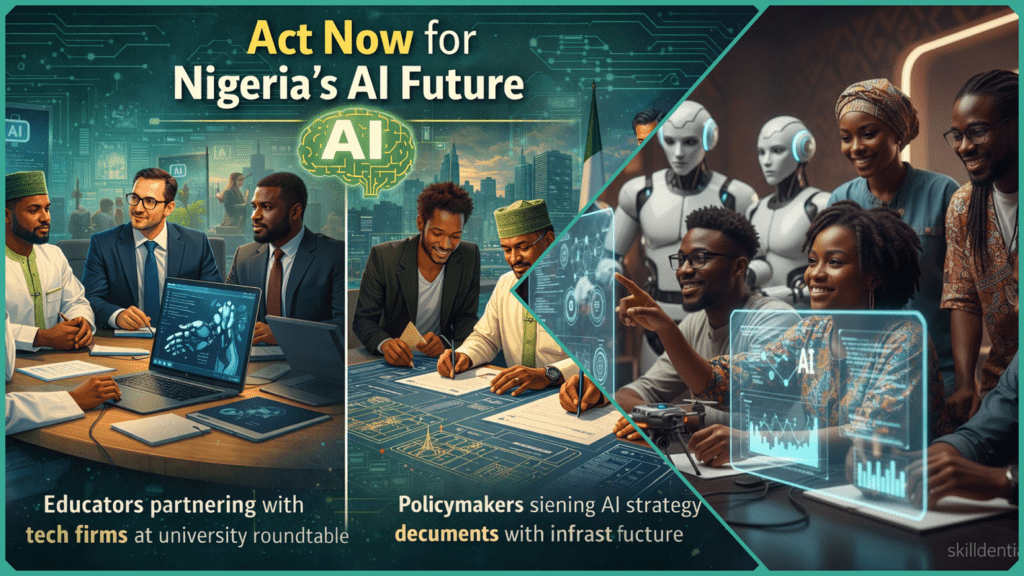
- Industry Partnerships: Facilitate stronger ties between universities and tech hubs in Lagos and Abuja. This includes inviting industry professionals to guest lecture and updating course projects to reflect real-world challenges.
Policymakers: The Enabler
The government must create the environment and infrastructure necessary for AI education to thrive.
- Infrastructure Funding: Fully implement the infrastructure provisions outlined in the National AI Strategy, specifically focusing on high-speed internet and reliable power supply for tertiary laboratories.
- R&D Commitment: Boost funding for research and development to 1% of the total education budget to encourage local innovation and AI application in sectors like healthcare and agriculture.
What is the 6-3-3-4 system in Nigerian education?
The 6-3-3-4 system is the national education structure comprising:
6 Years of Primary School (Basic education)
3 Years of Junior Secondary School (JSS)
3 Years of Senior Secondary School (SSS)
4-6 Years of Tertiary Education (Universities, Polytechnics, or Colleges of Education)
The goal is to prepare students for the Senior School Certificate Examination (SSCE) to gain tertiary admission. Since 2014, there has been a policy shift to integrate vocational skills earlier to reduce unemployment for those not proceeding directly to university.
Which sectors hire AI talent in Nigeria?
AI roles thrive primarily in Lagos and Abuja within the following sectors:
Fintech: Real-time fraud detection and credit scoring (e.g., Paystack, Flutterwave).
Agritech: Predictive analytics for crop yields and supply chain optimization.
Healthtech: Automated diagnostics and medical logistics.
Creative Industries: Generative AI for content creation and marketing automation.
What AI certifications suit Nigerian students?
To bridge the gap between theoretical university knowledge and industry demand, students should pursue practical, online certifications such as:
Data Analytics: Google Data Analytics Professional Certificate.
Machine Learning: IBM AI Engineering Professional Certificate or AWS Certified Machine Learning – Specialty.
General AI: Coursera AI for Everyone (Andrew Ng).
How does Nigeria’s National AI Strategy impact education?
The strategy aims to leverage AI for national productivity and economic growth. For education, it focuses on:
Curriculum Reform: Integrating AI and Robotics at the primary and secondary levels.
Teacher Training: Upskilling educators to teach digital literacy and AI basics.
Infrastructure: Phased investment in internet connectivity and high-performance computing centers in tertiary institutions.
What bootcamps train AI skills in Nigeria?
Intensive bootcamps provide the practical, project-based learning missing in many traditional curricula. Top choices include:
Data Science Nigeria (DSN): Focused on machine learning and deep learning projects.
Andela Learning Community (ALC): Offers AI and cloud computing pathways.
Coven Works: Specializes in intensive data science and AI labs.
In Conclusion
While Nigerian education remains rooted in a traditional theoretical framework, the rapid evolution of the global digital economy demands an urgent shift toward practical application. The skills gap is significant, particularly in bridging foundational computer science with the Machine Learning frameworks utilized in high-growth sectors like fintech and agritech.
However, the future is promising. Through a combination of focused bootcamps, industry-recognized certifications, and the implementation of the National AI Strategy, Nigerian students can bypass traditional institutional delays.
By taking proactive steps—such as completing a specialized certification or building a GitHub portfolio focused on local data challenges—students can position themselves to capture the high-value AI roles projected to emerge by 2030.