AI vs Cybersecurity: Which Career Path is Most Future-Proof?
In 2026, the tech landscape has reached a definitive turning point: neither Artificial Intelligence nor Cybersecurity stands alone as the “ultimate” future-proof career. Instead, the two fields have effectively collided. The most resilient professionals today are no longer pure specialists; they are hybrid experts—AI Threat Modelers and AI Security Specialists—who understand that you cannot build AI without securing it, and you cannot defend a modern network without the power of machine learning.
The numbers tell a story of explosive, interdependent growth. Information Security Analyst roles are projected to grow by 32–35% through 2034, a rate that dwarfs nearly every other occupation. Simultaneously, the World Economic Forum (WEF) identifies AI and big data skills as the #1 priority for business transformation. Yet, despite this demand, the industry is facing a breaking point: a global cybersecurity workforce gap that now exceeds 4.8 million unfilled positions.
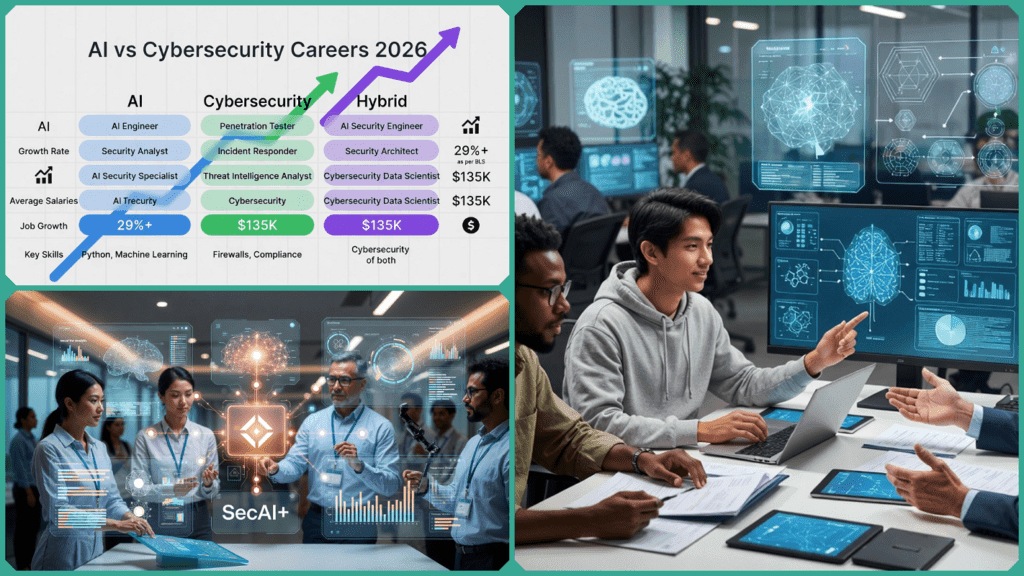
True future-proofing in this era requires a “dual-literacy” approach. As AI-driven threats—from automated phishing to adversarial model poisoning—become the new baseline, pure specializations risk rapid obsolescence. To stay relevant, the architects of tomorrow must learn to build the engine and master the shield at the same time.
Job Growth Comparison: The Numbers Behind the Hype
When evaluating a career path, raw demand is the ultimate indicator of “future-proofing.” As of early 2026, both AI and Cybersecurity are experiencing growth that outpaces nearly every other sector in the global economy, but for different reasons.
The Cybersecurity “Security” Net
Cybersecurity is currently defined by a perpetual talent cliff. While the global workforce has grown to approximately 5.5 million professionals, this hasn’t been enough to bridge the gap.
- Rapid Growth: The U.S. Bureau of Labor Statistics (BLS) projects a 29% growth rate for Information Security Analysts through 2034—a pace considered “much faster than average.”
- The 4.8 Million Gap: Globally, there is a staggering shortage of 4.8 million cybersecurity workers. In the U.S. alone, over 500,000 positions remain unfilled as organizations struggle to find qualified defenders.
- Recession Resistance: Because security is a regulatory and operational necessity, these roles are often protected even during economic downturns.
The AI Innovation Surge
AI career growth is driven by aggressive investment rather than a talent shortage alone.
- Top Priority: A 2026 World Economic Forum report reveals that 51% of organizations now prioritize AI skills above all other technical competencies.
- Emerging Roles: The “standard” AI developer role is evolving. We are seeing a massive spike in demand for MLOps (Machine Learning Operations) to manage model lifecycles and AI Governance Officers to handle the legal and ethical fallout of autonomous systems.
- The Pivot: While AI automates routine tasks, it creates a “net gain” of jobs by requiring humans to act as “agent orchestrators” and strategic supervisors.
The 2026 Winner: The Hybrid “Power User”
The data suggests that the most future-proof path isn’t a choice between the two, but a mastery of their intersection. Industry surveys show that 90% of cybersecurity teams now report a critical skills gap in AI/ML security.
Those who can defend against data poisoning (where hackers corrupt an AI’s training data) or use AI to automate threat hunting are seeing the highest salary premiums and the most aggressive recruitment in 2026.
Key Takeaway: If you want job security, choose Cybersecurity. If you want to lead innovation, choose AI. If you want to be irreplaceable, choose both.
Salary Trends: The Cost of Expertise in 2026
In 2026, the “pay gap” between AI and Cybersecurity has largely narrowed, but the structure of that pay remains different. While AI roles often feature aggressive total compensation packages (including equity), Cybersecurity roles offer unmatched base-salary stability and recession-proof demand.
The 2026 Salary Breakdown
Across the United States, specialized tech talent is seeing record-high earnings. The real story, however, is the 25% “AI Premium” now being applied to traditional security roles.
| Role Type | Average Base Salary (US) | Top Tier / Senior (90th Percentile) | Key “Future-Proof” Factor |
| Cybersecurity Analyst | $135,969 | $211,500 | Regulatory necessity; high stability. |
| AI Engineer | $145,080 | $250,000+ | High “Total Comp” (Bonuses + Equity). |
| AI Security Engineer (Hybrid) | $152,773 | $205,500 | Protects the company’s most valuable AI assets. |
| Cloud Security Architect | $140,000 | $185,000 | Essential for 2026 multi-cloud infrastructure. |
Why Hybrids Command a Premium
Managers in 2026 are increasingly hesitant to hire “pure” specialists. A pure AI engineer might build a brilliant model but leave it vulnerable to adversarial attacks, while a traditional security analyst might not understand how to audit a neural network.
As a result, “Hybrid” roles like AI Security Engineers or DevSecOps specialists with AI fluency now start at a higher baseline (often $150k+) because they solve two problems for the price of one.
Stability vs. Volatility
- The Cyber Edge: Cybersecurity is often viewed as a “utility.” Even if a company stops innovating, they cannot stop defending. This makes these salaries less volatile during market corrections.
- The AI Edge: AI salaries are currently inflated by a “Gold Rush” mentality. While the ceilings are higher (top researchers at labs like OpenAI or Meta can see packages in the millions), the roles are more sensitive to shifts in venture capital and corporate R&D budgets.
Pro Tip: In 2026, certifications like the CISSP (for security) or Google’s Professional ML Engineer (for AI) can boost these base figures by another 15–20%.
Skill Requirements: Building Your 2026 Toolkit
In 2026, the barrier to entry has shifted. Pure “coding” is no longer enough for AI, and pure “firewall management” is no longer enough for Cybersecurity. The most successful professionals are those who develop a “T-shaped” skill set—deep expertise in one area with broad literacy in the other.
The 2026 Skills Matrix
| Aspect | AI Careers | Cybersecurity Careers | Hybrid AI-Cyber Roles |
| Core Technical Skills | ML algorithms, data pipelines, Python, LLM fine-tuning. | Threat detection, GRC (Compliance), Cloud security, Identity (IAM). | AI threat modeling, Adversarial ML, Prompt injection defense. |
| Primary Growth Driver | Scaling “Agentic” AI systems for enterprise. | Closing the 4.8M global talent gap; Zero Trust adoption. | Automating SOCs with AI; Auditing model integrity. |
| Key Entry Barrier | Advanced math, statistics, and high coding aptitude. | Logic, systems thinking, and certifications (SecAI+). | Both technical worlds + soft skills for ethical oversight. |
| Automation Risk | Low for builders and researchers. | Low for strategic defenders and responders. | Minimal; AI is the tool, humans are the pilots. |
The Rise of “SecAI+”: The New Industry Gold Standard
One of the most significant shifts in 2026 is the launch of the CompTIA SecAI+ certification. This credential has quickly become the “Security+” of the new era. It validates that a professional can not only protect traditional networks but also:
- Defend against Adversarial ML: Protecting models from “data poisoning” where hackers corrupt the training sets.
- Implement Prompt Guardrails: Preventing “jailbreaking” attempts on company-facing AI bots.
- Audit AI Governance: Ensuring systems comply with the latest 2026 regulations like the EU AI Act.
Human Oversight: The Irreplaceable Skill
While AI now automates routine log analysis and basic malware scanning, it has amplified the need for human judgment. In 2026, we’ve learned that AI is a “force multiplier,” not a replacement.
- In AI, Humans are needed to debug “hallucinations” and ensure ethical alignment.
- In Cyber: Humans are needed to handle “high-stakes” incident response where an AI might lack the context of business priorities.
The Verdict for 2026: AI eases the “boring” parts of both jobs, but it creates a higher demand for humans who can manage the complexity that AI leaves behind.
The Hybridization Trend: Why Adaptability is Your Best Insurance
In 2026, the tech industry has moved past the “AI vs. Human” debate. We are now in the era of the augmented professional. Rather than replacing jobs, AI is acting as a force multiplier for those who know how to wield it.
The “Enhancement” Reality
According to recent industry sentiment, 87% of cybersecurity professionals now view AI as an enhancement to their roles rather than a threat. By automating the “drudgery” of manual log analysis and signature-based detection, AI is freeing up human experts to do what they do best: high-stakes strategy and complex problem-solving.
- New Roles for a New Era: We are seeing the rise of the AI Incident Response Lead. These specialists don’t just respond to static threats; they manage “Agentic AI” systems that hunt for vulnerabilities in real-time, essentially leading a digital army of autonomous defense agents.
- The 2030 Horizon: Projections show that by 2030, over 50% of all cybersecurity job postings will require explicit AI/ML literacy as a baseline requirement.
The “Skilldential” Evidence: A 40% Advantage
Data from recent Skilldential career audits highlights a stark divide in the 2026 job market. STEM students who pursued “siloed” paths—focusing exclusively on pure AI theory or traditional network security—often struggled with longer job searches.
- The Hybrid Payoff: In contrast, candidates who completed hybrid training programs (blending AI fluency with security fundamentals) saw 40% faster job placement rates.
- The “Generalist” Myth: Being a generalist is no longer enough. The market now demands “specialized hybrids”—someone who understands the deep math of an LLM and the security architecture required to protect it from prompt injection.
Battling “Data Poisoning” and Beyond
The hybrid professional is the only one equipped to handle 2026’s most sophisticated threats.
- Adversarial ML: Hackers are now using AI to “poison” the data that other AI models learn from. A traditional security analyst might miss the subtle anomalies in a data pipeline, but a hybrid specialist can audit the model’s integrity.
- Model Auditing: As companies deploy thousands of internal AI agents, the need for humans to audit these “silicon employees” for bias and security leaks has become a multi-billion-dollar niche.
Final Thought on Trends: In 2026, you aren’t competing against AI. You are competing against other humans who use AI better than you.
Which Career Path Fits You? The 2026 Decision Matrix
By now, it’s clear that the “perfect” choice depends on your starting line and your long-term goals. In 2026, the tech industry isn’t just looking for “smart people”—it’s looking for the right type of thinker.
The Career Switcher: Prioritize Stability & ROI
If you are pivoting from a non-tech background, Cybersecurity is often the faster, more reliable route.
- The Strategy: Focus on specialized certifications like the new SecAI+ or traditional foundations like Security+.
- Why: Organizations are desperate to fill the 4.8 million-person gap and are increasingly open to career switchers who can demonstrate “defensive logic” and compliance knowledge. You can often become job-ready in 6–12 months.
The STEM Student: High Prestige, Higher Floor
For students currently in university, AI is the “prestige” path, but it comes with a higher academic barrier.
- The Strategy: Don’t just study algorithms. Maximize your lucrativeness by graduation by choosing a Hybrid Minor.
- The Winning Combo: An AI major with a focus on Adversarial Machine Learning or Cloud Security will put you in the top 1% of applicants by 2027.
The Tech-Adjacent Manager: Anticipation Over Generalism
If you are already in a leadership or project management role, your value lies in Threat Anticipation.
- The Strategy: Move toward AI Governance or Risk Management.
- Why: Companies don’t just need people to build bots; they need leaders who can ensure those bots don’t hallucinate sensitive company data onto the public web.
Self-Assessment: Builder, Defender, or Hybrid?
- Choose the “Builder” (AI) Career Path if: You love advanced math, you enjoy the “trial and error” of training models, and you want to be at the forefront of creation.
- Choose the “Defender” (Cyber) Career Path if: You have a “detective” mindset, you enjoy outsmarting adversaries, and you value a virtually recession-proof career.
- Choose the “Hybrid” Career Path if: You want to be the most valuable person in the room. You enjoy the intersection of how a system thinks and how to break (or protect) it.
Take Your First Step
The market moves fast, and 2026 is the year of the “skills-first” economy. Don’t let indecision stall your progress. Download the 2026 Tech Skills Checklist — A step-by-step roadmap to mastering the essential skills that bridge the gap between AI and Cybersecurity.
AI vs. Cybersecurity Career Path: FAQs
What defines a “future-proof” tech career in 2026?
A future-proof career in 2026 is defined by non-repeatable human judgment. While AI can automate code generation or log monitoring, it cannot replace the ethical reasoning, strategic adaptability, and cross-domain expertise required in high-stakes environments. According to the WEF, the most resilient roles are those where AI acts as a “co-pilot” rather than a replacement.
Will AI replace cybersecurity jobs by 2030?
Current projections for 2030 show that AI will actually expand the cybersecurity field. While it may eliminate repetitive entry-level tasks (like basic alert sorting), it is creating a massive need for AI Security Advisors and Model Auditors. With a global shortage of 4.8 million professionals, the industry needs AI to keep up with the volume of attacks—human oversight remains the final line of defense.
How do entry-level salaries compare in 2026?
- Cybersecurity Analysts typically start between $70,000 and $96,490, depending on their certifications.
- AI Engineers: Command a slightly higher starting base of $103,015 to $115,000 due to the high math and coding barrier.
- The Hybrid Advantage: Candidates with “AI-Security” skills are seeing starting offers exceed $120,000, as they fulfill two critical needs for a single organization.
How do I enter the “Hybrid” AI-Cyber field?
The most efficient route in 2026 is to build a “Security First” foundation and layer on AI fluency.
- Core Certs: Start with a baseline like CompTIA Security+ or the newer SecAI+.
- Specialized Learning: Take a short-form course on Adversarial Machine Learning or AI Governance.
- Hands-on Practice: Use open-source tools to practice “threat modeling” on local LLMs to understand their vulnerabilities.
Which field has better job security right now?
Both are exceptionally secure, but Cybersecurity has a slight edge in “recession-proofing.” Organizations view security as a mandatory utility (like electricity), whereas AI budgets can sometimes be tied to innovation cycles. However, the 29–35% projected growth for security analysts ensures that as long as you keep your skills updated, you will remain in high demand.
If you want to build the future, go AI. If you want to protect it, go into Cybersecurity. If you want to own it, go Hybrid.
In Conclusion
In 2026, the tech industry has made its verdict clear: the most “future-proof” career isn’t about picking a side, but about mastering the intersection of creation and protection.
Final Takeaways for your 2026 Career
- Exponential Growth on Both Sides: Cybersecurity remains the “recession-proof” bedrock with a 29%–35% growth rate and a global shortage of 4.8 million experts. Simultaneously, the AI market is surging toward a $2 trillion valuation, creating entirely new categories of work that didn’t exist two years ago.
- The Hybrid Era is Here: In 2026, “siloed” specialists are at risk. 87% of professionals now use AI to enhance their security workflows. The most sought-after hires are those who can bridge the gap—using AI for real-time threat hunting while ensuring those same AI models aren’t vulnerable to adversarial attacks.
- Salaries Reflect the Complexity: With average salaries for both fields now exceeding $130,000–$145,000, the financial reward is high. However, the “Hybrid Premium” is real; roles that combine both disciplines, like AI Security Engineers, are commanding the highest starting packages and fastest placement times.
- Know Your Archetype: * If you thrive on innovation and building, lean toward AI.
- If you thrive on investigation and defense, lean toward Cybersecurity.
- If you want to be irreplaceable, master the tools of both.
Your Next Step: Get the Roadmap
The difference between a “tech worker” and a “future-proof specialist” in 2026 is a structured plan. Don’t waste time on outdated certifications.
- Get a personalized learning path based on your archetype.
- See the top 9 “Hybrid” skills employers are fighting for this year.
- Access a curated list of the most valuable 2026 certifications (like SecAI+).
Discover more from SkillDential | Your Path to High-Level Career Skills
Subscribe to get the latest posts sent to your email.