
AI in HR leverages machine learning and predictive analytics to transform human resource functions into data-driven strategic assets. By processing high-velocity datasets from HRIS via neural networks, these systems forecast talent requirements and identify latent skill gaps with up to 88% accuracy.
Platforms such as Visier and Workday facilitate real-time workforce optimization, typically reducing turnover risks by 10–20%. However, the integrity of these outputs depends on clean, unbiased data integration; without rigorous data hygiene, AI risks automating and amplifying legacy systemic errors.
How Does AI Improve Workforce Planning Accuracy?
Integrating AI in HR shifts workforce planning from reactive estimation to proactive modeling by replacing static spreadsheets with dynamic algorithmic frameworks. This improvement in accuracy is driven by three primary technical advantages:
High-Dimensional Data Processing
Traditional planning relies on manual inputs and linear correlations. Implementing AI in HR allows for the use of neural networks to process high-dimensional data—integrating internal metrics (attrition rates, performance scores, time-to-hire) with external variables (competitor hiring trends and economic indicators).
By identifying non-linear relationships that a human analyst might miss, these systems achieve 88% predictive accuracy for talent demand, significantly outperforming the 78% average of standard logistic regression.
Stochastic Scenario Simulations
Static models provide a single, often optimistic, headcount forecast. Modern applications of AI in HR use Monte Carlo simulations to run thousands of permutations simultaneously. These simulations account for variance in project timelines and budget shifts. This enables HR leaders to visualize a probability distribution of talent needs, effectively minimizing over-hiring by 15–30% through rigorous scenario testing.
Elimination of Cognitive Bias
Human-led forecasting is often skewed by “recency bias”—the tendency to over-weight the previous quarter’s results. By deploying AI in HR, organizations utilize longitudinal data across multi-year cycles to identify seasonal patterns and cyclical attrition. When integrated with clean data, these algorithms provide a neutral baseline for workforce allocation, ensuring staffing levels are dictated by data-backed necessity rather than departmental intuition.
Comparison of Accuracy Frameworks
| Feature | Traditional Spreadsheets | AI in HR Models |
| Logic | Linear / Deterministic | Non-Linear / Stochastic |
| Data Update | Manual / Periodic | Real-time / Continuous |
| Accuracy Rate | ~70–78% | ~85–92% |
| Primary Risk | Human / Recency Bias | Algorithmic Bias (if data is poor) |
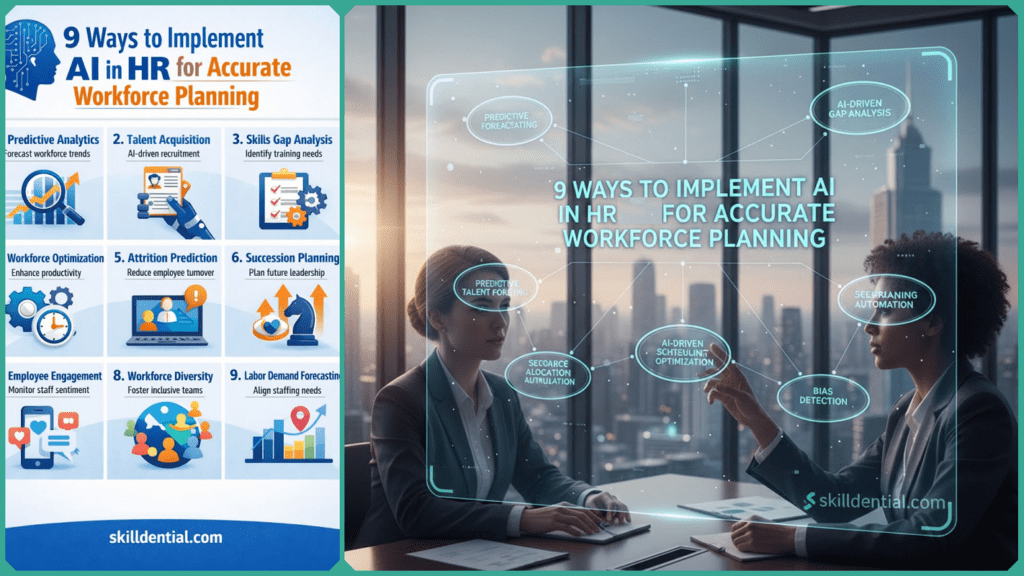
9 Ways to Implement AI in HR for Accurate Workforce Planning
Moving from theoretical accuracy to operational success requires a structured deployment of machine learning across the talent lifecycle. Implementing AI in HR is not a singular event but a multi-layered integration of predictive tools and data pipelines. The following nine strategies represent the industry standard for transforming raw HRIS data into high-precision workforce forecasts.
Predictive Talent Forecasting
Integrate AI in HR with your existing HRIS to analyze attrition rates and business growth for 3–18 month headcount projections. Tools like Gloat align forecasts with skills intelligence.
Case Study: In Skilldential career audits, HR Directors struggled with reactive hiring. Implementing predictive forecasting resulted in a 25% improvement in headcount ROI.
Skills Gap Analysis
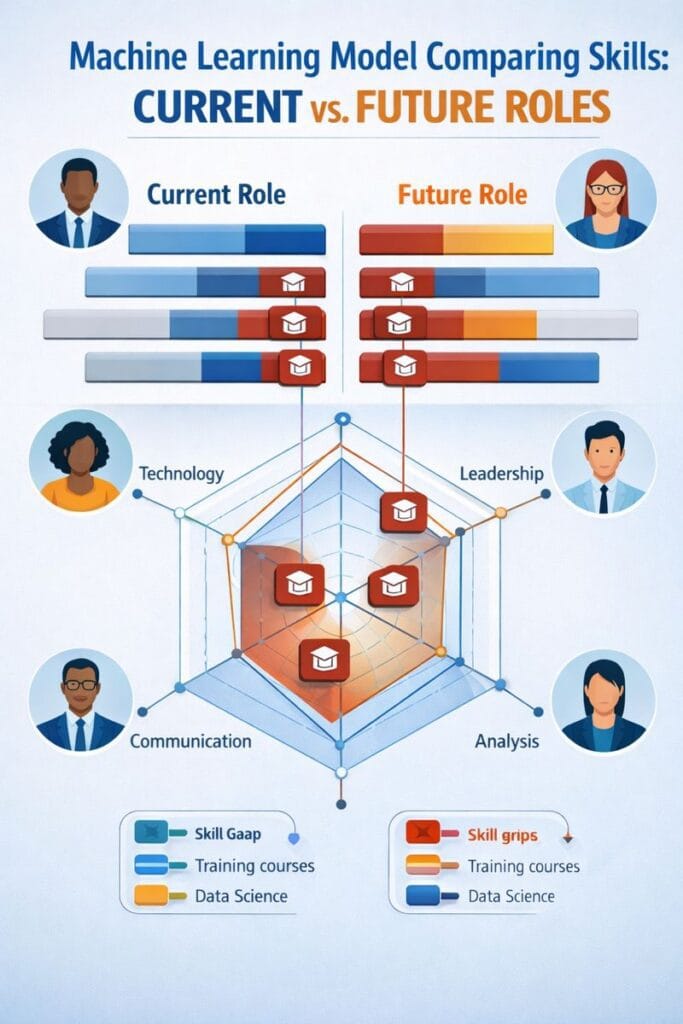
Deploy machine learning to scan employee profiles against future role requirements, flagging competency shortfalls. Utilizing AI in HR through platforms like Visier allows leaders to identify training needs proactively before they impact productivity.
Churn Prediction Modeling
Apply algorithms to tenure, performance, and engagement data to score flight risks using AUC (Area Under the Curve) metrics. By leveraging AI in HR to target retention for high-risk employees, organizations typically reduce turnover by 10–20%.
AI-Driven Sentiment Analysis
Process employee surveys and internal communications via Natural Language Processing (NLP) to detect dissatisfaction. This application of AI in HR surpasses exit interviews by providing real-time, unbiased qualitative insights into organizational health.
Dynamic Scheduling Optimization
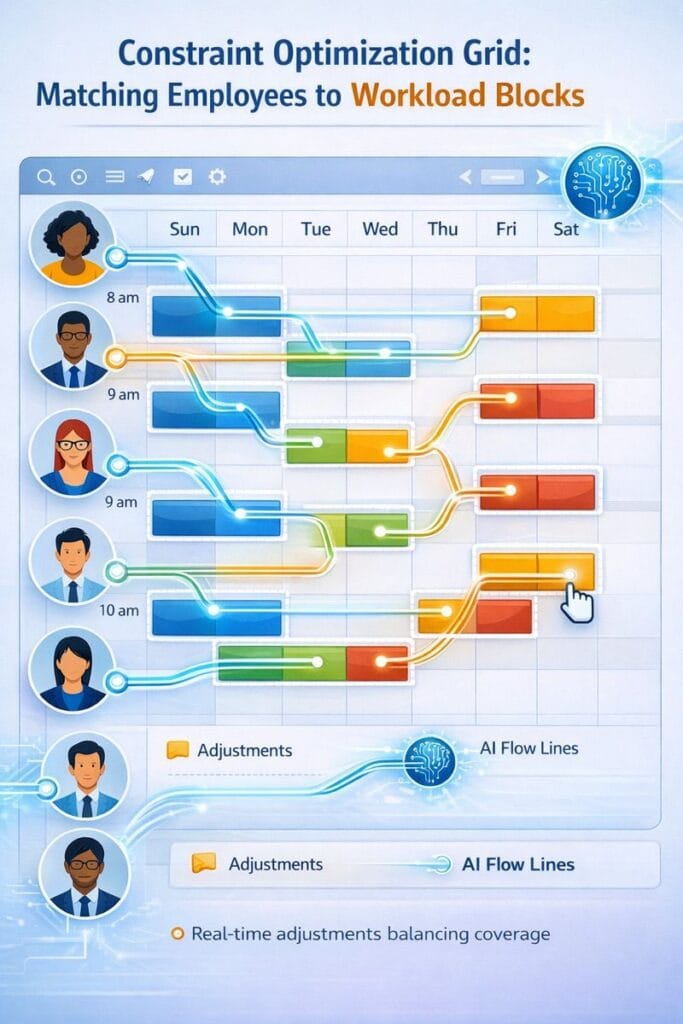
Apply constraint programming within tools like Workday to balance workloads and coverage. This use of AI in HR ensures that labor allocation matches fluctuating demand cycles without manual intervention.
Algorithmic Bias Detection
Use AI in HR to audit job postings and candidate assessments for demographic disparities. By identifying hidden biases in historical hiring data, planners can ensure future workforce growth is both equitable and legally compliant.
Automated Resource Allocation
Deploy AI in HR to match specific tasks to employee availability and skill sets. This real-time optimization increases labor utilization rates and identifies where “bench strength” is under-leveraged.
Stochastic Scenario Simulations
Use neural network models to run “what-if” analyses regarding market shifts or sudden turnover. This implementation of AI in HR provides a probability distribution of outcomes, allowing for more resilient strategic planning than static modeling.
HRIS Integration Pipelines
Establish robust API integrations between specialized tools (e.g., Beamery) and core systems such as Oracle HCM. Seamless data pipelines are essential when implementing AI in HR to ensure models have access to high-fidelity, real-time data for accurate forecasting.
Implementation Checklist for Accuracy
- Data Hygiene: Audit your HRIS for duplicate or incomplete records before model training.
- Model Validation: Compare AI forecasts against actual Q1-Q2 results to fine-tune weighting.
- Ethical Guardrails: Ensure all NLP and sentiment tools comply with GDPR and privacy standards.
AI in HR: Technical Tools Comparison
Selecting the right platform for AI in HR depends on whether your organization prioritizes core system consolidation or specialized “best-of-breed” intelligence. The following table evaluates four industry leaders based on their workforce planning architecture.
| Tool | Key Strength | Integration Ease | Accuracy Claim | Cost Model |
| Visier | Predictive People Analytics | High (Direct Connect): Pre-built connectors for major HRIS/ATS. | Up to 10x ROI through early attrition detection. | Subscription |
| Workday | Adaptive Headcount Planning | Enterprise Native: Best for organizations already on the Workday stack. | Real-time budget-to-actual reconciliation. | Custom / Enterprise |
| Gloat | Skills-Based Work Orchestration | Moderate (API-driven): Plugs into HCM to map internal mobility. | 80% increase in internal talent utilization. | Enterprise |
| Beamery | Skills Intelligence & Demand Forecasting | Moderate (Certified): Deep bi-directional sync with Workday and SAP. | 90% accuracy for inferred skill data. | Custom |
Analysis of Leading Platforms
- Visier: Often cited for its “Real-time People Data Platform,” it excels at turning raw data into actionable stories without requiring a dedicated data science team. Its strengths in AI in HR lie in pre-built templates for attrition and compensation.
- Workday (Adaptive Planning): For larger enterprises, this tool provides the most robust financial-to-HR bridge. It utilizes “Illuminate AI” to automate headcount reconciliation, which traditionally consumes 70% of a planner’s manual labor.
- Gloat: This platform is the pioneer of the “Talent Marketplace.” It uses AI in HR to deconstruct jobs into specific tasks and skills, allowing for highly accurate redeployment during organizational pivots.
- Beamery: Leveraging a proprietary “Knowledge Graph” of 20 billion data points, Beamery is the leader for “Skills-First” planning. It provides high-fidelity inferences for skills that employees may not have explicitly listed on their resumes.
How Do Neural Networks Enhance HR Predictions?
While traditional analytics rely on linear models—assuming a straight-line relationship between variables—AI in HR utilizes neural networks to interpret the complex, non-linear realities of human behavior.
Processing Non-Linear Relationships
In workforce planning, variables rarely move in tandem. For example, a 5% increase in overtime might not affect retention initially, but once it crosses a specific threshold, attrition may spike exponentially. Standard regression models often fail to capture these “tipping points.” Neural networks, however, use hidden layers to weight these variables dynamically, resulting in 88% accuracy for retention and demand forecasts.
Deep Pattern Recognition in Unstructured Data
Neural networks excel at “feature engineering”—the ability to find patterns in vast, disparate datasets without being explicitly told what to look for. By analyzing high-velocity data from HRIS, such as the frequency of internal profile updates or fluctuations in sentiment scores, AI in HR identifies the subtle precursors to turnover that traditional manual audits overlook.
Continuous Learning Loops
Unlike static spreadsheets that require manual updates, neural networks function as “living” models. As new data points enter the HRIS, the network recalibrates its weights. This ensures that your workforce planning remains accurate even as external market conditions or internal company cultures shift.
Technical Summary: Regression vs. Neural Networks
| Capability | Logistic Regression | Neural Networks (AI in HR) |
| Data Complexity | Low to Moderate | High / High-Dimensional |
| Relationship Type | Linear | Non-Linear & Multi-layered |
| Pattern Discovery | Manual / Hypothesis-led | Automated / Pattern-led |
| Accuracy (Retention) | ~78% | ~88% |
What Risks Does AI Mitigate in Workforce Planning?
Implementing AI in HR serves as a strategic safeguard against the financial and operational volatility inherent in manual workforce management. While spreadsheets are prone to “broken logic” and static data, AI models provide a resilient framework for risk mitigation.
Financial Risk: Eliminating Over-Hiring and Labor Surplus
Manual forecasting often leads to “headcount padding,” where departments over-request staff to buffer against uncertainty. By applying stochastic simulations, AI in HR identifies the precise labor requirements for specific business outcomes.
- The Impact: Predictive models can reduce over-hiring risks by 15–30%, directly preserving EBITDA by preventing unnecessary salary and onboarding expenditures.
Operational Risk: Correcting Human and Recency Bias
Human planners frequently suffer from “recency bias”—weighting the current month’s turnover more heavily than long-term cyclical trends. AI in HR mitigates this by utilizing longitudinal data to differentiate between seasonal attrition and genuine systemic flight risks.
- The Impact: Objective churn insights allow HR to move from reactive replacement to proactive retention, maintaining organizational stability during market shifts.
Legal and Ethical Risk: Bias Detection in Labor Allocation
Spreadsheet-based planning often masks underlying demographic imbalances in promotion pipelines or task distribution. Modern AI in HR tools include algorithmic auditing features that flag disparities in gender, age, or ethnicity.
- The Impact: By using objective, skills-based data for workforce allocation, organizations reduce the risk of non-compliance with labor laws (such as the Equality Act 2010 or GDPR) and ensure equitable career development.
Risk Mitigation Framework
| Risk Type | Manual Planning Vulnerability | AI in HR Mitigation Strategy |
| Data Integrity | Manual entry errors; stale data. | Automated API sync; real-time updates. |
| Forecasting | Linear “best guess” estimates. | Neural networks / non-linear modeling. |
| Retention | Reactive (after the resignation). | Predictive (high-risk scoring via AUC). |
| Bias | Subjective / Unconscious “gut feel.” | Fairness-aware algorithms / Blind screening. |
What is AI in HR workforce planning?
Workforce planning through AI in HR is a strategic process that utilizes machine learning and high-velocity data analytics to forecast future talent needs. Unlike traditional manual methods, it identifies latent skill gaps and models diverse staffing scenarios by automatically ingesting data from your HRIS, ATS, and external labor market signals.
How accurate are AI churn predictions?
When properly implemented, AI in HR models achieves 80–88% accuracy in identifying “flight risk” employees. These systems utilize neural networks to analyze engagement and productivity patterns, with success validated through ROC AUC (Area Under the Curve) and F1-scores rather than simple percentage-based guesses.
Can AI integrate with existing HRIS?
Yes. Modern AI in HR tools is designed for seamless integration via robust APIs. For instance, platforms like Workday or Oracle HCM allow for real-time data syncing. However, the accuracy of the output depends on a “data first” approach—ensuring your records are cleaned and unified before the AI begins its ingestion cycle.
Does AI reduce bias in HR planning?
When configured with ethical guardrails, AI in HR detects demographic disparities in hiring and promotion data that human audits often overlook. By analyzing large datasets objectively, AI can provide a neutral baseline for workforce allocation, though it requires regular “fairness audits” to ensure it does not replicate legacy systemic biases.
What metrics measure AI HR success?
Organizations implementing AI in HR should track three primary KPIs:
Retention Rate Improvement: Targeting a 10–20% reduction in avoidable turnover.
Forecast Accuracy: Measuring the delta between AI headcount projections and actual business needs (aiming for 85%+).
Headcount ROI: Tracking the reduction in over-hiring costs, typically resulting in a 15–30% efficiency gain.
In Conclusion
Integrating AI in HR transforms workforce planning from a reactive administrative burden into a proactive, high-precision strategic advantage. By leveraging neural networks for retention forecasting, stochastic models for scenario planning, and machine learning for skill-gap identification, organizations can achieve up to 88% accuracy in their talent projections. This data-driven approach not only minimizes the financial risks of over-hiring by 15–30% but also creates a more equitable, bias-resistant organizational framework.
To begin your transition, focus on high-fidelity data audits of your current HRIS records and initiate a pilot program using a targeted tool like Visier or Beamery to solve a specific pain point, such as attrition risk or skills mapping.
Executive Summary: AI in HR Implementation
- Strategic Objective: Transition from static, linear spreadsheets to dynamic, predictive workforce modeling.
- Core Technologies: Neural networks, Natural Language Processing (NLP), and Monte Carlo simulations.
- Primary Benefits: Increased forecast accuracy, 10–20% reduction in turnover, and elimination of recency bias.
- Immediate Action: Audit data hygiene and map API integration requirements for real-time analytics.
Ready to modernize your workforce strategy? Download the AI Implementation Checklist to guide your data audit, tool selection, and pilot launch.

With a focus on AI certifications, cybersecurity, and global job placement, I analyze high-income skill paths so you don't have to. Connect with me on [LinkedIn/X] to join the conversation on navigating the 2026 workforce.
- Blockchain Integration Frameworks to Scale Enterprise Trust - February 3, 2026
- 9 AI Certifications for Career Switchers from STEM Fields - February 3, 2026
- Top 9 AI Trading Platforms for Crypto vs. Stock Trading - February 3, 2026
Discover more from SkillDential | Your Path to High-Level AI Career Skills
Subscribe to get the latest posts sent to your email.