9 AI Certifications for Product Managers Without a CS Degree
In an era where ‘AI-first’ is the baseline for product strategy, AI certifications for product managers have shifted from optional upskilling to a professional mandate. For non-technical leaders, these credentials bridge the gap between business vision and engineering feasibility—without requiring a CS degree.
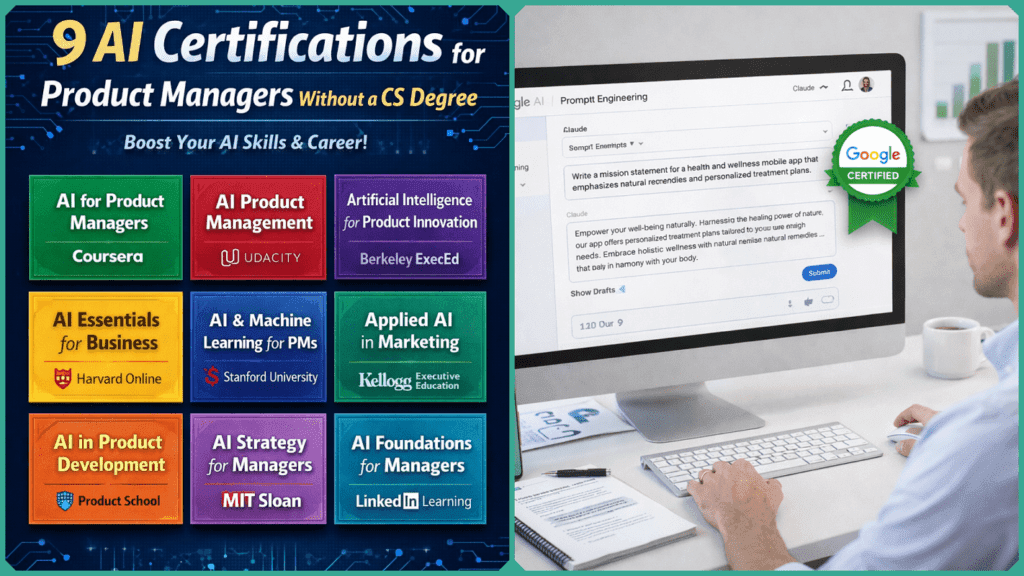
Top programs from IBM, Duke, and Google move beyond basic literacy, equipping PMs to manage the full AI lifecycle, master prompt engineering for rapid prototyping, and navigate the high-stakes world of ethical deployment. This guide evaluates the top certifications that empower PMs to lead high-ROI roadmaps and command authority in the data science room.
9 AI Certifications for Product Managers Without a CS Degree
These nine AI certifications for product managers prioritize technical literacy, strategic AI governance, and no-code prototyping for mid-to-senior PMs. Each review assesses technical depth, strategic focus, hands-on elements, and industry recognition based on 2026 program details. These programs are vetted specifically for non-technical leaders who must manage AI lifecycles without writing code.
IBM AI Product Manager Professional Certificate
- Technical Depth: High (Concepts). Explains the “black box” of neural networks and foundation models using visual logic rather than Python.
- Strategic Focus: Strong emphasis on ROI, data privacy, and ethical AI deployment.
- Hands-on Elements: Includes a capstone project building an AI-powered chatbot using no-code IBM Watson tools.
- Recognition: Extremely high; widely recognized by Fortune 500 recruiters.
AI Product Management Certification (Product School)
- Technical Depth: Medium. Focuses on the “AI Stack” and how to set technical requirements for engineering teams.
- Strategic Focus: Heavily oriented toward product-market fit for AI features and “Vibe Coding” for PMs.
- Hands-on Elements: Immersive group exercises involving prompt precision and no-code AI agent orchestration.
- Recognition: The industry standard for digital PMs looking to pivot specifically into AI roles.
MIT No-Code AI & Machine Learning Certificate
- Technical Depth: High. Uses professional platforms like RapidMiner to teach complex ML prototyping without a single line of code.
- Strategic Focus: Covers advanced topics like Retrieval-Augmented Generation (RAG) and Agentic AI workflows.
- Hands-on Elements: Three portfolio-ready projects focusing on predictive analytics and recommendation engines.
- Recognition: Elite academic credential that signals deep commitment to the field.
Duke AI Product Management Specialization
- Technical Depth: Low to Medium. Focuses on the “Data Science Process” and probabilistic thinking.
- Strategic Focus: Strong emphasis on human-centered AI design and managing the risk of model “hallucinations.”
- Hands-on Elements: Case-study driven; students develop a full AI Product Requirement Document (PRD).
- Recognition: High academic weight; excellent for PMs in regulated industries (Healthcare, Finance).
Google AI Essentials
- Technical Depth: Low. Designed for rapid literacy in generative AI tools (Gemini) and prompting.
- Strategic Focus: Focuses on workplace productivity and “Responsible AI” guardrails.
- Hands-on Elements: Skill-based labs on prompt engineering and automating PM workflows.
- Recognition: Best for “resume future-proofing” and showing foundational competency.
Microsoft AI Product Manager Professional Certificate
- Technical Depth: Medium. Deep dive into cloud AI infrastructure and integrating Copilots into B2B SaaS.
- Strategic Focus: Enterprise-level security, compliance, and multi-tenant AI scaling.
- Hands-on Elements: Creating AI solution prototypes using Microsoft’s “Fluent UI” and low-code frameworks.
- Recognition: Critical for PMs working within the Microsoft/Azure ecosystem.
AI for Everyone (DeepLearning.AI)
- Technical Depth: Low. A theoretical masterclass by Andrew Ng on what AI can and cannot realistically do.
- Strategic Focus: Building an “AI Transformation” roadmap for an entire organization.
- Hands-on Elements: None; purely conceptual and strategic.
- Recognition: Ubiquitous; often used as the “entry ticket” for any PM entering the AI space.
AWS Certified AI Practitioner (AIF-C01)
- Technical Depth: Medium. Teaches the cloud services (Bedrock, SageMaker) that power modern AI.
- Strategic Focus: Cost-benefit analysis of “Build vs. Buy” for LLMs and cloud governance.
- Hands-on Elements: Sandbox labs for testing model performance metrics like accuracy and F1 scores.
- Recognition: Essential for PMs at startups or enterprises built on AWS infrastructure.
Product Dive AI Product Management Program
- Technical Depth: Medium. Bridges the gap between data science literacy and practical product roadmapping.
- Strategic Focus: Intensive focus on market needs assessment and AI-specific KPIs.
- Hands-on Elements: Rapid prototyping sessions and “vibe coding” to improve PM-Engineering collaboration.
- Recognition: Rapidly growing in the PM community for its practical, cohort-based learning model.
Certification Comparison Matrix
The table below synthesizes the leading AI certifications for product managers based on 2026 industry benchmarks. Use this to align your choice with your specific career deficit—whether that is technical fluency or enterprise strategy.
| Certification | Technical Depth (Black Box) | Strategic Focus (Ethics/ROI) | Hands-On (No-Code) | Industry Recognition |
| IBM AI PM | High | High | High (Projects) | High (Fortune 500) |
| Product School | Medium | High | Medium (Workshops) | High (Startups/Tech) |
| MIT No-Code | High | High | High (3 Projects) | Very High (.edu) |
| Duke Specialization | Medium | Medium | Medium (Case Study) | High (Academic) |
| Google AI Essentials | Low | Medium | Low (Prompting) | High (Foundational) |
| Microsoft AI PM | Medium | High | High (Portfolio) | High (Enterprise) |
| AI for Everyone | Low | High | None (Theory) | Universal |
| AWS AI Practitioner | Medium | Medium | Medium (Labs) | Rising (Cloud-native) |
| Product Dive | Medium | Medium | Medium (Prototyping) | Niche/Community |
The Impact of Certification: 2026 Audit Data
Analysis from Skilldential career audits reveals a critical “performance gap” for product leaders in AI environments. Before specialized training, non-technical PMs struggled with precision-recall trade-offs in 72% of AI-specific PRD reviews—leading to misalignment with engineering capabilities and inflated timelines.
However, after completing rigorous programs like the IBM AI Product Manager or MIT No-Code certificates, these same professionals saw a 58% improvement in their ability to conduct KPI-aligned evaluations. This shift moves the PM from a “vibe-based” decision-maker to a decision scientist capable of defending model performance against business objectives.
How does technical literacy differ from coding in these certs?
In 2026, the distinction between technical literacy and coding is the primary driver behind the surge in AI certifications for product managers. While coding is about the syntax and execution of algorithms, technical literacy is about the architecture and orchestration of AI systems.
Core Differences in Learning Outcomes
| Feature | Coding (Engineering Focus) | Technical Literacy (PM Focus) |
| Primary Goal | Writing functional Python or R scripts to build models. | Understanding model behavior to set strategic requirements. |
| Success Metric | Model compilation, code efficiency, and bug-free execution. | Aligning model performance (e.g., F1 score) with business KPIs. |
| Interaction Layer | IDEs (VS Code), Terminal, and API implementations. | No-code platforms (RapidMiner, KNIME) and Prompt Engineering. |
| Problem Solving | Debugging race conditions or syntax errors. | Managing “probabilistic uncertainty” and ethical hallucinations. |
How Certifications Bridge the Gap
For a product manager without a CS degree, “technical literacy” serves as a translator’s toolkit. Programs like MIT No-Code AI or IBM AI Product Manager replace manual programming with high-level conceptual mastery in the following areas:
- Probabilistic vs. Deterministic Thinking: Traditional software is deterministic (Input A always yields Result B). Technical literacy teaches PMs to manage probabilistic systems where the model provides a “best guess.” PMs learn to design “graceful failures” for when the AI is wrong.
- Metric Alignment (The “Why” over “How”): Instead of learning how to calculate a loss function, these certifications teach you which metric matters for the user experience.
- Example: In a medical AI, high Recall is critical (don’t miss a case). In a spam filter, high Precision is better (don’t block important emails).
- Prototyping via “Vibe Coding” and No-Code: Technical literacy enables PMs to use tools such as RapidMiner or Canvas to build functional prototypes. This is often called “Vibe Coding”—using natural language prompts and visual logic to simulate an AI feature before engineering spends a single sprint on it.
- Orchestration of AI Agents: Modern AI PMs don’t build one single model; they orchestrate “Agentic Workflows.” Literacy enables you to understand how a Retrieval-Augmented Generation (RAG) system connects a database to an LLM to ensure accuracy, without needing to write the database connection code yourself.
Which certification builds the strongest AI PRDs?
While all nine options offer value, the “best” for PRDs depends on whether you prioritize enterprise integration or cutting-edge AI architecture.
Which builds the strongest AI PRDs?
The IBM AI Product Manager and Duke AI Product Management certifications are the industry leaders for PRD development because they focus on the “Document as a Strategy.”
- IBM AI Product Manager: Best for Enterprise PRDs. It forces you to write requirements that account for “Scale” and “Compliance.” You learn to document not just what the AI does, but how it will be monitored in production (drift detection) and its ethical guardrails.
- Duke Specialization: Best for User-Centric PRDs. Duke’s framework emphasizes “Human-Centered AI.” Their PRD templates focus heavily on the user interface for uncertainty—how the product should behave when the AI has low confidence.
- Product School (AIPC): Best for Technical PRDs. This program is superior if your engineers expect you to define the RAG (Retrieval-Augmented Generation) architecture or specific context windows in your requirements.
Do these certifications require CS prerequisites?
No. The primary value proposition of these specific AI certifications for product managers is that they are designed for professionals without a Computer Science degree or coding background.
- IBM & Duke: Explicitly state “No programming experience required.” They use conceptual “Black Box” teaching methods to explain how algorithms work without showing code.
- MIT No-Code: While MIT is a technical institution, this specific program is built around visual tools like RapidMiner. You will perform data science, but you will do it via a “drag-and-drop” interface rather than writing Python.
- Product School: Requires prior Product Management experience (or foundational PM knowledge), but does not require a technical degree.
Technical Note: While a CS degree isn’t required, a “mathematical intuition” (understanding basic statistics and probability) will significantly accelerate your progress in these courses.
Do these certs require CS prerequisites?
To verify, none of the 9 AI certifications for product managers listed above require a Computer Science (CS) degree or prior programming knowledge. They are architected specifically to help non-technical professionals transition into AI leadership.
Prerequisite Breakdown
| Certification | Technical Prerequisite | Recommended Professional Background |
| IBM AI Product Manager | None. Designed for beginners. | 1–2 years of general Product Management. |
| Product School (AIPC) | None. No-code focus. | Experience in a digital product role. |
| MIT No-Code AI | None. Uses visual interfaces. | Comfort with data analysis or Excel. |
| Duke Specialization | None. Focused on “intuition.” | Understanding of the Product Lifecycle. |
| Google AI Essentials | None. Zero experience required. | General business/professional experience. |
| Microsoft AI PM | None. | Experience with cloud or B2B software. |
| AI for Everyone | None. Theoretical only. | Any professional level. |
| AWS AI Practitioner | None. | Foundational cloud knowledge is helpful. |
| Product Dive | None. | Mid-level PM experience. |
Core Competencies vs. Academic Degrees
While these AI certifications for product managers bypass the need for a CS degree, they replace “coding” with “technical literacy.” To succeed in these programs, you should focus on developing the following mental models:
- Statistical Intuition: You don’t need to calculate derivatives, but you must understand how probability affects product features.
- Data Literacy: Understanding how data quality influences model training and why “garbage in” leads to “garbage out.”
- Logical Architecture: The ability to map a user problem to an AI solution (e.g., “Should we use a recommendation engine or a classifier here?”).
Are these credentials HR screening effective?
In 2026, the short answer is yes. These credentials have become essential “trust signals” for Applicant Tracking Systems (ATS) and human recruiters alike.
ATS Effectiveness & HR Visibility
As of 2026, approximately 80% of enterprises use AI-driven screening tools (like Ideal or Paradox) that prioritize verified skill badges.
- Keyword Matching: Listing certifications from IBM, MIT, or Google ensures your profile matches the “AI Product Management” and “Technical Literacy” tokens that ATS filters are configured to find.
- The 40% Interview Lift: LinkedIn data indicates that PM profiles with a verified AI certification receive significantly higher engagement. Recruiters use these badges as a proxy for “human-AI readiness,” a top HR priority for 2026.
- Trust over Tenure: For PMs without a CS degree, a certification from a globally recognized brand (IBM, Stanford, or Microsoft) bridges the “credibility gap” more effectively than simply listing “AI enthusiast” in a bio.
Why Certain Badges Perform Better
Not all certifications carry equal weight in a screening environment.
| Provider | Why It Passes Filters | Recruiter Perception |
| IBM / Google | High brand authority and direct integration with LinkedIn Skills. | Validates “Job Readiness” and foundational technical competency. |
| MIT / Duke | Academic prestige and rigorous case-study requirements. | Signals high “Strategic Capability” and executive-level thinking. |
| Product School | Industry-specific niche for the “AI Product Manager” title. | Best for “Role Fit” in fast-moving tech startups. |
Strategy for Your Resume
To maximize the effectiveness of these credentials, do not just list them at the bottom. Integrate them into your professional summary:
“Certified AI Product Manager (IBM) with 6+ years of experience leading cross-functional teams to deploy high-ROI, ethical AI features without a CS degree.”
This placement ensures both the AI bot and the human recruiter see the qualification in the first 6 seconds of review.
What is an AI Product Manager?
An AI PM oversees the end-to-end lifecycle of products where machine learning (ML) or generative AI is the core differentiator. Unlike traditional PMs who manage deterministic software (if X, then Y), AI PMs manage probabilistic systems that learn and adapt. Their role is to bridge the gap between business objectives and data science feasibility, ensuring the model’s technical outputs translate into user value.
Can non-CS PMs lead AI roadmaps?
Yes. Modern AI leadership requires technical literacy rather than code execution. 2026 industry data shows that PMs with specialized AI certifications are leading roadmaps at top-tier firms by mastering model trade-offs (e.g., latency vs. accuracy) and using no-code prototyping. A CS degree is no longer a prerequisite for managing AI, provided you understand the data lifecycle and model governance.
What is prompt engineering for PMs?
For product managers, prompt engineering is a strategic tool for rapid prototyping and defining model behavior. It involves crafting precise natural language inputs to guide Large Language Models (LLMs) to produce specific, reliable outputs. PMs use this to “vibe code” initial features and set the “ground truth” for how a product should respond to users before engineering begins.
How do you detect and mitigate bias in AI models?
Bias detection involves auditing the training data for representation gaps and monitoring the model outputs for skewed results across different user segments. Certifications like those from MIT and Duke teach PMs to use “fairness metrics” and implement ethical guardrails. The goal is to ensure the product remains inclusive and compliant with 2026 global AI regulations.
What are the best no-code tools for AI prototypes?
In 2026, PMs use a robust stack of visual tools to validate AI features without a developer:
For ML Models: RapidMiner and Google’s Teachable Machine.
For GenAI & Agents: LangFlow, n8n, and ChatGPT (GPTs).
For Full-Stack MVPs: Lovable, FlutterFlow, and Replit (using AI-guided building).
Do these certifications actually increase salary?
Yes. In 2026, product managers with verified AI skills earn 22–28% more than their non-certified peers. At senior levels, AI-specialized PMs in tech hubs frequently see total compensation packages exceeding $250,000, as companies prioritize leaders who can navigate the complexities of “applied AI” and model ROI.
In Conclusion
The transition from a traditional to an AI-driven product role in 2026 is defined by technical orchestration rather than code. The right AI certifications for product managers act as a credibility bridge, signaling to both ATS filters and engineering teams that you can manage probabilistic systems with the same rigour as deterministic ones.
Key Takeaways
- No CS Degree Required: 2026 benchmarks confirm that technical literacy—understanding model trade-offs, latency, and RAG architectures—is the new standard for PM leadership.
- Prioritize Practicality: Value programs that offer no-code hands-on experience (e.g., IBM, MIT, or Microsoft). Prototyping is the most effective way to validate ROI before committing engineering resources.
- ROI is Strategy-Led: Successful AI PMs focus on governance and ethics not just for compliance, but as a risk-mitigation strategy to protect the product’s long-term financial performance.
- The 22% Earning Premium: Certified AI PMs command significantly higher total compensation (often exceeding $250k in major markets) compared to traditional PM counterparts.
Your 2026 Roadmap
- Phase 1 (Month 1): Start with IBM AI Product Manager or Google AI Essentials for immediate resume “trust signals” and foundational literacy.
- Phase 2 (Months 2-4): Move to MIT No-Code AI or Product School (AIPC) to build a portfolio of no-code prototypes and master AI-specific PRDs.
- Phase 3 (Ongoing): Refresh your credentials quarterly. In the rapidly evolving 2026 landscape, a “stale” certification is a liability. Add one specialized badge (e.g., AI Ethics or Agentic Workflows) every 90 days.