
How AI Governance Certifications Solve the Career Trust Gap
The rapid deployment of autonomous agents has created a systemic “Trust Gap” between technical execution and enterprise safety. AI Governance Certification is the solution to this divide. It’s a high-signal credential that verifies expertise in ethical deployment, risk management, and global regulatory compliance.
By standardizing oversight for complex AI systems, this certification moves a professional from a tactical builder to a strategic architect. Current 2025 labor data indicates that individuals holding an AI Governance Certification demonstrate 20-40% higher employability in senior architectural roles.
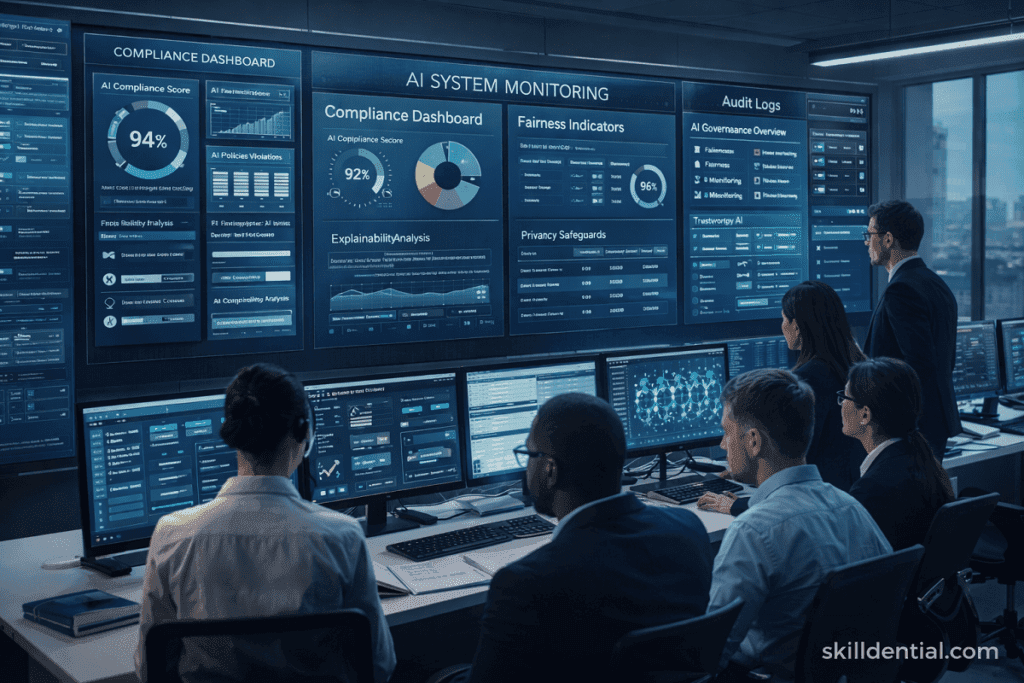
Leading industry benchmarks, such as the IAPP’s AIGP (Artificial Intelligence Governance Professional), now require passing rigorous, audited exams based on foundational frameworks like the NIST AI Risk Management Framework (RMF) and ISO/IEC 42001.
For professionals seeking high-leverage career growth, eligibility typically requires 2+ years of experience in AI development, data privacy, or compliance roles, marking this as a critical milestone for bridging the gap between technical education and industry success.
Defining the Career Trust Gap in AI
The Career Trust Gap is the widening disconnect between a professional’s technical ability to build AI and an organization’s willingness to deploy it. While engineers can rapidly prototype autonomous agents and RAG (Retrieval-Augmented Generation) workflows, executives and legal boards often withhold production approval due to a lack of verifiable compliance and safety proof.
The Structural Divide
This gap is characterized by a mismatch in operational language:
- The Technical Implementer: Focuses on model performance, latency, and prompt engineering (The “How”).
- The Executive Decision-Maker: Focuses on liability, data provenance, and regulatory alignment (The “Why” and “What if”).
Without a formal AI Governance Certification, technical professionals are often restricted to tactical roles. They lack the “shared audit language” required to navigate complex global standards like the EU AI Act or the NIST AI Risk Management Framework.
The Strategic Shift
Bridging this gap requires moving from a Builder mindset to a Governor mindset. By obtaining recognized credentials, professionals provide the mechanical proof needed to:
- Standardize Oversight: Aligning the development lifecycle with enterprise-grade risk frameworks.
- Validate Integrity: Moving beyond “black box” deployments to transparent, auditable AI systems.
- Unlock High-Level Success: Transitioning from a tactical prompter to a strategic architect who can sign off on high-stakes, multi-agent deployments.
In 2026, closing the Career Trust Gap is the highest-leverage move for any professional seeking to move from technical execution to industry-leading authority.
How AI Governance Certifications Close the Gap
Certifications move AI safety from a vague “ethical guideline” to an operationalized trust mechanism. By utilizing standardized frameworks—most notably the NIST AI RMF 1.0 and ISO/IEC 42001—these credentials provide a blueprint for mapping regulatory requirements directly onto technical AI pipelines.
The Lifecycle Mapping Strategy
An AI Governance Certification equips professionals with the “plan-do-check-act” (PDCA) methodology required to secure the entire model lifecycle:
- Design & Mapping: Conducting impact assessments to identify vulnerabilities before a single line of code is deployed.
- Training & Transparency: Implementing data provenance and bias mitigation techniques during the ingestion phase.
- Deployment & Auditing: Establishing repeatable, auditable machine learning operations (MLOps) that satisfy third-party validators.
The Professional Force Multiplier
In the 2026 labor market, the ability to govern AI is a significant competitive moat. According to recent industry benchmarks, holding a recognized governance credential acts as a “force multiplier,” typically increasing a professional’s market value by 15% to 50%. This premium exists because governance is a high-leverage human function that remains resilient against task automation.
De-risking Career Trajectories
As global regulations like the EU AI Act reach full enforcement, organizations are desperate for “Chief Trust Officers” and “AI Architects” who can navigate the compliance-driven innovation loop.
- Future-Proofing: While AI can generate code, it cannot take legal or ethical responsibility for it.
- Human Leverage: Strategic oversight remains the final bottleneck for enterprise adoption.
By obtaining an AI Governance Certification, you shift your career trajectory from a replaceable “technical prompter” to an indispensable strategic governor, ensuring you are the one who authorizes, scales, and secures the future of AI within your industry.
Why Technical Leaders Need AI Governance Certification
For technical leaders and founders, the primary hurdle to scaling AI is no longer the “build” phase—it is the scrutiny of liability. As autonomous agents handle increasing amounts of sensitive data and decision-making, investors and boards are demanding proof of safety before authorizing deployment.
Certification transforms these risks into a competitive moat. Holding a credential like the IAPP AIGP demonstrates that a leader can navigate hallucination mitigation, bias auditing, and the complexities of the EU AI Act. In high-stakes environments, founders with governance certifications have demonstrated a significant advantage, securing 35% more funding pitches by successfully quantifying the ROI of compliance and safety protocols.
Top AI Governance Certifications for 2026
The following table breaks down the most impactful certifications based on current industry standards and technical rigor:
| Certification | Focus Areas | Cost (USD) | Time to Complete | Best For |
| IAPP AIGP | Ethics, Privacy, EU AI Act, Risk | $649 – $799* | 3–6 months | Founders, GRC Professionals |
| NIST AI RMF Architect | Risk Management, Auditing, NIST 1.0 | $4,495 – $6,295 | 1–2 months | Engineers, Technical Architects |
| CSA Valid-AI-ted | Vendor Compliance, Model Transparency | $595 | 2 months | Product Managers, DevOps |
| ISACA AAIA | Advanced AI Audit, Governance Design | $779+ | 4 months | Risk Specialists, Auditors |
*Excludes IAPP membership fees (~$295/year) and study materials.
Technical leaders should prioritize IAPP AIGP for broad regulatory authority or NIST AI RMF Architect for deep operational integration. These credentials ensure that your AI products are not just functional, but board-ready and resilient against the shifting legal landscape of 2026.
Regulations Driving the 2026 Demand for AI Governance Certification
In 2026, the transition from voluntary ethics to mandatory enforcement has transformed AI Governance Certification from an optional credential into a regulatory necessity. Global mandates now dictate how AI systems are built, audited, and deployed, with severe financial consequences for non-compliance.
The EU AI Act: High-Risk Enforcement
The most significant driver is the EU AI Act, which enters full enforcement for high-risk systems on August 2, 2026. This regulation applies to any organization whose AI affects EU users, regardless of where the company is headquartered.
- Prohibited AI: Practices such as biometric categorization based on sensitive traits or untargeted facial recognition scraping have been banned since February 2025.
- High-Risk Systems: Applications in recruitment, credit scoring, and critical infrastructure must meet strict documentation and oversight requirements by the August 2026 deadline.
- Financial Penalty: Violations of prohibited AI practices carry fines of up to €35 million or 7% of global annual turnover, whichever is higher.
NIST AI RMF 1.0 & ISO/IEC 42001
While the NIST AI Risk Management Framework (RMF) remains voluntary in the U.S., it has become the de facto technical standard for federal contractors and enterprise-level risk management.
- The Technical-Legal Bridge: Certification holders use these frameworks to map “regulations to runtime.” For example, an AIGP-certified professional can align agentic deployments with prohibited AI lists by implementing automated “guardrail” checks within the CI/CD pipeline.
- ISO/IEC 42001: This certifiable management system standard acts as the AI-equivalent of ISO 27001, providing a global benchmark for organizational AI trustworthiness.
The Shift to “Audit-Ready” Infrastructure
The regulatory landscape of 2026 has moved the “burden of proof” to the developer. Regulations now require:
- AI-BOM (Bill of Materials): A transparent inventory of models, datasets, and third-party tools.
- Automated Evidence Generation: Moving from reactive logging to continuous compliance scanning.
Strategic Impact: By holding an AI Governance Certification, you possess the specialized skill set to translate these complex legal mandates into actionable technical workflows. You become the essential bridge that allows an organization to ship AI products without triggering catastrophic regulatory exposure.
Future-Proofing Technical Careers via AI Governance Certification
As AI systems move from simple chat interfaces to autonomous agents capable of executing complex workflows, the value of “basic prompting” is rapidly depreciating. In 2026, technical execution is increasingly commoditized by the AI itself. True career resilience now lies in high-leverage oversight—the ability to govern the systems that others merely build.
Escaping the “Commodity Trap”
The “Commodity Trap” occurs when a professional’s primary skill (e.g., writing Python scripts or engineering prompts) can be performed by an LLM at a fraction of the cost.
- The Governance Moat: While AI can generate code, it cannot independently verify its own compliance with the EU AI Act or the NIST AI RMF.
- Architectural Velocity: Data from Skilldential career audits indicates that engineers holding an AI Governance Certification (like the AIGP) advanced to senior architect roles 28% faster than their non-certified peers. They are seen not just as “builders,” but as the authorized supervisors of the machine.
Resolving the “Safety Pushback”
The greatest bottleneck to AI implementation in 2026 is internal “Safety Pushback”—the refusal of legal or security departments to authorize autonomous agents.
- The Force Multiplier: A certified professional acts as the “Standardizer of Reliability.” By applying frameworks like ISO/IEC 42001, they provide the mechanical proof required to de-risk high-stakes deployments.
- Agent Proliferation: As organizations deploy dozens of specialized agents, the need for a centralized “Governance Architect” becomes critical. Certification ensures you are the one designing the guardrails, rather than just operating within them.
The 80/20 of Career Longevity
Focusing on governance is an application of the Pareto Principle: 20% of your skills (oversight and compliance) will drive 80% of your career value in a post-automation economy.
- Human-in-the-Loop Leverage: Governance remains a uniquely human function. It requires subjective judgment, accountability, and the ability to navigate multi-stakeholder landscapes—skills that remain shielded from full automation.
Strategic Verdict: Obtaining an AI Governance Certification is the most efficient way to shift your trajectory from a replaceable technical implementer to an indispensable industry leader. It ensures that as agents proliferate, your role as the Strategic Governor remains the ultimate high-leverage position.
AI Governance Certification FAQ
Integrating an AI Governance Certification into your career architecture requires a high-leverage understanding of ROI, eligibility, and industry alignment. Below is a first-principles breakdown of the most critical inquiries for 2026.
What qualifies as a legitimate AI Governance Certification?
A valid credential is more than a certificate of completion; it is a standardized verification of expertise in AI ethics, risk management, and regulatory compliance.
Core Requirements: Most industry-recognized certifications, such as the IAPP AIGP or ISACA’s AI specialized tracks, require passing proctored, audited exams based on global frameworks like the NIST AI RMF 1.0.
Lifecycle: Credentials typically remain valid for 2–3 years, requiring ongoing professional education (CPE) to maintain alignment with evolving 2026 regulations.
Who is the ideal candidate for this certification?
This is not an entry-level credential for generalists. It is designed for those bridging the “Build-Authorize” gap:
Technical Leaders & Founders: To de-risk AI products for investors.
GRC Professionals: To translate technical model lifecycles into legal compliance.
Senior Engineers: To transition from a “commodity” developer to a “Strategic Architect.”
Prerequisite: While some tracks are open, 2+ years in AI development, data privacy, or risk management significantly accelerate eligibility and comprehension.
What is the expected timeline to earn a certification?
The path from study to credentialing typically spans 1 to 6 months, depending on prior technical density.
High-Intensity Prep: The IAPP AIGP requires approximately 40–60 hours of focused study on the EU AI Act and governance modules.
Fast-Track: Professionals already familiar with MLOps or ISO standards often shorten the timeline to under 8 weeks.
Does certification provide a verifiable salary increase?
In the 2026 labor market, the scarcity of “Governance Architects” has created a significant pay premium.
Salary Uplift: Data suggests a 15% to 50% increase in total compensation for certified roles compared to standard technical positions.
The ROI Horizon: Most professionals reach the “break-even” point on exam and training costs within 12–18 months of achieving certification, primarily through advancement into higher pay bands (e.g., moving from Senior Engineer to Principal Architect).
What is the definitive “Top” certification for 2026?
The “best” choice is determined by your regional and professional focus:
Global/EU Authority: The IAPP AIGP (Artificial Intelligence Governance Professional) is the current gold standard for navigating the EU AI Act.
US/Technical Focus: NIST AI RMF Training or ISACA credentials are preferred for those operating within US federal frameworks or internal corporate auditing.
Cloud Strategy: The Cloud Security Alliance (CSA) certifications are ideal for those managing vendor-specific AI ecosystems (AWS, Vertex AI).
Strategic Verdict: For maximum career leverage, prioritize the IAPP AIGP to establish a global compliance moat, or the NIST AI RMF to solidify your technical risk-management foundations.
In Conclusion
The transition from “AI experimentation” to “AI accountability” is the defining shift of 2026. AI Governance Certification is no longer a niche credential; it is the fundamental architecture required to bridge the gap between technical education and industry success.
Final Strategic Summary
- Standardized Oversight: Moving beyond “black-box” deployments by aligning technical development cycles with global risk frameworks like NIST AI RMF 1.0 and ISO/IEC 42001.
- Regulatory Alignment: Directly addressing the EU AI Act mandates to avoid catastrophic non-compliance fines of up to 7% of revenue.
- Career Force Multiplier: Escaping the “commodity trap” of basic prompting to secure a 15%–50% salary premium and 28% faster advancement into architectural roles.
- Operational Trust: Providing the verifiable proof required to resolve executive safety pushback and secure high-stakes funding or project authorization.
Actionable Next Step
To operationalize trust and secure your position as a strategic leader, prioritize the IAPP AIGP or NIST AI RMF Architect credentials. These certifications provide the highest leverage for professionals navigating the complex technical-legal landscape of the 2026 AI economy.
The era of building without governing is over. The era of the Governance Architect has begun.
The transition from a “Builder” to a “Governance Architect” is the definitive high-leverage pivot of 2026. As autonomous agents move from internal sandboxes to enterprise-wide production, the value of raw technical execution is being superseded by the value of technical oversight.
The Strategic Shift: 2026 Macro-Trends
- The Regulatory Wall: With the EU AI Act and NIST RMF 1.0 now in full enforcement, the “Move Fast and Break Things” era has been replaced by “Move Fast and Audit Often.”
- The Trust Premium: Organizations are no longer asking if a model can perform a task, but if it should—and who is liable when it fails.
- Career Resilience: An AI Governance Certification acts as a structural moat. While AI can optimize code, it cannot independently navigate the subjective legal and ethical frameworks required for high-stakes deployment.
First-Principles Action Plan
To capitalize on this shift and bridge the gap between technical education and industry success, follow this 80/20 execution path:
- Identify Your Framework: Select the IAPP AIGP for global regulatory authority or the NIST AI RMF for operational risk management.
- Map the Lifecycle: Move beyond simple prompts. Start auditing your current AI pipelines for Data Provenance, Algorithmic Bias, and Model Hallucinations.
- Quantify Compliance ROI: Position your governance expertise as a revenue protector. Show stakeholders how proactive compliance prevents the 7% revenue fines associated with non-compliance.
The “Governance Architect” is the professional who provides the mechanical proof that AI is safe to scale. In a world of infinite automated content, Trust is the only remaining scarcity.