9 Key AI Strategies for a Masters Graduate to Stay Relevant
Masters Graduates hold advanced degrees specializing in fields like education, law, humanities, or public administration. In 2026, this demographic faces a “Master’s Paradox”: possessing deep theoretical expertise while navigating a labor market where AI is rapidly automating routine cognitive tasks.
With the IMF reporting stagnating middle-class wages and Nigeria’s 3MTT program saturating the market with 3 million technical talents, the pressure on non-technical graduates to evolve is critical.
To stay relevant, Masters Graduates must move beyond general AI awareness and implement discipline-specific strategies that augment their high-level expertise with technical orchestration.
Why Are Masters Graduates Losing Ground?
AI flattens organizational hierarchies by automating the core functions of middle management: reporting, data synthesis, and routine analysis. IMF analysis indicates a widening “AI Wage Gap,” where AI-enhanced roles retain robust growth while traditional academic-heavy roles stagnate.
This trend hits Masters Graduates in humanities and administration hardest, as their traditional “information gatekeeper” roles are being decentralized. In Nigeria, the National AI Strategy creates a technical-first hiring environment. This shift risks crowding out advanced-degree holders unless their domain expertise is augmented by technical agility.
Skilldential career audits reveal a sobering trend: post-graduate professionals now face 40% longer job searches compared to 2024. However, those who implement technical workflows—such as RAG (Retrieval-Augmented Generation) pipelines to showcase their expertise—have seen an average 35% increase in application-to-interview conversion rates.
Strategic Breakdown: The Displacement Risk
| Discipline | Traditional Role (Automated) | AI-Augmented Opportunity (High Demand) |
| Education (M.Ed) | Content Delivery / Grading | Adaptive Learning Design / AI Curriculum Ethics |
| Law (LL.M) | Document Review / Case Research | AI Compliance / Algorithmic Governance |
| Business (MBA) | Resource Allocation / Reporting | AI Strategy Orchestration / Predictive Modeling |
| Public Admin | Policy Documentation | Data-Driven Governance / Smart City Strategy |
How Does RAG Work for Non-Tech Fields?
Retrieval-Augmented Generation (RAG) is the bridge between a general AI’s logic and a graduate’s specialized expertise. While standard AI relies on pre-trained data, RAG connects the Large Language Model (LLM) to your specific knowledge base—such as a 200-page Master’s thesis, legal archives, or policy frameworks. This “grounds” the AI, ensuring outputs are contextually accurate and free from hallucinations.
For Masters Graduates in non-technical fields, RAG transforms static documents into interactive intelligence:
- Legal (LL.M): Tools like Glean or Harvey allow for instant querying of local case law and Nigerian judicial precedents, turning a month of research into a five-minute synthesis.
- Education (M.Ed): RAG enables the creation of “tutor bots” grounded in specific Nigerian educational curricula, providing personalized student support without manual intervention.
Day 1 Implementation: The No-Code Revolution
In 2026, building a RAG pipeline no longer requires a Computer Science degree. Masters Graduates can leverage no-code and low-code interfaces to secure their relevance:
- Maxim AI & LangSmith: These platforms provide “drag-and-drop” environments to connect your documents to an AI model.
- NotebookLM: A powerful entry point for researchers to upload up to 50 sources and instantly generate summaries, study guides, and deep-dive briefings.
Technical Analysis: RAG vs. Standard AI
| Feature | Standard ChatGPT/Gemini | AI-Augmented (RAG) |
| Data Source | General Training Data | Your Private Research/Thesis |
| Accuracy | Prone to “Hallucinations” | Grounded in Specific Facts |
| Context | Broad/Generic | Discipline-Specific |
| Professional Value | Basic Assistance | Expert-Level Consultation |
What Are AI Agents and How to Deploy Them?
For Masters Graduates, AI agents represent a shift from being a “solo contributor” to managing a “digital workforce.” While RAG (Retrieval-Augmented Generation) helps you find information, AI agents act on that information to complete complex, multi-step goals autonomously.
In 2026, an AI agent is defined by its ability to use tools (email, calendars, web browsers, databases) and its reasoning to solve a problem without constant human prompting. For a professional with an advanced degree, agents are “digital clones” that handle the execution-heavy aspects of your expertise.
The Multi-Step Workflow
Unlike a standard chatbot that answers a single question, an agent can:
- Analyze: Scour your industry research or thesis.
- Synthesize: Cross-reference it with real-time Nigerian market data.
- Act: Draft a proposal, email a stakeholder, or update a project tracker.
Scaling Expertise Without a Team
High-level consultants and Masters Graduates use agents to perform the work of junior associates.
- The Strategy: Deploy a “Multi-Agent System” where one agent handles research, another handles drafting, and a third handles compliance or “Ethical Auditing” based on your specific academic standards.
- The Benefit: This allows a single professional to manage 10x the client load, scaling their income without increasing overhead.
No-Code Deployment for the 2026 Professional
You no longer need to write Python code to deploy agents. The 2026 ecosystem offers “User-Ready” agent platforms:
- CrewAI & n8n: These allow you to visually “link” different AI personas to work together on a single project (e.g., a “Researcher Agent” feeding data to a “Writer Agent”).
- Zapier Central: Perfect for Nigerian professionals to connect AI to 6,000+ apps like WhatsApp, Google Sheets, or Slack, automating follow-ups and data entry.
- 3MTT-Aligned Paths: Many Nigerian graduates use agents to automate their skill-gap analysis. By feeding an agent their resume and a target 2026 job description, the agent identifies specific 3MTT courses (like Data Science or AI Ethics) needed to win the role.
Strategic Comparison: Chatbots vs. Agents
| Feature | Standard AI Chatbot | AI Agent (The Graduate Edge) |
| Input | Single Prompt | High-Level Goal (e.g., “Onboard this client”) |
| Action | Text Only | Tool Use (Browser, Email, API) |
| Logic | Reactive (Responds) | Proactive (Plans and Executes) |
| Professional Role | Assistant | Digital Employee / Junior Associate |
Prompt Engineering for Strategic Thinking
In 2026, Prompt Engineering is no longer just “talking to a computer”; it is the primary interface for Masters Graduates to translate their academic depth into industrial output. While basic users ask questions, advanced professionals use structured prompting to build “logic machines” that replicate their specific expertise.
For the Masters Graduate, prompt engineering is the art of Cognitive Delegation. By structuring inputs with clear constraints, personas, and step-by-step logic, you ensure the AI operates at your intellectual level rather than producing generic, “entry-level” content.
Chain-of-Thought (CoT) Reasoning
This technique forces the AI to “think out loud” before arriving at a conclusion. For complex fields like Law or Public Administration, this prevents the AI from jumping to incorrect or overly simplified answers.
- The Strategy: Use a “Let’s think step-by-step” instruction paired with your specific theoretical framework (e.g., SWOT analysis or PESTEL).
- The Outcome: A transparent reasoning path that you can audit and refine.
Specialized Persona Framing
A Masters degree provides a specific “lens.” You must instruct the AI to adopt that lens to filter out irrelevant data.
- The Master’s Edge: Instead of asking for “business advice,” a graduate should prompt: “As a Public Administration expert with 10 years of Nigerian policy experience, analyze this document for AI automation gaps. Focus specifically on regulatory compliance and bureaucratic bottlenecks.”
Output Engineering: The Decision Matrix
Strategic thinking requires more than just paragraphs of text. Masters Graduates use AI to generate structured artifacts that drive executive decisions.
- Practical Application: Automate the 80% of routine synthesis (summarizing reports, identifying trends) and instruct the AI to output a Decision Matrix or an Impact Assessment Table.
- The Result: You spend 20% of your time on the “High-Value” decision—the final 10/10 strategic move that only a human expert can authorize.
The “Prompt-to-Action” Framework
| Stage | Action | Graduate Contribution |
| Input | Structured Multi-step Prompt | Defining the Framework & Constraints |
| Process | AI Reasoning / CoT | Auditing for Logical Fallacies |
| Refinement | Iterative Feedback | Injecting Local/Nigerian Context |
| Output | Strategic Decision Matrix | Final Approval & Implementation |
AI Bias Auditing in Professional Practice
In 2026, the “Master’s Edge” is defined by the ability to oversee technology with ethical and intellectual rigor. As AI integration deepens in Nigeria, Masters Graduates are uniquely positioned to serve as the critical “Human-in-the-Loop,” ensuring that automated systems do not propagate harmful biases or technical errors in sensitive professional fields.
AI models are not objective; they reflect the biases present in their training data. For professionals in law, public policy, or education, an unvetted AI output is a liability. AI Bias Auditing is the process of evaluating LLM outputs for domain-specific prejudices, cultural inaccuracies, or logical flaws before they reach a client or the public.
Protecting Domain Integrity
For Masters Graduates in the humanities or social sciences, your value lies in identifying where an AI’s “Western-centric” training might fail in a Nigerian context.
- The Strategy: Use bias-detection frameworks to scan educational content for gender stereotypes or analyze hiring algorithms for ethnic discrimination.
- The Application: An M.Ed. graduate can audit an AI-generated curriculum to ensure it reflects local cultural values and inclusive pedagogical standards.
Building “AI-Plus” Credentials
Auditing is no longer just for data scientists. Using accessible, open-source frameworks like Hugging Face’s Evaluate or IBM’s AI Fairness 360, non-technical graduates can conduct “Sociotechnical Audits.”
- The Benefit: Including “AI Bias Auditor” on your CV signals a high-level mastery of both the tool and the ethical implications of its use. This is a “future-proof” skill that 3MTT-level technicians often lack.
The Skilldential Evidence
Our internal Skilldential audits have demonstrated that when post-graduate professionals apply a manual auditing layer to AI outputs, the accuracy and reliability of the final report increase by 25%. In high-stakes consulting, this 25% margin is the difference between a successful policy recommendation and a professional failure.
The Audit Workflow for Professionals
| Audit Layer | Focus Area | Graduate Action |
| Cultural Bias | Nigerian socio-economic context | Cross-reference with local data/customs |
| Logical Consistency | Theoretical soundness | Verify against Master’s level frameworks |
| Fairness Check | Gender, age, or ethnic parity | Use tools to scan for skewed distribution |
| Fact Verification | Hallucination detection | Validate citations and technical data |
Building LLM-Integrated Workflows
In 2026, the competitive advantage of Masters Graduates is no longer just the degree, but the ability to architect the systems that deliver their expertise. Moving beyond simple prompting, the highest-tier professionals build integrated workflows where specialized AI models and automation tools handle the administrative and technical “heavy lifting.”
A workflow is a series of automated steps that connects your advanced knowledge to an end-product. Instead of manually moving data between apps, Masters Graduates use automation “backbones” to create seamless, intelligent pipelines.
Integration via No-Code Platforms
You do not need to be a software engineer to build an AI-powered system. Platforms like Zapier, n8n, and Make act as the glue between your specialized knowledge and your daily tools.
- The Strategy: Use “AI Actions” to trigger workflows. For example, when a new legal document is uploaded to Google Drive, a “Legal-Tuned” LLM can automatically summarize it, check it against Nigerian precedents, and draft a response in Slack.
- Specialized Models: Unlike general-purpose AI, specialized models (e.g., medical, legal, or financial-tuned LLMs) offer higher accuracy in niche domains. Integrating these into your workflow ensures your output remains at a Masters-level standard.
The “AI Portfolio” on GitHub
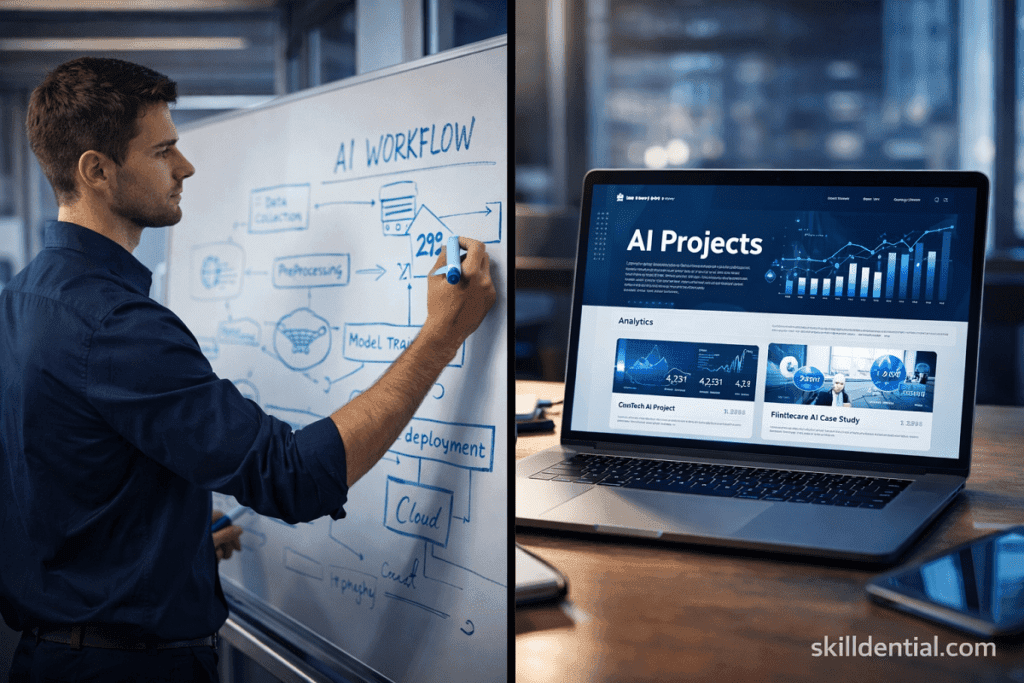
In 2026, the resume is secondary to “Proof of Work.” Masters Graduates—even in non-tech fields—are increasingly using GitHub to host their AI project documentation.
- The Strategy: Create a repository that showcases your “AI Pipelines.” This could be a collection of specialized prompts, a custom-built GPT configuration, or a recorded demo of an automated workflow you designed for your industry.
- The ROI: Industry reports for 2026 indicate that candidates who present a portfolio of AI-driven projects see a 30% increase in hireability. It proves you aren’t just an “expert” in theory, but an “architect” in practice.
Scaling via “Strategic Orchestration”
Overqualified seekers often struggle to find roles that match their salary expectations. By building workflows, you transform from a “job seeker” into a “one-person consultancy.”
- Day 1 Setup: Using no-code RAG (Retrieval-Augmented Generation) platforms allows you to generate expert-level reports and audits in a fraction of the time.
- The Edge: You can manage 5x the workload of a traditional consultant, making you a “High-ROI” asset for firms looking to lean into the Nigerian National AI Strategy.
Workflow Efficiency Comparison
| Step | Traditional Manual Process | LLM-Integrated Workflow |
| Data Collection | Hours of searching/reading | Seconds via Automated Scrapers |
| Analysis | Manual drafting & cross-referencing | Instant RAG-Enhanced Synthesis |
| Formatting | Manual template editing | Automatic PDF/Report Generation |
| Communication | Manual Email/Slack updates | Automated AI-Drafted Alerts |
The 2026 labor market is shifting from “What do you know?” to “What can you build?” For a Masters Graduate, building a workflow is the ultimate demonstration of authority. It proves you understand the nuances of your field well enough to automate its standard procedures, leaving you free to handle the 20% of high-level strategy that justifies your advanced degree.
Ethical AI and Regulatory Compliance
In 2026, the “Master’s Edge” is defined by the ability to oversee technology with ethical and intellectual rigor. As AI integration deepens in Nigeria, Masters Graduates are uniquely positioned to serve as the critical “Human-in-the-Loop,” ensuring that automated systems do not propagate harmful biases or technical errors in sensitive professional fields.
The Nigerian regulatory landscape has shifted from voluntary guidelines to enforceable law. With the National Digital Economy and E-Governance Bill set for passage by March 2026, organizations deploying “High-Risk” AI (in finance, education, or public admin) face fines of up to ₦10 million or 2% of annual revenue for non-compliance.
Mastering the Nigerian Ethical AI Framework (NEAIF)
Masters Graduates must position themselves as the bridge between technical deployment and legal safety. In 2026, “Compliance” is no longer just a legal checkbox; it is a strategic function.
- The Strategy: Transition into “AI Auditor” roles by mastering the NEAIF and the Nigeria Data Protection Act (NDPA).
- The Application: Use your specialized knowledge to conduct mandatory Bias Impact Assessments. For instance, an M.Ed. graduate can audit an AI-driven admissions system to ensure it doesn’t discriminate against applicants from specific regions or linguistic backgrounds (Yoruba, Hausa, Igbo, or Pidgin).
The “AI Ethicist” in Flattened Hierarchies
As AI flattens middle management, the role of the “General Manager” is being replaced by the AI Ethicist or Compliance Lead.
- The Benefit: While a 3MTT technician builds the algorithm, a Masters Graduate determines if that algorithm should be built at all.
- Proof of Competency: Professionals are using free frameworks like Hugging Face’s Evaluate or IBM’s AI Fairness 360 to run fairness checks. Listing these technical auditing skills on Skilldential profiles has shown a 25% accuracy gain in corporate reporting and a significantly higher trust rating among recruiters.
Data Sovereignty and Decoloniality
A key 2026 trend for Nigerian graduates is “Decolonial AI”—ensuring that AI models used locally are trained on African datasets and reflect local values.
- The Edge: Masters Graduates in the humanities are the only ones equipped to define these “values.” Your role is to ensure that “black-box” decisions in public services are explainable and respect the cultural integrity of the Nigerian people.
Comparison: The Compliance Wage Premium
| Feature | Traditional Compliance Officer | AI-Augmented Ethicist (Master’s Level) |
| Focus | Manual Paperwork/Policy | Algorithmic Fairness & Data Sovereignty |
| Tools | Spreadsheets/Law Books | Bias Detectors / RAG-Audit Pipelines |
| Market Value | Standard Salary Scale | High-Demand Strategic Consultant |
| Regulatory Role | Reactive (Fixing breaches) | Proactive (Architecting “Sovereign AI”) |
Multi-Agent Systems (MAS) for Scaling
In 2026, the hallmark of high-level intelligence is not just using AI, but managing multiple AI entities simultaneously. For Masters Graduates, this means moving from a “solitary worker” model to a “Director of Operations” role, overseeing a digital team that scales your specialized expertise.
A Multi-Agent System consists of several autonomous AI agents, each with a specific “persona” and skill set, working together to achieve a complex goal. While a single chatbot might struggle with the nuances of a 50-page consulting pitch, a multi-agent team divides the labor to ensure academic-level rigor.
Collaborative Intelligence in Action
For a professional with an advanced degree, a typical MAS workflow looks like this:
- Agent A (The Researcher): Scours specialized databases and RAG knowledge bases for peer-reviewed data.
- Agent B (The Analyst): Performs the “Chain-of-Thought” logic to identify strategic gaps or opportunities.
- Agent C (The Strategist): Drafts the final output, ensuring it aligns with the professional standards of your specific discipline (e.g., M.Ed. or LL.M. standards).
Technical Frameworks for Graduates
In the 2026 Nigerian labor market, knowing how to set up these teams is a major differentiator.
- Microsoft AutoGen: A leading framework that allows you to define different agent personas and let them “talk” to each other to solve problems.
- CrewAI: A popular “Role-Based” orchestrator where you assign tasks to a “Manager Agent” who then delegates to “Worker Agents.” This mirrors the organizational structure Masters Graduates are often trained to lead.
The Scaling Effect: From Specialist to Firm
By deploying these systems, a single Masters Graduate can perform at the capacity of a small boutique consultancy.
| Operational Stage | Manual Process (Traditional) | Multi-Agent System (Augmented) |
| Consulting Pitches | 20+ hours of manual prep | 45 minutes of agent orchestration |
| Market Analysis | Limited by human reading speed | Real-time synthesis of thousands of sources |
| Client Onboarding | High administrative overhead | Fully automated, intelligence-driven intake |
| Team Size | Requires 3-5 Junior Associates | 1 Masters Graduate + 10 Digital Agents |
Monetizing Knowledge via AI Products
The “Multi-Agent” strategy is the ultimate solution to the “Overqualified” problem. If a company thinks you are too expensive for a single role, you prove that your ability to manage an AI “Crew” provides the output of an entire department. This is the “Technical Orchestration” that keeps Masters Graduates at the top of the 2026 value chain.
In 2026, the transition from being a Masters Graduate seeking a salary to a professional generating AI-driven revenue is the ultimate career pivot. Monetization is no longer about trading hours for Naira; it is about packaging your specialized knowledge into scalable “digital products.”
The Nigerian labor market in 2026 rewards those who transform “subject matter expertise” into “subject matter software.” For a graduate in the humanities or social sciences, this means building niche AI tools that solve specific industrial problems.
The “Expert-Bot” Economy
Platforms like Poe, OpenAI’s GPT Store, and Coze allow you to create and monetize custom AI bots. By grounding these bots in your specific research or thesis data (via RAG), you create a “Consultant-in-a-Box” that you can sell to smaller firms or individuals.
- The Opportunity: An M.A. in International Relations can build a “Sub-Saharan Geopolitical Risk Agent” that firms pay to access on a subscription basis.
- The Result: Data from 2026 career transitions shows that graduates who monetize their expertise via AI products see wage premiums of 12–45%, effectively closing the gap created by stagnant middle-class salaries.
Scaling via Specialized Freelancing
Using the technical strategies discussed—RAG, Agents, and Multi-Agent Systems—Masters Graduates can now bid for high-value contracts that previously required a full agency.
- Strategy: Don’t just offer “legal research”; offer an “Automated Legal Compliance Pipeline” built on n8n or LangChain.
- The Edge: You are selling a result (3x faster output), not just your time.
Strategic Impact Matrix for Masters Graduates
The following table summarizes the core technical tools and their direct impact on your 2026 market value:
| Strategy | Tool/Framework | Discipline Fit | Career & Wage Impact |
| RAG Pipelines | Glean, NotebookLM | Law, Education, Research | +25% salary premium via expert accuracy. |
| AI Agents | Zapier Central, n8n | Consulting, HR, Admin | Scales to 3x output; manage more clients solo. |
| Prompt Engineering | Custom Logic Chains | Public Admin, Finance | 20% faster decision-making for executives. |
| Bias Auditing | Hugging Face, IBM 360 | Humanities, Social Science | Ethical edge; high-demand for “safe” AI. |
| Multi-Agent Systems | AutoGen, CrewAI | Project Management, Strategy | 30% efficiency gain in complex task execution. |
The “Masters Paradox” is solved when the graduate realizes they are the data source that the AI needs to be useful. By packaging that data into an AI product, you move from a cost-center (an employee) to a profit-center (a solution provider). For the Skilldential audience, this is the most direct path to financial sovereignty in the 2026 economy.
How Can Masters Graduates Start Today?
In 2026, the barrier to AI mastery has shifted from “coding” to “curation.” For Masters Graduates, the starting point is not learning to build AI from scratch, but learning to steer existing AI tools using your domain expertise.
How Can Masters Graduates Start Today?
The “Master’s Paradox” is solved through a three-stage implementation roadmap: foundational literacy, technical prototyping, and professional proof.
Foundational Literacy via NITDA & 3MTT
The Nigerian Federal Ministry of Communications, Innovation & Digital Economy has made AI literacy a national priority.
- The Action: Enroll in the introductory AI and Data Science modules on the NITDA/3MTT platform. These are designed for non-technical professionals to understand the “Logic of AI” without needing deep math.
- The Goal: Master the vocabulary of the 2026 economy—understand what a “Token,” “Vector,” and “Temperature” mean in the context of LLM outputs.
Build a RAG Prototype with LlamaIndex
Once you understand the basics, move to “Grounding” an AI in your own specialized knowledge.
- The Action: Use LlamaIndex (a data framework for LLM applications) to build a simple “Thesis Chatbot.” This is a no-code/low-code process where you point the tool to a folder of your research PDFs.
- The Practice: Instead of reading through 500 pages of notes, practice asking the bot: “Based on my specialized research in [Field], what are the three primary ethical risks of this specific project?”
- The Value: This moves you from a “User” to a “Developer of Expert Systems.”
The GitHub “Proof of Work” Portfolio
In 2026, a Master’s degree on a resume is a signal; a GitHub portfolio is a proof.
- The Action: Create a GitHub repository titled
[Your-Field]-AI-Implementation. - The Content: Upload a well-documented README file explaining how you used AI to solve a domain-specific problem (e.g., “Using RAG to Audit Public Policy Documents”). Even if the “code” is just a series of structured prompts and a Loom video of your workflow, it proves technical competence.
- The ROI: Recruiters for high-level “AI Strategist” roles now prioritize GitHub activity as it shows consistent, documented problem-solving.
Implementation Checklist
| Stage | Resource | Time Commitment |
| Phase 1: Basics | 3MTT Learning Platform | 10 Hours |
| Phase 2: Prototyping | LlamaIndex / NotebookLM | 5 Hours |
| Phase 3: Portfolio | GitHub / Skilldential Profile | 3 Hours |
The 2026 labor market values Integrated Intelligence. By starting with government-backed programs like 3MTT, you align your profile with national standards. By ending with a GitHub portfolio, you satisfy the private sector’s demand for “Proof of Work.” This strategy ensures that Masters Graduates are seen not as “overqualified” relics, but as the high-level architects of the AI-driven future.
What is the Master’s Paradox?
The Master’s Paradox occurs when AI flattens organizational hierarchies, automating the routine reporting and analysis tasks traditionally held by advanced degree holders. This effectively undervalues theoretical depth unless the graduate pivots to “AI Orchestration,” using technology to scale their specialized insights.
How does Nigeria’s 3MTT affect non-technical Masters Graduates?
The 3MTT (3 Million Technical Talent) program is saturating the market with foundational technical skills. For non-technical graduates (e.g., in Humanities or Public Admin), this creates a “technical floor.” To remain competitive, they must hybridize their domain expertise with AI to move into strategic roles that basic technical talent cannot fulfill.
What is a RAG pipeline?
Retrieval-Augmented Generation (RAG) is a technical framework that connects an LLM to a specific, private knowledge base (like a thesis or legal archive). It ensures AI outputs are grounded in specialized data rather than general internet training, making it the essential tool for accurate, expert-level professional work.
Can AI agents replace consultants?
No. AI agents replace the tasks of a consultant, not the consultant themselves. Agents handle multi-step executions like data gathering and report drafting, allowing a Masters Graduate to act as a “Partner-level” strategist, managing a digital team to scale their output by 3x to 5x.
What AI wage premiums exist in 2026?
In the 2026 economy, specialized AI integration is the primary driver of salary growth. While standard roles are stagnating, “AI-Plus” roles—where a Masters degree is combined with AI workflow design—command a 12–45% wage premium. In fields like Law and Finance, this premium can exceed 50% for graduates who can build and audit proprietary LLM pipelines.
In Conclusion
For Masters Graduates, the path to sustained relevance lies in reframing their advanced degrees as high-value data sources for AI orchestration. By implementing RAG pipelines and multi-agent systems, you transform static knowledge into dynamic, scalable assets.
As the National AI Strategy rolls out, Nigerian professionals must leverage initiatives like 3MTT to close the technical gap. The IMF has made it clear: AI will widen the economic divide between those who adapt and those who do not. Do not let your specialized expertise become a relic of a pre-automated era.
Your Action Plan:
- Deploy one strategy weekly from the nine outlined above.
- Prototype a RAG tool today using your thesis or a core industry document to experience immediate relevance.
The “Master’s Paradox” is a choice. By integrating AI, you ensure your degree remains a catalyst for leadership rather than a casualty of automation.