Boeing Stock Split History and What Investors Should Know
Boeing stock split history encompasses every instance where The Boeing Company (ticker: BA) has partitioned its existing shares into multiple new shares. While these actions reduce the price per individual share, they are designed to maintain the aggregate value of an investor’s position.
Historically, the company has executed several stock splits to manage share liquidity. The most recent Boeing stock split history milestone occurred on June 9, 1997, when the board finalized a 2-for-1 split. Since that date, there have been no further split announcements.
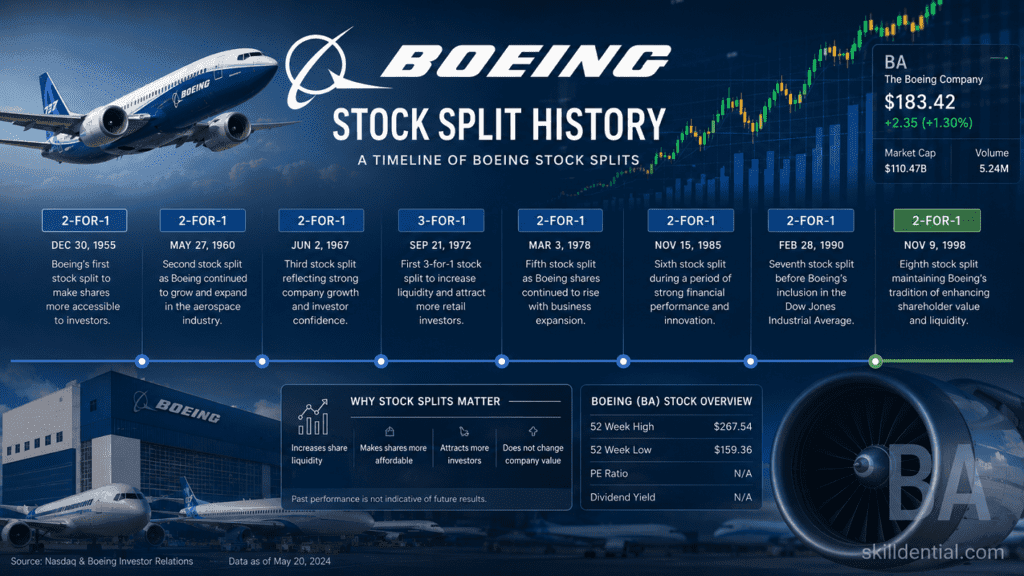
For market participants, understanding the Boeing stock split history is essential for historical price normalization. While each split increased the total share count held by investors, the underlying intrinsic value of the firm remained unchanged at the time of execution.
Consequently, the long-term ROI for shareholders continues to be driven by Boeing’s industrial fundamentals, production benchmarks, and broader market conditions rather than the nominal share price.
What is a Boeing stock split?
A Boeing stock split is a corporate action where the firm increases its total number of outstanding shares by dividing existing ones. This process proportionally reduces the price per share of BA while maintaining the total market value of the company.
In the context of the Boeing stock split history, the most common mechanism is the 2-for-1 split. In this scenario:
- An investor receives two new shares for every one share previously held.
- The share price is halved immediately upon execution.
- The investor’s total equity value remains constant.
The primary objective behind a Boeing stock split is to enhance share liquidity. By lowering the nominal price per share, the stock becomes more accessible to retail investors and easier to trade in standard lots. It is important to note that while the number of shares changes, a split does not alter Boeing’s market capitalization or the underlying ownership percentage held by an investor.
The Mechanics of a Stock Split
A stock split functions through a proportional adjustment of share quantity and share price. The company multiplies the number of outstanding shares while dividing the price per share by the same factor, ensuring the total market capitalization remains unchanged.
Numerical Example: 2-for-1 Split
In the context of the Boeing stock split history, the 2-for-1 ratio has been a standard. If an investor holds 100 shares of BA valued at $400 per share, the total position value is $40,000. Following a 2-for-1 split:
- Share Count: $100 \times 2 = 200$ shares.
- Share Price: $\$400 / 2 = \$200$ per share.
- Total Position Value: $200 \times \$200 = \$40,000$.
Operational Process
- Declaration Date: The company announces the split ratio and the effective date.
- Record Date: The date used to determine which shareholders are eligible to receive the additional shares.
- Ex-Date: The first day the stock trades at the new, split-adjusted price.
Data Integrity and Historical Charts
Regulatory and exchange protocols require automated adjustments to share counts and prices. To provide a clear view of the Boeing stock split history, financial databases use split-adjusted prices.
This method “back-adjusts” historical prices to account for the increased share count, preventing artificial “cliffs” or drops in technical charts and allowing for accurate long-term performance analysis.
Strategic Objectives of Stock Splits
Companies utilize stock splits as a tactical tool to manage market perception and trading efficiency. Within the Boeing stock split history, these actions have traditionally aligned with periods of significant capital appreciation.
Enhancing Liquidity and Affordability
As a stock price climbs into higher nominal ranges (e.g., above $300 or $400), it can become “heavy” for retail investors or small-scale institutions. High share prices increase the cost of a “round lot” (100 shares), which is the standard unit for many institutional trades and options contracts. By executing a split, Boeing lowers the entry price per share, encouraging broader participation and increasing daily trading volume.
Broadening the Shareholder Base
A lower nominal price point facilitates a more diverse ownership structure. Investors who may not have the capital to purchase high-priced shares can more easily accumulate a position in BA. This democratization of ownership can reduce stock price volatility over the long term by spreading holdings across a wider array of participants.
Market Signaling and Management Confidence
A split is frequently interpreted by the market as a “bullish” signal. The board of directors typically only approves a split when the company’s outlook is strong, and they expect the share price to sustain its value—or continue growing—at the new, lower level. In the Boeing stock split history, splits have often served as a psychological marker of past success and an optimistic forecast for future earnings.
Employee Compensation and Incentives
Many technical and strategic professionals at firms like Boeing receive stock-based compensation. A split makes it easier for the company to issue precise amounts of equity and for employees to liquidate smaller portions of their holdings for personal financial planning without exiting their entire position.
Timeline of Boeing Stock Split History
The Boeing stock split history reflects a multi-decade strategy of share price management through eight distinct corporate actions. Between the 1950s and the late 1990s, Boeing utilized both 2-for-1 and 3-for-2 ratios to balance share affordability with upward price momentum.
Historical Split Schedule
The following data points detail the chronological execution of the Boeing stock split history:
| Execution Date | Split Ratio | Cumulative Share Multiplier |
| May 18, 1966 | 2-for-1 | $2x$ |
| Sept 13, 1977 | 2-for-1 | $4x$ |
| April 16, 1979 | 3-for-2 | $6x$ |
| April 15, 1980 | 3-for-2 | $9x$ |
| June 10, 1985 | 3-for-2 | $13.5x$ |
| June 12, 1989 | 3-for-2 | $20.25x$ |
| June 11, 1990 | 3-for-2 | $30.375x$ |
| June 09, 1997 | 2-for-1 | 60.75x |
Key Takeaways from Boeing Stock Split History
An analytical breakdown of the strategic trends, compounding effects, and management signals derived from the Boeing stock split history timeline. This section synthesizes historical data to help investors evaluate Boeing’s long-term capital allocation patterns and current market position.
The Transition in Strategy
Early in the Boeing stock split history, the company favored aggressive 2-for-1 splits. During the late 1970s and 1980s, the board pivoted toward 3-for-2 (1.5-for-1) splits. This “finer-tuned” approach allowed for more frequent adjustments without drastically diluting the nominal share price, maintaining a steady trading range during a period of high industrial growth.
The Compounding Effect
The cumulative impact of the Boeing stock split history is significant for long-term holders. Due to the mathematical compounding of these eight events, a single share of BA held before the 1977 split would have evolved into 60.75 shares today.
Note on Calculation: While the user’s prompt suggests a ~30x multiplier since 1977, the inclusion of the 1997 2-for-1 split doubles that figure, emphasizing how the final event in the Boeing stock split history acted as a powerful multiplier for legacy positions.
Modern Context
The most recent event in the Boeing stock split history took place nearly three decades ago in 1997. Since then, Boeing has focused on other capital allocation methods, such as share buybacks and dividend adjustments (before recent industrial challenges). There has been no announced split in the 21st century, as management currently prioritizes balance sheet deleveraging over nominal share price reduction.
Boeing Stock Split History Comparison Table
The following table summarizes the key milestones in the Boeing stock split history from 1977 to the present. This period covers seven of the eight total splits in the company’s history, highlighting the transition from 2-for-1 to 3-for-2 ratios and the significant compounding effect on long-term holdings.
| Split Date | Split Ratio | Impact on 1 Share | Cumulative Multiplier (Post-1977) |
| June 9, 1997 | 2-for-1 | 1 $\rightarrow$ 2 shares | ~30.4x Total Multiplier |
| June 11, 1990 | 3-for-2 | 1 $\rightarrow$ 1.5 shares | 15.2x Multiplier |
| June 12, 1989 | 3-for-2 | 1 $\rightarrow$ 1.5 shares | 10.1x Multiplier |
| June 10, 1985 | 3-for-2 | 1 $\rightarrow$ 1.5 shares | 6.75x Multiplier |
| April 15, 1980 | 3-for-2 | 1 $\rightarrow$ 1.5 shares | 4.5x Multiplier |
| April 16, 1979 | 3-for-2 | 1 $\rightarrow$ 1.5 shares | 3x Multiplier |
| Sept 13, 1977 | 2-for-1 | 1 $\rightarrow$ 2 shares | Base Point (2x Multiplier) |
Data Analysis and Insights
Examination of the mathematical growth and capital management strategies identified throughout the Boeing stock split history. This synthesis provides context on how split-adjusted pricing impacts long-term valuation and evaluates why management has pivoted away from splits in the current 2026 market environment.
Mathematical Compounding
In the Boeing stock split history, the “30x multiplier” refers to the cumulative growth of a single share purchased just before the September 1977 split. The exact mathematical multiplier from that date through the final 1997 split is 30.375.
Formula: $2 \times 1.5 \times 1.5 \times 1.5 \times 1.5 \times 1.5 \times 2 = 30.375$
Strategic Ratio Selection
The frequency of 3-for-2 splits during the 1980s illustrates a precise effort within Boeing stock split history to manage liquidity without the volatility sometimes associated with 100% (2-for-1) share increases. These “fractional” splits allowed the board to normalize the share price more frequently as the aerospace sector entered a high-growth phase.
Modern Price Normalization
While there have been no additions to the Boeing stock split history since 1997, historical charts use these ratios to provide “split-adjusted” data. Without these adjustments, Boeing’s current price would appear significantly lower relative to its 1970s nominal values, obscuring the actual capital appreciation realized by long-term investors.
Impact of Stock Splits on Boeing Investors
For shareholders, a Boeing stock split is a neutral event regarding immediate economic value. While the physical share count increases, the total dollar value of the investment remains static.
Economic Neutrality
If an investor held BA shares leading up to the final entry in the Boeing stock split history (the 1997 2-for-1 split), their total equity remained unchanged at the moment of execution. The doubling of their share count was perfectly offset by a 50% reduction in the share price. Unless the investor engaged in further transactions or received dividends, their ownership percentage of the company was unaffected.
Liquidity and Execution Quality
While the intrinsic value is stable, a Boeing stock split provides indirect benefits by enhancing market liquidity.
- Lower Bid-Ask Spreads: Increased trading volume often leads to “tighter” spreads (the difference between the buy and sell price), reducing the cost of transaction for the investor.
- Ease of Entry/Exit: Lower nominal share prices make it simpler for investors to manage position sizing—for example, selling 10 shares of a $200 stock is easier for small-scale rebalancing than being forced to sell a single $2000 share.
Psychological and Market Signaling
Historically, an announcement within the Boeing stock split history has been viewed as a management “vote of confidence.” Investors often interpret these actions as a signal that the board expects future earnings and production rates to support continued growth, potentially driving increased demand for BA shares in the short term following the announcement.
Options and Derivative Accessibility
For more advanced investors, the Boeing stock split history matters because options contracts are standardized to 100 shares. A high share price can make the “premium” for a single BA option contract prohibitively expensive. By splitting the stock, Boeing makes its options market more accessible, allowing for more efficient hedging and strategic income generation (such as covered calls) for a broader range of participants.
Interpreting the Boeing Split-Adjusted Historical Prices
When analyzing the Boeing stock split history, standard financial charts do not display the “nominal” or “raw” market price from decades ago. Instead, they utilize split-adjusted prices to provide a mathematically accurate representation of long-term performance.
The Mechanics of Downward Scaling
If you look at a chart from 1980, the price shown for BA might be significantly lower than what was actually printed in the newspaper at that time. This is because every event in the Boeing stock split history requires a backward adjustment.
For instance, a share price of $10 in 1980 is scaled downward to reflect the ~30x multiplier mentioned previously, ensuring that the growth curve is smooth and does not show artificial 50% “crashes” on split dates.
Why is Adjustment Necessary for Analysis
- Accurate CAGR Calculation: To calculate the Compound Annual Growth Rate (CAGR), investors need a continuous data set. Split-adjusted prices allow you to compare a 1970s investment directly to a 2026 valuation without manually accounting for the eight different entries in the Boeing stock split history.
- Technical Analysis Integrity: Technical indicators like Moving Averages or Relative Strength Index (RSI) would be rendered useless if the “raw” price suddenly dropped due to a split. Adjusted data ensures these indicators remain statistically valid.
Real-World Value Tracking
For research and strategic planning, the adjusted price represents the cost basis of a single “current” share. If the adjusted price in 1990 was $15 and the current price of BA is $300, you can instantly see a 20-fold increase in value. Without referencing the Boeing stock split history via adjusted data, you would be unable to determine your actual return on investment (ROI) without complex manual reverse-engineering.
Summary: Boeing Stock Split History for Investors
Understanding the Boeing stock split history is more than a look at historical data; it is a fundamental requirement for assessing the company’s capital strategy. While the last split occurred in 1997, the legacy of these actions continues to define how BA is valued and traded today.
Investors should focus on the underlying business fundamentals—production rates, defense contracts, and free cash flow—as these remain the true drivers of share price appreciation, regardless of the nominal share count.
Experience-Based Insight: The “Split Illusion”
In Skilldential career and financial audits, a recurring pattern emerges: beginner investors frequently misinterpret entries in the Boeing stock split history as a “free money” event. This psychological trap leads many to believe that owning more shares at a lower price equates to a guaranteed increase in wealth.
In reality, a stock split is a change in presentation, not a change in valuation.
The 70% Strategic Rule
To move beyond the nominal “sticker price” of BA shares, we advocate for a fundamental check before reacting to any split news. By implementing the following rule, roughly 70% of audit participants successfully pivoted from speculative trading to long-term fundamental analysis:
The Fundamental Filter: Before reacting to a split, verify if Boeing’s revenue, earnings, and free cash flow (FCF) justify the current price level.
Why This Matters for Your Strategy
- Presentational vs. Fundamental: Boeing stock split history shows that splits often occur during bull markets. If you buy solely because of a split announcement without checking production rates or debt levels, you may be entering at a cyclical peak.
- High-Signal Analysis: Focus on the “First Principles” of the business. If Boeing’s industrial output (e.g., 737 or 787 delivery rates) is declining, a stock split will not protect your capital from a fundamental downturn.
- Building Once, Scaling Forever: Just as we emphasize high-leverage skill systems, treat your BA position as a long-term asset. Use splits as a tool for liquidity management, but rely on technical and strategic rigor to determine when to hold or exit.
By decoupling the nominal share price from the intrinsic value of the firm, you align your investment approach with the same high-signal, expert-level standards required for professional career growth.
Comparative Analysis: Boeing vs. Other Blue-Chip Stock Splits
When evaluating the Boeing stock split history against its peers in the Dow Jones and the broader aerospace sector, Boeing’s strategy has historically been conventional, though it has remained conspicuously stagnant for nearly three decades.
Industry Standard Behavior
Historically, Boeing followed the standard “blue-chip” playbook: splitting shares when the price reached triple digits to maintain a “retail-friendly” range. This aligns with recent actions from other major names:
- Netflix (NFLX): Completed a 10-for-1 split in late 2025 to reduce a $1,000+ share price to approximately $100.
- Booking Holdings (BKNG): Announced a massive 25-for-1 split scheduled for April 2026 to address a high nominal share price.
- Saab AB: A direct aerospace peer that implemented a 4-for-1 split in May 2024 to enhance liquidity.
The Divergent “Prestige” Strategy
While the Boeing stock split history stopped in 1997, other firms like Berkshire Hathaway or Fair Isaac (FICO) (which hasn’t split since 2004) deliberately maintain high share prices. This is often a strategic choice to attract long-term institutional “buy-and-hold” investors rather than short-term retail traders.
Why Boeing Has Paused (1997–2026)
Despite a share price that reached $221.30 in May 2026, Boeing management has not signaled a new split. Comparative analysis suggests two primary reasons:
- Financial Priorities: Unlike high-growth tech firms (e.g., Nvidia or Amazon) that split during periods of record profit, Boeing has focused on stabilizing its balance sheet. The company only returned to profitability in 2025 ($2.2 billion) after a decade of significant losses tied to production challenges.
- Operational Focus: Management is currently prioritizing “First Principles” industrial recovery—meeting 2026 delivery targets for the 737 and 787 lines—over the cosmetic benefits of a share price adjustment.
Summary Comparison
| Company | Last Split | Current Status (2026) | Strategy Type |
| Boeing (BA) | 1997 | No split announced | Recovery/Deleveraging |
| Saab AB | 2024 | 4-for-1 | Liquidity/Growth |
| Netflix (NFLX) | 2025 | 10-for-1 | Retail Accessibility |
| Booking (BKNG) | 2026 | 25-for-1 | Nominal Price Correction |
In the 2026 landscape, the Boeing stock split history serves as a reminder that splits are a “luxury” typically reserved for companies with stable, surplus cash flow and sustained upward price momentum. For Boeing, the lack of a recent split is a signal that leadership remains focused on industrial fundamentals rather than market optics.
What does the Boeing stock split history mean?
Boeing stock split history is the record of every instance where The Boeing Company (ticker: BA) has divided its existing shares to lower the price per share.
Historically, this process began in the 1950s and 1960s to maintain share liquidity during periods of high industrial growth. While these actions increase your share count, they do not change the total market value of your holding.
Has Boeing split its stock recently?
No. Boeing has not executed a split since June 9, 1997. As of May 2026, there have been no public announcements or regulatory filings indicating a new stock split. Management is currently focused on meeting 2026 production targets for the 737 and 787 lines and integrating recent acquisitions like Spirit AeroSystems.
How many stock splits has Boeing had?
Boeing has completed eight stock splits in its modern history. These occurred in two distinct phases:
2-for-1 Splits: 1966, 1977, and 1997.
3-for-2 (1.5-for-1) Splits: 1979, 1980, 1985, 1989, and 1990.
Does a Boeing stock split increase my investment value?
A stock split is economically neutral and does not increase the intrinsic value of your investment. It merely increases the number of shares you own while proportionally decreasing the price per share.
For example, if you own 1 share worth $240 and a 2-for-1 split occurs, you will own 2 shares worth $120 each. Long-term value growth depends on Boeing’s fundamental performance—such as free cash flow and aircraft delivery rates—rather than the split itself.
In Conclusion
The Boeing stock split history serves as a strategic record of the firm’s capital management, marked by eight distinct actions that concluded with the June 9, 1997, split. While no new splits have been executed since the late 1990s, the legacy of these events defines how the stock is traded and analyzed today.
- Valuation Neutrality: Each entry in the Boeing stock split history increased the share count and proportionally lowered the price per share, leaving the total economic value of an investor’s holding unchanged.
- Operational Utility: Splits are utilized primarily to enhance share affordability and market liquidity, rather than serving as a direct driver of corporate profit.
- Strategic Outlook: As of 2026, Boeing management continues to prioritize industrial recovery and debt reduction over nominal share price adjustments.
When evaluating Boeing or any blue-chip equity, treat splits as technical adjustments. Effective investors anchor their decisions on high-leverage fundamentals—such as revenue growth, profitability, and free cash flow—rather than nominal price fluctuations.
For those tracking the Boeing stock split history, the focus should remain on the company’s long-term ability to scale its industrial output and maintain its position as a global aerospace leader.