
How ChatGPT Ads are Redefining “Search Intent” in 2026
ChatGPT Ads are sponsored placements officially introduced by OpenAI in January 2026 for the Free and new $8/month “Go” tiers. Appearing as labeled “Sponsored Recommendations” at the bottom of responses, these ads target conversational queries with high-intent context.
Priced at roughly $60 CPM—triple Meta’s average—they are being positioned as premium inventory akin to live sports. While OpenAI promises ads will not influence core AI responses and will exclude sensitive topics like health or politics, the barrier to entry remains high: availability is currently limited to early adopters with $1M spending commitments.
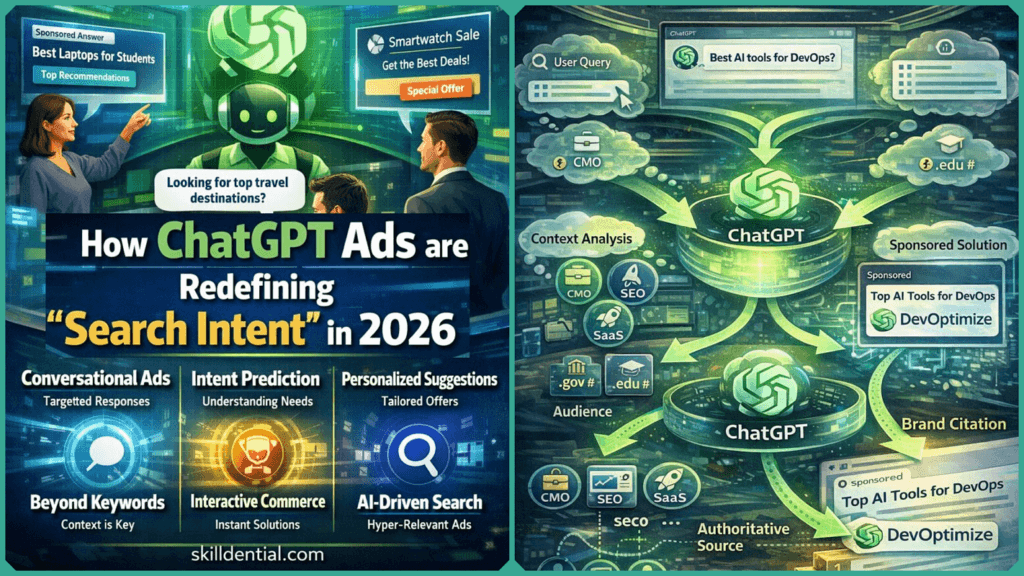
But this isn’t just a new line item in a media budget; it represents a fundamental shift from keyword-matching to understanding the “why” behind every conversation.
How ChatGPT Ads Work: The Semantic Shift
ChatGPT Ads are not just a new “placement”; they represent a move away from the Keyword Economy and into the Context Economy. Here is how the mechanics function in early 2026:
Placement & Format: The “Post-Answer” Moment
Rather than interrupting the flow, ads are integrated as “Sponsored Recommendations” in a tinted, clearly labeled box at the end of an AI-generated response.
- The Logic: OpenAI is banking on the “post-answer moment”—the point where a user has received information and is ready to take the next step (e.g., buying the ingredients for a recipe or booking the hotel for a trip itinerary).
- Direct Interaction: Unlike a static Google link, some ads allow users to directly chat with an advertiser’s AI within the interface to ask follow-up questions about pricing, shipping, or compatibility.
Targeting: From Keywords to User Problems
Traditional Search (PPC) is reactive: you bid on “CRM software.” ChatGPT Ads are proactive and semantic.
- Semantic Matching: The system uses the entire conversation history (the “session context”) to match an ad.
- Example: Instead of waiting for a user to type “buy hiking boots,” the ad is triggered when a user says, “I’m planning a trip to the Swiss Alps in November, and I’m worried about my ankles.” The AI understands the problem (ankle support/cold weather) and suggests the solution (a specific brand of boots) without the user ever searching for a product name.
The Measurement Gap: Awareness over Attribution
For performance marketers, the current model is a challenge. Because OpenAI prioritizes user privacy, the data shared with advertisers is intentionally limited:
- Available Metrics: High-level data on Impressions and Clicks.
- The Missing Link: There is currently no post-click conversion tracking or “pixel” support.
- The Result: Early 2026 campaigns are being treated as “Top of Funnel” (TOFU) awareness buys. Brands are paying for the prestige of being the “Recommended Solution” by the world’s most famous AI, rather than direct last-click attribution.
What Is Search Intent in ChatGPT Ads?
In 2026, “Search Intent” has evolved from a static keyword match into a dynamic, contextual dialogue.
From Keywords to Contextual Narratives
Traditional search intent is linear: you type “running shoes” (keyword) and get a list of stores (result). ChatGPT Ads operate on multidimensional intent.
- The Traditional Way: Keywords like “running shoes” or “best marathon gear.”
- The ChatGPT Way: Understanding the problem behind the query. If a user says, “I’m training for my first marathon, but my flat feet are causing arch pain,” the AI recognizes the intent as “Injury Prevention + Equipment Acquisition.”
- The Result: The ad doesn’t just match the word “shoes”; it matches the user’s specific biological and situational needs.
The “Problem-Solution” Framework
On Google, ads often feel like interruptions. In ChatGPT, they are positioned as seamless solutions. Because the AI interprets the entire conversation—not just the last sentence—it can serve an ad that feels like a natural “next step” in the advice it just gave. This shifts the advertiser’s role from a “seller” to a “cited resource.”
Redefining GEO: The New SEO
This shift has given birth to Generative Engine Optimization (GEO). In this new landscape, the goal isn’t just to rank #1; it’s to be the most citeable solution.
- AI Citations over Clicks: Instead of optimizing for “Click-Through Rate” (CTR), brands are now optimizing for Inclusion Rate.
- The Goal: To have your product or service so well-structured in its data and authoritative in its “brand voice” that the AI selects you as the sponsored answer to the user’s complex problem.
Key Takeaway: In 2026, you don’t “bid on keywords.” You “bid on moments of need.”
The $60 Question: Why Are ChatGPT Ads So Expensive?
The most debated aspect of OpenAI’s 2026 ad rollout is the price tag. At $60 CPM (Cost Per Mille), ChatGPT is positioning itself not as a competitor to social media, but as “The Super Bowl of Search.”
Premium Inventory vs. Commodity Reach
To put the $60 CPM in perspective, consider the current 2026 landscape:
- Meta (Instagram/Facebook): ~$10–$20 CPM
- Google Display: ~$5–$15 CPM
- ChatGPT: $60 CPM
OpenAI is explicitly comparing this inventory to premium live sports (like the NFL) or prime-time television. They aren’t selling “eyeballs”; they are selling “undivided attention” within a high-utility environment where users are often in a “state of flow.”
Capturing the “Moment of Decision”
Media buyers justify the premium because of where the ad sits in the user journey.
- Passive Intent (Meta): You see an ad for a watch while looking at a friend’s vacation photos.
- Active Intent (Google): You search for “best dive watches” and see 10 blue links.
- Conversational Intent (ChatGPT): You are deep in a 10-minute chat about the best diving spots in Belize, and the AI suggests a specific waterproof watch at the exact moment you’re planning your gear list.
In 2026, this is called “Decision Delegation.” Advertisers are paying a premium to be the solution the AI “chooses” when a user is ready to act.
The “Elite Brand” Barrier
With a reported $1 million minimum spending commitment for early pilot partners, OpenAI is intentionally keeping the “noise” low.
- By pricing out smaller players initially, they ensure the first ads users see are from trusted, blue-chip brands (e.g., Nike, Coca-Cola, Salesforce).
- This protects the user experience—making ads feel like a “premium recommendation” rather than “spammy clutter”—which is vital for maintaining trust in AI responses.
The Verdict: The high CPM is a gamble that Quality > Quantity. For brands, it’s a bet that one highly relevant AI citation is worth more than a thousand ignored banners on a social feed.
ChatGPT Ads vs. Traditional Search: A New Paradigm
While Google has dominated the “intent” market for over two decades, OpenAI is not trying to beat Google at its own game. Instead, it is launching a different sport entirely.
The table below breaks down the fundamental shift from Search Engines to Answer Engines.
| Aspect | ChatGPT Ads (2026) | Google Ads (Traditional) |
| Placement | Post-Response: Clearly labeled “Sponsored Results” at the bottom of a specific AI answer. | Priority Results: Top, middle, and bottom of the Search Engine Results Page (SERP). |
| Intent Matching | Semantic Context: Leverages the entire multi-turn conversation to understand the user’s “why.” | Keyword Triggers: Relies primarily on specific words or phrases typed into a search bar. |
| Pricing Model | $60 CPM: High-cost, impression-based model similar to premium “Big Event” TV ads. | $1–$5 CPC (avg): Performance-based “Cost-Per-Click” where you only pay for engagement. |
| User Expectation | The Advisor: Users expect a synthesized solution to a complex problem. | The Library: Users expect a list of options (links) to browse and compare. |
| Metrics & Tracking | Limited: Aggregated impressions and clicks; no post-click conversion tracking (yet). | Robust: Full-funnel attribution, conversion tracking, and deep audience analytics. |
The Key Distinction: Sequential vs. Parallel Discovery
In a traditional Google Search, users engage in Parallel Discovery. They see 10 blue links and 4 ads simultaneously, choosing which one to click. This drives competition based on headlines and “clickability.”
In ChatGPT, the experience is Sequential. The AI provides the answer first, and the ad follows as the logical next step. Because the AI has already built “trust” through its answer, the ad carries the weight of a personal recommendation rather than a billboard. This “Ad-as-a-Solution” model is exactly why OpenAI feels justified in charging $60 for every 1,000 views.
Skilldential Insights: The GEO Survival Guide
At Skilldential, our 2025-2026 career audits for SEO professionals and SaaS founders revealed a startling trend: marketing teams are seeing an average 40% decline in organic clicks due to the rise of AI Overviews and chat-based answers.
The “blue link” is no longer the destination; the citation is. To combat this, we’ve identified three pillars of the GEO (Generative Engine Optimization) shift that separate the winners from the laggards:
The “Citation Uplift” Strategy
Our data shows that brands focusing on authoritative, fact-dense content—rather than keyword density—see a 25% uplift in AI citations within just weeks.
- The Tactic: Move away from “What is [Topic]” blog posts. Instead, publish “Information Gain” content: proprietary data, unique case studies, and structured expert opinions that AI models can’t find elsewhere.
Structured Data is the New Code
In the era of ChatGPT Ads, your website must be machine-readable.
- Why it works: Using advanced Schema.org markups (like
Product,Review, andFAQ) serves as a “cheat sheet” for AI. It allows the model to instantly verify your facts, making it significantly more likely to cite your brand as a “Sponsored Recommendation” or an organic source.
The “Conversational Presence” Audit
The most prepared CMOs in 2026 aren’t just looking at their Google rankings; they are auditing their Unpaid Presence.
- The Audit: Ask ChatGPT, “What are the top solutions for [Your Industry]?” without using your brand name.
- The Goal: If the AI doesn’t mention you organically, it likely won’t trust you as a sponsored placement either. Fixing your “organic reputation” with the AI is the first step toward a successful paid ad strategy.
Skilldential Tip: If you are a small business, don’t wait for the $1M minimum spend to drop. Start your GEO work now. When the ad platform finally opens to SMBs, the AI will already “know” your brand, lowering your effective cost per acquisition.
Final Thoughts: Is the $60 CPM Worth It?
For traditional SMBs, the answer is “not yet.” But for elite brands, ChatGPT Ads are the first step into a world where advertising isn’t an interruption—it’s an expert recommendation.
ChatGPT Ads FAQs
What exactly are ChatGPT Ads?
ChatGPT Ads are clearly labeled “Sponsored Recommendations” that appear at the bottom of AI-generated responses. They were introduced in January 2026 to support the Free tier and the new $8/month ChatGPT Go subscription. Unlike traditional banner ads, these are designed to be contextually relevant “next steps” for the user.
How much do ChatGPT Ads cost?
Early industry reports indicate a premium price of roughly $60 CPM (per 1,000 impressions). This is significantly higher than Meta’s $15–$20 average because OpenAI is selling “Decision-Point Intent.” During the current pilot phase, OpenAI is prioritizing large-scale advertisers with spending commitments of up to $1 million.
Do ads influence the quality or bias of ChatGPT’s answers?
No. OpenAI operates under a strict principle of “Answer Independence.” This means advertisers cannot pay to change the text of the AI’s organic response. The ad is a separate unit located below the answer, and the AI’s “thinking” remains objective and driven by your prompt, not a sponsor’s budget.
What is Generative Engine Optimization (GEO)?
GEO is the new SEO. It is the process of optimizing your brand’s digital footprint so that AI models (like GPT-5.2) find your content authoritative and easy to cite. Instead of just “ranking for keywords,” GEO focuses on providing the best structured data and context so you become the AI’s primary recommendation.
Are any topics off-limits for advertisers?
Yes. To maintain user trust, OpenAI has banned ads from appearing in conversations involving health, mental health, and politics. Additionally, ads are not served to users under the age of 18, verified via OpenAI’s new age-prediction models launched in early 2026.
Who should be considering ChatGPT Ads right now?
Currently, the platform is best suited for Blue Chip brands and SaaS companies with high customer lifetime value (LTV) who want to capture users at the exact moment of high-intent discovery. For SMBs, the current move is to focus on organic GEO until a self-service, lower-minimum ad platform is released.
In Conclusion
The rollout of ChatGPT ads in early 2026 marks the official end of the “Ad-Free AI” era and the birth of the Answer Economy. While the $60 CPM and $1 million minimums currently keep the platform reserved for elite global brands, the underlying shift affects everyone.
We are moving away from a web of “links” and toward a web of “solutions.” In this new landscape, high-intent conversational depth outperforms raw volume every time.
The Skilldential Final Checklist:
- For SMBs: Don’t wait for self-service ads. Focus on GEO today. If ChatGPT doesn’t “know” your brand organically, your future paid ads will be twice as expensive and half as effective.
- For SaaS Founders: Ensure your technical documentation and use cases are structured for AI crawlers. Your goal is to be the “default recommendation” for the problems your software solves.
- For CMOs: Audit your “Conversational Presence.” Ask the models what they think of your brand—before you start paying them to say it.
The transition from keyword-matching to Contextual Intent isn’t just a trend; it’s the new standard for how value is exchanged on the internet. Whether you are a “Blue Chip” ready to spend $1M or a small creator optimizing your first FAQ, the goal is the same: Stop being a search result and start being the answer.