
Deriv TradingView Chart and The AI Economy Intersection
The Deriv TradingView Chart is an advanced interface that bridges Deriv’s diverse markets with TradingView’s high-powered analytical engine. By supporting multi-timeframe analysis and Pine Script automation, it provides a standardized structure for data-driven decisions—a necessity backed by standards from the SEC and CFTC.
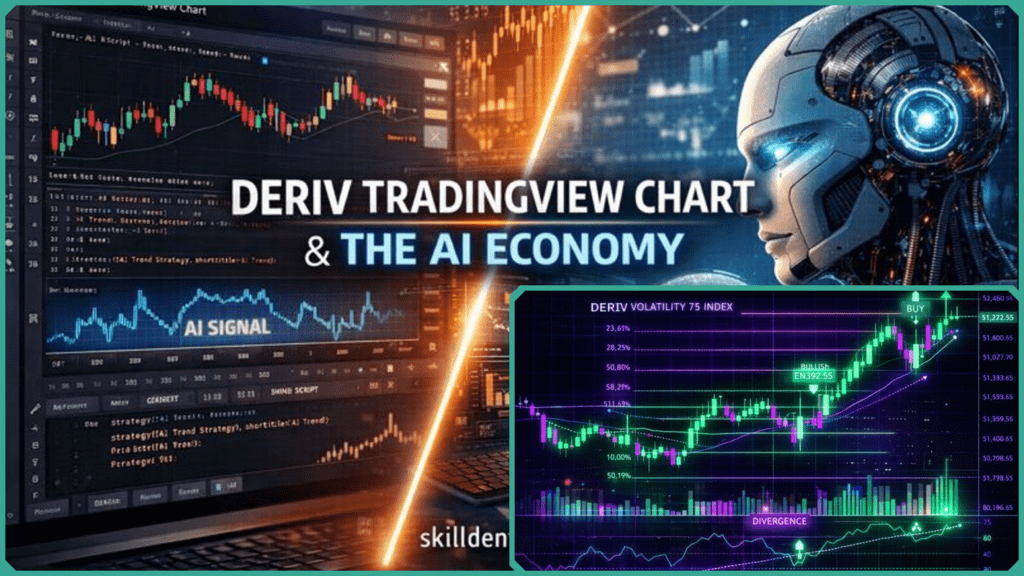
But in the era of AI evolution, technical analysis is no longer just about drawing lines. To truly master this platform today, traders must move beyond basic synchronization and discipline. They must learn to leverage the chart as a data hub for AI-driven insights, turning standard market data into a competitive edge in the new digital economy.
How the Deriv TradingView Chart Works
The Deriv TradingView Chart operates as a sophisticated bridge between raw liquidity and professional-grade visualization. It works by embedding TradingView’s advanced charting library directly into the Deriv ecosystem, creating a “best-of-both-worlds” environment.
The Technical Synergy
Instead of relying on basic web-based interfaces, this integration splits the workload into two specialized streams:
- The Analytical Engine (TradingView): Processes market data visually. It hosts over 100 technical indicators, 110 drawing tools, and specialized chart types like Renko, Kagi, and Point & Figure that go beyond standard candlesticks.
- The Execution Engine (Deriv): Handles the “heavy lifting” of financial logic. This includes real-time order routing, margin calculations, and account management.
Key Operational Features
Behind this seamless interface are several layers that make it a cornerstone of the AI Career Economy:
- Unified Data Streams: Traders can access exclusive Deriv markets—including Synthetic Indices (Volatility 75, Boom/Crash) and traditional Forex—all within the same standardized TradingView interface.
- Cloud-Based Synchronization: Because the engine is web-integrated, your custom Pine Script strategies and chart layouts are saved in the cloud. This enables a “trade anywhere” career model, allowing a transition from desktop to mobile without losing data.
- Algorithmic Ready: The chart acts as a host for automated scripts. By using Pine Script v6, traders can now incorporate machine learning libraries to filter market noise, a task that previously required high-level Python knowledge.
Why this matters: This separation of “Analysis” and “Execution” reduces the technical lag and visual clutter found in older platforms. It allows you to focus on the strategy logic, which is the most valuable skill in an AI-driven market.
Why the Deriv TradingView Chart Outperforms Basic Web Traders
The Deriv TradingView Chart is superior because it replaces “visual guessing” with structured, repeatable analysis. While basic web traders are designed for casual use with fixed indicators and simplified displays, this professional-grade interface is built for precision and long-term consistency.
Multi-Dimensional Analysis vs. Static View
Basic traders often limit you to a single chart per tab with a few standard indicators. In contrast, the Deriv TradingView integration allows you to:
- Layer Custom Logic: Combine multiple indicators (like RSI and Volume Profile) into a single, cohesive strategy.
- Split-Screen Monitoring: Watch multiple timeframes simultaneously—for example, spotting a 24-hour trend on one side while timing your entry on the 5-minute chart on the other.
- Advanced Chart Types: Access non-time-based charts like Renko or Kagi, which filter out market noise and focus purely on price movement—a massive advantage for trading volatile Synthetic Indices.
Rule-Based Execution for Prop Firm Success
For traders aiming at professional careers or prop firm funding, emotional discipline is the “make or break” factor.
- Advanced Alerts: Instead of staring at screens for hours, you can set 12+ notification conditions. These alerts can trigger based on price, technical drawings, or custom scripts, ensuring you only engage the market when your rules are met.
- Standardized Data Structures: By using the same engine as institutional traders, you learn to make decisions based on market structure rather than “gut feeling.” This builds the exact track record that prop firms look for: disciplined, rule-based growth.
The Power of Pine Script
Perhaps the biggest differentiator is Pine Script. While basic traders lock you into “off-the-shelf” tools, TradingView allows you to:
- Backtest Strategies: Test your ideas against years of historical data in seconds to see if they actually work before risking capital.
- Automate Logic: Create your own specialized indicators that highlight specific “AI Evolution” patterns, such as liquidity sweeps or momentum shifts.
The Professional Edge: In the new AI career economy, the ability to operate complex data tools is a marketable skill. Mastering the Deriv TradingView Chart moves you from being a “platform user” to a “market analyst.”
How to Sync Deriv with TradingView for Maximum Clarity
To properly sync Deriv with TradingView, users must select the TradingView chart interface within the Deriv ecosystem (typically via the “Trader’s Hub” or within Deriv X). Clarity begins with technical alignment: you must manually confirm that the symbol, timeframe, and contract type match your intended strategy.
Consistency is the cornerstone of professional trading. Mismatched timeframes or looking at different contract views (such as CFD vs. Options data) often leads to perceived “signal failure,” where an indicator appears to work on one screen but fails on another.
The “Skilldential” Insight
In Skilldential career audits, we observed that next-gen retail traders frequently struggle with inconsistent chart settings across different sessions. This “setting drift” creates mental fatigue and execution errors. By implementing a fixed TradingView layout with saved templates, traders saw a 27% reduction in missed trade confirmations.
Steps for a Professional Sync:
- Initialize the Interface: From your Deriv dashboard, launch the TradingView chart tool to ensure you are receiving the direct data feed.
- Define Your Workspace: Set your primary timeframe (e.g., 15m for entries, 4H for trend) and layer your necessary indicators.
- Use the Cloud Save: Click the Cloud/Save icon at the top right of the TradingView interface. Name your layout specifically (e.g., “Volatility 75 – Scalping AI”).
- Enable Auto-Save: Ensure “Autosave” is toggled on so any new drawing or indicator adjustment is preserved across devices.
- Verify Synchronization: If using multiple screens, ensure the Symbol and Interval sync buttons are active in the layout settings to move all charts in unison.
Pro Tip: Mastery in the AI economy isn’t just about knowing where to click; it’s about creating a standardized digital environment where your tools work for you, not against you.
How AI Integrates with the Deriv TradingView Chart
In the current era of AI Evolution, integration with the Deriv TradingView Chart has moved beyond simple “bots” to a sophisticated “Co-Pilot” model. AI integrates through three primary layers: pattern recognition, indicator optimization, and script automation.
Rather than replacing the trader, these tools act as a high-speed analytical layer that filters out market noise, allowing you to focus on high-probability setups.
AI-Assisted Pine Scripting
The most significant shift in 2026 is the Pine Script v6 revolution. You no longer need to be a professional coder to build custom tools.
- Prompt-to-Code: Traders use Large Language Models (LLMs) to describe a strategy in plain English—for example, “Create a trend filter that only triggers during the London session when volatility is 20% above the daily average.” * Debugging & Refinement: AI can instantly scan your existing scripts to find logical errors or optimize the code for faster execution on Deriv’s real-time feeds.
Machine Learning Pattern Recognition
TradingView’s engine now supports advanced Machine Learning (ML) libraries that categorize market regimes.
- Dynamic Classification: Instead of static indicators, ML models analyze historical price behavior to identify if the current market is in “Accumulation,” “Expansion,” or “Distribution.”
- Sentiment Overlays: New tools can pull external data (like “Social Pulse” scores or Fed liquidity metrics) and overlay them directly onto your Deriv charts to provide a “macro” context to your technical signals.
Strategy Optimization & Backtesting
AI transforms the Strategy Tester from a simple spreadsheet into a predictive feedback engine.
- Heuristic Optimization: AI can run thousands of variations of your stop-loss and take-profit levels in seconds, identifying the “sweet spot” for a specific Deriv instrument like Volatility 75.
- Emotional Bias Detection: Modern AI-integrated journals can link to your TradingView data to detect “Revenge Trading” or “Risk Creep,” flagging patterns where your human emotions are overriding your proven strategy.
The Shift: Your role is moving from “Manual Chart Watcher” to “Strategy Supervisor.” You bring the creative edge and risk tolerance; the AI handles the data-crunching and consistency checks.
Realistic AI-Driven Tools on TradingView
In 2026, AI on TradingView has moved beyond the “hype” of autonomous bots and into practical, augmented intelligence tools. These tools don’t just “predict” price; they process millions of data points to highlight high-probability setups that the human eye might miss.
Machine Learning (ML) Pattern Recognition
Instead of manually drawing every “Head and Shoulders” or “Double Bottom,” traders now use ML-enhanced scripts (often built with Pine Script v6) that categorize market regimes in real-time.
- KNN (K-Nearest Neighbors) Indicators: These look at the current price movement and find the “nearest” matches in historical data to suggest a probabilistic outcome.
- Automatic Market Structure Shift (MSS): AI tools now automatically plot Break of Structure (BOS) and Change of Character (CHoCH), filtering out “fake” breaks by analyzing the volume and speed of the move.
Volatility Clustering and Sentiment Overlays
AI excels at measuring “Market Feel”—the invisible forces of liquidity and emotion.
- Social Pulse & Sentiment Flow: Tools like SentimentFlow AI analyze news and social data (NLP) to overlay a sentiment score directly on your chart. If you see a bullish technical signal but “Social Pulse” is deep red, the AI is warning you of a potential “bull trap.”
- Liquidity Raid Engines: These scripts identify “equal highs” and “equal lows” where institutional stop-losses are likely sitting, signaling where the market might “sweep” next before reversing.
AI-Optimized Pine Scripting (No-Code Development)
The most realistic “career tool” for the new economy is AI-assisted coding. Traders are using LLMs (like ChatGPT or TradingView’s native AI assistant) to generate custom logic:
- The Prompting Era: You can prompt an AI to “Create a volatility-responsive trailing stop based on ATR and 3-candle momentum,” and it will generate the Pine Script code instantly.
- Heuristic Optimization: Use AI to run thousands of “what-if” scenarios on your strategy, finding the exact settings that would have performed best on specific Deriv instruments over the last 12 months.
Smart Decision Dashboards
Modern AI tools often come as a “HUD” (Heads-Up Display) on your chart. Instead of 20 different lines, you get a clean dashboard showing:
- Regime Filter: Is the market trending, ranging, or about to explode (squeeze)?
- Risk/Reward Calculator: AI-driven tools that automatically calculate your position size based on current volatility, so you never over-leverage a trade.
Professional Standard: Real AI tools are designed to reduce cognitive load. By delegating the “data-crunching” to AI, you preserve your mental energy for the high-level tasks: managing risk and executing with discipline.
From Guessing to Governance: The AI Trading Mindset
In the Era of AI Evolution, the greatest shift isn’t in the charts themselves, but in the mind of the trader. AI changes the trading mindset by replacing subjective “gut feelings” with objective validation logic.
Instead of asking, “Does this setup look good?”—a question prone to fear and greed—the AI-augmented trader asks, “Does this meet my predefined technical and statistical thresholds?” This transition from a “perceptive” mindset to a “governance” mindset is what separates hobbyists from professionals in the new career economy.
Removing Emotional Bias with Binary Rules
Human decision-making is often derailed by cognitive biases like loss aversion (holding losers too long) or FOMO (chasing winners). AI enforces a rule-based structure that neutralizes these emotions:
- Condition Validation: AI tools can be set to “unlock” the trade button only when specific data points align (e.g., RSI divergence + Volume spike + Trend confirmation).
- Risk Guardrails: Automation can enforce hard stops, such as a “Daily Loss Limit” that locks the platform after a certain drawdown, preventing the emotional “revenge trading” that destroys most careers.
Reducing Decision Fatigue
Modern markets offer an overwhelming amount of information—news, social sentiment, and multi-timeframe data. This leads to decision fatigue, where the quality of your trades drops as the day progresses.
- Information Prioritization: AI acts as a filter, highlighting only the most relevant setups based on historical probability.
- Contextualization: Instead of predicting the future, AI contextualizes the present. It tells you: “Current conditions match a setup that has a 68% win rate over the last 5 years.” This data-backed confidence allows you to execute without hesitation.
Transferable Career Skills
This shift in mindset mirrors how modern data-centric roles operate in top-tier tech and finance firms. By mastering the Deriv TradingView Chart with an AI-driven approach, you are developing high-demand skills for 2026:
- Data Literacy: The ability to interpret complex dashboards and visualize trends.
- Algorithmic Thinking: Breaking down a complex goal into a series of “If/Then” logical steps.
- Performance Auditing: Using AI-powered journals to identify and fix recurring behavioral mistakes.
| Old Mindset (Guessing) | New Mindset (Data-Driven) |
| Focuses on “The Big Score” | Focuses on “The Process” |
| Reacts to Price Action | Validates with Multi-Source Data |
| Driven by Greed/Fear | Driven by Probabilistic Logic |
| High Emotional Drain | High Strategic Focus |
The Career Advantage: When you stop “guessing” and start “supervising” your data, you are no longer just a trader—you are a Digital Asset Manager. This is the core competency of the New AI Career Economy.
Future-Proofing Your Career with the Deriv TradingView Chart
Mastering the Deriv TradingView Chart does more than just help you spot a trend; it builds a foundation for longevity in the New AI Career Economy. As we move deeper into 2026, the global workforce is shifting from “manual execution” to “systems orchestration.”
By learning to manage complex data dashboards and automated scripts, you are moving away from speculative trading and toward a legitimate career as a Financial Data Analyst.
Developing Systems Architecture Skills
In the AI era, the most valuable professionals aren’t just “prompting” chatbots; they are building systems.
- The Trading Connection: When you set up a Deriv TradingView layout with multi-timeframe alerts and Pine Script filters, you are practicing Systems Architecture.
- The Career Edge: This ability to map a complex goal (profitable trading) into a reliable, automated workflow is a direct parallel to roles like FinTech Product Manager or Algorithmic Risk Strategist.
Analytical Reasoning and Data Literacy
The “Era of AI Evolution” demands workers who can interpret high-velocity data.
- Mastery in Action: Using the Deriv TradingView Chart forces you to analyze Synthetic Indices or Forex through the lens of statistics rather than emotion. You learn to read “Exposure Scores”—how much risk your strategy is exposed to at any given time.
- The Career Edge: This is the core of Business Intelligence. Employers in 2026 prioritize candidates who can look at a dashboard (like TradingView or Power BI) and extract actionable insights without being overwhelmed by the volume of information.
Transitioning from Trader to “Agent Manager”
The blueprint for a pro career in 2026 is moving from being the “worker” to being the “architect.”
- Supervisory Trading: Instead of manual chart watching, you manage “Agent Pods”—automated scripts and AI-driven indicators that handle the research and pattern detection for you.
- The Career Edge: This mirrors the shift in tech where professionals manage Autonomous AI Agents to handle logistics, coding, or research. Trading becomes your “lab” for mastering the human-in-the-loop management style that is now fundamental across all high-paying sectors.
| Skill Learned on Deriv | Transferable AI Career Role |
| Pine Script v6 Automation | AI Workflow Orchestrator |
| Statistical Backtesting | Data Science / Model Auditor |
| Rule-Based Governance | Compliance & Risk Technologist |
| Sentiment Analysis Integration | Market Intelligence Analyst |
The Verdict: Mastering these tools ensures you aren’t just “riding the wave” of AI—you are the one building the surfboard. You aren’t just a trader; you are a data professional with the discipline to manage automated systems in a volatile world.
Comparison: Basic Deriv Web Trader vs. Deriv TradingView Chart
To finalize your blog post, a side-by-side comparison clearly shows why the Deriv TradingView Chart is the essential choice for anyone serious about the AI Career Economy. While the basic web trader is functional for simple execution, the TradingView integration provides the “data-hub” necessary for modern financial analysis.
| Feature | Basic Deriv Web Trader | Deriv TradingView Chart |
| Indicators | Limited to ~80 fixed options. | 100+ built-in plus 100k+ community scripts. |
| AI Integration | None (Manual only). | AI-assisted Pine Scripting & ML patterns. |
| Alerts | Basic price-level notifications. | Multi-condition & Automated alerts. |
| Drawing Tools | Simplified/Standard tools. | 110+ smart tools (Fibonacci, Gann, Elliot). |
| Backtesting | Manual/Visual review only. | Strategy Tester with deep historical data. |
| Career Readiness | Low (Casual user level). | High (Builds professional analyst skills). |
| Prop Firm Alignment | Weak (Harder to track strict rules). | Strong (Enables rule-based governance). |
Key Takeaways for Your Readers
- The “Skill Gap”: Using the Basic Web Trader keeps you in a “retail” mindset. Moving to the TradingView Chart moves you into a “Professional” mindset.
- Automation: TradingView allows you to build systems that work while you sleep, whereas basic traders require constant manual screen time.
- Standardization: Prop firms and institutional desks use TradingView’s data structure. Learning it now means you are speaking the “language of the industry.”
Mastering the Deriv TradingView Chart in the Era of AI Evolution isn’t just about finding better trades; it’s about upgrading your professional identity. By shifting from guessing to data-driven governance, you are positioning yourself at the forefront of the new financial economy.
Deriv TradingView Chart FAQs
What is the Deriv TradingView Chart used for?
It is a professional-grade interface used for advanced technical analysis. It bridges Deriv’s exclusive markets (like Synthetic Indices) with TradingView’s world-class engine, allowing you to use over 100 indicators and 110 drawing tools to plan trades with institutional precision.
Does the Deriv TradingView Chart use artificial intelligence?
Yes, but as a “co-pilot” rather than a replacement. AI is used for pattern recognition (automatically spotting trends), indicator optimization, and AI-assisted coding via Pine Script v6. It helps filter market noise so you can focus on high-probability setups.
Is the Deriv TradingView Chart suitable for beginners?
Absolutely. While it has a steeper learning curve than a basic web trader, it is designed to be intuitive. Beginners benefit from a “cleaner” visual experience and the ability to practice with Paper Trading or Bar Replay to build confidence without risking real capital.
Can Pine Script be automated with AI tools?
Yes! Modern AI models like ChatGPT or specialized Pine Script generators can now take a strategy described in plain English and turn it into working code. This allows traders to build custom bots and alerts without needing a degree in computer science.
Does mastering TradingView help beyond trading?
Yes. The skills you gain—data literacy, systems thinking, and analytical discipline—are highly transferable. In the 2026 AI economy, the ability to manage complex data dashboards and rule-based systems makes you a strong candidate for roles in FinTech, Data Analysis, and Risk Management.
In Conclusion
The Deriv TradingView Chart is no longer just a luxury for technical traders; it is a critical interface for the AI Career Economy. By bridging professional-grade visualization with automated logic, it allows you to move away from the “gambler’s” mindset and toward the role of a Digital Systems Architect.
Final Summary
- Structured Analysis: The platform enables repeatable, rule-based strategies that replace visual guessing with statistical evidence.
- AI Enhancement: AI doesn’t replace the trader; it acts as a “Data Co-Pilot” for pattern recognition and code optimization.
- Skill Transferability: The discipline required to master this chart—data literacy, systems thinking, and emotional regulation—aligns perfectly with high-demand careers in the broader AI economy.
Final Recommendation: Treat your TradingView layout as your “professional office.” The more organized, standardized, and data-driven your setup becomes, the more your trading evolves from a speculative hobby into a sustainable, tech-driven career.
Step-by-Step Action Plan
- Sync Today: Move your primary analysis from the basic web trader to the Deriv TradingView interface.
- Save Your Work: Create a “Master Template” and use the Cloud Save feature to ensure consistency.
- Explore AI: Use a chatbot to help you write a simple Pine Script v6 indicator that automates one of your manual rules.
- Audit Your Mindset: Shift your goal from “finding a winner” to “executing a validated system.”