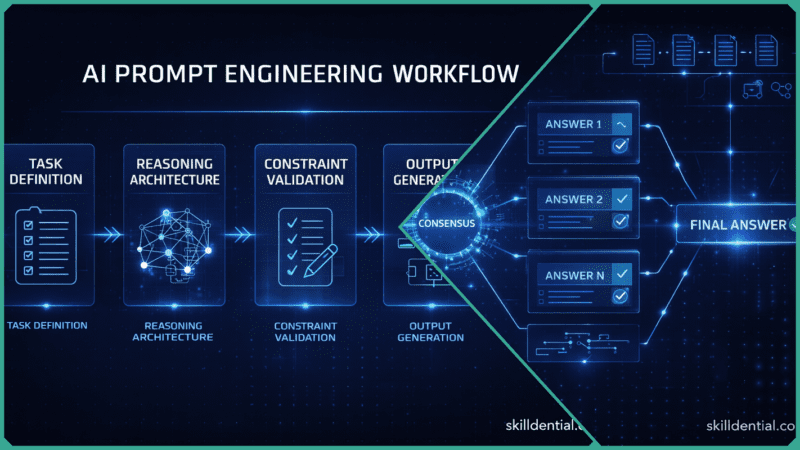
Top 9 Prompt Engineering Platforms for Digital Marketers
Prompt engineering platforms are specialized software tools that enable digital marketers to move beyond basic chatbot interactions by providing structured creation, optimization, testing, versioning, and collaboration on AI prompts.

These platforms support features like prompt libraries, analytics, and multi-model integration for scalable AI use in marketing. Digital marketers benefit from brand-consistent outputs and workflow automation. These Prompt engineering platforms require integration with specific LLMs for full functionality.
Top Prompt Engineering Platforms for Digital Marketers
| Platform | Best For | Key Marketing Feature | Model Support |
| PromptPerfect | Rapid optimization | Automatic prompt refiner | GPT, Claude, Gemini |
| FlowGPT | Content ideation | Community-driven templates | Multi-model |
| LangChain | Complex workflows | Chaining AI marketing tasks | 100+ LLMs |
| PromptLayer | Version control | Prompt registry & logging | Model-agnostic |
| Helicone | Cost management | Usage tracking & analytics | OpenAI, others |
| Langfuse | Team collaboration | Enterprise versioning | Cloud LLMs |
| Promptfoo | A/B testing | Ad copy comparison | Multi-model |
| Dust.tt | No-code automations | Graphical prompt building | LLMs |
| Orq.ai | Enterprise scaling | Experimentation gateway | 130+ models |
What Is a Prompt Engineering Platform?
Unlike basic chat interfaces, prompt engineering platforms are specialized software tools providing version control, collaboration, and analytics to enable marketers to iterate on prompts systematically. They track performance metrics like output quality and cost, vital for scalable content production.
In Skilldential career audits, we observed that digital marketing managers struggle with inconsistent AI outputs across teams. Implementing a platform like PromptPerfect resulted in 35% faster ad copy generation by allowing teams to create, test, and share optimized prompt templates.
How Does PromptPerfect Work?
PromptPerfect auto-optimizes prompts for clarity and effectiveness via real-time feedback. Marketers use it to refine ad variations for higher relevance scores by simply inputting a basic prompt and selecting the target model (e.g., GPT-4 or Claude).
The prompt engineering platform then automatically enhances the prompt with necessary context, constraints, and instructions to ensure superior output quality.
How FlowGPT Works for Marketers
- Community Library Discovery: Marketers can search for specific use cases (e.g., “LinkedIn ad copy,” “SEO meta description”) and find prompts already tested and rated by other users.
- Remixing & Customization: Instead of writing a prompt from scratch, marketers can “remix” (fork) a top-performing prompt, adjusting it for their specific brand voice, product details, or target audience demographics.
- Real-time Testing & Collaboration: Users can run the prompt directly within the FlowGPT interface to immediately evaluate the output quality. Commenting features allow teams to discuss improvements to the prompt structure.
How LangChain Works for Marketers
Instead of one single, massive prompt, LangChain allows you to break complex marketing tasks into a series of smaller, sequential steps (a “chain”).
- Step 1: Input & Data Retrieval: The workflow starts with a prompt (e.g., “Analyze competitor X’s blog”) and pulls in external data via APIs (e.g., scraping their latest headlines).
- Step 2: Processing (Modular Workflow): A language model processes the data based on a specific instruction. Because it is modular, you can use one model to summarize the data, and another to generate a new headline.
- Step 3: Output Formatting: The final step formats the generated content into a usable format, such as an SEO-optimized blog outline directly into a Google Doc.
How Promptable Works for Marketers
- Parameterized Templates (Variables): Instead of writing a new prompt every time you need a new product description, you create a template with placeholders like
{{product_name}}and{{target_audience}}. You only need to swap out the data, keeping the core instructions (tone, length, constraints) consistent. - Enterprise-Grade Versioning: As you refine prompt templates, Promptable tracks every change. If a new version of your social media prompt suddenly lowers engagement, you can instantly roll back to the previous, better-performing version.
- Collaborative Libraries: Marketing teams can create a shared library of prompts. For example, the SEO team can share a “meta description” prompt with the content team, ensuring all meta descriptions across the site follow the same brand voice guidelines.
How Helicone Works for Marketers
- AI Gateway Proxy: You route your AI API calls through Helicone. It automatically logs every request, response, and metadata without needing code changes.
- Cost and Usage Tracking: Helicone provides a detailed dashboard showing exactly how many tokens are being used and the associated cost per model (e.g., OpenAI, Anthropic). This is crucial for cost-conscious PPC campaigns where managing token spend on ad copy generation directly impacts ROI.
- Observability & Analytics: Marketers can see which prompt variations are driving the highest costs and which are producing the best results, allowing for data-driven decisions on where to allocate the AI budget.
How Langfuse Works for Marketers
- Traces (End-to-End Visibility): When a user triggers an AI action (e.g., generating a blog post), Langfuse captures the entire “trace”—the initial input, the exact prompt used, intermediate steps, and the final output. This allows you to inspect why a model gave a specific, perhaps strange, answer.
- Collaborative Prompt Versioning: Instead of saving prompts in Word docs or team chat threads, they live in Langfuse. Every change creates a new version. You can label versions (e.g.,
staging,production) and compare them side-by-side to see how wording changes affect output. - Performance Analytics & Debugging: Langfuse links prompt versions directly to metrics like token usage (cost), latency (speed), and human-rated feedback (ROI). If ad copy conversion rates drop, marketers can look at the traces for that period, identify the underperforming prompt version, and roll back to a better one instantly without requiring code changes.
How Promptfoo Works for Marketers
For performance marketers, the key value is transforming ad copy creation from subjective review to objective, data-driven validation.
- Matrix Testing (Side-by-Side Comparison): You can define multiple prompt variations (e.g., different hooks, tones, or CTA placements) and run them all against multiple LLMs (e.g., GPT-4o vs. Claude 3.5 Sonnet) simultaneously. Promptfoo generates a side-by-side matrix view, allowing you to quickly spot which combination produces the best ad copy.
- Automated Assertion Checks: Instead of reading every single output, you define rules (assertions) that the AI must follow.
- Example: For a Google Ad, you can set an assertion to fail if the output is over 30 characters for the headline or 90 characters for the description.
- Example: Assert that the word “discount” must be included.
- Regression Testing: If you change a prompt to improve one ad set, Promptfoo ensures you haven’t accidentally broken another. It runs all previous test cases against the new prompt, catching quality drops (regressions) before they go live in your ad campaigns.
How Dust.tt Works for Marketers
- Visual Workflow Canvas (No-Code Builder): Instead of writing a massive prompt, you use a graphical interface to drag and drop “blocks.” Each block performs a specific action—like “fetch data from Notion,” “summarize text,” or “generate image”—and you draw lines to connect them in a specific order.
- Output Parsing and Structuring: A major challenge with LLMs is getting them to output data in a usable format (e.g., a structured table instead of a conversational paragraph). Dust includes custom blocks designed to parse AI output into structured data that can be fed into other tools or spreadsheets.
- Prototyping Content Workflows: Content strategists can visually prototype a full content lifecycle. For example, you could map out a flow that automatically:
- Monitors a Google Sheet for new topic ideas.
- Generates an SEO outline based on brand guidelines.
- Drafts the blog post content.
- Saves the final draft directly into CMS (like WordPress or Notion).
How Orq.ai Works for Marketers
- AI Gateway & Model Routing: Rather than hardcoding your marketing app to only use GPT-4, you connect to Orq.ai’s gateway. Orq then routes your prompt to the best performing or most cost-effective model among their 130+ supported options (OpenAI, Anthropic, Gemini, open-source models, etc.).
- Multimodal Prompt Testing: Marketers can run the same prompt across different models to see which one provides the best results for a specific marketing task.
- Use-Case Specific Optimization (e.g., Meta Descriptions): Orq allows you to set up specific “golden datasets” for marketing tasks. You can run hundreds of meta description prompts through different models to measure which combination yields the highest relevance score and best adheres to character limits.
How to Choose a Prompt Engineering Platform?
Here is a comprehensive breakdown to help you make an informed decision when selecting a prompt engineering platform, tailored for marketing workflows.
Evaluate by Marketer-Focused Criteria
To ensure your investment increases efficiency rather than adding complexity, evaluate platforms based on these five pillars:
- Multi-Model Support: Flexibility is key. Choose platforms that allow you to switch between GPT-4, Claude 3, Gemini, and others to find the best model for specific tasks (e.g., Claude for long-form copy, GPT-4 for logic).
- Prompt Versioning & History: Avoid “mystery edits.” The platform must track every change to a prompt, allowing you to rollback to a previous version if a new variation underperforms in a live campaign.
- Collaboration & Sharing: For team scalability, look for tools that allow you to create a shared library of branded prompt templates, ensuring consistency across different team members.
- Analytics & ROI Tracking: Monitor token spend and latency. This is crucial for performance marketers monitoring ROI on automated ad copy generation.
- Marketing Stack Integration: Ensure the platform connects with tools you already use, such as Google Workspace, Notion, or Slack, to automate workflows.
Matching Platforms to Specific Needs
| Need | Recommended Platform | Why? |
| Rapid Optimization | PromptPerfect | Automatically refines basic prompts for better output without manual effort. |
| Community & Ideation | FlowGPT | Excellent for discovering and remixing pre-tested prompt templates from other marketers. |
| Workflow Chaining | LangChain / Dust.tt | Ideal for building complex, multi-step marketing automation workflows (no-code friendly). |
| Enterprise Governance | Promptable | Focuses on robust version control, security, and enterprise-wide prompt management. |
Final Selection Checklist for Nigerian Marketers
When selecting tools from within Nigeria, consider the following logistical factors:
- Payment Accessibility: Ensure the platform accepts international payments seamlessly (e.g., Virtual Dollar cards) or offers localized pricing/payment options.
- Data Latency: If using platforms with API integrations, choose tools that have reliable server uptime to avoid campaign delays.
- Free Trial Utilization: Prioritize platforms with free tiers or generous trial periods to test if the platform actually improves your speed before committing to a monthly subscription.
What defines a prompt engineering platform?
Platforms centralize prompt creation, testing, and management with advanced features beyond basic interfaces. They emphasize scalability for professional workflows.
Why use one over ChatGPT alone?
They add versioning, collaboration, and metrics, reducing errors in team settings. Basic chats lack audit trails for compliance.
Are free tiers sufficient for marketers?
Free options handle prototyping and small campaigns effectively. Scale to paid for analytics and teams.
Which supports ad copy testing best?
Tools like Promptfoo and FlowGPT excel in A/B comparisons and libraries. They quantify variations’ performance.
How do they ensure brand consistency?
Variables, templates, and shared libraries enforce guidelines across outputs. Versioning prevents drift.
In Conclusion
Prompt engineering platforms significantly outperform basic chatbot interfaces by providing essential infrastructure for version control, collaborative team workflows, and performance analytics. Whether you require automated prompt optimization or robust enterprise-level management, there is a tool suited to your needs, with many offering free tiers to get started.
To achieve immediate marketing gains, test trials for PromptPerfect to accelerate content creation or FlowGPT to tap into community-driven insights. Adopting these platforms today is not just about efficiency; it is about securing a competitive edge in AI-driven marketing.