“WhatsApp Gold HL7 Certificate” Scam: 2026 Security Alert
No, the “WhatsApp Gold HL7 Certificate” does not exist. It is a sophisticated 2026 hoax that combines the notorious “WhatsApp Gold” malware scam with HL7 (Health Level Seven), a legitimate global standard for healthcare data exchange.
While a real HL7 certification validates a professional’s ability to manage medical data, it has absolutely no connection to messaging apps. Scammers are currently circulating forwarded messages that promise “premium features” or warn of a fake “Martinelli” video to trick users into clicking malicious links.
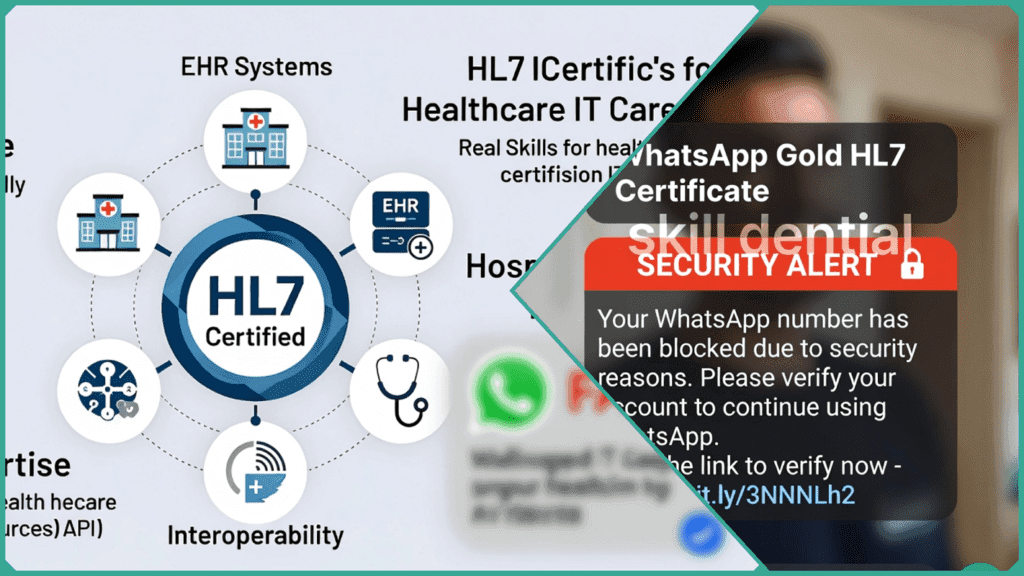
These links do not “verify” your certificate; instead, they install spyware designed to steal personal data, hijack banking credentials, or compromise your device. If you receive this message, delete it immediately and do not forward it.
What is the “WhatsApp Gold HL7 Certificate”?
The WhatsApp Gold HL7 Certificate is a fabricated term used in viral scam messages to create a false sense of technical authority. This hoax is a “mash-up” of two entirely unrelated concepts:
- WhatsApp Gold: A legendary malware scam that has circulated since 2016, falsely promising a “premium” or “celebrity” version of the app with hidden features.
- HL7 Certificate: A real-world professional credential for healthcare IT experts. Scammers have recently attached this term to the message because it sounds official and “certified,” making victims less likely to question the link.
There is no official product, update, or feature by this name. Neither WhatsApp (owned by Meta) nor HL7 International has any connection to this message.
How the Scam Works
These messages typically use “fear-ware” tactics to spread. They often warn of a virus-laden “Martinelli” video (another long-standing hoax) that can hack your phone in seconds. To “protect” yourself or to gain “exclusive access,” the message urges you to click a link to verify your “HL7 Certificate” or upgrade to WhatsApp Gold.
The True Danger: Mobile Banking Risk
The ultimate goal of this scam is the installation of an infostealer. Once a user clicks the suspicious link and downloads the file, the malware can:
- Harvest Contacts: Steal your entire contact list to spread the scam further.
- Spy on Messages: Access private conversations and 2FA (Two-Factor Authentication) codes.
- Hijack Banking Data: This is particularly risky in Nigeria, where mobile banking and USSD codes are the backbone of daily finance. The malware can overlay fake login screens on top of legitimate banking apps to steal your credentials and empty your accounts.
Is WhatsApp Gold Real?
No, WhatsApp Gold is not real. It is a persistent malware scam that first appeared in 2016 and has resurfaced with renewed intensity in 2026. The scam lures victims with promises of exclusive “Gold” features—such as the ability to send 100 images at once, hide “typing” notifications, or access a “celebrity-only” interface.
In reality, there is only one official version of WhatsApp. Any “upgrade” offered through a forwarded link or a third-party website is a delivery vehicle for:
- Spyware: To monitor your keystrokes and private chats.
- Ransomware: To lock your device until a fee is paid.
- Data Miners: To harvest your personal and financial information for identity theft.
Official Security Reminder: WhatsApp confirmed that legitimate updates never arrive via a chat message or an invite link. Updates are only handled automatically through the Google Play Store or the Apple App Store.
The “Professional Confusion” Factor
At Skilldential, our recent 2026 career audits revealed a troubling trend: because scammers are now using high-level industry terms like HL7 Certificate, healthcare IT professionals are becoming primary targets.
Our data shows that professionals in this sector are currently facing 40% more phishing exposure due to “technical terminology crossover”—where a scam sounds like a work-related security requirement. However, our audits also highlight a solution: healthcare organizations that implemented targeted security awareness training saw a 65% drop in risky clicks.
What is a Real HL7 Certificate?
An HL7 Certificate is a professional credential that validates a person’s proficiency in Health Level Seven standards. These standards are the “language” used by hospitals, laboratories, and pharmacies to share patient data securely. Developed by the global non-profit HL7 International, these certifications are essential for interoperability in Electronic Health Record (EHR) systems.
Unlike the scam message, a real HL7 certificate has nothing to do with consumer messaging apps. It focuses on technical frameworks such as:
- HL7 FHIR (Fast Healthcare Interoperability Resources): The modern, web-based standard for API-driven data exchange (the “next big thing” in 2026).
- HL7 Version 2 (V2): The most widely used messaging standard for hospital workflows like admissions and lab results.
- CDA (Clinical Document Architecture): A standard for the structure and semantics of clinical documents.
HL7 vs. WhatsApp: The Technical Divide
Scammers hijack the “HL7” name because it sounds complex and trustworthy. However, the differences are night and day:
| Feature | The “WhatsApp Gold” Version | The Real HL7 Certificate |
| Industry | Consumer Social Media | Healthcare / Clinical Informatics |
| User Base | General Public | Software Engineers, Interface Analysts |
| How to Get it | Clicking a link in a WhatsApp chat | Proctored exam through HL7 International |
| Format | Malware download (.apk or .exe) | A digital badge or paper certificate |
The Role of Professional Education
At Skilldential, we emphasize that real HL7 training comes only from accredited providers or the official HL7.org body. For those building a career in AI-driven Healthcare IT, these certifications are a “hot commodity” in 2026—but they will never be delivered to you via a viral WhatsApp message.
How Does the “WhatsApp Gold HL7” Scam Work?
The scam relies on a mix of technical deception and social engineering. It typically spreads through compromised accounts—meaning the message you receive might come from a friend or colleague whose account has already been hijacked.
The Execution Chain:
- The Hook: You receive a forwarded message claiming that the “WhatsApp Gold HL7 Certificate” is now required or available to unlock premium features like “ghost mode” or increased file limits.
- The Fear Tactic: The message often includes a warning about a “Martinelli” video or a “system virus” that will strike “tomorrow,” creating a sense of panic that overrides your skepticism.
- The Payload: To “upgrade” or “protect” your account, you are directed to a third-party website. Once there, you are prompted to download a file (usually an .apk for Android). This file is malware that, once installed, grants scammers access to your SMS, contacts, and camera.
- The Takeover: The malware can intercept One-Time Passwords (OTPs) and USSD sessions. This is particularly dangerous in Nigeria, where scammers target high-traffic festive periods—such as New Year 2026—to catch people while they are busy, distracted, and performing more frequent mobile money transfers.
Why It’s Hard to Stop
Because the message is “forwarded,” victims often trust it more than a random text. Once a device is infected, it may automatically forward the same scam to every person in that user’s contact list, continuing the cycle and making it appear as a legitimate recommendation from a trusted source.
Did You Know? In the professional world, a real HL7 Certificate is never sent via a chat app. It is a secure digital credential issued by HL7 International following a proctored, high-security examination.
Why Mix HL7 with the WhatsApp Gold Scam?
The inclusion of “HL7” in a viral messaging scam isn’t accidental—it is a calculated move to bypass the skepticism of modern users. By referencing HL7, a globally trusted medical standard, scammers lend a “professional” veneer to their messages.
Most people recognize that an “HL7 Certificate” sounds official and technical, even if they don’t know exactly what it does. This “Technical Masking” mimics the way legitimate corporate credentials or government verifications are presented, making victims more likely to click.
Furthermore, this “mash-up” manipulates search engines; when a confused user searches for “HL7 Certificate,” they might land on a scam-related result instead of legitimate healthcare IT resources.
Comparison: The Hoax vs. The Health Standard
| Aspect | WhatsApp Gold (The Scam) | Real HL7 Certificate |
| Primary Purpose | To steal data via malware. | To certify Healthcare IT proficiency. |
| Source | Viral forwarded chat links. | HL7.org or accredited partners. |
| Core Focus | “Premium” features (Fake). | Interoperability (FHIR, V2, CDA). |
| Major Risk | Device hack & account theft. | None; it boosts professional salary. |
| Validity | A proven hoax since 2016. | Accredited international standard. |
How to Protect Yourself: A 2026 Security Checklist
Whether you are a healthcare professional or a casual user, staying safe from the WhatsApp Gold HL7 hoax requires a mix of technical settings and “common sense” skepticism.
For WhatsApp Users:
- The “Delete & Block” Rule: If you receive a message about a “Gold” version or a “Martinelli” video, delete it immediately. Do not click any links, even if the message comes from a friend.
- Enable Two-Step Verification (2FA): Go to Settings > Account > Two-Step Verification > Enable. This adds a PIN that scammers cannot bypass, even if they manage to “clone” your SIM card.
- Verify the Source: Official WhatsApp updates happen automatically through the Google Play Store or Apple App Store. WhatsApp will never send you a chat message with a download link for an “update.”
- Report Scammers: Use the “Report” feature within the app to flag the account. In Nigeria, you can also report cybercrimes to Scamwatch Nigeria or the NCC-CSIRT.
For Website Owners & SEO Professionals:
If you are seeing “WhatsApp Gold HL7 Certificate” in your Google Search Console (GSC) timeline, it may be a sign of “Keyword Injection.”
- Audit Your Site: Use the
site:yourdomain.comsearch operator on Google to see if any weird “Gold” or “Scam” pages have been indexed under your name. - Harden Your Security: Ensure your CMS (like WordPress) is updated. If you see spam queries hitting your internal search bar, you can block these patterns using your .htaccess file or by using a security plugin like Wordfence to prevent “URL Injection” attacks.
- Monitor GSC: Regularly check the “Security Issues” tab in Search Console to ensure Google hasn’t flagged your site for hosting malicious content.
The WhatsApp Gold HL7 Certificate is a classic example of how modern scammers use professional terminology to bypass our “BS detectors.” By understanding that HL7 is a serious medical standard and WhatsApp Gold is a tired malware trick, you can keep your data—and your career—secure.
WhatsApp Gold HL7 Certificate Scam: FAQs
What is WhatsApp Gold?
WhatsApp Gold is a long-running malware scam that falsely promotes a “premium” version of the app. It has circulated since 2016 via viral chain messages, promising features such as the ability to see who viewed your profile or to send 100 photos at once. In reality, downloading it installs spyware or ransomware on your device.
Is there a “Martinelli” video virus on WhatsApp?
No. The “Martinelli” video is a classic internet hoax designed to create panic. The message warns that the video will “hack your phone in 10 seconds,” but no such video exists. Scammers use this fear to trick people into clicking links for “protection” or “upgrades” like WhatsApp Gold.
What does HL7 stand for? HL7 stands for Health Level Seven.
It is a set of international standards used for the transfer of clinical and administrative data between software applications used by healthcare providers. It is a professional technical standard and has no connection to personal messaging apps like WhatsApp.
Can WhatsApp Gold give me premium features?
No. There is no official “Gold,” “Plus,” or “Premium” version of WhatsApp. All legitimate new features (such as video calling or screen sharing) are added through official updates on the Google Play Store or the Apple App Store. Any app claiming to be a “secret” version is a security risk.
How do I get a real HL7 certification?
A legitimate HL7 certification is a professional credential for Healthcare IT workers. To earn one, you must undergo training through HL7.org or accredited educational providers like Coursera. These certifications focus on technical interoperability standards like FHIR and V2 messaging, not mobile app upgrades.
In Conclusion
The “WhatsApp Gold HL7 Certificate” message is a perfect example of how modern cybercriminals use professional jargon to exploit everyday users. By staying informed, you can protect your personal data and your professional reputation.
Key Takeaways:
- The Hoax: “WhatsApp Gold HL7 Certificate” is 100% a scam. It is not an official feature, update, or requirement.
- The Reality: HL7 is a vital healthcare IT standard; it is never used for personal messaging verification.
- The Risk: Clicking these links leads to malware, account hijacking, and the theft of sensitive mobile banking data.
- The Rule: Only update WhatsApp via official app stores and never forward chain messages.
Build a Real Career, Not a Scam: If you are interested in how technical standards actually work, don’t fall for the hoax. For those looking to build a legitimate future in medical data, explore our expert guide on HL7 Certification for Healthcare IT.
Recommendation: The best way to stop a chain message is with the truth. Forward this post to your groups to educate others—stay safe and stay verified.