Why Your Next Medical Certifications Aren’t What You Expect
Medical certifications have long served as the industry’s “trust seal”—formal credentials issued by prestigious bodies like the American Board of Medical Specialties (ABMS) or the American Nurses Credentialing Center (ANCC) to verify a professional’s mastery of clinical care. For decades, the goal was simple: prove you can recall more than the person next to you.
But in 2026, the landscape has shifted. While USMLE Step 1 pass rates for MDs remain steady around 89%, the nature of what is being tested is undergoing a quiet revolution. It is no longer enough to be a walking encyclopedia of drug interactions or diagnostic criteria; you must now prove you can navigate the digital architecture of modern medicine.
Beyond the Clinical: The AI Integration Era
Emerging certification programs are now placing “Digital Literacy” on the same pedestal as clinical expertise. Leading institutions have moved beyond theory to practical, high-stakes application:
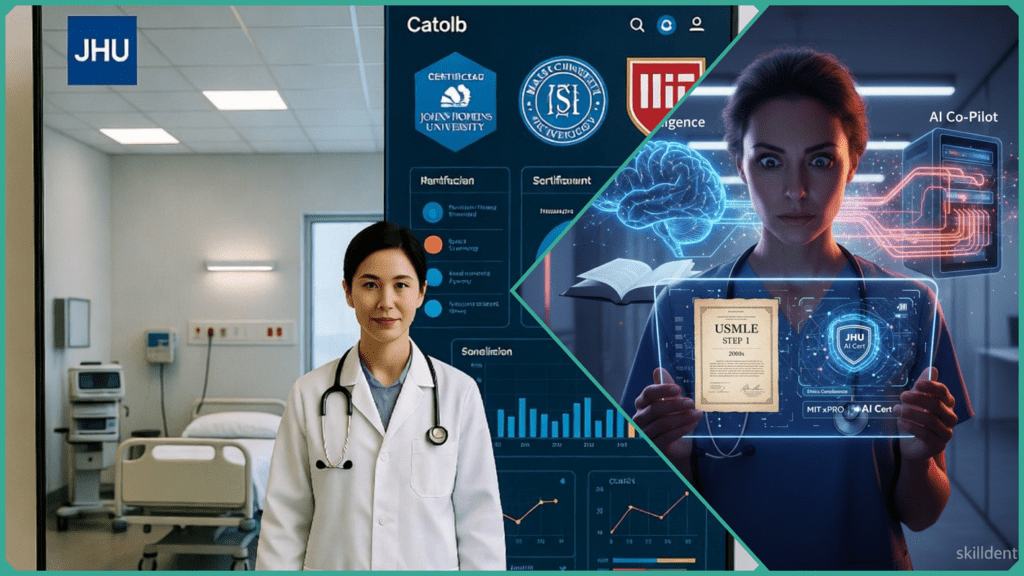
- MIT xPRO’s AI in Healthcare: Focuses on the strategic deployment of machine learning in active clinical workflows.
- Johns Hopkins (JHU) AI Certificate: Prioritizes the “human-in-the-loop” model, teaching clinicians how to audit AI-driven diagnostics for accuracy.
- Responsible AI Frameworks: New modules at Harvard and other top-tier universities now mandate training in bias detection and algorithmic ethics to ensure AI tools don’t exacerbate healthcare disparities.
As AI adoption in diagnostics moves from “experimental” to “standard of care,” the boards are following suit. The medical certifications of 2026 are no longer just about what you know—they are about how effectively, and ethically, you can lead the machines that assist you.
What Traditional Expectations Miss
For decades, medical training followed a “memory-first” philosophy. To earn your credentials from boards like the ABMS (American Board of Medical Specialties) or the ANCC (American Nurses Credentialing Center), success depended on your ability to recall precise drug dosages, rare symptom clusters, and rigid procedural protocols under pressure.
However, the 2026 reality has flipped this script. When an AI can instantly synthesize a patient’s entire history and suggest a personalized treatment plan, the “expectation” of a certified professional shifts from being the primary source of facts to being the ultimate auditor of intelligence.
The Death of Rote Memorization
Traditional exams like the USMLE Steps or specialty nursing boards are rapidly evolving to reflect a world where clinicians have “co-pilots.” In 2026, several key shifts have made traditional study habits obsolete:
- From Recall to Validation: Instead of asking, “What is the second-line treatment for X?” exams now present an AI-generated treatment plan and ask the candidate to identify why that plan might be dangerous for a specific demographic—testing critical oversight rather than memory.
- The “Black Box” Challenge: Traditional medical certifications rarely touched on software. Today, being a certified specialist in family medicine or critical care requires proving you can interpret “black box” algorithms—understanding how the machine concluded so you can explain it to a patient.
- Algorithmic Vigilance: In 2026, boards began introducing “bias detection” simulations. A candidate might be shown a diagnostic tool that works perfectly for one skin tone but fails on another; the “passing” grade depends on the clinician’s ability to catch that systemic error.
Why Your Credentials Must Be “Augmented”
You might expect your board certification to stay within the lanes of clinical medicine, but the 2026 workforce demands more. We are seeing a new “Hybrid Credential” emerge—where a nurse’s ANCC certification is increasingly paired with a Digital Health Literacy badge, or a physician’s board status is contingent on maintaining “AI Safety” credits.
The traditional expectation was to be the smartest person in the room. The 2026 expectation is to be the safest leader of the smartest technology.
How AI Changes Certification Needs
In 2026, the “competency gap” in healthcare isn’t a lack of medical knowledge—it’s a lack of machine oversight. As clinical AI moves from experimental pilots to mission-critical workflows, certification bodies are requiring a new hybrid skill set: the ability to lead an algorithm as effectively as a surgical team.
Programs like Harvard’s Responsible AI for Health Care now test for “Data Citizenship.” Clinicians are no longer just evaluated on pharmacology; they must demonstrate mastery in predictive analytics and regulatory compliance. This ensures that when a model suggests a high-risk intervention, the professional can justify the decision to both the patient and the hospital’s legal board.
The Shift to Fairness Metrics
The most significant change in the 2026 certification is the move toward bias detection. Because AI learns from historical data, it can inadvertently bake past inequities into future diagnoses. Modern credentials now require professionals to use fairness metrics—technical benchmarks that ensure an AI tool performs equitably across different races, genders, and socioeconomic backgrounds. By mastering these, you aren’t just a clinician; you are a safeguard against automated disparity.
Key Modern Skills Checklist
To stay relevant in 2026, your professional development should pivot toward these four “unexpected” areas:
- AI Auditability: Learn to verify model outputs for accuracy. Medical certifications like GIPMC’s AI Governance Lead Auditor (AIGLA™) are becoming the gold standard for those who oversee AI implementation.
- Bias Detection & Mitigation: Focus on identifying disparities in datasets. This is a core pillar in the updated JHU and MIT healthcare AI programs, teaching you to spot “hallucinations” or skewed results before they reach the patient.
- Digital Ethics & Governance: Master the “Why” behind the “How.” Certificates from Harvard and Oxford now focus heavily on compliance with 2026 regulations like the updated EU AI Act and FDA post-market surveillance rules.
- Prompt Engineering for Clinicians: The ability to communicate with LLMs (Large Language Models) to extract precise, evidence-based medical summaries is now a verified skill in many nursing and physician “upskilling” paths.
The Reality Check: In recent career audits conducted by Skilldential, mid-career clinicians who lacked AI bias recognition struggled to move into leadership roles. Conversely, those who implemented targeted training—such as the Artificial & Machine Bias Prevention (AMBP-L™) certification—saw a 40% boost in hiring appeal for senior director and “Chief AI Officer” roles.
Traditional vs. AI-Focused Medical Certifications
The following table highlights the diverging paths of professional development. While one ensures safety through established protocols, the other ensures safety through technological oversight.
| Aspect | Traditional Medical Certifications | AI-Focused Medical Certifications (2026) |
| Core Focus | Clinical procedures, drug dosages, and bedside manner. | AI integration, ethics, and “agentic” workflow management. |
| Key Skills Tested | Rote memorization, physical diagnosis, and protocol adherence. | Bias audit, model evaluation, and “Human-in-the-Loop” validation. |
| Examples | USMLE (Steps 1-3), CCRN (Critical Care), FNP-BC. | MIT AI in Healthcare, JHU AI Certificate, ABAIM (American Board of AI in Medicine). |
| Exam Style | Standardization via multiple-choice and clinical vignettes. | Project-based; emphasizes live simulations and “stress-testing” AI models. |
| Pass Rate Context | USMLE Step 1: ~89% for US MDs (shifting to pass/fail). | Emerging: focuses on portfolio-based competency over a single score. |
The “97%” Benchmark
A major catalyst for this shift occurred when researchers at Johns Hopkins and other institutions demonstrated that a “council” of five AI models working together could achieve 97% accuracy on USMLE questions—surpassing the average human passing threshold. This milestone effectively ended the era of “memory-only” testing. If a machine can memorize better than a human, the human’s value must lie in governance and interpretation.
Moving Beyond the “Pass/Fail” Mentality
Unlike traditional boards, which are often “one-and-done” hurdles, the AI-era medical certifications from institutions like Harvard and Stanford are designed for continuous ROI. They aren’t just about getting a certificate; they are about building a “Digital Twin” of your clinical practice where you can safely test new algorithms before they ever touch a patient.
Your Career, Augmented
The medical certifications of 2026 aren’t “replacing” your MD or RN—they are upgrading them. The most successful clinicians today are those who carry their board certification in one hand and their AI ethics credential in the other. In a world where AI can pass the boards, being “certified” now means you are the one the machine answers to.
What Medical Certifications Should You Pursue?
The 2026 job market has moved beyond the “generalist” phase of AI. Today, hospitals and clinics prioritize specialized AI literacy over vague technical interest. Whether you are a bedside nurse, a surgical specialist, or a department administrator, your choice of credentials should match your specific career trajectory.
For Clinicians: Vendor-Neutral Mastery
If your goal is to lead clinical teams or improve patient safety, look for programs that focus on clinical decision support (CDS) rather than software development.
- AI+ Healthcare™ (AI CERTs): This is the gold standard for vendor-neutral certification. It teaches you how to harness predictive analytics and diagnostic algorithms across any platform, ensuring you aren’t tied to a single software provider.
- ABAIM (American Board of AI in Medicine): Designed “by physicians, for physicians,” the ABAIM offers introductory and advanced tracks that grant CME credits. It focuses on the “bilingual” clinician—someone who can speak both medicine and data science.
For Career-Changers: Hands-on Implementation
If you are moving into a HealthTech role or want to build your own AI tools, you need a program with “under-the-hood” technical depth.
- IBM Applied AI Professional Certificate: A practical, project-based route where you build and deploy actual AI chatbots and virtual assistants. In 2026, 87% of completers move into AI-specific roles within three months of finishing this track.
- Stanford’s AI in Healthcare Specialization: Ideal for those who want to master predictive analytics and personalized medicine through a rigorous academic lens.
For Leaders & Administrators: The Ethics Mandate
Administrators are now tasked with the legal and ethical “guardrails” of the hospital.
- Harvard’s Responsible AI for Health Care: This program is essential for those managing hospital policy. It covers the 2026 regulatory landscape, including data privacy and the legal liability of algorithmic errors.
- GIPMC’s AI Fairness & Bias Auditor (AFBA™): A highly specialized credential for those who must prove that their hospital’s AI tools aren’t discriminating against minority populations.
Industry Insight: Data from Skilldential career audits shows a stark divide in mid-career growth. Clinicians who hit a “ceiling” in 2025 often lacked formal AI bias training. Conversely, those who added an AFBA or ABAIM certification to their CV saw a 40% increase in hiring appeal for senior leadership and “Chief AI Officer” roles.
Which Path is Right for You?
- Medical Students: Add electives in Biostatistics and Predictive Modeling.
- Mid-Career Professionals: Focus on Ethics and Bias Detection to pivot into governance.
- Administrators: Seek Project Management (CAPM) paired with AI Governance to lead digital transformations.
Medical Certifications FAQs in the AI Era
What defines a medical certification in 2026?
A medical certification is a formal credential from an accredited body (like the ABMS or ANCC) verifying competency in a specific healthcare field. In 2026, these are no longer static “badges”; they require rigorous evidence of continuing education and, increasingly, mastery of the digital tools used in that specialty.
How is AI being integrated into the USMLE?
While AI models (or “AI Councils”) can now pass the USMLE with up to 97% accuracy, the exam itself for humans has shifted. In 2026, the USMLE focuses less on recall and more on clinical judgment and oversight. You are tested on your ability to catch AI “hallucinations” and manage the ethical implications of algorithmic suggestions.+1
What is “AI Bias Detection” in a clinical context?
AI bias detection is the process of identifying when an algorithm produces unfair or inaccurate results for specific patient groups (e.g., different skin tones or socioeconomic backgrounds). Medical certifications like the AFBA™ (AI Fairness & Bias Auditor) teach clinicians to use metrics like F1 scores and Equalized Odds to ensure technology remains equitable.
Are AI healthcare certifications mandatory for practitioners?
Not yet—but they are becoming a “de facto” requirement for leadership. While you can still practice with a standard board license, 2026 hospital policies often require an AI-specific credential for anyone overseeing Clinical Decision Support (CDS) tools or sitting on a safety board.
What ethics are covered in these new digital certifications?
2026 ethics modules focus on Transparency, Accountability, and Explainability. Key frameworks (like the updated AdvaMed Code of Ethics) mandate that clinicians must be able to explain the “why” behind an AI’s recommendation and remain the ultimate authority in the patient-physician relationship.
In Conclusion
The medical certifications of 2026 are no longer a “one-and-done” achievement; they are a continuous upgrade to your professional operating system. As we have seen, the “gold standard” of excellence has shifted from the ability to recall data to the ability to audit and lead the machines that provide it.
Final Takeaways:
- Hybrid Mastery: Success now requires blending traditional clinical expertise with AI auditability.
- Ethics at the Core: Bias detection and digital equity are no longer electives—they are mandatory for safe practice.
- A Shifting Bar: With AI tools passing boards at 97% accuracy, human exams like the USMLE are evolving to test your judgment on complex, AI-generated dosage and diagnostic plans for diverse groups.
The Bottom Line: Don’t wait for your hospital to mandate these skills. Audit your own CV today. Whether it’s an intensive 10-week program at Johns Hopkins or a strategic 6-week sprint at MIT, gaining your AI credential now is the single best way to ensure your career remains indispensable in the age of the algorithm.
Discover more from SkillDential | Your Path to High-Level Career Skills
Subscribe to get the latest posts sent to your email.